Better AI Models, Better Startups
07 Jun 2024 · almost 2 years ago
Coming Up (0s)
- OpenAI product releases generate anticipation and concern among startups.
- Improved AI models benefit all startups.
- Startups should monitor AI announcements and plan accordingly.
AI Challenges for Startups (1m22s)
- OpenAI's demos focused on consumer applications, posing challenges for YC-funded consumer companies.
- Competition with OpenAI involves both product quality and distribution.
- The increasing capabilities of AI models, such as code generation, create new opportunities for startups.
- Better models simplify integration with regular business logic.
- Multiple powerful AI models are preferable for startups to avoid dependence on a single provider.
GPT-4 vs. Gemini 1.5 (5m0s)
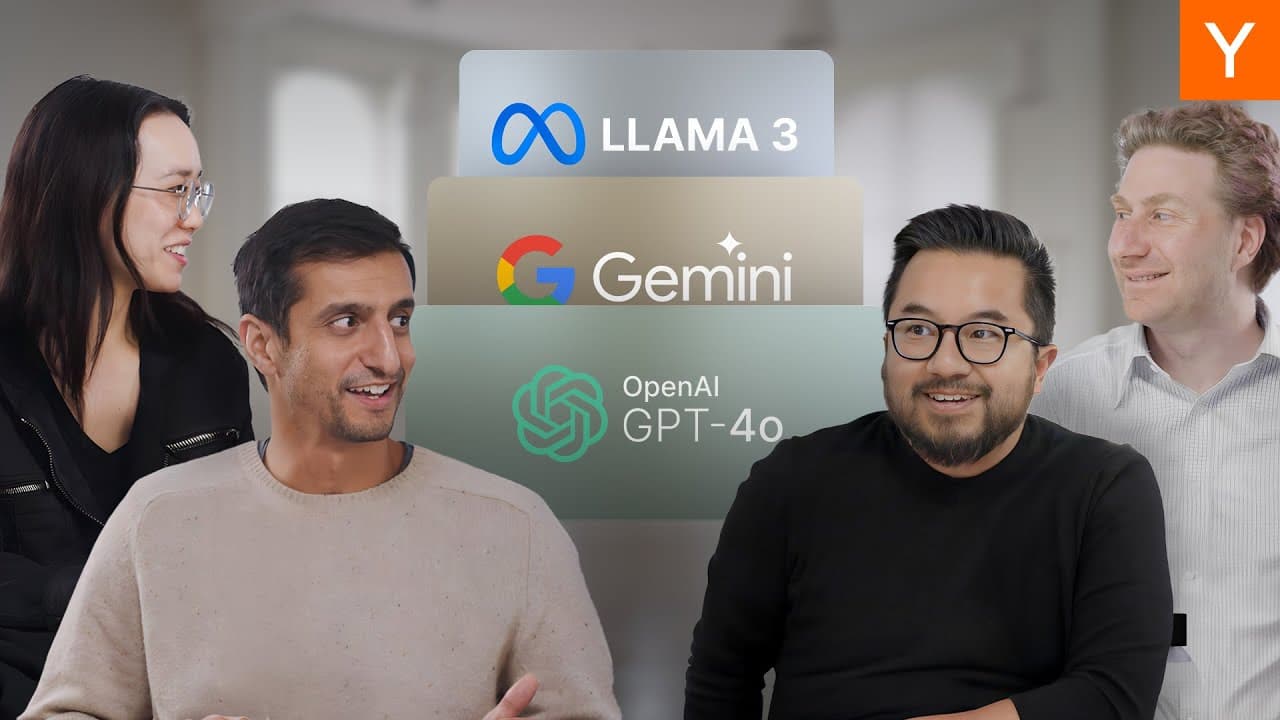
- Key difference between GPT-4 and Gemini 1.5 is how they handle different types of data.
- GPT-4 uses a text-based Transformer model with added modules for speech and video processing.
- Gemini 1.5 is a true mixture-of-experts model that activates specific paths for different data types, making it more energy efficient.
- Gemini 1.5 has a context window of a million tokens, which is significantly larger than GPT-4's 128,000 tokens.
- Google's demo at I/O missed the mark compared to OpenAI's demos.
- Gemini 1.5's white paper reveals it to be a true mixture-of-experts model, which is a new technique.
- Gemini 1.5 is trained from the ground up with actual text, image, and audio data, allowing different parts of the network to activate depending on the data input.
- Google's TPU infrastructure enabled them to train Gemini 1.5 on a large amount of data, making it very energy efficient.
- Gemini 1.5 has a context window of a million tokens, which is significantly larger than GPT-4's 128,000 tokens.
RAG future in consumer apps (8m32s)
- The emergence of advanced AI models may impact startups focused on rack infrastructure tooling.
- Privacy-conscious individuals still prefer rack systems for data storage and control.
- Infinite context windows enable the development of more advanced consumer applications with comprehensive user knowledge.
- Open-source models like Olama allow users to train personal AIs with their own data.
- Rack infrastructure remains crucial for long-term permanent memory storage and privacy concerns.
- Chat GPT's memory feature demonstrates the development of user-specific memory based on interactions.
- The accuracy of retrieval from an infinite context window may not always be reliable.
- Rack infrastructure is still necessary for precise information retrieval and privacy concerns.
- The complexity of context windows requires careful management and optimization.
- A smaller but reliable context window is preferable to a larger one with uncertain behavior.
- Enterprises prioritize data privacy and logging, making a giant context window less desirable.
- Companies like Google, Anthropic, and Meta may enter the market with comparable technologies.
- Founders are already using different models for prototyping and scaling, and the ecosystem of model routers and observability Ops software is rapidly progressing.
- Startups should not be overly concerned about model releases, as they are usually not reliant on any single model.
Diverse AI Options (15m19s)
- Diverse AI options prevent monopolies and promote market competition.
- Many companies making a billion dollars each is preferable to a few companies worth trillions.
- Meta has a large GPU cluster for training recommendation models to compete with TikTok.
- The GPUs turned out to be valuable for training large language models.
- Startups are worried about being crushed by OpenAI or Google.
- OpenAI product releases create anxiety among startups about their survival.
- This situation is similar to when startups were concerned about Google and Facebook in the past.
- The best response to concerns about competition from big tech companies is to consider the possibility of those companies entering the VC space.
- Startups should learn from past hype cycles to make informed decisions about what to work on.
- Competing head-on with Google by building a better search engine was not a successful approach.
- Vertical search engines, such as a better Google for real estate, had some success.
Specialized Services (19m15s)
- Vertical search engines like Redfin and Zillow have access to specialized data and monetize through services related to their niche.
- Redfin's success demonstrates the effectiveness of vertical search engines in influencing consumer behavior and decision-making.
- Vertical search engines don't necessarily need superior technology to succeed; they can thrive by focusing on specific verticals and providing additional services.
- Bundling software can be a successful strategy, as demonstrated by Microsoft's dominance over Netscape.
- Enterprises often prefer comprehensive solutions from a single vendor rather than multiple disparate solutions.
- Dropbox faced significant challenges when news of Google Drive leaked, highlighting the competitive advantage of established tech giants with vast resources.
GPT-4o and Desktop App (22m14s)
- OpenAI released GPT-4o, a multimodal LLM, and the first version of a desktop app.
- The desktop app currently functions as a web experience but hints at future developments.
- LLMs on the desktop have access to all files, applications, IDEs, browsers, and can perform transactions, resembling a true personal assistant.
- OpenAI aims to capture the public's imagination with a general-purpose AI system that understands user intent and performs tasks.
- Competing with OpenAI in this area is challenging, similar to competing with Google on search.
- OpenAI's goal is to create products used by billions of people, making it difficult for startups to succeed in similar areas.
- Google's dominance in adtech and vertical search due to strategic importance.
- Startups should avoid areas where OpenAI's future releases are easily predictable.
Valuable Products (25m15s)
- Perplexity AI excels at research and finding specific information but lacks creativity compared to ChatGPT.
- Startups should focus on valuable but unsexy AI tools, such as B2B solutions or niche applications, which big companies may overlook.
- The potential of AI agent-type apps extends beyond popular ones like ChatGPT, and there's room for multiple successful players in the market.
- B2B AI startups have significant potential due to the human aspect of sales and the need for detailed software to handle complex scenarios.
- Permit Flow, a successful B2B AI startup, expedites the construction permit application process.
- Advanced AI models are driving the creation of better startups.
- The GPT store may expand into B2B, introducing a charging mechanism for its use.
- B2B AI applications have proven successful in fintech, particularly in KYC and compliance tasks for banks.
- AI can enhance mundane tasks, enabling individuals to accomplish the work of many.
Better Business Models (30m59s)
- Better AI models lead to improved software functionality.
- Startups can charge more for additional features and functionality enabled by better AI models.
- Revenue growth can be significant, as seen in YC startups that increased revenue from $6 million to over $30 million within a few months.
- The market opportunity for AI-powered automation is vast, potentially larger than the entire SaaS industry.
- There is a need for more founders to explore this area given the significant revenue potential.
- Startups should be concerned about competitors using AI models, not just OpenAI or Google.
- The key to success is building the best product with the right nuances and details on top of these models.
- Opportunities exist for consumer AI companies, particularly in the area of assistance and productivity tools.
Consumer AI Opportunities (33m58s)
- Edgy AI applications, such as those involving legal or PR risks, present opportunities for startups.
- OpenAI's success with edgy AI models, like image diffusion models, highlights the potential for startups to capitalize on areas that incumbents may avoid.
- Examples of edgy AI applications include Replica AI's AI boyfriend/girlfriend model and Character AI's highly engaging virtual entities.
- Deepfake technology, as seen in Infinity AI's movie-making platform, offers edgy possibilities but faces potential legal challenges.
- The balance between edgy content and legal/ethical considerations creates opportunities for innovative startups.
- A Twitter user, Sandip, asks about specific updates from OpenAI, Google, and Meta that excite the speakers.
Emotional Depth and Translation (37m26s)
- OpenAI's text-to-speech model exhibits emotional depth, making it sound more human-like compared to existing models.
- The live translator demo has the potential to break language barriers and facilitate communication globally.
Outro (40m47s)
- The speaker expresses excitement about the potential of new tech product releases and looks forward to seeing what users create with these advancements.
Browse more from
AI

Elon Musk's Pay Package and Broadcom's Surge | Bloomberg Technology

The Rise of Enterprise AI | Bloomberg Technology

Elon gets paid, Apple's AI pop, OpenAI revenue rip, Macro debate & Inside Trump Fundraiser

TWIST News: xAI's massive $6B raise, the startups building our drone future & TWIST500 | E1957

AI that actually makes your job easier with Arvind Jain from Glean

Woke Google Maps, how Wells Fargo is losing money on fintech, and the global AI race | E1967
Ready to get started?
Save, summarize & chat with your content.
GET STARTED
IT'S FREE
No credit card required · 30 Day Refund on Premium · 24 Hour Support