The future of enterprise search and AI-powered work productivity with Glean’s Arvind Jain | E1916
20 Mar 2024 · 2 years ago
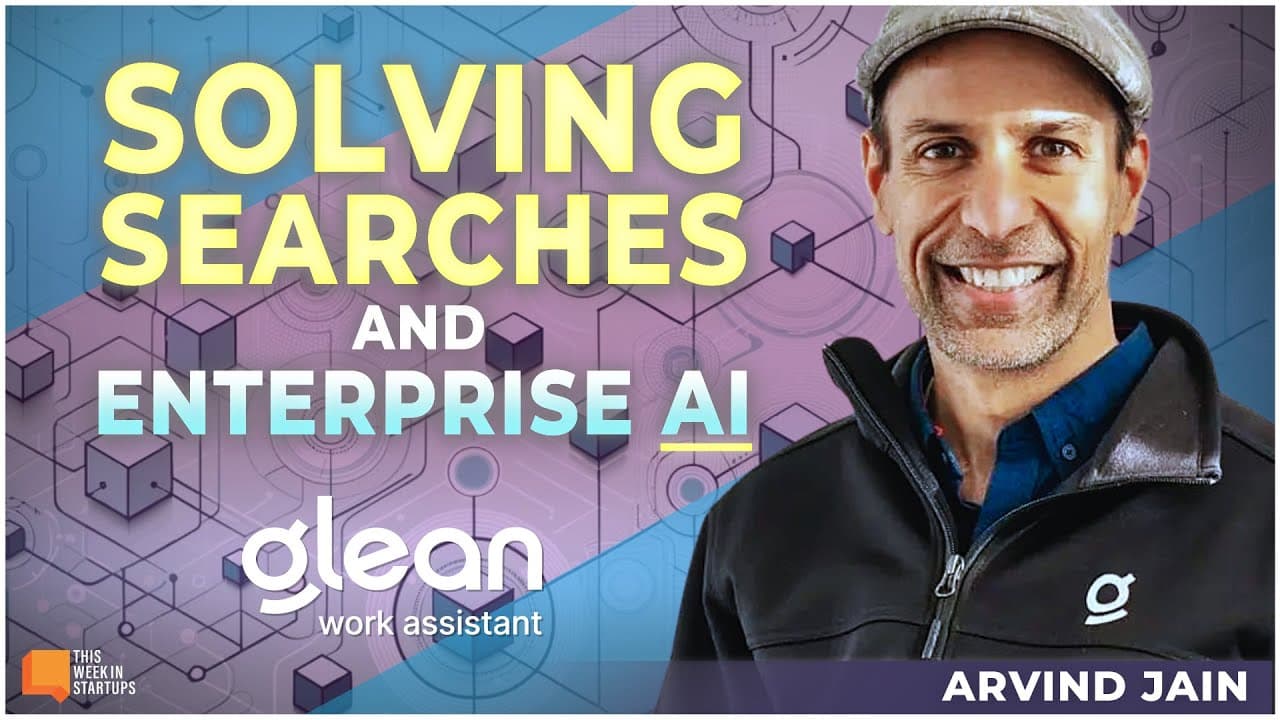
Glean’s Arvind Jain joins Jason (0s)
- Arvind Jain from Glean joins Jason to discuss the future of enterprise search and AI-powered work productivity.
- Jain believes that the majority of AI work in the future will be based on open-source models.
- Open-source models are hard to beat, and many startups are using them.
- Glean is an AI-powered search engine and assistant that helps people get more work done.
- It allows users to ask any questions they have and Glean will use all of the company's knowledge, data, and information to answer those questions.
- Glean is not a general AI like ChatGPT, it is specifically designed to search and answer questions within an enterprise's data.
Glean’s beachhead market and primary focus (2m35s)
- Glean is typically deployed company-wide and sold to CIOs.
- The top users of Glean are engineers, support personnel, and sales personnel.
- Glean is useful to every employee in a business and is sold through the CIO.
- Glean sits on top of existing systems like Intercom, HubSpot, and Zendesk, acting as a connective tissue that connects knowledge across different systems.
- Glean helps users find the right answers to resolve cases, even if the answers are in external sources like Slack conversations or internal Jira issues.
- Glean helps support agents quickly find information and resolve customer requests by tapping into internal discussions and conversations.
Glean’s approach to data confidentiality (5m13s)
- Glean utilizes various language models, including PaLM 2, Gopher, and GPT-4, allowing customers to select their preferred model for summarization and synthesis tasks.
- Glean collaborates with Azure to leverage GPT-4 while ensuring data privacy through a contract that safeguards customers' data.
- Access to information within Glean is restricted based on individual user permissions within the organization.
- Many enterprises trust major cloud vendors like Google, Microsoft, and AWS for secure data storage and rely on their robust security measures.
- Glean supports hosting open-domain language models as the core language model in its enterprise search platform.
- To prevent data exposure, CIOs should ensure employees avoid using public consumer-based products like ChatGPT, which may inadvertently share sensitive information with the provider.
- Glean offers a secure environment for enterprise search, ensuring that data sent to Azure or Google complies with security agreements and is not misused.
OpenPhone - Get 20% off your first six months (11m57s)
- OpenPhone simplifies business communications with an easy-to-use app.
- It can be used on phones or desktops, making it convenient for teams.
- Shared phone numbers can be created for multiple employees to handle calls and texts.
- OpenPhone is the number one rated business phone on G2 for customer satisfaction.
- Twist listeners can get an extra 20% off any plan for the first 6 months at openphone.com/Twist.
- OpenPhone can port existing numbers from other services at no extra cost.
Competition against native tools and building language models in SaaS companies (13m13s)
- Glean builds smaller language models to understand company knowledge.
- SaaS companies like Salesforce, Atlassian, and others are not building their own language models but are using APIs to access large language model providers like GPT-3 or Jini.
- In the future, every application is expected to have some AI smarts and may even move to a chat interface.
- Glean solves a different problem by tying together knowledge from different systems in one place, making it easier for users to find information and ask questions.
Glean’s approach to permissions (17m0s)
- Glean's AI-powered search tool understands permissions and retrieves documents that users have access to.
- Glean indexes content from various systems and continuously updates its index in real time, providing fast search results without the need to send messages to multiple systems.
- Glean does not store any Enterprise data in the language model but uses it for understanding and generating responses.
- Search functionality is often overlooked by enterprise software companies, who focus on competing features.
- To solve the search problem, Glean considers the enterprise context and uses signals from various sources to determine the relevance and importance of information.
- Enterprise knowledge can be viewed as a graph with interconnections between different pieces of knowledge and people.
- Glean leverages enterprise-wide data to understand user behavior and preferences, delivering more relevant information to users.
Lemon.io - Get 15% off your first 4 weeks of developer time (24m20s)
- Lemon.io offers on-demand developers with at least three years of experience and strong portfolios.
- Only 1% of candidates who apply to Lemon.io are accepted.
- Lemon.io handles the integration of developers into teams.
- Twist listeners get 15% off their first four weeks with Lemon.io.
Compliance and the "CEO God Mode" feature (25m23s)
- Glean has a compliance mode that is highly restricted and available only to governance and legal teams.
- The compliance mode allows users to search for specific information across all documents, such as insider trading or project acquisition-related keywords.
- Glean is not a system of record, so users do not need to explicitly delete data in Glean when it is deleted in the original system.
- AI can help businesses address governance gaps by automatically finding sensitive information that may have been missed due to incorrect permission settings.
- AI-powered tools like Glean can help businesses improve productivity by automating tasks such as searching for information and answering questions.
- AI can also help businesses address governance gaps by automatically finding sensitive information that may have been missed due to incorrect permission settings.
- AI can help businesses make better decisions by providing insights and recommendations based on data analysis.
- AI can help businesses improve customer service by providing personalized and efficient support.
Potential of productivity software, and people analytics in tech businesses (29m28s)
- Glean's AI-powered search platform analyzes vast amounts of enterprise data to identify the most productive employees and their work patterns.
- The platform provides insights into individual productivity, including working hours, active resource usage, and potential idle time.
- Glean empowers individuals to gain insights into their own work patterns and identify areas for improvement.
- Managers can use Glean to get summaries of their team's work, but they can only access information that they have permission to see.
- The future of enterprise search involves understanding user intent and providing relevant resources, with conversational interfaces playing a significant role.
Impact of AI on business models (40m4s)
- AI's ability to directly answer user questions may disrupt the cost-per-click (CPC) business model of search engines.
- As AI provides direct answers, users may be less likely to click on ads, reducing the effectiveness of the CPC model.
- Search engines may need to develop new monetization strategies, such as charging for impressions, clicks, or conversions, or by facilitating transactions and taking a cut of the revenue.
- Google, as the dominant search engine, is well-positioned to adapt to these changes and continue generating revenue from user searches.
Arvind’s thoughts on Google Gemini (42m45s)
- Arvind believes that Google is in a strong position regarding AI models.
- Despite any issues, Google's AI models, like Gemini, work well.
- Google has the best AI talent, the most extensive data centers, and the necessary machines.
- Arvind thinks the concerns about Google's decline are exaggerated.
- Google's cautious approach to releasing AI models is due to its core mission of providing accurate information.
- Apple's limited release of AI features is likely due to their focus on fit and finish.
Open source vs closed models in AI development and the progress of OpenAI (45m17s)
- Majority of AI work in the future will be based on open-source models (80%).
- Open-source models have a strong momentum and are hard to beat in terms of technology advancements.
- OpenAI's lead in text-based models is closing every quarter.
- Smaller, faster, and cheaper models are becoming more viable alternatives to costly models.
- It is becoming increasingly difficult to decide which model is the right choice for a specific task.
AGI and the limitations and potential of AI as an assistant (47m49s)
- Artificial general intelligence (AGI) is when an AI agent completely replaces a human role in an enterprise.
- Glean is an enterprise search and AI-powered work productivity solution that aims to be an assistant for everyone at work.
- Glean's pricing model is per seat, with a focus on midsize to large enterprises.
- Glean's setup is turnkey and can be up and running within a day in a 2,000-person enterprise.
- Glean's domain name, gle.com, is valued at around half a million dollars.
Browse more from
AI

Training AI-powered recycling robots with Rebecca Hu from Glacier

Sam Altman: OpenAI, GPT-5, Sora, Board Saga, Elon Musk, Ilya, Power & AGI | Lex Fridman Podcast #419

Bryan Johnson: Why Humans are No Longer Qualified to Manage Our Own Affairs | E1130

AI could be the solution for bureaucracy with Emilie Poteat from Advocate

Only AI can prevent forest fires with Allison Wolff from Vibrant Planet

Blockchain tech is working to combat AI-based deepfakes (w/ Melody Hildebrandt and Mike Blank)
Ready to get started?
Save, summarize & chat with your content.
GET STARTED
IT'S FREE
No credit card required · 30 Day Refund on Premium · 24 Hour Support