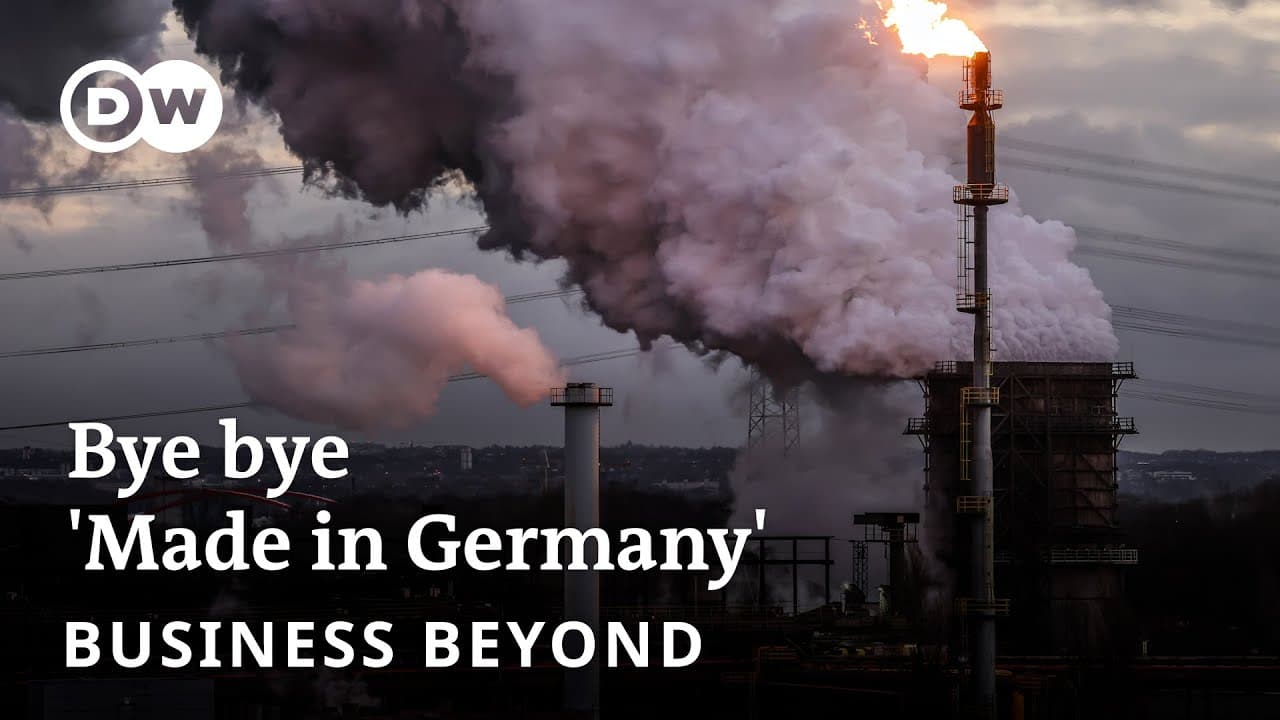
Is Germany’s economic model doomed? | DW Business Beyond
17 Nov 2023 · over 2 years ago
Introduction (0s)
- BASF, a chemical company, is cutting jobs in Germany and investing in China.
- Germany's economic growth has decreased, with rising pessimism among companies.
- German economic strengths are under scrutiny as global economic changes challenge their model.
- Germany's economic troubles could affect the EU due to close trade relationships.
Germany’s Economic Success Story (2m19s)
- Germany went from being economically struggling post-reunification to a leading exporter.
- Labor market reforms, such as creating lower-wage jobs, made German labor cheaper and boosted competitiveness.
- Global demand for manufacturing goods increased due to emerging markets and the opening of new economies.
- "Made in Germany" became a mark of quality, particularly in technology-driven products.
- China's rise as a market economy significantly benefited German exports.
Problem 1: Dwindling Demand (5m16s)
- Global economic instability and recession threats have reduced demand for German products.
- Exports to China, a major market for Germany, have declined, impacting German companies across various sectors.
- Germany's economy is suffering due to lower global demand for both consumer and capital goods.
- Energy crises have compounded problems; the Ludwigshafen BASF plant faced massive energy bills and cut jobs while continuing expansion in China.
- Energy price surges and uncertainties have led some businesses to consider relocating outside Germany.
- Lower productivity in Germany is partly due to fewer hours worked, leading to deindustrialization.
Problem 3: Consumption (10m26s)
- Domestic consumption is too low; stagnant wages and reliance on exports exacerbate the problem.
- Wage expectations in Germany have hit their lowest point since 1991.
- High inflation and energy costs further suppress consumer spending in Germany.
Problem 4: Investment and Digitalization (11m43s)
- Germany's export sector remains critical, but reliance on traditional goods over digital products poses risks.
- The German tech sector struggles, with a notable exception being SAP.
- Germany invests less in its economy compared to European neighbors, impacting digital infrastructure and innovation.
- A cultural aversion to public debt and a frugal government approach means underinvestment in future technologies like IT.
- Marianne Janik, CEO of Microsoft Germany, criticizes the country's fiscal conservatism.
- Digital expertise is lacking among German small and medium businesses, with 40% unable to find digitally skilled employees.
- Retraining initiatives are growing but must address a significant digital skills gap.
- Plans to improve include doubling AI funding and new research labs, but foundational digital advancements are needed first.
Problem 5: Innovation (16m6s)
- Germany's position in innovation is mediocre, ranking 10th globally despite a high patent registration rate.
- Bureaucracy hampers business creation, with new company startups and construction permits facing delays.
- Examples like Marvel Fusion show difficulty obtaining large funding in Germany, pushing companies abroad.
- The country has talent and an industrial ecosystem but lacks the funding to commercialize innovations domestically.
Conclusion (18m37s)
- Germany faces both short-term and structural economic challenges.
- Past economic successes due to trade, energy, and industry have created complacency.
- A new economic model is needed, with a focus on future investment, improved conditions for growth, and adaptations to change.
- Energy supply improvements and removing barriers for renewables are positive steps.
- Maintaining export power while exploring new trade agreements offers a balanced approach.
- Germany's future relies on addressing current slumps while being proactive for when global economic conditions improve.
- Reflective external perspectives are vital for the German economy to consider what it wants to represent.
Browse more from
Economics
Housing, food and gas are core things families spend money on: Fmr. NEC Deputy Director Ramamurti
The Fed has a problem, says Veritas Financial's Greg Branch
China Beige Book's Qazi: There is not an obvious growth driver in China for the next several years

Citadel CEO Ken Griffin speaks at the MFA Network Miami conference — 1/30/2024
Federal Reserve Leaves Rate Unchanged, Signals Cuts | WSJ
Federal Reserve Chair Jerome Powell speaks after Fed holds interest rates steady — 1/31/2024
Ready to get started?
Save, summarize & chat with your content.
GET STARTED
IT'S FREE
No credit card required · 30 Day Refund on Premium · 24 Hour Support