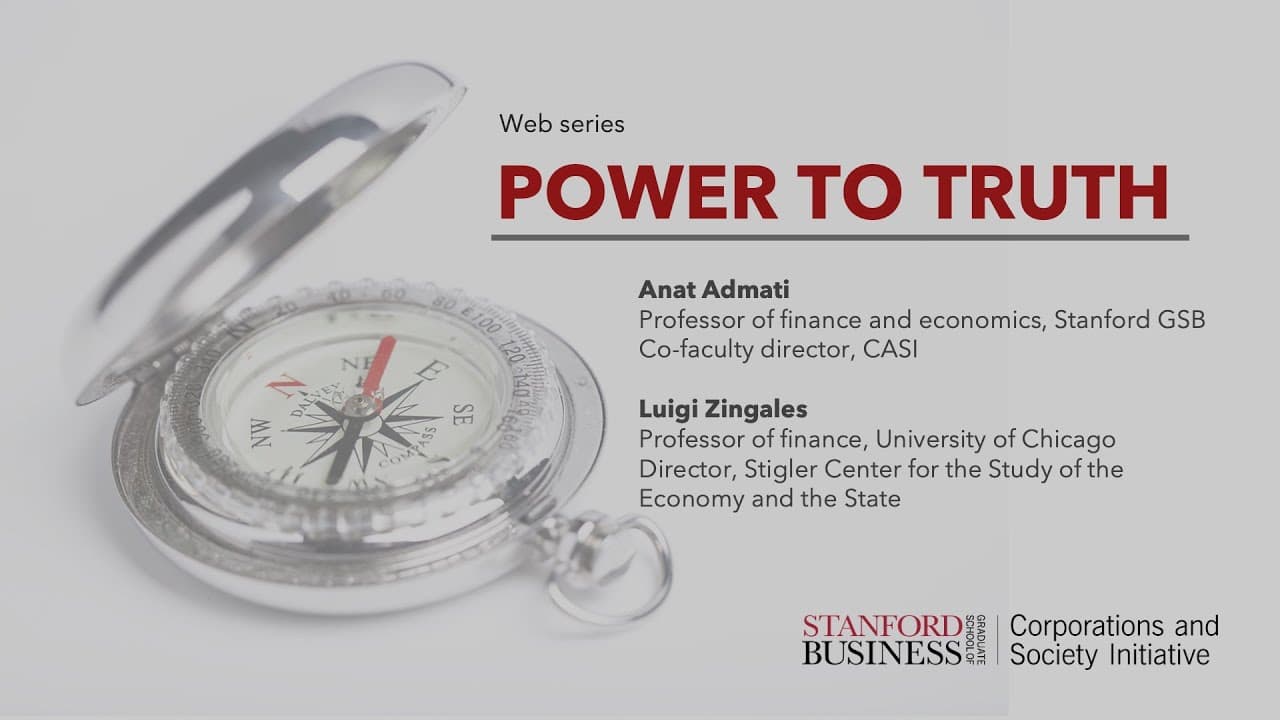
Power to Truth: Straight Talk with Luigi Zingales and Anat Admati
20 Mar 2024 · 2 years ago
Corruption of Knowledge
- Luigi Zingales, a professor of finance at the University of Chicago, discusses the concept of "corruption of knowledge" or the distortion of what we know.
- Economists are susceptible to the same incentives and biases that can lead to regulatory capture, despite the protection of tenure.
- Data is essential for economic research, but there is potential for conflicts of interest when data is controlled by entities with vested interests.
- Economists should be aware of these biases and critically evaluate the sources and motivations behind the data they use.
- Journalists and the media play a crucial role in uncovering distortions of knowledge, but they too must be mindful of potential biases and agendas.
Data and Research
- The lack of data on security prices before the creation of CRISP in the late 1960s at the University of Chicago hindered the study of market efficiency and the usefulness of brokers.
- Understanding the theory and appreciating the costs and benefits of different policies require both knowledge and data.
- There are many opportunities for manipulation of knowledge, including conflicts of interest, framing of questions, implicit assumptions, and selective presentation of data.
- Bias and vested interests can influence research findings, with studies that support certain viewpoints being more likely to be published and cited.
- The "Sher Home principle" suggests that if a party with relevant data does not refute a study's findings, it can be considered evidence supporting the study's validity.
- Meta-studies in economics should consider issues such as selective reporting and the influence of vested interests.
- Reverse engineering explanations in economics, especially from a Chicago perspective, can overlook significant factors and provide convenient explanations that align with certain ideologies.
Bias and Expertise
- Developing a personal brand as a defender of a particular viewpoint can shift focus away from objective research.
- Consistency of results across studies by the same author is valued in litigation and media, but it can also be a sign of bias or lack of critical thinking.
- Expertise is often valued for its consistency, but this can lead to a lack of diversity of thought and opinion.
- Economists should be aware of the potential for their work to be distorted by incentives, both personal and professional.
- Social psychologists' work on motivated reasoning and self-deception can help economists understand why people sometimes convince themselves that something is true even when it is not.
Academic Freedom and Responsibility
- Academics have the freedom to speak and challenge conventional wisdom, but they should also be aware of their own biases and the potential consequences of their work.
- Tenure is important for protecting academic freedom, but academics should not take it for granted and should use it to speak out against injustice and wrongdoing.
Browse more from
Economics
Fed Holds Rates Steady, Still Sees Three Interest-Rate Cuts This Year | WSJ

LIVE: Jerome Powell testifies on monetary policy in Senate hearing
Is Money Really the Best Measure of Value? with Mohammad Akbarpour

Business Government and Society Forum Conversation with Jerome Powell, Federal Reserve Chair
China’s Looming Crises | CNBC Marathon
Chase Bank CEO on Economic and Geopolitical Risks: Full Interview | WSJ
Ready to get started?
Save, summarize & chat with your content.
GET STARTED
IT'S FREE
No credit card required · 30 Day Refund on Premium · 24 Hour Support