Ep39 “Why Does the Non-Profit Model Work?” with Daniel Diermeier
16 Feb 2024 · 2 years ago
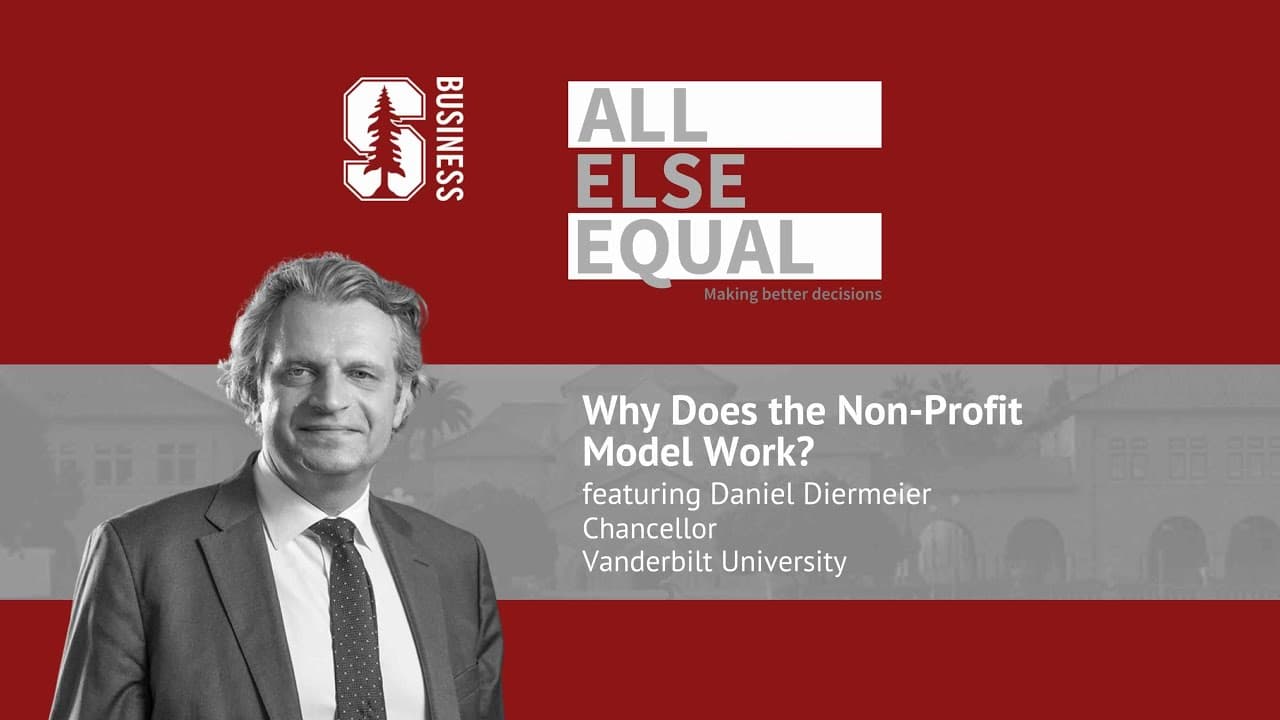
Nonprofits vs. For-profit Organizations
- Nonprofits lack a clearly defined party in whose interest the organization is being run, unlike for-profit organizations with residual claimants (shareholders).
- The absence of a disciplining mechanism in nonprofits could lead to abuse.
Universities as Nonprofits
- Universities are often run as nonprofits and have been successful despite the absence of a clear profit motive.
- Universities have various stakeholders, including current students, faculty, administrators, and alumni.
- Alumni seem to have a strong connection to their universities and are willing to donate time, effort, and money to them.
- The reputation of a university is crucial for maintaining donations and involvement from alumni.
- The reputation of a university responds slowly to changes, making it surprising that the nonprofit model works as well as it does.
- Vanderbilt University's objective is to produce groundbreaking research and transformative education.
- Universities are built for the long haul and focus on generating resources through quality work and reputation rather than storing away resources for the future.
- The most successful universities focus on creating a positive feedback loop where excellence leads to reputation, which in turn attracts talent and resources, leading to further excellence.
- A university's reputation is its most valuable asset and should be protected by being clear about the university's values and principles and communicating in a way that resonates with multiple stakeholders.
- Balancing the interests of different stakeholders, such as students, faculty, alumni, and the general public, is a complex challenge for university leaders.
Funding and Governance
- Nonprofits, including universities, rely on philanthropy and federal research support as sources of capital.
- Their governance structures are designed to ensure that they stay on track with their mission without direct financial incentives.
- Investment decisions should be made strategically, considering factors such as emerging fields, potential for eminence, and resource strength.
The Role of Alumni
- Alumni have a deep and unique bond with their universities, which motivates them to care about the university's success and actively participate in its governance.
Advantages of the Nonprofit Model
- The private model of funding through endowments allows universities to pursue their mission without being so dependent on public funding.
- The research conducted by great universities generates a tremendous amount of social benefit, but the return on investment is not captured by the university.
- Universities have a huge advantage over for-profit R&D shops and companies because of the multi-purpose use of research infrastructure and the education of graduate and undergraduate students.
- For-profit organizations won't invest in research because they can't capture the positive externalities, whereas non-profit organizations don't care about not capturing the positive externalities, giving universities a competitive advantage.
- The non-profit structure may be the right way to go after big problems that need to be solved in society rather than trying to discipline for-profit organizations with various mechanisms.
Browse more from
Higher Education
Information Session: Stanford Graduate Degrees, Certificates, and Courses I 2024

Ep44 “The Future of Higher Education Part 1” with Carmen Twillie Ambar and Kimberly Wright Cassidy

Ep45 “The Future of Higher Education Part 2” with Niall Ferguson
Dean Jonathan Levin 2024 GSB Spring Reunion Address

Maybe startups can fix higher education with Tade Oyerinde from Campus

Plagiarized by Harvard's President | Dr. Carol Swain | EP 467
Ready to get started?
Save, summarize & chat with your content.
GET STARTED
IT'S FREE
No credit card required · 30 Day Refund on Premium · 24 Hour Support