Stanford EE259 I Inertial sensors: accelerometer principle of operation & architecture I 2023 I Lec5
20 Jan 2024 · over 2 years ago
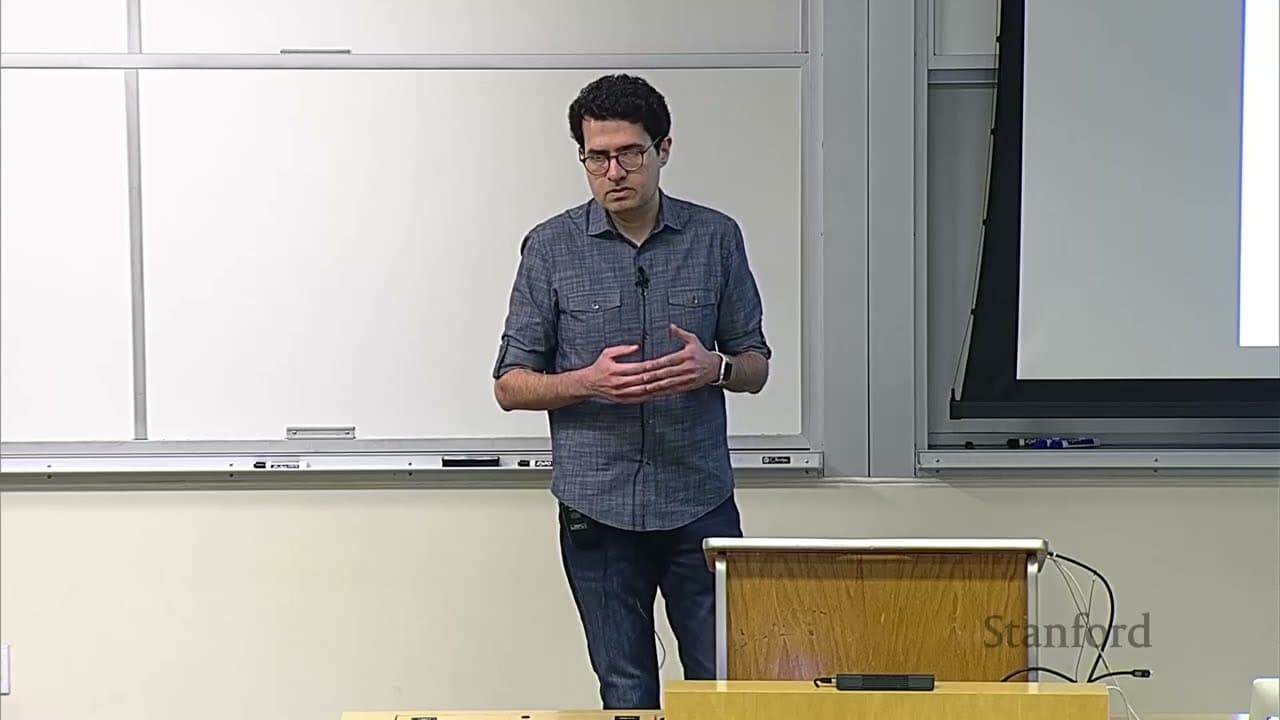
This video is part of a course on sensors and navigation. The instructor starts by reviewing the content covered in the previous chapter on GPS. He emphasizes that the concepts introduced in that chapter can be applied to other types of sensors as well.
Next, the instructor discusses inertial sensors, which are crucial for dead reckoning and navigation. He explains that inertial sensors can measure linear acceleration and rotational motion. He describes the two main types of localization techniques: position fixing and dead reckoning.
The instructor then introduces mechanical accelerometers, which are based on a damped harmonic oscillator system. He explains the physics principles behind accelerometers and how motion transduction mechanisms work. He discusses different technologies used in accelerometers, such as mechanical, optical, acoustic, and fluid-based systems.
Next, the instructor explains how the displacement of the proof mass in an accelerometer can be measured using capacitive sensing. He describes the system architecture of an accelerometer and how the voltage of the moving plate of the capacitor is proportional to the displacement of the proof mass. He also discusses the importance of modulating the voltage and using a low-pass filter.
Finally, the instructor explains how to derive the acceleration from the digitized voltage measured by the accelerometer. He provides the equation and discusses the importance of the sampling rate.
Overall, this video provides an overview of inertial sensors and accelerometers, discussing their principles, technologies, and system architectures.
Browse more from
Stanford EE259 I Ultrasonic sensor (Sonar) principle of operation & architecture I 2023 I Lecture 8
Stanford EE259 Principles of Sensing for Autonomy I Introduction, GPS overview I 2023 I Lecture 1
Stanford EE259 I Sonar ranging and bearing angle estimation I 2023 I Lecture 9
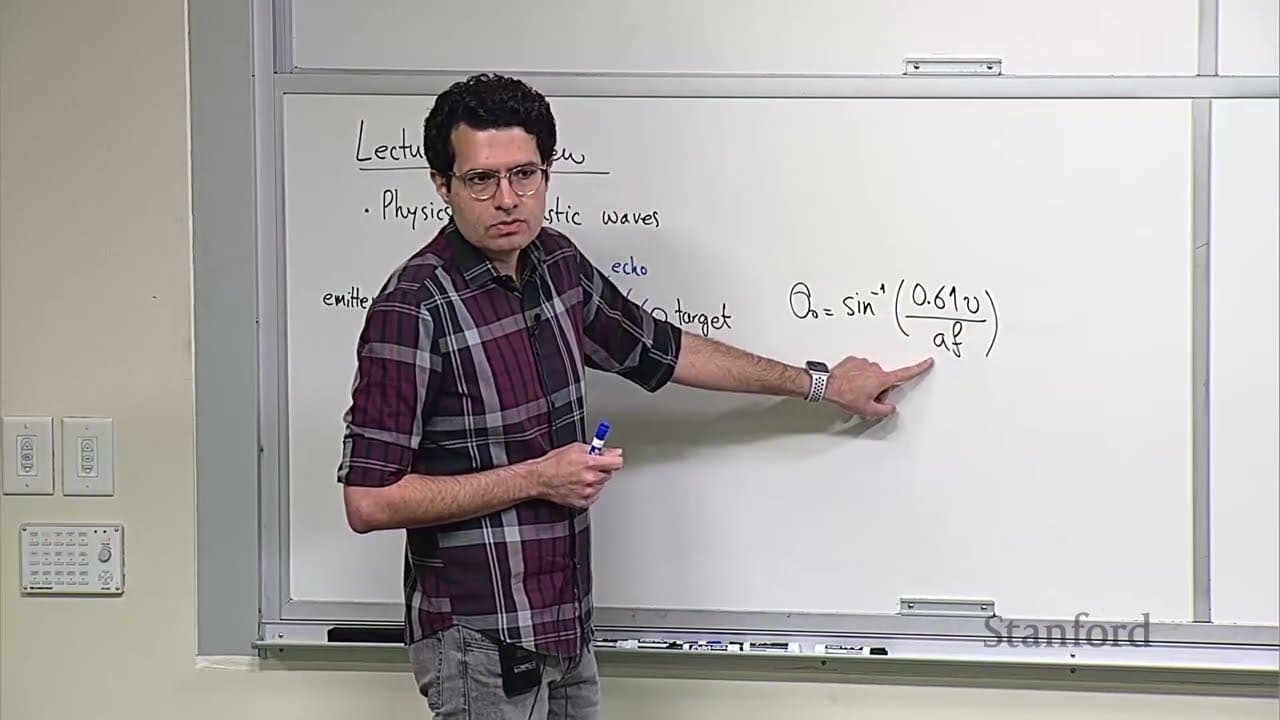
Stanford EE259 I Radar principle of operation & architectures (pulsed, FMCW, PMCW) I 2023 I Lec. 10
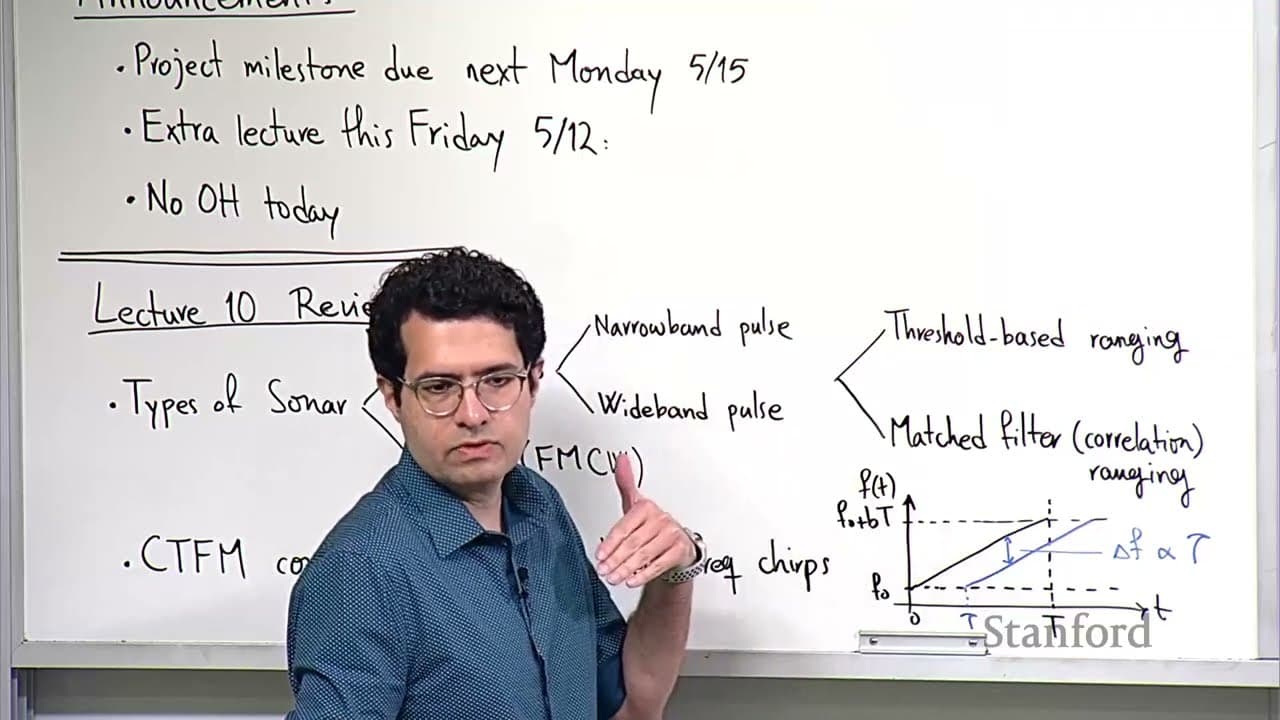
Stanford EE259 I Radar antenna designs and characteristics I 2023 I Lecture 11
Stanford EE259 I Gaussian beams, beam scanning techniques I 2023 I Lecture 16
Ready to get started?
Save, summarize & chat with your content.
IT'S FREE
No credit card required · 30 Day Refund on Premium · 24 Hour Support