Navigating Challenges in Distressed Companies w/ Becki DeGraw | Wilson Sonsini Startup Legal Basics
20 Sep 2024 · over 1 year ago
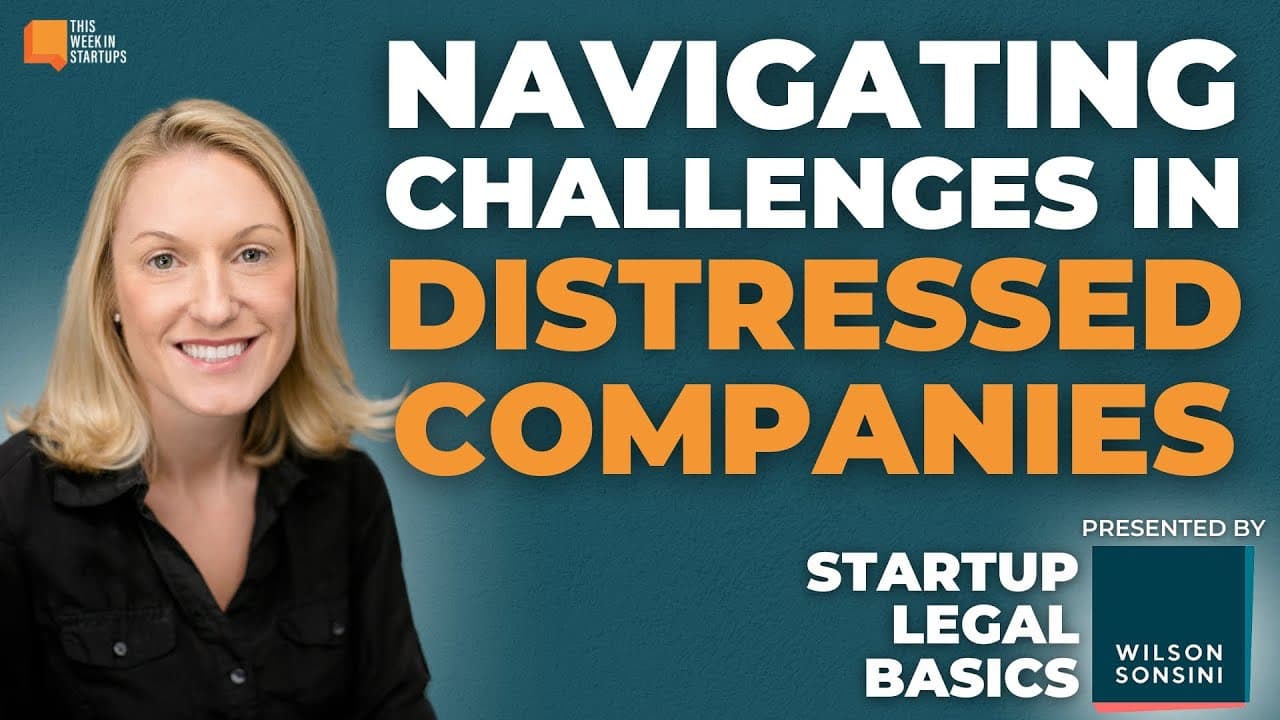
Wilson Sonsini partner Becki DeGraw joins Jason (0s)
- Venture capitalists (VCs) sometimes resign from the boards of struggling companies. (18s)
- The departure of VCs from a board can leave the remaining members, often including the co-founders, to navigate the company's challenges. (39s)
- Companies facing difficulties are referred to as "distressed companies." (1m2s)
Distressed companies and VCs leaving the board; Challenges in distressed companies (1m4s)
- In a distressed company, directors and officers face increased scrutiny for their actions, especially when seeking financing from insiders. (1m17s)
- Insider financing options, such as down rounds and recaps, often come with less favorable terms, higher risks, and potential for future legal claims. (1m43s)
- Distressed companies often require more frequent board meetings, leading to increased legal fees and demands on time and resources. (2m11s)
Insider-led down rounds and pay-to-play scenarios (2m31s)
- Some investors may choose to resign from the board of a distressed company if they believe their investment is a lost cause and their presence poses a liability. (2m32s)
- A pay-to-play scenario arises when a company facing financial difficulties needs additional funding, and existing investors are pressured to participate to avoid negative consequences, such as the conversion of their preferred stock to common stock at a disadvantageous ratio. (3m26s)
- While pay-to-play rounds are intended to secure funding for struggling companies, they often result in unfavorable outcomes, with legal action being rare even in successful cases. (5m12s)
Legal actions and stockholder lawsuits in successful turnarounds (7m7s)
- Companies that successfully turn around after being in distress may face stockholder lawsuits. (7m33s)
- Having a well-documented process for decision-making, including obtaining sign-offs from all parties involved, can help mitigate the risk of lawsuits. (8m21s)
- Conducting a market check before accepting funding from insiders, even if it results in a down round, can demonstrate that a fair process was followed. (9m9s)
The importance of a market check in financing; Voting against board decisions (9m25s)
- A market check is when a company needing to raise money speaks with multiple investors to gauge interest and potentially secure funding. (9m32s)
- Documenting all investor interactions, including rejections, is crucial for companies, especially when dealing with insider financing, as it provides transparency and protects against potential legal issues. (10m4s)
- Board directors have a fiduciary duty to act in the best interest of the company and its stockholders, even if it means voting against proposals they deem unfair or detrimental to shareholder value. (16m22s)
Character and incentives in the startup ecosystem; High-profile legal and ethical issues (18m3s)
- Running a startup requires extreme dedication, which can lead individuals to bend or reinterpret rules in pursuit of disruption. (18m17s)
- A crypto company's request to meet with Panamanian lawyers in the BVI, coupled with a million-dollar fee for setting up a nonprofit with undisclosed directors, raised red flags. (19m29s)
- High legal fees and volatility are inherent in the startup world, but good legal counsel can make the journey smoother. (20m59s)
Browse more from
Venture Capital

'Super weird' is the best way to describe this startup's pivot | Equity Podcast

JP Morgan's head of startup banking says 'Founder Mode' won't get you a unicorn | Equity Podcast

Shardul Shah: How Index Makes Decisions & Why Benchmarks & Averages in VC are BS | E1202

Eric Vishria: Where is the Value in AI - Chips, Models or Apps? | E1206

The AI secondary shares market is giving Beanie Babies economics | Equity Podcast

AI's tween years, who's taking over climate tech, and the latest for Fearless Fund | Equity Podcast
Ready to get started?
Save, summarize & chat with your content.
GET STARTED
IT'S FREE
No credit card required · 30 Day Refund on Premium · 24 Hour Support