
Introduction and a Learning Moment
- As a junior engineer, a person was assigned a task to create a concise daily report to show the life of bugs for the day, which was a perfect task for a junior engineer, but due to a typo in the chrome expression, the report was sent every minute to the entire engineering organization, including the CTO 10s.
- The team handled the situation well, with nobody yelling or making the junior engineer feel stupid, and instead, they all laughed, fixed the issue, and moved on, which made the junior engineer feel safe learning from the mistake 2m6s.
- The junior engineer, Kasha, learned that great teams are not defined just by their technical skills, but by how they communicate and help each other get better, and this idea has followed Kasha throughout her career 2m6s.
Kasha's Role and Perspective on Engineering Challenges
- Kasha leads engineering in a commerce space at Netflix and has been doing so for about 10 years, and she has realized that the hardest problems engineers face are not about systems, but about people, communication, assumptions, alignment, and how to scale their own judgment 4m30s.
- Kasha will be discussing how clarity builds trust, alignment creates influence, and scaling oneself turns that into something lasting, with the goal of providing ideas that can be implemented on Monday to make a difference between a great engineer and someone who can quietly change an entire organization 6m20s.
Clarity in Engineering and Its Impact
- Kasha will start with a story about clarity, which involves helping the payments team with a project to support a new payment method in Brazil, which was the first big merchant to use this method for subscription payments, and the project looked complicated due to the invisible complexity of keeping a relationship alive 8m10s.
- Senior engineers often lead by recognizing patterns and applying past experiences to new problems, rather than simply knowing all the answers, which allows them to simplify complex issues and earn trust with their team members 10s.
- Clarity is essential in engineering as it earns influence by helping others see things clearly, and when team members realize that someone's clarity makes their job easier, they start coming to them for guidance and to think things through 2m6s.
- Even when individual thinking is clear, clarity can be lost during handoffs between multiple teams, leading to mismatches and errors, as seen in a migration project where two teams had different interpretations of the same specification 4m42s.
- The problem of lost clarity often arises from local truths and lack of consistency across teams and systems, resulting in technically correct but inconsistent implementations, which can be difficult to identify and resolve 8m36s.
- To address this issue, it's essential to pay closer attention to conversations that don't happen and areas where understanding breaks down, as alignment and clarity are critical in distributed systems to ensure consistency and prevent errors 12m10s.
The Importance of Alignment in Engineering Teams
- Clarity is essential for individuals and teams to do good work, but alignment is necessary for that work to fit together, and it's where the impact really starts to scale, especially when it comes to multiple teams 10s.
- A project to expand the use cases for a machine learning model that runs payment transactions revealed the importance of alignment, as the project team and engineering team had different perspectives on how to proceed, with the project team wanting to move fast and the engineering team wanting to stabilize first 2m6s.
- The conversation started to loop, with everyone having valid points but getting frustrated, until the question was asked, what would it take for everyone to feel confident with the model six months from now, which changed the tone and turned the conversation into a collaborative effort to design a solution together 4m42s.
- The alignment that was achieved allowed the team to expand the model while cleaning up the integration layer, defining cleaner input boundaries, and investing in future resilience, which improved collaboration between teams and helped people focus on what the system needed next 6m15s.
- Alignment is not about forcing agreement, but about helping people see that they're solving the same problem from different angles, and it's about being connective, not persuasive, which allows things to move faster and feel lighter 8m10s.
Personal Alignment and Imposter Syndrome
- There's another kind of alignment that's important, which is the alignment you have to build inside your head, as sometimes the hardest person to convince that you belong in the room is yourself, and this was a challenge when joining Netflix as a senior engineer from a startup 10m40s.
- The experience of joining Netflix and being faced with a complex codebase, referred to as "spaghetti code," was a challenge, but it was an opportunity to learn and grow, and to develop the skills needed to align with the team and the organization 12m20s.
- The complexity of a system can sometimes be overwhelming, and it may seem like there is an elegant design underlying it, but often it is just overengineered, and recognizing this can help alleviate feelings of impostor syndrome 10s.
- Impostor syndrome can be a sign that the thing being looked at is too complicated, and complexity can masquerade as sophistication, but it is often just a lack of clarity, and asking simpler questions can help to clarify things 42s.
- Asking questions like what problem an abstraction is solving, if it is needed, and what a simple design would look like can help to make the system better and make the person asking the questions feel more grounded 2m6s.
- Clarity is not just something created for others, but also something that needs to be rebuilt inside oneself every time a new space is entered, and the antidote to impostor syndrome is curiosity, humility, and a willingness to ask questions 4m10s.
Scaling Oneself as an Engineer
- As engineers scale themselves, they hit a wall not because the work gets harder, but because there is more of it, and they need to find ways to create clarity for themselves and others to make good decisions without relying on individual memories 6m15s.
- Using tools like Genai to summarize meeting transcripts into short architectural decision records can help to create a simple and accessible record of decisions and trade-offs, and can help to scale the process beyond individual engineers 8m40s.
- Creating enough clarity that other people can make good decisions without relying on individual engineers is what scaling oneself really looks like, and it is not about doing more, but about creating a system that can maintain itself 11m20s.
- The habit of creating clarity and documenting decisions can change how a team works, and can help new engineers to understand why things are working in a certain way, by making decisions and trade-offs accessible in a repository 13m30s.
Reproducibility and Systems of Clarity
- Growth at a high level is not about speed, but about reproducibility, making reasoning visible, and allowing others to reuse, challenge, and build on it, which helps to create systems of clarity that keep working even when the individual is no longer there to explain them 10s.
- As individuals scale themselves, their job stops being about making great technical decisions and starts being about helping other people make good technical decisions, which involves recognizing what has been learned through trial and error and compressing it into patterns that others can use immediately 2m6s.
- A senior engineer, Mary, was working on a data migration project and was frustrated because she was spending more time in meetings than doing actual engineering, which led to a discussion about the importance of structuring meetings for decision-making, including having an agenda, identifying who has input and who is the decision maker, and writing down what was decided and who is doing what 4m42s.
Structured Decision-Making and Meetings
- Structuring meetings for decision-making is crucial for alignment, and it involves naming the decision explicitly, identifying who has input and who is the decision maker, timing the conversation, and writing down what was decided and who is doing what, which helps to create clear next steps and ensures that tasks are assigned to specific individuals 6m15s.
- Scaling oneself is not just about documentation, but about recognizing what has been learned through trial and error and compressing it into patterns that others can use immediately, which can help other engineers skip past mistakes and create exponential growth 10m0s.
The Role of Senior Engineers in Building Clarity
- The real work of a senior engineer is not about writing more code, but about building clarity that outlives them, creating alignment, and helping others grow, which involves solving engineering problems such as transferring judgment, scaling pattern recognition, and making tacit knowledge explicit 14m20s.
- The influence of an individual is not just measured by their personal accomplishments, but also by how others think, decide, and communicate after being part of their process, which is a lasting impact that sustains motion 10s.
Shaping How Others Think and the Lasting Impact of Influence
- As one progresses in their career, their focus shifts from proving technical skills to shaping how things are done, building systems and architectures, and eventually realizing that their biggest contribution is in shaping how others think 42s.
- There is no commit history for the kind of work that involves shaping how others think, but it is this part that keeps everything moving forward long after the code has changed 1m6s.
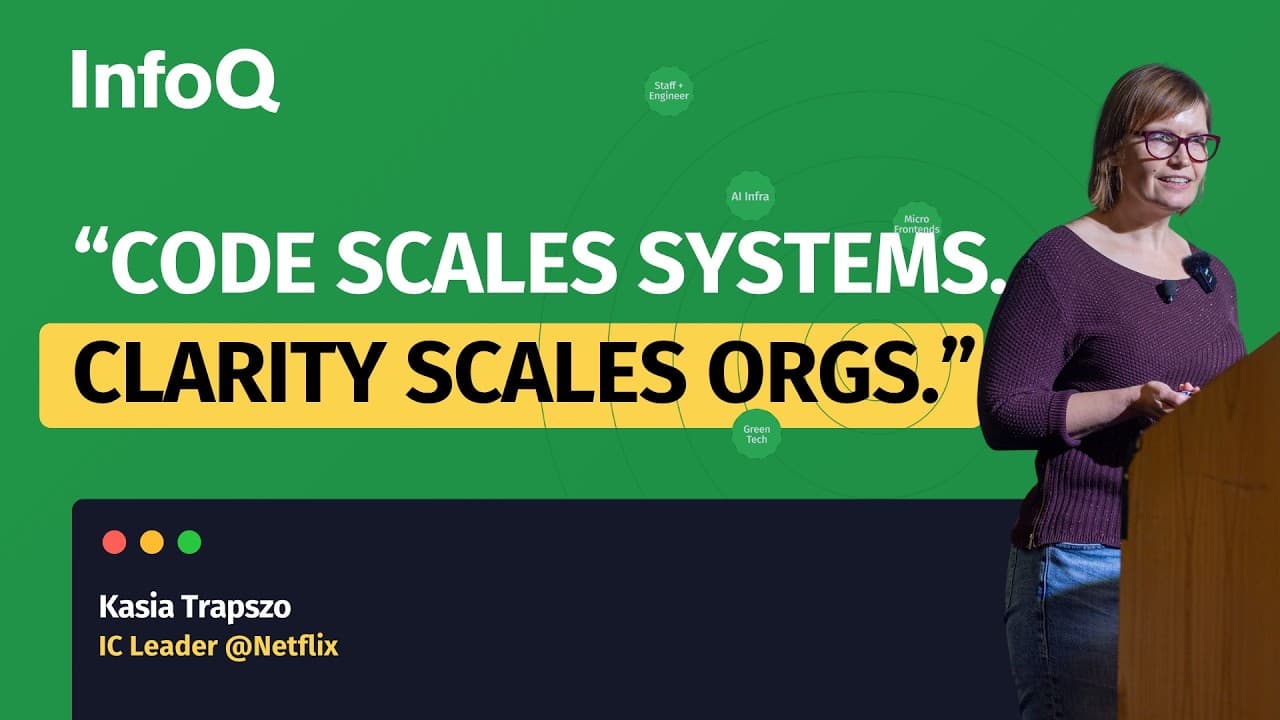
- The key takeaway is that code might scale a system, but experience and clarity scale organizations, and this is the kind of impact that lasts 2m6s.
Practical Steps to Scale Clarity and Influence
- A challenge is presented to pick one decision made in the past week that someone else might need to know about in six months, write three sentences about it, and put it somewhere where others can find it, as a small act of clarity to start scaling people, not just systems 3m5s.
- When framing decisions, it is not necessary for them to be yes or no, but rather to ensure that the decisions being made are clear, such as choosing a database or deciding on a system architecture 5m30s.
- To incentivize people to scale themselves and share knowledge, leadership needs to believe in the model of leadership engineering and measure its effectiveness, such as by tracking the efficiency of teams in delivering code with the help of experienced individuals 8m40s.
Building Psychological Safety and Trust in Teams
- The way to prove the effectiveness of this model is to find a way to measure it, such as by showing that teams are more efficient at delivering code when they have guidance from experienced individuals, which can help convince leadership of its value 10m50s.
- Psychological safety is something that every team should have as part of its culture, and it is particularly visible when something goes wrong, allowing people to learn from mistakes without blame or fingerpointing, using blameless retrospectives 42s.
- When influence is not enough and teams are not listening, it may be a sign of lack of trust, which can be built by showing technical skills, leading by example, and being willing to take on tasks that nobody else wants to do 4m10s.
Managing Knowledge and Cognitive Overload
- Adopting architecture decision records can help share knowledge, but it can also result in cognitive overload if there are too many decisions and documents floating around, and using Gen AI to create and maintain these records can help keep them consistent and up-to-date 8m30s.
- Imposter syndrome is common among software engineers, and while it may not go away, being aware of it and recognizing that it is normal can help, but distinguishing it from the Dunning-Krueger effect, which involves overestimating one's capabilities, is important to avoid limiting coworkers 12m20s.
- Building trust with teams can be done in many ways, including showing technical skills, being willing to take on tasks that nobody else wants to do, and leading by example, which can help establish credibility and influence 6m0s.
- Using Gen AI to maintain architectural decision records can help reduce cognitive overload by ensuring that the records are consistent, up-to-date, and make sense, and can also help identify areas that need to be updated or aligned 10m40s.
Building Trust and Delegation in Engineering Leadership
- Building trust in oneself to start delegating tasks involves receiving feedback from others, such as coworkers trusting and willing to review pull requests quickly, which is a great sign that one is doing something right 10s.
- As a technical lead, teaching the team to learn and adopt patterns from leads can be achieved by leading by example, practicing what one preaches, and being willing to do tasks that nobody else wants to do, such as taking meeting notes, to build trust with the team 2m6s.
- To compete with someone who is loud and persuasive, such as a product person, it is essential to find alignment by understanding the reason behind their perspective and using empathy to create a better working relationship, which can help build trust and turn potential conflicts into opportunities 4m37s.
Creating a Culture of Learning and Mistake Tolerance
- Building a culture that allows people to make mistakes and learn from them requires leadership to set the tone, and as an engineering leader, it is crucial to create a space where people can learn from their mistakes without fear, even when the impact is significant, and people are under pressure 9m14s.
- Leading by example, being willing to do tasks that nobody else wants to do, and using empathy to understand others' perspectives are key takeaways for engineering leaders to build trust, create a positive culture, and make a significant impact on their teams 6m30s.
- To implement a culture change, such as learning from mistakes and incidents, it has to come from top-down leadership, as individual contributors (ICs) have less leverage in driving this change 10s.
Leadership Challenges and Alignment in Organizations
- When engineers are aligned but leadership is not, it's a difficult problem to solve, and one approach is to go up a level to try to get leadership to align 2m6s.
- As a senior individual IC, to prove their value to the company, they need to demonstrate that their work, such as bringing clarity, creating alignment, and bridging gaps, is additive and valuable to the team, and the engineering organization needs to value this kind of work 4m42s.
- The "disagree and commit" approach is a valid way to get alignment, where individuals with different ideas on how to solve a problem can still commit to the chosen solution, prioritizing what's right for the company and the project 8m10s.
Closing Remarks and Appreciation
- The audience is asked to thank Kasha for coming and giving a great talk, as well as answering questions 0s
- Kasha is appreciated for their contribution, with a expression of gratitude extended to them 0s
- The talk and question-and-answer session given by Kasha is considered great by the person expressing thanks 0s