

The Texas Power Crisis
- A severe winter storm caused chaos across the United States, with over 200 million Americans on alert due to snow and ice, and severe weather conditions led to a power crisis in Texas, with many losing electricity and access to clean water 42s.
- The power crisis in Texas led to hospitals evacuating patients, dozens of deaths, and a full-blown humanitarian crisis, with many blaming green energy and frozen wind turbines for the crisis 2m6s.
- However, it was pointed out that Texas only relies on wind power for about 25% of its electricity, with the majority coming from thermal heat sources like natural gas, coal, and nuclear, which were also severely impacted by the cold weather 3m28s.
- Texas Governor Greg Abbott repeated the claim that the green New Deal would be a deadly deal, but it was noted that this claim is unfounded and that the state's power grid issues were more complex 3m19s.
- The majority of Texas's power grid is separate from the rest of the country, designed to avoid federal regulation, which contributed to the severity of the crisis 3m51s.
- Fox News hosts, including one in particular, were criticized for blaming green energy and wind turbines for the crisis, with it being pointed out that their claims were not supported by science 2m12s.
- It was also noted that the crisis in Texas was not solely due to the weather, but also due to uniquely Texan issues, including the state's separate power grid and lack of federal regulation 3m47s.
- Texas's independence limited its ability to import energy from neighboring states, putting significant pressure on UROTCO, the company managing the state's grid, to meet surging demands during a recent storm 4m23s.
- UROTCO scrambled to meet the demands and later admitted that Texas was seconds and minutes away from catastrophic, month-long blackouts, which is a big shift from their initial response of tweeting out passive-aggressive energy-saving hints 4m34s.
- The company's lack of preparedness was partly due to the state's decision to leave the choice of winterizing facilities up to power companies, many of which opted against the upgrades due to their expensiveness 5m38s.
- A decade ago, Texas was hit with a similar storm that paralyzed the state, and federal regulators warned that power plants needed to winterize to prevent such incidents from happening again 5m48s.
- State officials knew about the potential risks but failed to act, and the recent storm highlighted the consequences of their inaction 6m2s.
- The state's philosophy of "every man for himself" has defined the response from officials, with one mayor posting that no one owes anyone anything, and it's not the local government's responsibility to support people during trying times 6m51s.
- The mayor's post sparked a ferocious backlash, leading to his resignation, and there was also controversy surrounding Ted Cruz, who fled the state with his family to Cancun during the storm 6m57s.
- Cruz initially claimed that he had always planned to drop his family off and return, but later admitted that he had planned to stay the whole time and blamed his pre-teen daughters for the trip 7m21s.
- Heidi Cruz organized a vacation to Cancun, Mexico, with her friends and neighbors, inviting them to join her family at the Ritz Carlton, after her house was freezing due to the Texas blackout 7m49s.
- Ted Cruz claimed he was bullied into taking the trip by his daughters, and then cyberbullied into returning home early by the internet, leaving his wife to care for their children alone in Cancun 8m14s.
- Former Governor and US Secretary of Energy Rick Perry suggested that Texans would prefer to go without electricity for longer than three days in order to avoid federal regulation 8m37s.
- Thousands of Texans are still struggling after the blackout, and organizations like Feeding Texas are providing assistance to those in need 9m26s.
- The Texas blackout was caused by a failure to implement critical lessons from a similar event 10 years ago, rather than a deliberate choice by Texans to sacrifice their power and heat 9m7s.
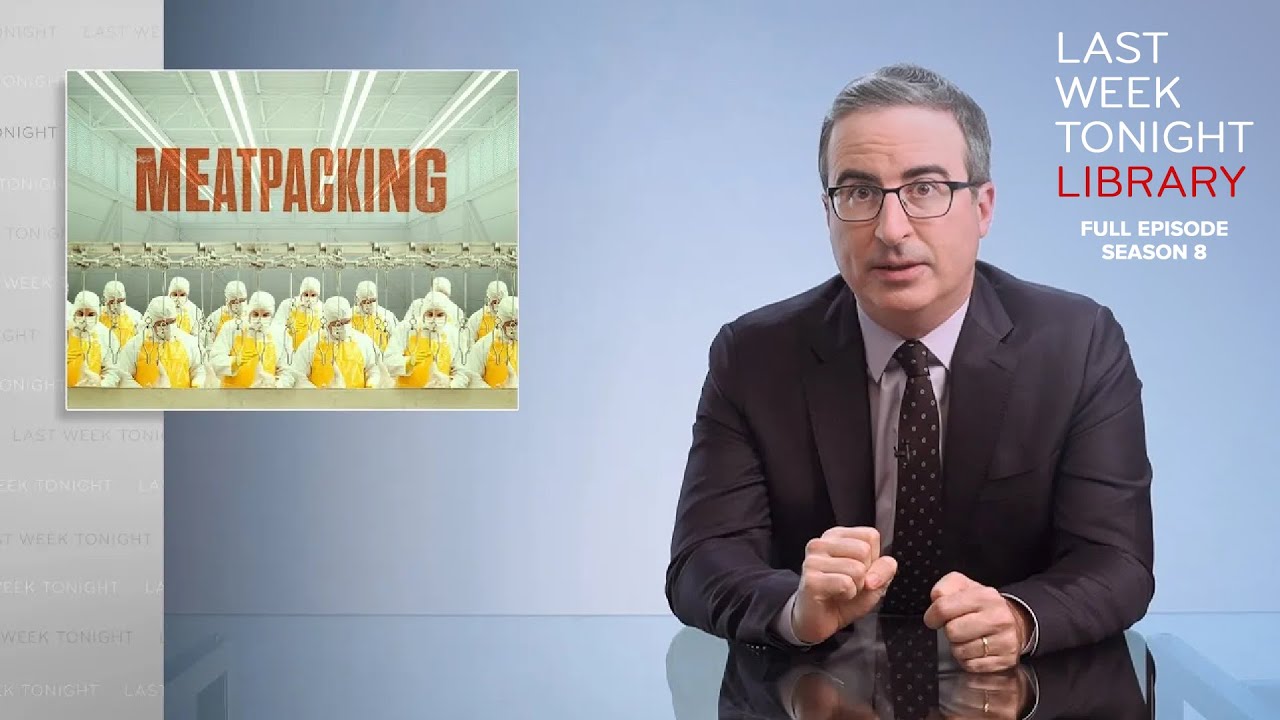
The Meatpacking Industry Crisis
- The main story concerns the grim conditions humans face working in meatpacking facilities, which is a highly consolidated industry with roughly 85% of beef production in America controlled by four companies 12m12s.
- Meatpacking companies, such as Tyson, claim to prioritize their employees' well-being, referring to them as their "most valuable asset" and "family," but this claim is disputed 12m32s.
- Allegations have been made against managers at a Tyson pork processing plant in Iowa, including a supervisor taking bets on how many employees would catch COVID-19, which led to the firing of seven managers 13m22s.
- The incident highlights a larger problem in the industry, where workers dispute companies' claims of prioritizing their safety, and at least 57,000 meatpacking workers have contracted COVID-19, with at least 280 deaths as of February 18th 14m25s.
- The treatment of workers in the meatpacking industry has been poor for a long time, with workers packed closely along conveyor belts, often working at breakneck speeds, and reporting high rates of injury and illness 14m41s.
- Maximum allowable line speeds in poultry have doubled since 1979, with workers reporting averaging 35 to 45 birds per minute, contributing to the hazardous working conditions 14m53s.
- In the US meatpacking industry, line speeds are extremely high, with a plant able to process five whole birds in less than 2 seconds, making it difficult for workers to safely butcher chickens 15m6s.
- Due to the relentless pace, workers have reported struggling to take breaks, even to use the bathroom, which may explain incidents like the one at the Smithfield production line in Virginia, where an employee relieved himself under the production line and then continued working 15m34s.
- The combination of urine and pork is a serious concern, and the incident highlights the problem of workers being put in positions where they feel they have no choice but to compromise their health and safety 15m58s.
- Oxfam released a report detailing grim conditions for poultry workers, including being denied bathroom breaks, with some workers wearing diapers during their shifts 16m16s.
- The US meatpacking industry has some of the highest rates of occupational injury and illness, with a worker losing a body part or being hospitalized about every other day in a recent three-year period 17m21s.
- Plants are often crowded, leading to common injuries such as cuts from neighboring workers' knives, and rapid line speeds can exacerbate problems like repetitive stress injuries and carpal tunnel syndrome 17m33s.
- Workers often feel disposable, with many experiencing injuries and being treated like machines, rather than being valued as human beings 17m46s.
- Companies often strategically locate their plants in areas with few labor protections, allowing them to get away with treating their workers poorly 18m27s.
- Meatpacking companies often hire vulnerable groups, including former prisoners, refugees, and immigrants, with around 175,000 immigrants working in the industry in the US, making them wary of complaining about mistreatment 18m33s.
- Companies minimize accountability by exploiting loopholes in the system, such as not reporting serious injuries to OSHA if treatment remains at a first-aid level 18m59s.
- A GAO report found that plants offer on-site first-aid treatments instead of referring workers to doctors, even for severe injuries like fractures 19m10s.
- Workers with severe injuries may not be sent to doctors, with one worker making over 90 visits to the company's nurse before being referred to a physician 19m24s.
- Workers are aware of the system being gamed and may be discouraged from seeking medical attention, with some being told they would be fired if they saw their own doctor 19m48s.
- Workers' compensation programs, which provide medical treatment and lost wages, are run at the state level and have been influenced by companies to reduce benefits and make them harder to access 20m14s.
- An example of this influence is Bo Pilgrim, a poultry CEO, who attempted to bribe a senator in 1989 to influence the overhaul of Texas' workers' compensation system 20m37s.
- Bo Pilgrim co-founded Pilgrim's Pride and was known for his lavish spending, including a 37-foot bust of his head and a mansion referred to as "Cluckingham Palace" 21m27s.
- Tyson has taken a lead in pushing for changes in workers' compensation laws in various states, making it harder for workers to receive payments for job-related injuries 22m13s.
- In Texas, companies can opt out of paying into workers' compensation entirely and create their own rules for injury payments, which Tyson has done 22m24s.
- To receive medical care from Tyson, injured workers must sign a document releasing the company from claims arising from their injuries, which can be pressured into signing on the spot 22m40s.
- Workers who do not sign the waiver may have to sue the company, which can take years, although Texas law now gives workers 10 days to consider signing the waiver 22m57s.
- Companies like Tyson seem to care about the physical wellbeing of some of their workers, such as those in corporate offices, who are offered on-site fitness classes and workshops on meditation 23m30s.
- There is a stark contrast between the treatment of workers in Tyson's corporate offices and those in their factories, as well as a disparity in the racial demographics of salaried and hourly workers 24m23s.
- The Occupational Safety and Health Administration (OSHA) is woefully understaffed, with a 45-year low in inspectors, making it difficult for the government to remedy the issues in the meatpacking industry 24m45s.
- Even when OSHA inspectors do visit plants, they may be limited in what they can do, and in some cases, have been prevented from conducting broader searches, even when workers are getting seriously injured 25m3s.
- Meatpacking plants have inherently suspicious conditions, and even when OSHA finds violations, their power to take action is weak, with the average fine for a serious safety violation in 2019 being just over $3,700 25m59s.
- This fine amount can make it cheaper for companies to run an unsafe plant and pay fines rather than provide a safe work environment 26m14s.
- During the pandemic, corporate workers were able to work from home, but plant workers were kept on the job despite the difficulty of social distancing, leading to predictable deaths 26m31s.
- The federal response to these deaths was weak, with JBS being fined only $115,000 after six workers from one of their plants in Colorado died from COVID-19 26m47s.
- The fine was particularly egregious given that the funeral costs for one of the workers, Saul Sanchez, exceeded the fine amount, and JBS brings in over $50 billion a year 27m8s.
- The fine amount was equivalent to 0.003% of JBS's profits last year, which is not a sufficient deterrent for companies to prioritize worker safety 27m23s.
- JBS is fighting the claims for workers' comp survivor benefits from Saul Sanchez's widow and others who have lost loved ones, arguing that the COVID infections were not work-related 27m54s.
- To address these issues, OSHA should implement a federal emergency workplace standard giving meatpacking workers the right to social distancing and other protections, and the agency should be rebuilt and strengthened in the long term 28m16s.
- The USDA should also do more to ensure lines move at safe speeds, and a baseline should be set for what states have to offer in terms of workers' comp to prevent a "race to the bottom" 28m28s.
- The situation is critical, with over 1,500 employees contracting the virus and eight dying at a Tyson plant as of mid-December 28m48s.
Court Proceeding with Mr. Glenn
- A court proceeding is taking place, with a witness, Mr. Glenn, being questioned, and there is a mention of no smoking in court 29m37s.
- The witness is holding a stuffed animal that belongs to his nephew and is asked to put it down 29m49s.
- The witness is then asked to bring an end table with a "T" on it closer to the camera so that it can be read, as the picture submitted into evidence is not clear 29m59s.
- The witness's battery is running low, and they are given permission to take a break to charge it, but they are unable to do so because the charger is in the kitchen or the dog room 30m8s.
- The witness is asked to focus on the task at hand and to lift their head and adjust their position to better display the end table 30m23s.
- The witness is instructed on how to hold the end table up to the camera so that it can be read 30m30s.


