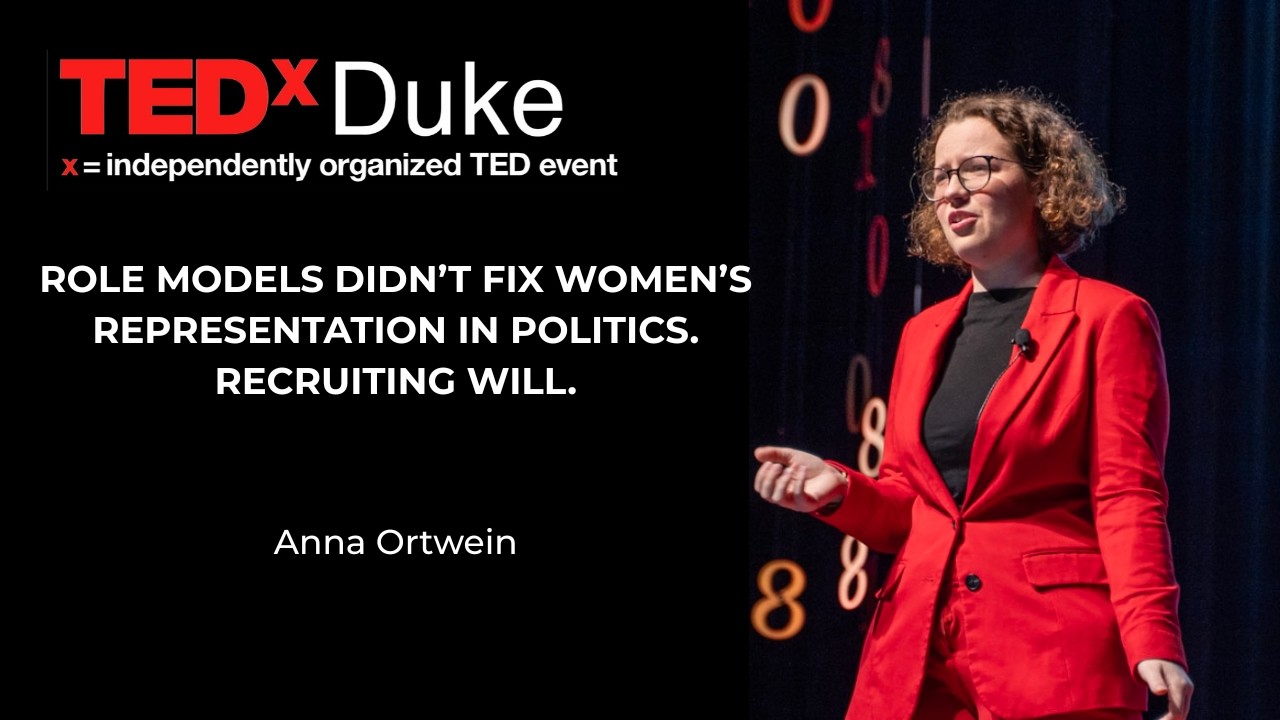


Systemic Barriers for Women in Politics
- Young women entering politics often face sexist rhetoric, including comments about their appearance, suggestions to leave politics to men, and dismissive remarks about their qualifications 0s.
- The German word "trotzdem," meaning "despite this," serves as a framework for understanding the systemic obstacles women must overcome to succeed in political environments 42s.
- Although Germany had a female chancellor, Angela Merkel, for 16 years, the country continues to struggle with deeply ingrained biases against women as serious political voices 1m15s.
- The presence of a female leader at the highest level does not necessarily equate to systemic change, as evidenced by the stagnant rate of women's representation in the German Parliament both before and after Merkel’s tenure 1m48s.
- In the United States, the election of Kamala Harris as the first female Vice President expanded public imagination regarding leadership but did not fundamentally rewrite the political system or increase the representation of women in Congress, which remains at 28% 2m25s.
Challenges Faced by Young Female Candidates
- When attempting to run for the German Federal Parliament, a local state board president opposed the candidacy by falsely claiming that a male candidate would receive more votes and by spreading misinformation about the board's support 3m5s.
- The candidate successfully challenged these allegations by confronting the board president, which resulted in the president being forced to resign and the candidate securing the nomination 3m35s.
- Young female candidates face an intersectional challenge where they are marginalized due to both their gender and their age 4m5s.
- Youth participation in politics is essential because younger generations are the most affected by long-term policy decisions regarding issues like the cost of living and affordable education 4m20s.
- Political intimidation, such as being labeled an "intern" by opponents like the Alternative for Germany (AfD) party, is used as a tactic to discourage young women and signal that they do not belong in the political sphere 4m45s.
Societal Expectations and Candidate Evaluation
- Running for political office is difficult for women, particularly for young women, who must possess significant resilience to succeed 0s.
- Women do not lack the ability to win elections; in fact, data indicates they hold a slight advantage over male counterparts 12s.
- Voters often favor candidates who are married or have children, characteristics that are more difficult for women to maintain due to the time-consuming and demanding nature of political life 22s.
- Society often uses marriage and motherhood as shorthand for maturity and responsibility, while the experiences of younger candidates are frequently dismissed as less legitimate 45s.
- Candidates should be evaluated based on their commitment to public service, the depth of their experience, and their capacity to represent the lives of their constituents 1m0s.
Policy Impacts of Female Representation
- The composition of political bodies shapes the legislative agenda, as men and women often hold different policy priorities 1m12s.
- Because women frequently manage the majority of household and caregiving responsibilities, they are more likely to prioritize education and health policy 1m20s.
- A KFF national survey revealed that 57% of women view gun violence as a major concern or constant threat in their communities, compared to 43% of men 1m55s.
- Increased female representation is not merely symbolic; it has tangible consequences for policy, as demonstrated by the passage of the Family and Medical Leave Act in 1993 after years of advocacy by Representative Patricia Schroeder 2m15s.
Structural Reforms for Political Inclusion
- Achieving a significant shift in political outcomes requires changing how candidates are recruited and prepared, as well as addressing the unequal distribution of household labor 2m45s.
- Political parties often place women on lists or in constituencies without a realistic chance of winning, or simply to meet quotas 3m0s.
- Empowerment programs are insufficient if women are not supported when they are in contention for actual power 3m15s.
- Nominations should be made transparent, as closed-door selection processes tend to favor those already established within the political "club" 3m22s.
- Because politics often demands endless availability, it systematically rewards those who can dedicate the most time, which currently favors men 3m30s.
- Effective support for women in politics requires mentorship, media coaching, debate preparation, fundraising assistance, and protection against personal attacks 3m45s.
- Structural changes such as providing childcare at events, offering parental leave, and allowing hybrid participation are necessary to ensure politics is not limited to those who can sacrifice all other aspects of their lives 3m55s.
- Universities can contribute to this effort by providing campaign training workshops to help potential candidates identify their passions 4m10s.
Training and Mentorship for Future Leaders
- Success in politics requires the ability to network and effectively communicate one's personal story 0s.
- The foundational requirement for women entering politics is receiving direct encouragement and validation that they belong and that their voices matter 0s.
- Current campaign training models, such as those offered by Yale's Campaign School, can be prohibitively expensive, costing $5,000 for in-person workshops and $2,500 for online sessions 7s.
- While Duke previously provided free one-day workshops for students, there is a need to shift toward a model that provides training that is free, accessible, and ongoing rather than treating it as a luxury product 15s.
Transforming the Political Paradigm
- The current political paradigm often asks women to adapt to existing structures, but the goal should be to transform politics to accommodate everyone 26s.
- Women have historically been encouraged to endure and survive within political systems, but survival should not be conflated with equality 32s.
- Achieving a significant shift in political representation requires systemic changes, including how political parties recruit, how households share responsibilities, how universities prepare students, and how voters reward candidates 38s.
- A shift in focus is needed so that the initial discourse surrounding women in politics centers on their policy goals and potential contributions rather than their appearance 47s.
- Increased participation and leadership by women in decision-making roles could lead to substantial changes in public safety, education, and health policy 53s.
- The objective is to move past debates regarding whether women belong in politics and instead observe the impact of having women present wherever decisions are made 1m0s.