
The Escalation and Consequences of Conflict
- The reality of conflict affects 1 in 4 people today, and war and violence are becoming the choice rather than the last resort, with the situation in Iran being a visible example of its impact on energy prices, trade routes, and political polarization 10s.
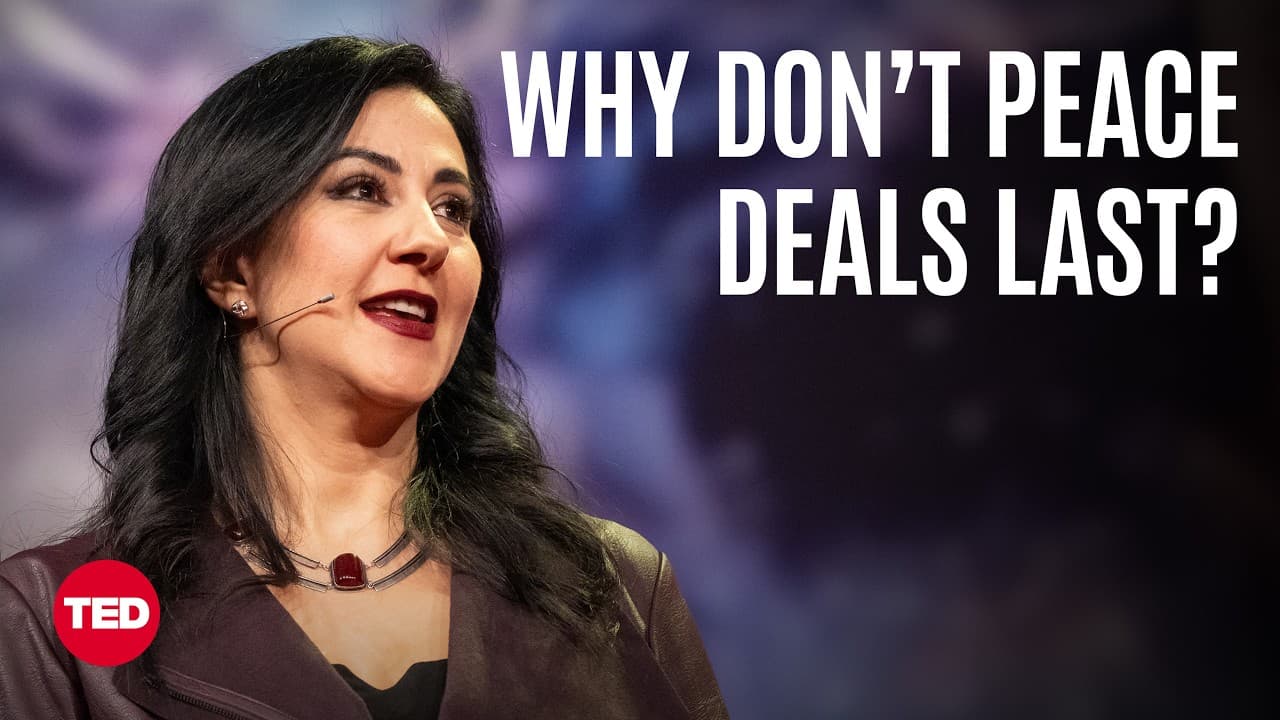
- Even when wars end and agreements are signed, violence often returns within five years, and the current approach to peace has been overly bureaucratized, with a familiar Western liberal model and toolbox that may not be effective in building lasting peace 42s.
- The limitations of the current approach to peace can be seen in the Middle East, where tens of millions of people are living with the unfinished business of wars, failed political settlements, and occupation, and in Afghanistan, where 20 years of intervention and investment ended with the Taliban back in power 2m6s.
- The breakdown of peace is often due to issues of power, politics, and incentives, as well as a lack of legitimacy and trust among the broader public, which is essential for building durable peace and can be felt through good governance, trust in institutions, and preservation of dignity 4m10s.
Founding and Principles of the Principles for Peace Foundation
- To address these challenges, the Principles for Peace Foundation was founded to help peacemakers build more legitimate and durable peace by drawing on lessons from dozens of countries and developing principles, tools, and methodologies to support those trying to make peace hold 6m30s.
- The approach to building peace should be based on principled pragmatism, which combines self-interest with a commitment to principles, rather than relying on idealism or power politics, and should prioritize cultivating legitimacy and trust in a world where might is right and transactionalism is prevalent 8m40s.
Challenges in Traditional Peacebuilding Approaches
- Personal experiences, such as being born and raised Palestinian, have shown that when identities are shaped by loss and violence, othering and dehumanizing the other side can become normal, and empathy for the other side is rarely the entry point for building peace 10m50s.
- Traditional dialogue programs that focus on empathy and sharing may not be effective in building lasting peace, as they may not address the underlying issues of power, politics, and incentives, and may not provide a sustainable solution to the complex problems faced by communities in conflict 12m20s.
Personal and Professional Experiences in Conflict Resolution
- The career of working with people affected by conflict spanned nearly two decades, but personal experiences, including the destruction of a house, made it difficult to work on personal issues, until the war in Gaza expanded and prompted a change, 10s.
- A group of 76 Israeli and Palestinian leaders, including security leaders, business leaders, investors, political figures, and journalists, were brought together in a room to discuss their grievances and work towards a solution, despite the overwhelming loss and trauma caused by the war, 2m6s.
A New Approach to Dialogue: Self-Interest and Common Ground
- The approach taken in the room was to focus on self-interest, rather than moral agreement, and to prioritize what could not be afforded to lose, such as security, dignity, and the future for children, in order to find common ground, 4m6s.
- A sequence called STIR, which stands for Self-Interest, Transaction, Recognition, and Humanity, was introduced to facilitate the discussion and help the group move beyond their positions and towards a more humane understanding of each other, 6m38s.
The STIR Framework and the Uniting for a Shared Future Coalition
- The STIR sequence allowed the group to build a platform for dialogue and action, which became the Uniting for a Shared Future Coalition, a coalition of over 550 Israeli and Palestinian leaders who work together to push for a political solution, even in the midst of war, 8m50s.
- The coalition has been successful in bringing Israelis and Palestinians together to advocate for a joint message, from heads of state to the UN Security Council, and has helped to build trust and recognition of each other's losses, despite the continued brutality of the reality on the ground, 11m30s.
The Ongoing Brutality and Existential Threats in the Conflict
- The reality of the conflict continues to be brutal, with both Israelis and Palestinians feeling existentially threatened, and Palestinians living under occupation, facing settler violence, devastation in Gaza, and the threat of annexation in the West Bank, 13m20s.
The Middle East at a Crossroads: Confrontation or Cooperation
- The Middle East is at a critical juncture, where it can either remain in a state of perpetual confrontation and war, or transition into a new era of political security and cooperation, thereby stopping the export of instability to the rest of the world 10s.
- Resolving the Israeli-Palestinian conflict is crucial, as it is the key fault line that continues to fuel radicalization, and its resolution can pave the way for a new logic of political security and cooperation in the region 42s.
Principled Pragmatism as a Path to Peace
- In a world driven by transactional relationships, the antidote to the idea that "might is right" is not idealism or moralizing, but rather principled pragmatism, which involves launching coalitions of the willing around enlightened self-interest to advance peace and security 1m30s.
- To achieve humanity, it is necessary to start with self-interest, recognition, and transaction, and then work towards the return of humanity, and this approach can be applied to any situation where conflict reigns, by stirring the situation until humanity rises 2m6s.