

Brendan Carr's Censorship and Threats to Free Speech
- Brendan Carr is being criticized for his actions as FCC Chairman, with some considering him to be engaging in censorship by using government power to silence voices that are supposed to be free, and leaving behind a legacy of corruption 10s.
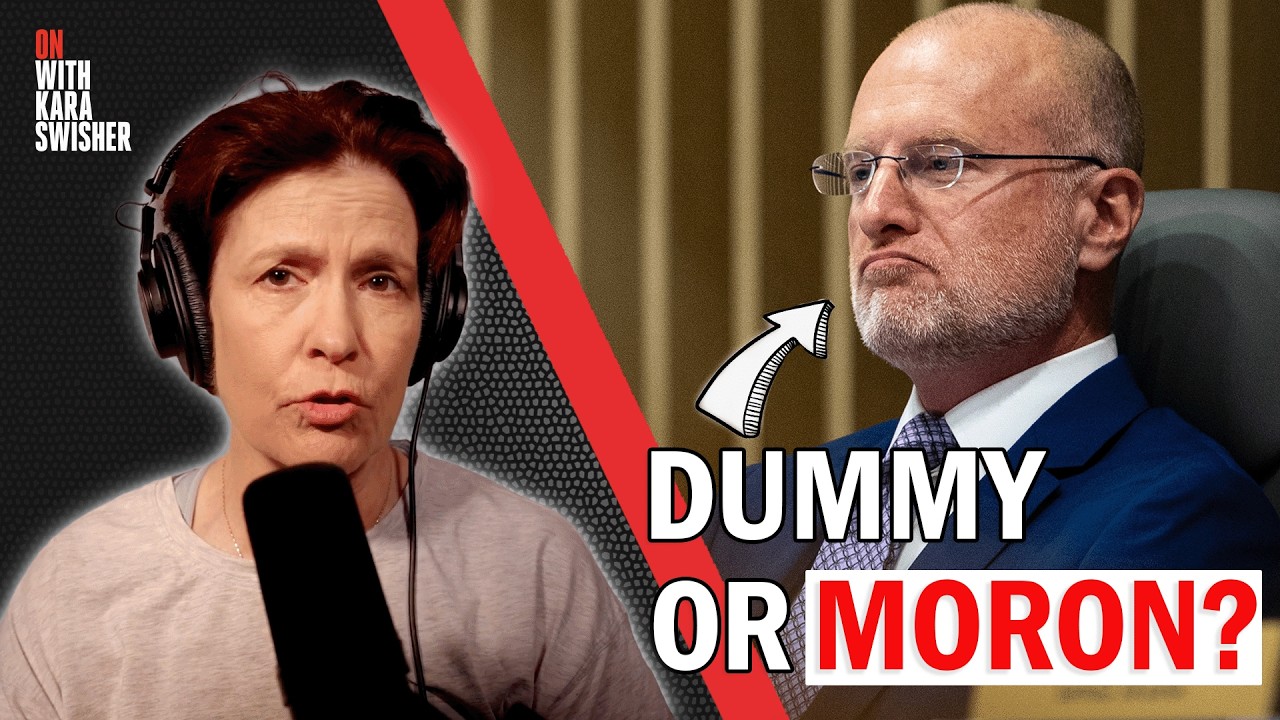
- The topic of Brendan Carr's behavior has been discussed extensively, with the question of whether he is a moron or not being a major point of contention, and his actions being seen as a threat to the First Amendment 42s.
- Commissioner Anna Gomez believes that the most egregious thing the FCC has done under Carr's leadership is calling up local licenses for renewal, specifically targeting Disney, which is seen as a direct assault on the First Amendment and an attempt to threaten the company due to its content 2m6s.
- The FCC's actions are being seen as part of a larger administration-wide campaign of censorship and control, with the agency being used as a weapon to bully companies into changing their content or policies, and the licensing of local broadcast stations being used as leverage to achieve this goal 4m10s.
- The issue of local licenses is complex, with the FCC licensing local broadcast stations rather than networks, and Disney only owning and operating a small number of these stations, but the FCC's actions being seen as an attempt to pressure the company into changing its content or policies 5m30s.
- The actions of Brendan Carr and the FCC are being widely criticized, with many considering them to be unprecedented and dangerous, and a threat to the principles of free speech and the First Amendment 7m20s.
- Brendan Carr's actions against broadcasters and media organizations are considered an assault on free speech, as he justifies his actions by claiming to protect American voices and prevent silencing, which is seen as a reversal of the actual situation, where he is engaging in censorship and suppressing speech 10s.
- Carr's approach is criticized for using government power to silence voices that are supposed to be free, and for attempting to impose equal voices, which is not a feature of the First Amendment, but rather a distortion of its core idea, which allows media organizations to decide what news they cover and how they cover it 42s.
FCC's Actions Against Disney and ABC
- The equal time rule is mentioned as a relevant aspect of Carr's actions, and his approach is seen as a blunt instrument, with some critics arguing that he is not a sophisticated actor and a bad lawyer, who is imposing chilling effects by pulling random words out of statutes and inverting the idea of free speech 2m6s.
- The example of Disney and its network ABC is given as a particular case where Carr's actions are seen as egregious, with some arguing that calling in the licenses early is unprecedented and a clear example of his attempts to silence voices he disagrees with 2m6s.
- The owners of most TV stations in the United States, such as Tegna and Nextar, are mentioned as examples of large media conglomerates that are being targeted by Carr's actions, and their merger is seen as an example of the quid pro quo in the Trump administration 4m30s.
- The use of language meant to protect speech is criticized as being distorted by Carr to attack speech that the president doesn't like, and it is argued that this approach is dangerous and could be used by any administration, regardless of political persuasion, to silence dissenting voices 6m0s.
- The FCC has been investigating The View for months and recently called for a review of the licenses of eight of Disney's ABC local stations, with Disney accusing the FCC of violating its free speech rights 10s.
- Commissioner Gomez sent a letter to Disney CEO Josh Demorro stating that ABC was a victim of a sustained coordinated campaign of censorship and control by the Trump administration, and is happy to see Disney pushing back against the FCC 1m42s.
- The FCC is looking into whether The View violated old federal rules requiring equal airtime to rival political candidates, with Brendan Carr issuing guidance in January reminding broadcasters of the rule, which hasn't been enforced in decades 2m6s.
- Disney claims that The View is a bonafide news program, which would exempt it from the equal airtime rule, but the FCC has started an enforcement proceeding to investigate this claim 2m6s.
- The FCC told unaffiliated ABC stations to file paperwork on a candidate's appearance, and then used this as evidence against Disney's station, which Commissioner Gomez sees as a form of entrapment 4m30s.
- Commissioner Gomez believes that the FCC's actions are an attempt to control the narrative and restrict free speech, and is supporting Disney's pushback against the FCC's investigation 4m30s.
Brendan Carr's Regulatory Tactics and Legal Challenges
- Brendan Carr is attempting to impose speech controls on Disney's content by enforcing a rule, and his actions are considered wrong because he is using his statutory power over broadcast stations to pressure Disney into adjusting its content on channels where the FCC has no authority, such as Disney Plus and YouTube 10s.
- The issue started with NBC during the election when Kamala Harris appeared on Saturday Night Live, and despite NBC filing the necessary paperwork, Brendan Carr began criticizing the show, and has been looking for an excuse to regulate content ever since 2m6s.
- Carr regularly invokes the FCC's news distortion policy, which is a narrow rule that prohibits deliberate and material distortion of the news by a media organization's senior leadership, but this power has not been used in generations 42s.
- Carr has threatened to deny or revoke broadcast licenses from companies that are "running hoaxes and news distortions," and his actions are seen as an attempt to chill free speech, particularly in response to critical coverage of certain topics, such as the Iran war 4m30s.
- The concept of news distortion refers to the deliberate and material distortion of news, essentially meaning the dissemination of fake news, and Carr's attempt to use this policy is considered a clumsy attempt to control speech 6m40s.
- Carr's goal is to affect the business of streaming services, which are popular among young Americans, by threatening the broadcast stations that are still important to many people, in order to pressure companies like Disney into adjusting their content on unregulated platforms 3m50s.
- The government has broader authority to regulate broadcasters due to their reliance on government-issued monopolies over spectrum, and this authority is exercised with the public interest in mind, but this framework does not apply to other forms of media 10s.
- The Supreme Court has never suggested that the government has the power to regulate broadcasters based on viewpoint, and even in cases like Red Lion, which upheld the fairness doctrine, the court emphasized that the government does not have the authority to restrict speech on the basis of viewpoint 42s.
- Brendan Carr is engaged in restricting speech on the basis of viewpoint, which is not within the government's authority, and this is a concern for freedom of speech and the chilling effect on the press 2m6s.
- Brendan Carr has attempted to revoke the broadcast licenses of large stations and shows, and the mechanism by which he can enforce this is through real sanctions, such as withholding approval for a merger, which can have significant financial implications 4m10s.
- The chilling effect of Brendan Carr's actions is not limited to the institutions directly targeted, but also affects other media organizations that may self-censor to avoid being targeted, resulting in anticipatory obedience and the suppression of certain viewpoints 5m30s.
- The threats made by Brendan Carr and other administration officials are often the point, as nobody wants to face an investigation over the content of their broadcast, and this can lead to a situation where media organizations censor themselves without needing to be explicitly threatened 7m20s.
- The First Amendment is being threatened by the current administration, which is pushing for a single viewpoint to be presented to the public, thereby limiting diverse viewpoints and potentially violating the First Amendment rights of viewers and listeners 10s.
- The FCC's actions, such as imposing sanctions, are likely to be challenged in court and lost due to the First Amendment's prohibition on censoring content, with the Communications Act also having a section that specifically prohibits censorship 2m6s.
The Legal and Constitutional Implications of FCC Actions
- Brendan Carr's approach to regulating broadcast content is seen as a way to threaten companies like Google and Verizon, which are major distribution points for content, and could be pressured into changing their algorithms or throttling certain content 4m6s.
- The FCC's threats to media distribution platforms, including broadcast television and radio stations, may not survive legal challenges but could still cost companies a lot of money and lead to them caving to pressure, with tech companies often prioritizing lucrative contracts over free speech 6m6s.
- Disney has shown courage in standing up for First Amendment rights in the past and has been encouraged to continue pushing back against the FCC's actions, with the hope that other companies will follow their lead 8m6s.
- The new FCC chairman's actions are seen as a test balloon for the administration's efforts to pressure companies into complying with their desires, with the ultimate goal of controlling the flow of information and limiting free speech 10m6s.
- Brendan Carr began his career as a DC attorney at a firm representing telecom clients, including AT&T and Verizon, and later joined the FCC as a staff attorney in 2012, before being promoted to general counsel in 2017 10s.
- Carr's evolution into what former FCC chairman Tom Wheeler has described as an activist chairman can be compared to the difference between the FCC of Trump's first term and the current one, with Carr becoming more prominent in his role 2m6s.
- The Trump administration has implemented policies that can be seen as an assault on free speech, including threatening to deport technology researchers who criticize major social media platforms' content moderation policies, which reflects a larger philosophy of silencing criticism and disagreement 4m42s.
The FCC's Structure and Independence
- The FCC, under Carr's influence, has been involved in efforts to regulate broadcasters and legacy news media, while the Federal Trade Commission has gone after content moderation and advertising companies that refuse to place ads on certain platforms 6m15s.
- The FCC commission typically consists of five commissioners, with no more than three from the same party, but currently has only three commissioners, with two Republicans and one Democrat, due to resignations and a lack of nominations from the White House 8m30s.
- Brendan Carr's shift towards becoming a MAGA warrior may be attributed to his being a political animal, seeking a lucrative exit ramp, such as a podcast, and positioning himself for future opportunities 12m10s.
- Brendan Carr, a commissioner of the FCC, has been involved in efforts to regulate content on platforms and broadcasters, which is a shift from the typical focus of the FCC on spectrum policy and providing cheaper and faster broadband, especially in rural areas 10s.
- Carr wrote the FCC chapter in the conservative policy agenda project, Project 2025, which aims to exert power over the nation and control what people say, and his policy goals include reigning in big tech, banning Tik Tok, and addressing perceived censorship of conservatives on social media 2m6s.
- The FCC has some authority over broadcast stations, but there is no statutory equivalent to social media or Google search, and the government can exert power over these companies in other ways, such as by running test balloons using the power to regulate content on broadcast networks 4m30s.
- Carr's behavior, including wearing a gold lapel pin depicting Trump's silhouette, has raised questions about the agency's independence, and he has stated that the FCC is not an independent agency, contradicting the statement on the FCC's website that it is an independent US government agency overseen by Congress 9m20s.
- Carr was questioned by Senator Ben Ray Lujan during a Senate Oversight Committee hearing about the FCC's independence, and he ultimately stated that the FCC is not an independent agency, despite the statement on the FCC's website 10m40s.
- The FCC is not an independent agency in the strictest sense, as its chairman can be removed by the president, and this lack of independence can lead to partisan decision-making and suppression of certain types of speech 10s.
- The Supreme Court's current view is that agencies should not be independent, but rather should be part of a unitary executive, where the president has significant control over the agencies and their leaders, which can be seen in the FCC's actions under the Trump administration 2m6s.
FCC's Role in Media Mergers and Foreign Ownership
- The politicization of agencies like the FCC and the SEC is part of a broader shift under the Trump administration, where agencies are being used to suppress certain types of speech and advance partisan interests, rather than acting as independent regulators 42s.
- The creation of independent agencies like the FCC was intended to prevent them from being controlled by partisan whims, and instead allow them to act as expert agencies making decisions based on their expertise, rather than political considerations 4m30s.
- The FCC has a limited role in reviewing mergers like the proposed acquisition of Warner Brothers by Paramount, as there are no licenses being transferred, and the agency's ability to review the merger is limited, which has raised concerns about the adequacy of the review process 8m10s.
- Brendan Carr, a key figure in the FCC, has been accused of advancing the Trump administration's agenda, including pushing for the review of foreign ownership interests in the Paramount-Warner Brothers merger, and has been criticized for his role in suppressing certain types of speech and advancing partisan interests 6m40s.
- The concept of the "billionaire buddy bypass" refers to the lack of rigorous review of transactions, resulting in approvals without proper oversight, often occurring at the commission level in the dark of night 10s.
- The FCC's primary concern is foreign ownership, and in this case, the foreign wealth funds involved are controlled by governments that are not friendly to the press and freedom of speech, with Paramount requesting a waiver of up to 100% of indirect ownership 42s.
- The involvement of foreign companies, such as Tencent, a Chinese company controlled by the government, raises concerns about the potential impact on content and the freedom of speech, with the possibility of 100% foreign ownership having unimaginable consequences 1m30s.
- The FCC approved a $6 billion merger of Tegna and NextStar, which would create the country's largest television broadcaster, but a federal judge recently blocked the merger, highlighting the need for transparency and regulatory oversight 3m30s.
Media Concentration and Competition Concerns
- There is a long-standing rule that no company should own more than 39% of the broadcasters in a given region to ensure diversity and competition in the media, but this rule is being challenged by arguments that companies need to get bigger to compete with other media giants 4m40s.
- The merger of Tegna and NextStar would result in the company owning significantly more than 39% of local news stations in many regions, potentially leading to a lack of competition and a concentration of power, which could have negative consequences for local journalism and the ability to hold local governments accountable 6m0s.
- The idea of promoting competition among local news operators to create better local news is sound, but the approach of allowing two companies with clear allegiance to the president to get bigger and compete with Mark Zuckerberg is not a good strategy 10s.
- Taxing Mark Zuckerberg and making him fund local news is suggested as an alternative idea to promote local news and competition 42s.
FCC's Scrutiny of DEI Policies
- Brendan Carr's views on Diversity, Equity, and Inclusion (DEI) policies are discussed, particularly in the context of the FCC's investigation into Comcast's DEI policies and potential calls for early license renewal for NBC 2m6s.
- Carr's statement on DEI policies is examined, where he claims that the FCC has been consistent in requiring companies to review their policies and ensure they do not have "invidious forms of DEI" that could be considered discriminatory 2m6s.
- The interpretation of DEI as potential discrimination is questioned, and it is argued that the FCC's probes into companies' DEI policies may not be within the agency's remit, and that this approach is reminiscent of the Trump administration's tactics 4m30s.
- The Trump administration's approach to civil rights laws is criticized as cynical and dishonest, with the claim that they are being used to achieve censorship and impose sanctions on institutions that are seen as political enemies 6m10s.
- The mention of Verizon is highlighted as particularly concerning, as it suggests that the FCC's approach to DEI policies could have far-reaching implications for various companies and institutions 8m40s.
FCC's Antitrust and NFL Scrutiny
- Verizon and T-Mobile have eliminated their Diversity, Equity, and Inclusion (DEI) policies in order to gain approval for mergers, specifically Verizon's purchase of Frontier and T-Mobile's purchase of Lumos, which is seen as an example of corruption 10s.
- The National Football League (NFL) is facing scrutiny from the Federal Communications Commission (FCC) and the Department of Justice (DOJ) over its antitrust exemption, with Commissioner Brendan Carr stating that the inquiry may not lead to any action, and this decision is believed to be influenced by Rupert Murdoch and other broadcasters 2m6s.
- The intent behind the public notice regarding the NFL's antitrust exemption is to understand the market and the impact of the league's broadcasting deals on local broadcasters, who are losing advertising dollars to streamers and would lose a significant source of funding if they were to lose the NFL broadcasts 4m10s.
- The situation with the NFL's antitrust exemption is seen as an example of mega-populism running into reality, where the government's power is being considered to ensure that sports leagues can bargain collectively, but this may not be effective due to the wealth and influence of the league's owners 6m20s.
The Relevance of FCC Regulation in the Digital Age
- The FCC's regulation of broadcasters is becoming increasingly irrelevant, with broadcast television accounting for only about 20% of total viewing in the US, and the rules that Commissioner Carr has resurrected date back to a time when broadcast spectrum was scarce, which is no longer the case 10m30s.
- The discussion revolves around the role of government in regulating tech platforms and the impact of algorithmic control on media consumption, with the opinion that all government speech regulations are bad and that a diversity of viewpoints is necessary 10s.
- The tech platforms' lack of transparency in their algorithms is a concern, and the government's pressure on big tech companies to favor certain viewpoints is also a topic of discussion, with the example of Mark Zuckerberg's potential influence on Instagram 42s.
- The idea that social media can provide pushback against algorithms and that people can overcome them is considered optimistic, but there are indications that young people may still be resistant to AI and that social media can facilitate discussion about current events 2m6s.
- The role of the FCC is considered important, particularly in supporting local broadcasters and ensuring that consumers are aware of when political ads are using AI, with a proposed rule to require disclosure of AI-generated content 4m30s.
- The evolution of media regulation is necessary, given the significant changes in the media landscape since the time when there were only three major broadcasters, and the FCC's role needs to adapt to the new technological reality 6m40s.
Historical Context and Media Regulation Evolution
- The repeal of the fairness doctrine in 1987 by President Reagan is mentioned as a factor that contributed to the rise of partisan media, including the career of Rush Limbaugh 10m0s.
- The FCC's policies, under Commissioner Brendan Carr, may impact political coverage ahead of the midterm elections, potentially affecting what news organizations cover and how they cover it, due to the Trump administration's threats to media organizations 10s.
Media Self-Censorship and Political Pressure
- There is concern that media organizations may adapt their editorial decisions based on the perception of what the Trump administration wants, even without explicit threats, creating a dangerous situation 42s.
- Different types of media regulation are being considered, including structural regulation that wouldn't give government officials the ability to intervene at the level of viewpoint or content, but would instead focus on issues like diversity of news sources and social media platforms' decision-making 2m6s.
Potential Long-Term Consequences of FCC Actions
- Commissioner Gomez suggests that setting up a bipartisan commission of experts could be a great way to address these issues, and notes that the 39% cap is statutory and not an FCC rule 4m30s.
- The potential lasting consequences of Commissioner Carr's actions at the FCC include a long-term effect on the psyche of broadcasters, making them more afraid of the FCC and potentially harming the finances of local broadcasters, as well as lessening the value of licenses 6m10s.
- The impact of the FCC's actions on the value of licenses is also being watched by Wall Street, and a lawsuit by Disney could potentially put an end to the current situation and establish a precedent 8m20s.
FCC's Capricious and Corrupt Behavior
- Brendan Carr's actions have made the FCC appear more capricious, poorly run, and useless, including issuing an order banning Wi-Fi routers not made in the United States, only to grant waivers to companies like Netgear and Eero, which is owned by Amazon, after they promised to build routers in the US in the future 42s.
- The FCC's actions under Brendan Carr's leadership have created a legacy of corruption, with the agency operating through bribes and kickbacks, and doing what the president wants, which is a dangerous trend that needs to be addressed 2m6s.
Unitary Executive Theory and Agency Independence
- The notion of the unitary executive, where the president has complete control over the country and can do whatever they want by firing and hiring agency officials, is a concern that needs to be addressed, and it is hoped that the next Democrat in power will take steps to reset the country and restore independence to government agencies 4m30s.
Media Organizations' Failure to Defend Free Speech
- The failure of media organizations to stand up for their First Amendment rights is a concern, as it creates a factual precedent that can have long-term effects on democratic culture, and the example of ABC settling a lawsuit with Trump over a statement made by George Stephanopoulos is cited as an example of this 8m10s.
- The long-term effect of Brendan Carr's actions and the failure of media organizations to stand up for their rights is a concern for democratic culture, and it is hoped that change will come from the conditions created by Brendan Carr's actions and the need to restore independence to government agencies and protect speech and local news 10m0s.
- There is no judicial opinion stating that a major media organization, such as ABC, violated the first amendment, but there is a precedent of these organizations handing over large sums of money to the president in response to weak lawsuits, which is a concerning trend that may impact the exercise of power by government officials in the future 10s.
- This trend is exemplified by cases where media organizations, such as CBS and Meta, settled with the president, turning over huge sums of money, and this set of factual precedents may have significant implications for the next time government officials try to exercise this kind of power 42s.
- The Disney lawsuit is considered important in this context, as it may help to establish a clearer precedent for how media organizations should respond to lawsuits from government officials, and it is hoped that it will help to prevent the erosion of first amendment rights 2m6s.
Conclusion and Hope for Change
- Brendan Carr, a commissioner, has been invited to appear on the show to discuss his views and respond to criticisms, and he is welcome to come on for equal time, although he is not bound by this offer, and he is free to express his opinions without restriction 4m30s.
- The show appreciates the work of Commissioner Gomez and other individuals, such as Neili and Jal, who are doing important work in their respective fields, and the show's producers and staff, including Christian Castro Relle, Michelle Aloy, and others, are also acknowledged for their contributions 6m10s.
- The show features a segment called "Brendan Carr's Dummy" and has received theme songs from listeners, including a Gregorian chant by Viola de Gumba, which was purchased by the show, and another song called "Dumb Car" sent by Billy in Santa Fe 7m40s.