

Introduction to Light and Bioluminescence
- Human life is closely associated with light, and modern society relies heavily on light-emitting materials, with light being present in various forms, including smartphones, smartwatches, and LED lights, which emit light when materials and molecules return to their ground state after being excited by electrical energy 10s.
- Bioluminescence, the phenomenon of light emission through chemical reactions within biological organisms, has evolved more than 50 times independently and is found in over 3,000 species, with the first appearance of bioluminescence estimated to be around 2.5 billion years ago when oxygen first entered the Earth's atmosphere 42s.
- Bioluminescence is not limited to fictional representations in movies, but can be observed in real-life organisms, such as dinoflagellates, which are small algae that bloom intensively in certain areas, producing a molecule called luciferin that reacts with oxygen to produce light 2m6s.
- Bioluminescent organisms can be found in various environments, including forests in Germany, where a fungus called Panellus stipticus can be found on old birch stumps, emitting a green glow due to the oxidation of a derivative of caffeic acid 4m30s.
Bioluminescence in Nature and Science
- Scientists have been able to clone bioluminescent systems and create artificial bioluminescent plants, such as a petunia developed by the startup Light Bio, which was recognized as one of the greatest inventions of 2024 by Time magazine 6m40s.
- Fireflies are one of the most well-studied bioluminescent systems, with their ecological function being mainly for male attraction, and can be observed in meadows at night, typically in late May or early June, just after sunset 8m10s.
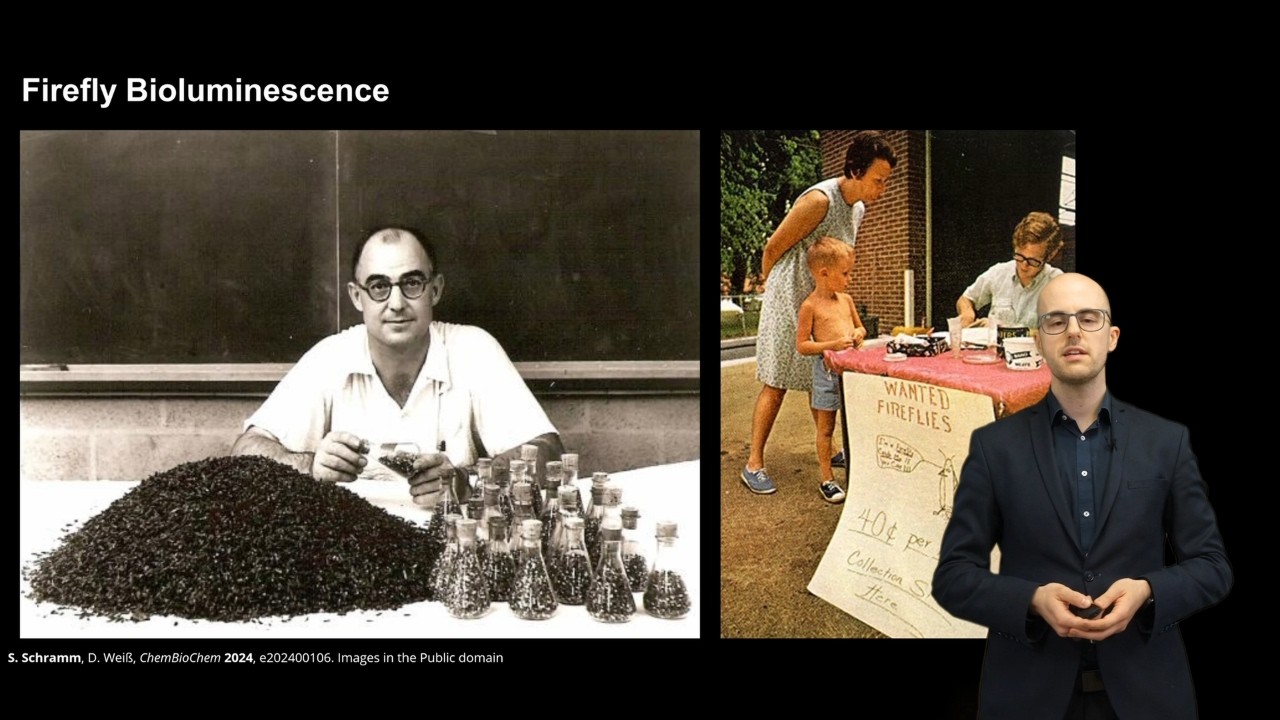
- Scientists studied the bioluminescent system of fireflies in the 1950s and 1960s, collecting around 15 to 20,000 specimens and extracting molecules from the abdominal part of these organisms to understand the bioluminescent reaction, which has a quantum yield of about 41% 10s.
- The bioluminescent reaction in fireflies is a closed-loop system, meaning that the reaction product can be reused to run the reaction repeatedly, and this knowledge can be used to engineer new materials for displays and beyond 42s.
Fireflies and the Study of Bioluminescent Reactions
- Fireflies are one of the most well-studied bioluminescent systems, with their ecological function being mainly for male attraction, and can be observed in meadows at night, typically in late May or early June, just after sunset 8m10s.
- Scientists studied the bioluminescent system of fireflies in the 1950s and 1960s, collecting around 15 to 20,000 specimens and extracting molecules from the abdominal part of these organisms to understand the bioluminescent reaction, which has a quantum yield of about 41% 10s.
- The bioluminescent reaction in fireflies is a closed-loop system, meaning that the reaction product can be reused to run the reaction repeatedly, and this knowledge can be used to engineer new materials for displays and beyond 42s.
Bioluminescence and OLED Technology
- To apply this knowledge, it is necessary to understand how an OLED works, which is comprised of many layers, with the emissive layer being where the magic happens, and charges recombine to excite molecules into their excited state 2m6s.
- Researchers have wondered how to translate the knowledge from bioluminescence to the design of new OLEDs, and one idea was to look at the structure of the firefly's abdominal surface, which has a scale-like pattern that can create an interference phenomenon to increase efficiency 2m6s.
- However, OLED technology has a sustainability problem, with increasing reports of OLED materials being found in wildlife and human breast milk, and bioaccumulating due to their high stability, which can be addressed by using knowledge from bioluminescent systems to engineer bio-inspired organic light emitting materials 4m30s.
Sustainability Challenges and Bio-Inspired Solutions
- However, OLED technology has a sustainability problem, with increasing reports of OLED materials being found in wildlife and human breast milk, and bioaccumulating due to their high stability, which can be addressed by using knowledge from bioluminescent systems to engineer bio-inspired organic light emitting materials 4m30s.
- By combining OLED materials with green chemistry, it is possible to create sustainable light emitting materials, and the structural diversity of bioluminescent organisms can be used for inspiration, with fireflies being one of the best-studied organisms 6m10s.
- The precise color modulating mechanism of fireflies has been understood, and materials inspired by the firefly luciferin have been engineered to emit over the entire optical spectrum, from blue to red and even white light emission 8m20s.
Firefly-Inspired Materials and Color Emission
- The precise color modulating mechanism of fireflies has been understood, and materials inspired by the firefly luciferin have been engineered to emit over the entire optical spectrum, from blue to red and even white light emission 8m20s.
- The future vision is to use these materials to build bio-inspired OLEDs, called bio-OLEDs, which should combine the positive properties of OLEDs with the sustainability aspects of bioluminescence, such as being metal-free, biodegradable, and showing low bioaccumulation 10m40s.
Research and Applications in Dresden
- Research is being conducted in a laboratory in Dresden, with funding from the European Union within the research network Biotronic, to study bio-inspired materials and their applications in the field of bioelectronics, including smart packaging materials and medical sensing applications 10s.
- One example of these applications is the development of smart packaging materials that can sense certain pH changes and indicate whether a product, such as meat, is fresh or spoiled, with a white label indicating good meat and a red label indicating spoiled meat 42s.
- These bio-inspired materials can also be used for medical sensing applications, such as developing biodegradable capsules that can sense bacteria contamination in the body and biodegrade after use, eliminating the need for large endoscopes or removal of the capsule 1m30s.
Future Vision and Environmental Impact
- The goal of this research is to contribute to a future with a more sustainable and vibrant ecosystem, using biodegradable and bio-inspired materials to reduce waste and promote a healthier environment, based on the principle that where there's life, there's also light 2m6s.