

Glass and our place in the universe 0s
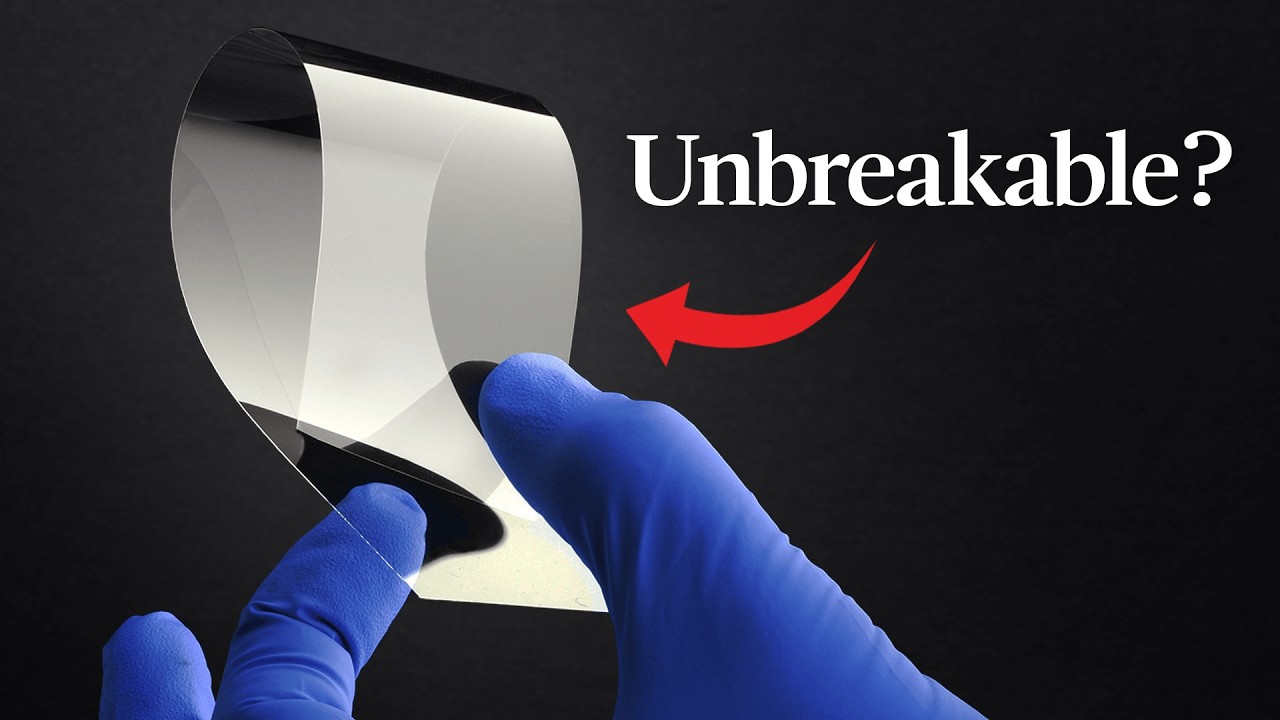
- Glass is inherently brittle and symbolizes fragility, yet it is expected to be transparent, scratch-resistant, thin, flexible, and unbreakable in modern times 0s.
- Despite its fragility, glass has been a crucial material in human history, transforming the way people live, driving scientific revolutions, and changing perspectives on the universe 23s.
- The development of unbreakable glass was a significant challenge, as seen in the case of Apple's first iPhone, which initially had a plastic screen that scratched easily 42s.
- Steve Jobs, dissatisfied with the plastic screen, approached Wendell Weeks, the CEO of Corning, to create a suitable glass for the iPhone, which led to the development of Gorilla Glass 1m11s.
- The creation of Gorilla Glass was a rapid process, taking only six months to complete, and it was successfully integrated into the first iPhone 1m17s.
How Gorilla Glass works 1m23s
- Gorilla Glass has been used in various devices such as phones, computers, and wearable devices for the last 17 years and is now used on billions of devices, becoming more durable over time 1m23s.
- A key scratch demo was conducted to compare the scratch resistance of polycarbonate and Gorilla Glass, showing that Gorilla Glass is more resistant to scratches 1m49s.
- To break glass, two things are required: a flaw and stress, as demonstrated by sandblasting a spot on the glass to introduce a flaw and applying stress to break it 2m21s.
- A comparison of the strength of strengthened soda lime glass and Gorilla Glass was made, with Gorilla Glass being significantly more resistant to breaking 2m42s.
- The process of making sharp edges from obsidian, a volcanic glass, has been used by humans for over 1.2 million years for cutting implements, arrowheads, and spear tips 4m11s.
- Obsidian is still used today in some surgical scalpels due to its ability to be sharpened to a very fine edge, with some tips being sharpened to just three nanometers across 4m22s.
- Despite being used for over a million years, glass remains a brittle material that can be prone to breaking, but advancements in technology have led to the development of more durable materials like Gorilla Glass 4m34s.
What is glass? 4m35s
- Humans began making glass relatively recently, around 5,600 years ago 4m38s.
- The most common type of glass is primarily composed of oxygen and silicon, which are the two most abundant elements in Earth's crust 4m43s.
- Oxygen and silicon can be found naturally in the form of quartz, a crystalline silicon dioxide 4m50s.
- Quartz has a crystalline structure, meaning its atoms are arranged in a regular repeating pattern 4m55s.
- Quartz is the primary component of sand 5m0s.
- Glass can be formed by heating sand to approximately 1700 degrees Celsius until it melts, and then rapidly cooling it 5m5s.
- The rapid cooling process during glass formation prevents the atoms from arranging themselves in a crystalline structure, resulting in glass 5m14s.
Is glass a liquid? 5m15s
- Glass is considered an amorphous solid because its atoms don't have enough time to return to their periodically arranged crystal structure, resulting in a disorganized arrangement 5m16s.
- The misconception that glass is a liquid likely arises from its amorphous structure, but glass is solid at room temperature because its atoms are fixed in place and cannot flow past each other like in a liquid 5m35s.
- The amorphous structure of glass makes it brittle, as there is no way for the structure to relieve stress, leading to the formation of cracks and eventual fracturing when stress is applied 5m56s.
- A demonstration using sandpaper to represent a rough surface, such as asphalt, shows how a small flaw on the surface of glass can lead to cracking and fracturing when stress is applied 6m17s.
- The demonstration involves using a fixture to bend and pre-stress the glass, introducing a flaw, and then dropping it to test its durability 6m30s.
- The demonstration compares the durability of alternative glass and Gorilla Glass, with the latter withstanding a more severe test, known as the "mega slap," without breaking 6m59s.
Different types of glass 7m29s
- The basic recipe for glass involves silicon dioxide, but adding other ingredients like sodium carbonate and calcium oxide can change its properties, and this process has been done for thousands of years 7m30s.
- Adding sodium carbonate and calcium oxide to silicon dioxide lowers the temperature at which it becomes liquid from 1700 degrees Celsius to around 1000 degrees Celsius, making it the reason why soda lime glass accounts for around 90% of all glass manufactured today 7m38s.
- Adding boron trioxide to the mixture forms a borosilicate glass, which has a low coefficient of thermal expansion, making it resistant to drastic temperature changes and suitable for laboratory glass like beakers 7m56s.
- Borosilicate glass does not grow or shrink much with temperature changes, unlike regular glass which can shatter when exposed to boiling water due to rapid expansion 8m2s.
- The recipe for Gorilla Glass is secret, but it is based on a combination of silicon, aluminum, magnesium, and sodium, and scientists constantly try different formulations to find more durable and scratch-resistant glasses 8m36s.
- The earliest human-made glass was likely an accident, formed when sand made its way into metalworking furnaces, creating small glass beads 9m16s.
- Glass making became its own art form, used to make decorations, ornaments, statues, tableware, and containers, and its impermeability to water made it ideal for bowls and bottles 9m30s.
- By adding elements like cobalt oxide and cuprite to the glass mixture, glass makers can change the color of the glass, with cobalt oxide producing a vivid blue and cuprite producing red 9m52s.
Invention of transparent glass 9m59s
- Historical glasses were initially opaque, and it took thousands of years after the invention of glass making to develop transparent glass, which is what we commonly think of as glass today 9m59s.
- The first step towards creating transparent glass was made around 100 AD when glass makers in Alexandria added manganese dioxide to the mixture, resulting in semi-opaque glass that allowed some light to pass through 10m17s.
- Semi-opaque glass led to the use of glass for windows, providing a physical barrier that kept warm air in and wind and critters out while allowing light to shine into homes 10m31s.
- The first truly transparent glass was made many centuries later, around the Italian city of Venice, where the art of glass making was thriving and generating significant revenue 10m48s.
- However, the need for very hot furnaces to make and manipulate glass posed a problem in Venice, a city built almost entirely of wood, leading to frequent accidental fires 11m3s.
- In 1291, the government of Venice relocated all glass makers to the island of Murano to mitigate the risk of fires, and the island became known as the Isle of Glass, famous for producing beautiful and intricate glassware 11m18s.
- Angelo Barovier, a glass maker on the island of Murano, invented clear glass by burning seaweed rich in potassium oxide and manganese to create ash, which he then added to his glass mixture, resulting in transparent glass 11m35s.
Why is some glass transparent? 11m56s
- Most materials are opaque because when photons hit them, the photons are absorbed, exciting an electron and pushing it up to a higher energy level, but this only happens when the photon's energy matches the energy of an allowed electron transition 11m56s.
- In transparent glass, the energy required to move an electron from a lower state to a higher state is higher than the amount of energy that a photon of visible light has, so the photon just passes right through 12m13s.
- Glass interacts with other parts of the electromagnetic spectrum, absorbing much of the ultraviolet spectrum because UV photons have more energy, making it opaque to UV 12m28s.
- Colored glass is made by adding impurities into the glass, which affects the electron energy levels and changes the color of the glass 12m48s.
- The most common glass used for windows, soda lime, has impurities of iron oxides, which give the glass a green tinge because it absorbs more of the other colors than it does green 13m2s.
- The importance of transparent glass can be appreciated by imagining a scenario where it suddenly disappears, affecting daily life, including windows, glasses, and screens 13m19s.
Invention of glass lenses 14m54s
- Truly transparent glass was a significant innovation for three reasons, and its development led to the creation of small, thicker-in-the-center glass discs that were ground, shaped, and polished into lenses in northern Italy in the early 1300s 14m58s.
- These early lenses were initially not widely used, except by monks, due to low literacy rates, but they were used to correct farsightedness 15m13s.
- The invention of the printing press around 1440 led to a decrease in book production costs, resulting in increased literacy rates, and subsequently, a growing awareness of farsightedness among the population 15m28s.
- As a result, glasses became a vital tool, and the existing lens technology was available to address the problem of farsightedness 15m48s.
- A father and son duo played a significant role in the development of lenses 150 years after the initial innovation 15m51s.
Development of magnification 15m52s
- Hans and Zacharias Janssen created the world's first microscope by placing two lenses in line with each other, allowing objects to appear about 20 times their original size 16m0s.
- Antony Van Leeuwenhoek made significant improvements to the microscope in the 1660s by grinding the lenses himself, enabling him to magnify objects 200 times and see human cells 16m16s.
- Robert Hook published "Micrographia," a book featuring sketches of the microscopic world, which was made possible by the use of transparent glass 16m24s.
- Hans Lippershey, an eyeglass maker, applied for a patent for a spy glass in 1608, which was intended for use in warfare to spy on enemies 16m37s.
- Galileo Galilei adapted the spy glass idea to create a telescope, pointing it towards the sky to study the stars and planets, and was able to magnify objects in the night sky by about 30 times 16m55s.
- Galileo's telescope allowed him to observe the craters of the moon, the phases of Venus, and four of Jupiter's largest moons in 1610, providing evidence against the geocentric model of the universe 17m7s.
- The invention of transparent glass was crucial for these discoveries, and four centuries later, it is now possible to create glass that is orders of magnitude more transparent than water 17m30s.
- Modern glass, such as that used in optical fibers, is so transparent that a column as deep as the Mariana trench would allow visibility all the way to the bottom 17m47s.
How to make glass more durable 18m2s
- To make glass more durable, a process involving an aluminosilicate base and submerging the glass in a potassium salt solution at 420 degrees Celsius is used 18m14s.
- This process replaces some of the sodium atoms in the glass with potassium atoms, which are physically larger, increasing the compressive strength in the surface of the glass and making it more durable 18m41s.
- The increased compressive strength is due to the larger potassium atoms being squeezed together in the same amount of space as before, making the glass more resistant to scratches and drops 18m57s.
- A visual difference in size between the treated and untreated glass cannot be seen, but the durability difference can be observed through testing, such as dropping heavy objects onto the glass 19m5s.
- Scientists at Corning are constantly refining the process to make the glass even more durable, conducting various tests such as bending, scratching, and dropping heavy steel balls onto the glass 20m28s.
- The team at Corning also tests different glass prototypes, including replica phones with various glasses for the screen, dropping them from increasing heights to test durability 20m57s.
- The goal of these tests is to make the next version of Gorilla Glass even more durable than it already is, with the understanding that while the glass is still not perfect and can crack, it is constantly improving 21m10s.


