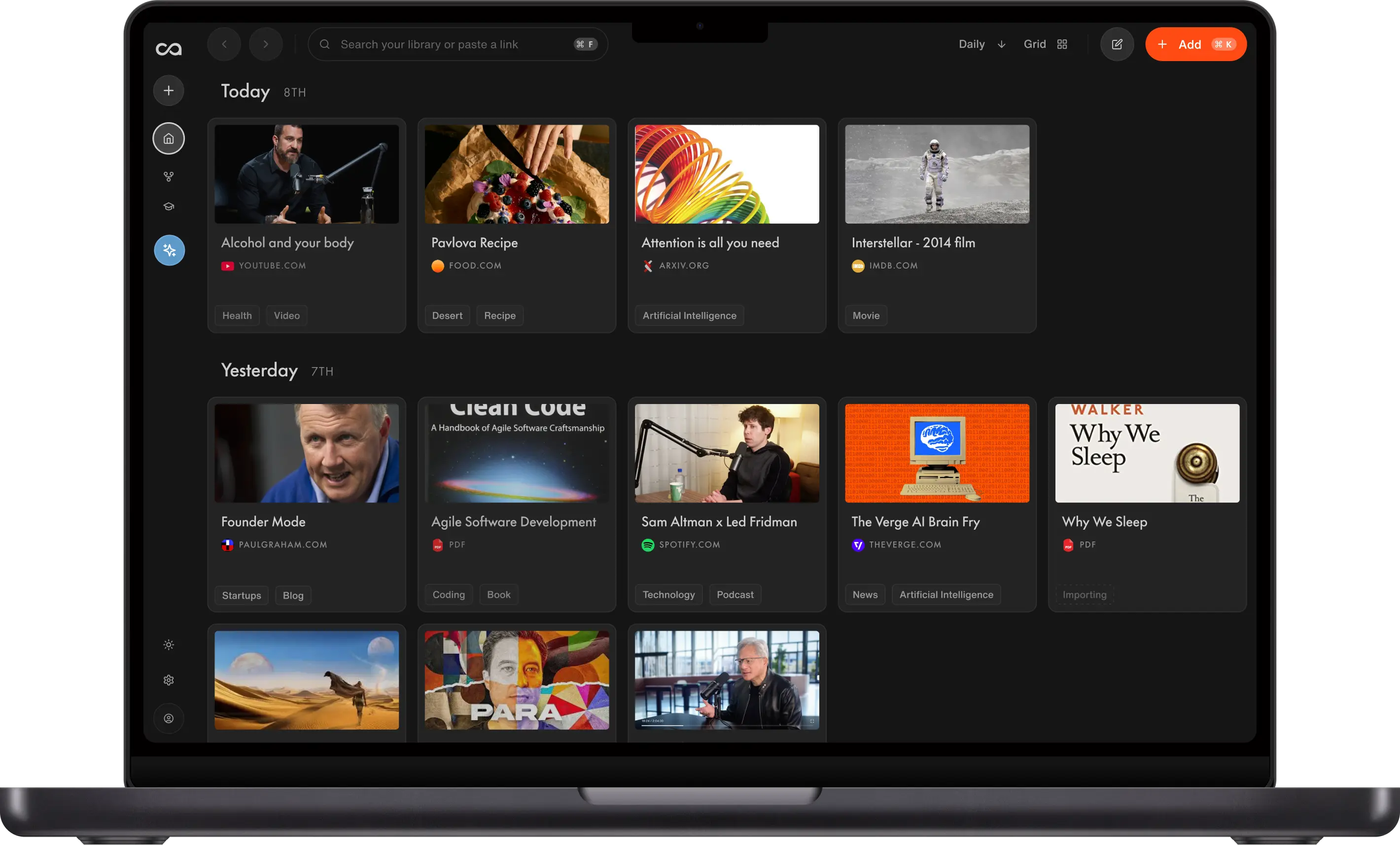
To actively learn means engaging with material through retrieval, practice, and spaced review, not passive reading or scrolling. Combine active recall, spaced repetition, and AI tools like Recall, Boterview, Quizlet, Anki, Chunks, and The Sponge to retain knowledge long term. This guide covers how to actively learn, evidence-based protocols, and the best educational AI tools.
Quick Answer: How Do You Actively Learn?
To actively learn means testing yourself on what you studied, practicing retrieval, and reviewing material at spaced intervals, not passively rereading notes or scrolling summaries. The strongest approach combines active recall, spaced repetition, and educational AI tools that schedule quizzes and feedback. Recall is our top pick for a lifelong knowledge base with built-in review; Boterview for interactive courses; Quizlet for flashcards; Anki for open-source SRS; Chunks for microlearning chapters with built-in spaced repetition; and The Sponge for turning web pages into flashcards, bookmarks, and cheat sheets you can actually remember. For students specifically, see AI tools for students. For memory techniques in depth, see our active recall and spaced repetition guide.
Key takeaways
- Actively learn by retrieving information from memory: quizzes, flashcards, and self-testing beat passive rereading.
- Spaced repetition schedules review just before you forget, shifting knowledge into long-term memory.
- Educational AI tools (Recall, Boterview, Quizlet, Anki, Chunks, The Sponge) automate quizzes, courses, microlearning chapters, flashcards from web pages, and review schedules.
- Intrinsic motivation and a growth mindset make actively learning sustainable beyond exams and work pressure.
- Swap 20 minutes of social scrolling for a short quiz session to build an actively learn habit.
Table of Contents
- Quick Answer: How Do You Actively Learn?
- Why We Lose the Joy of Actively Learning
- How to Actively Learn: Active Recall & Spaced Repetition
- How to Actively Learn with Curiosity and Consistency
- Evidence-Based Protocols to Actively Learn
- Best AI Tools to Help You Actively Learn
- FAQs about Actively Learn, Active Recall, and Educational AI Tools
When I think about actively learning and the joy it brings, I picture it as a sinusoidal wave. In the early years, joy peaks around middle and high school. These are formative years where the world unfolds in a series of discoveries: the magic of mathematical equations, the ability to express ourselves through language, and the unveiling of life's mysteries through biology.
Then something shifts. As we move through high school and into university, learning becomes more of a means to an end. We view it as an obligation, an interruption in the chaotic excitement of our teenage years. The joy of actively learning is often replaced by the pressure to achieve, pass exams, and meet external expectations.
If we're lucky enough to find a career that resonates with us, that joy can resurface. We find ourselves in a rhythm of working, actively learning, and growing, all while being paid for it. However, for many, this learning journey plateaus once we've mastered the essentials of our job. Without new challenges or external stimuli, we fall into routines, and true learning gets replaced by consuming surface-level content. Podcasts, TikTok feeds, and quick bites of information become the norm, used more for small talk at social events than for active learning.
As a result, most of us lose touch with the intrinsic joy of learning, it is something foreign that we only caught a rare glimpse of in our early years. The wonder of exploring new ideas and uncovering patterns has been replaced by the relentless pressure to perform at work, meet deadlines, and cram for tests. But here's something I truly believe: learning can be one of the most fulfilling experiences in life.
The good news? You can reignite that joy, today. This blog will guide you through effective active learning protocols that not only restore the magic of discovery but also introduce the best educational AI tools to enhance your learning journey. Whether it's educational AI-powered learning tools, or memory techniques such as active recall and spaced repetition, these strategies will transform learning back into a process of growth and exploration.
Why We Lose the Joy of Actively Learning
The downward curve of the sinusoidal wave starts in high school and continues into university. This is where most traditional educational systems, with their focus on standardized testing, begin to shift learning away from curiosity and understanding toward memorization and parrot learning. These methods, while necessary to scale education, rarely capture the spirit of discovery or the intellectual excitement that true active learning can bring. This overemphasis on memorization, rather than active recall or deeper comprehension, seeds the association between learning and stress, turning it into a competitive arena rather than an exploratory journey.
For high-achieving students, and those whose parents want to keep it that way, learning becomes synonymous with winning, a relentless pressure to perform. On the flip side, those who don't rank at the top often perceive learning as a chore, a means to an end, or worse, as something they're simply not good at. This disengagement leads to frustration and a belief that learning is just not for them. Instead of actively learning and sparking curiosity, the system funnels many students into a cycle of disengagement and disinterest.
As we transition into the working world, this gap in our perceived joy of actively learning only widens. According to the Gallup 2023 Global Workplace Report, a staggering 59% of global workers and 52% of U.S. workers are "quiet quitting," doing the bare minimum at their jobs. With the average job requiring 8 hours a day, 5 days a week, and 25 leave days a year, that amounts to 1,880 hours annually, 32% of our waking hours, spent disengaged and dissatisfied.
While I don't claim to have the solution to what seems like a growing epidemic of dissatisfaction at work, one thing is clear: the joy of learning, when rekindled, can spark a meaningful change. Even carving out just a small portion of your day to engage with actively learning, whether through educational AI-powered learning tools, spaced repetition, or memory retention techniques, can reignite a passion for growth. Instead of seeing learning as something you've outgrown, it can become a vital part of your daily routine, bringing back that sense of discovery and intellectual excitement.
Before I jump to the recommendations on how to enhance learning and all the cool new educational AI tools out there to boost your learning, there are some buzzwords that are worth actually getting familiar with: Active Recall & Spaced Repetition. Here is a more detailed blog on actively learning through Active Recall and Spaced Repetition, but below is just the TLDR of it.
How to Actively Learn: Active Recall & Spaced Repetition
For the full guide to active recall and spaced repetition, including how Recall turns saved content into quizzes and review schedules, read our dedicated memory guide. Below is the TLDR.
What is Active Recall?
Active Recall is a highly effective learning technique that involves actively retrieving information from memory rather than passively reviewing material. Instead of simply re-reading notes, watching videos, or highlighting text, active recall requires you to test yourself on what you've learned.
Here's how it works:
- Retrieval Practice: The main principle is to force your brain to actively bring information back from memory. This strengthens the neural pathways associated with that knowledge, making it easier to recall in the future.
- Strengthens Memory: Research shows that the act of recalling information from memory helps reinforce active learning, making the material stick better in your brain. The more often you successfully retrieve the information, the stronger your retention becomes.
- Practical Examples:
- Flashcards: Using flashcards is a classic example of active recall. You look at a question or prompt, then attempt to recall the answer without looking at your notes.
- Self-Quizzing: Regularly testing yourself on newly learned material, either through quizzes or writing down what you remember from a lesson, is another example.
- Summarizing from Memory: After reading a chapter or article, try summarizing it without looking at the text. This forces you to actively engage with the material.
- Why It's Effective: Unlike passive study methods, such as re-reading or highlighting, active recall promotes deeper active learning. It encourages your brain to engage with the material and recognize what you truly know versus what you're familiar with.
Active recall is even more effective when combined with spaced repetition!
What is Spaced repetition?
Spaced Repetition is an active learning technique that involves reviewing information at increasing intervals over time to improve long-term retention. The idea is based on the "forgetting curve," which suggests that people gradually forget information unless it's reviewed. Spaced repetition helps you revisit material just as you're about to forget it, strengthening your memory and keeping the information fresh in your mind.
Here's how it works:
- Review at Optimal Intervals: Instead of cramming or reviewing all the information at once, you space out your study sessions over days, weeks, or even months. The intervals between reviews get progressively longer as the material becomes more familiar to you.
- Forgetting Curve: The technique counters the natural tendency to forget by reinforcing knowledge just before it fades. This helps shift information from short-term to long-term memory.
- How It's Done:
- Flashcards: Using spaced repetition software (like Anki, Quizlet, or The Sponge), digital flashcards are shown at different intervals based on how well you remember the content. If you recall the answer easily, the interval before you review it again increases. If you struggle, the system shows the card more frequently.
- Educational AI Tools for Active Learning: Some AI-powered learning platforms, like Recall, use algorithms to track when you should review certain topics, optimizing your learning schedule for maximum retention.
- Why It's Effective: Studies show that spaced repetition significantly improves learning and retention. Instead of overwhelming your brain with all the information at once, spacing out the review process helps strengthen neural connections. This makes it easier to retrieve the information when you need it.
- Combining with Active Recall: Spaced repetition is often paired with active recall to maximize effectiveness. By actively testing yourself at spaced intervals, you're not only reinforcing the material but also strengthening your ability to recall it over time.
This method is particularly useful for actively learning complex subjects, language vocabulary, or preparing for exams where long-term retention is crucial.
How to Actively Learn with Curiosity and Consistency
Here's a systematic approach to rewire your mindset and enhance your learning experience using curiosity, effort, and modern tools.
Step 1: Focus on Intrinsic Motivation
The joy of active learning is often rooted in curiosity. When you're curious, learning becomes its own reward. However, for many, this curiosity has been shaped by external pressures from school, university, or work. To kickstart your curiosity, dedicate time to exploring topics that genuinely excite you. Unsure where to begin? Spend 30 minutes a day exploring new subjects, whether it's art, technology, history, or even cooking, and reflect on how you respond. Curiosity is a powerful emotion, and as you explore, you'll find which topics give you energy.
By focusing on intrinsic motivation, you'll transform learning into something that enhances your life rather than a task you must complete. When you follow your curiosity, active learning tools and techniques become far more enjoyable and effective.
Step 2: Adopt a Growth Mindset
A growth mindset is the belief that we can improve through effort and practice. To fully enjoy active learning, it's essential to shift your focus away from performance and toward effort. Instead of tying your identity to the outcome, begin to associate praise and a sense of accomplishment with the hard work you put in. This may feel unnatural, especially if you've come from a background where rewards were performance-based, but it's crucial for rediscovering the joy of active learning.
For instance, many expert GCSE math tutors in the UK and the US emphasize the importance of consistent effort over immediate results. They encourage students to view mistakes in mathematical equations or problem-solving processes as valuable opportunities to learn and grow. By shifting the focus from simply getting the right answer to understanding the reasoning behind each step, students become more confident and engaged in their learning journey.
A growth mindset allows you to enjoy the learning process, which is essential for long-term success. This shift helps you embrace actively learning as a journey of self-improvement, rather than a pursuit of external validation.
Check out the full episode with Andrew Huberman and Dr. David Yeager: How to Master Growth Mindset to Improve Performance.
Step 3: Review and Reflect with Active Recall & Spaced Repetition
Once you've found a topic that excites you and adopted a growth mindset, the next step is to focus on retaining and reviewing what you've learned. The goal here is to counter the brain's natural tendency to forget, using techniques like active recall and spaced repetition. Periodically testing yourself on the material you've studied is one of the most effective ways to boost retention and deepen understanding.
This is where educational AI tools for active learning, like Recall, can play a vital role. By building a personal knowledge base and organizing your learning materials, Recall helps you review content at optimal intervals, ensuring that you retain key information over time. The combination of active recall and educational AI-powered learning tools is a powerful way to enhance both your memory and your learning experience.
By incorporating intrinsic motivation, a growth mindset, and educational AI tools to enhance active learning, you can rediscover the joy of deep, meaningful learning and make it a fulfilling part of your daily routine.
Evidence-Based Protocols to Actively Learn
Bringing joy back into learning is only half the equation. To actively learn and ensure knowledge retention, it's essential to employ evidence-based techniques that are designed to combat the brain's natural tendency to forget. Inspired by Andrew Huberman's episode on Optimal Protocols for Studying & Learning, this section outlines the key takeaways to make your learning more effective and fulfilling. I encourage you to watch the full episode.
Offset Forgetting
One of the primary focuses in actively learning should be on offsetting forgetting. Contrary to popular belief, the most effective study methods are not determined by whether you're a visual or auditory learner. The real key to successful learning lies in techniques that actively counteract the natural process of forgetting.
Key Protocols for Actively Learning:
-
Get in the right headspace to actively learn
Effective learning requires focus and alertness. When you're fully present, it signals to your nervous system that the information you're consuming is important. This is where the role of sleep comes into play. Quality sleep is essential for actively learning, as it supports the brain's ability to focus and retain information. Even a simple 5-10 minute mindfulness meditation daily can improve focus, memory, and recall ability.
-
Periodic testing
Active recall is one of the most powerful ways to enhance retention. Testing yourself immediately after learning new material helps solidify that knowledge. Research shows that self-testing can improve retention by up to 50% compared to passive study methods. Pair this with periodic testing, such as using educational AI tools for actively learning like Recall, which offers quizzes and reviews to ensure you're retaining key concepts over time. Recall is available through the Chrome extension, Firefox add-on, and mobile apps for iPhone and Android.
-
Build a routine to trigger actively learning
Building a consistent study routine is crucial. A study of over 700 medical students found that the most successful students share common habits: they schedule 2-3 focused study sessions per day, spread over 3-4 hours, at least five days a week. Distraction-free, solo study sessions, combined with teaching material to others, enhance understanding. Incorporating educational AI tools into your routine, consider switching 20 minutes of social scrolling to 20 minutes with a quiz on Recall, Quizlet, or The Sponge. Recall Plus is the best option for lifelong knowledge management at $10/month billed yearly or $12/month billed monthly, and students can get a 20% discount by emailing support from their student email address.
-
Hacks to actively learn
- Deliberate cold exposure, like cold showers, can enhance memory consolidation by triggering the release of adrenaline.
- Caffeine may boost epinephrine levels, but maintaining overall alertness and attention is more crucial for effective learning.
- Hydration is also important for maintaining cognitive function.
By implementing these evidence-based protocols, including active recall, spaced repetition, and interleaved practice, and integrating educational AI tools for learning, you can transform your learning experience. Not only will you retain more information, but you'll also bring back the joy that makes actively learning a rewarding, lifelong pursuit.
Best AI Tools to Help You Actively Learn
So let's get into those tools that can enhance your learning, boost your memory and seamlessly fit into your workflow by just swapping your social scroll time with some active learning time. Below are our top 6 picks!
#1 Educational AI Tool: Recall
Recall is a powerful AI tool that uses spaced repetition and active recall to quiz you on a schedule tailored to your learning curve.
How it works:
- A hybrid of content: Recall combines both user created notes and summaries of any online content into one knowledge base. Recall summarizes any online content, such as YouTube videos, PDFs, Wikipedia articles, news, and blogs in just seconds. You can then edit and fully customize the content to your liking.
- A Self-Organizing Knowledge Graph: The summaries are automatically saved in a knowledge graph. Each summary includes key mentions extracted from the video, PDF, or web page. Recall uses these key mentions to automatically find connections with the saved content, interlinking your notes. You can easily find connections with past content, helping you resurface related information faster and more efficiently. That said, you can also do it manually so you can create your own links between notes.
- Automatic Categorization: Each summary also receives a tag, automatically categorizing the content based on the topic.
- Personalized Active Learning Schedule: This is the best part! Recall enhances this through the Recall Review feature, which uses spaced repetition to create a personalized learning schedule tailored to your learning curve. Whether it's on mobile or the web app you can test yourself anytime, anywhere and replace futile scroll time with active learning on the go.
#2 Educational AI Tool: Boterview
Boterview generates interactive courses from your prompts, with a learning-by-doing approach that helps you internalize material faster than passive reading or summarizing alone.
How it works:
- AI-generated courses from prompts: Describe what you want to learn (for example, "Vectors course for beginners") and Boterview builds units, lessons, and interactive challenges.
- Learning by doing: Structured learning paths with quizzes, flashcards, and challenge types including true/false and multiple choice.
- Immediate AI feedback: Every answer gets an explanation of what you got right and where you went wrong.
- Progressive unlock: Short, focused lessons unlock as you advance so you stay motivated.
- Quests and streaks: Track progress and celebrate completed challenges.
Boterview fits learners who want practice, repetition, and feedback loops instead of treating learning as passive consumption.
#3 Educational AI Tool: Quizlet
Quizlet is a popular study tool that allows users to create and use digital flashcards. It is highly versatile, supporting various subjects and learning styles, including visual, auditory, and kinesthetic learning.
How it works:
- Flashcards: You can create custom flashcards or use millions of pre-made ones available in the Quizlet library. Great for memorizing facts, definitions, and concepts.
- Spaced Repetition: Quizlet uses an AI-powered algorithm to help you actively learn more effectively by spacing out study sessions over time, which helps with long-term retention.
- Study Modes:
- Learn Mode: An AI-guided process that tests you on what you don't know and reinforces what you've learned.
- Match Game: Helps reinforce active learning through quick and engaging games.
- Write Mode: Encourages active recall by requiring you to type out answers.
- Practice Tests: Quizlet can generate practice quizzes from your flashcards, using multiple-choice, true/false, and written answer formats.
- Interactive Diagrams: Particularly useful for visual learners, Quizlet allows you to create or study interactive diagrams for subjects like anatomy, geography, and biology.
- Audio Learning: For auditory learners, Quizlet has text-to-speech functionality to help with pronunciation and listening.
#4 Educational AI Tool: Anki
Anki is a powerful open-source flashcard app, best known for its customizable Spaced Repetition System. It's widely used by students for actively learning languages, medical terms, exam preparation, and long-term memorization.
How it works:
- Customizable Flashcards: Anki allows you to add text, images, audio, and even video to flashcards. You can create advanced card types like cloze deletions (fill-in-the-blank) and image occlusion (hiding parts of an image).
- Add-ons & Plugins: Anki has a large library of community-created add-ons that can enhance its functionality. Some examples include statistical analysis of your progress, automatic import of information, and more.
- Spaced Repetition: Anki's SRS is designed to show you cards right before you forget them. It uses algorithms based on your memory performance to decide when to present each flashcard.
- Cross-Platform Sync: Anki syncs across devices, including desktop (Windows, macOS, Linux), mobile (iOS, Android), and web browsers, so you can access your decks anywhere.
- Shared Decks: Users can upload and download shared decks from the AnkiWeb library. This is particularly useful for subjects like medical school exams, language learning, and other academic topics.
- Cloze Deletion: This feature allows you to remove portions of a card for more active recall, especially useful in memorizing passages or long definitions.
#5 Educational AI Tool: Chunks Microlearning
Chunks is a microlearning app that turns big subjects into short, readable chapters you can finish in a few minutes a day. Instead of building your own flashcards, you read editorial narratives across history, philosophy, literature, science, and art, with spaced repetition woven quietly underneath so ideas resurface at the right moment for retention.
How it works:
- Bite-sized chapters: Every topic is broken into short, self-contained stories designed to be read in five to ten minutes.
- AI-generated, human-verified: Chapters are AI-generated and reviewed by a human against Chunks' editorial guidelines before publishing, giving the content narrative quality with an accuracy check.
- Built-in spaced repetition: Recaps and recall prompts return at spaced intervals, so you retain what you read without maintaining decks.
- Broad humanities and science catalogue: Learn across history, philosophy, literature, science, and art in one place.
- Free tier: A rotating set of full stories is free; premium unlocks the complete catalogue.
- Learn anywhere: Designed for phones, so you can learn on a commute or coffee break.
Chunks fits adults who want to learn humanities and science through short, well-written chapters instead of building flashcards.
#6 Educational AI Tool: The Sponge
The Sponge is best for lifelong learners who want to turn web browsing into knowledge they can actually remember.
Most of us already spend hours reading articles, docs, and Wikipedia tabs. The Sponge approaches that habit from the learning side. Its browser extension uses AI to turn web pages into study materials, while flashcards, bookmarks, and cheat sheets let you choose whether to memorize, save, or quickly reference what you find. Spaced repetition then brings important information back at the right time, so it does not disappear into a passive archive.
How it works:
- AI-generated flashcards from web pages: One click turns the page you are reading into concise, editable cards, assigned to relevant decks.
- Flashcards, bookmarks, and cheat sheets: Choose the format that fits the knowledge: memorize it, save it for later, or keep a compact reference.
- One-click capture through a web extension: Capture while you browse instead of copying notes into a separate study app later.
- Spaced repetition reminders and quizzes: Review cards at intervals based on how well you know them, so retrieval becomes the default, not rereading.
- Progress and usage analytics: See what you are actually reviewing, so active learning stays visible instead of fading into another unread library.
Pricing: 30-day trial with unlimited AI-generated cards; Pro is $3.99/month.
The Sponge is more focused on fast capture, active recall, and long-term retention than on building flexible documents, databases, wikis, or project workspaces. Choose The Sponge when your priority is learning and remembering what you read; choose a general-purpose workspace when you need to organize and collaborate on information. Next to the other tools here, it sits closest to Quizlet and Anki on the flashcard side, with the difference that cards start from the page you are already reading.
I hope you enjoyed the read and found this guide useful to kick start your journey of effortlessly and passionately learning how to actively learn, with the right mindset, evidence-based protocols, and AI tools that make retrieval practice part of your daily routine.
FAQs about Actively Learn, Active Recall, and Educational AI Tools
Actively Learn Basics
Techniques to Actively Learn
Educational AI Tools to Actively Learn
Ready to get started?
Save, summarize and chat with your content.
No credit card required · 30 Day Refund on Premium · 24 Hour Support