
The Christmas Truce and the Paradox of Empathy in War
- The Western Front in December 1914, during World War I, was a scene of fear and desolation, with French, British, and German soldiers packed into tight trenches, separated by a strip of land known as no man's land, where everything around them was designed to restrict their imagination 10s.
- On Christmas Eve, German soldiers began to sing "Silent Night," and French and British soldiers from across no man's land reciprocated and joined into the song, prompting an exchange of food, photographs, and even burying their dead together, as well as playing football together, which showed that the soldiers were able to see past the rigid categories that war imposed upon them 2m6s.
- The entire machinery of war depended upon the soldiers not making this recognition, and military officials were quick to adapt and prevent any further instances of fraternization, but this piece of history still shows a central paradox of empathy, which is that empathy can be powerful enough to interrupt hatred during the full-blown force of a war 4m30s.
The Power and Limitations of Empathy in History
- Empathy can be restricted to a moment, but if it is not limited to the moment, it has the potential to reshape history and change its course, and human progress is not just a story about larger states or more powerful weapons or more advanced technologies, but also about the story of an expanding moral imagination 6m20s.
Empathy as a Survival Strategy in Early Human Evolution
- Before empathy became a moral ideal, it was a survival strategy, as early humans were not the fastest or the strongest of creatures, and an individual human on their own was wholly unimpressive, making them reliant on other people recognizing their needs and choosing to respond to them 8m40s.
- The development of empathy may seem to contradict the popular conception of natural selection, the survival of the fittest, as explained by evolutionary biologist Richard Dawkins, but empathy was an essential tool of survival, and it developed because human cooperation had to go far beyond kin selection, depending on social intelligence 10m50s.
Game Theory and the Evolution of Cooperation
- In game theory, the prisoner's dilemma produces a mutually destructive and detrimental result for both parties involved, because the two parties are not allowed to communicate or understand each other, and they are restricted to only one single instance of interaction, highlighting the importance of empathy and cooperation in human survival 12m30s.
- Human beings were able to break free from constraints by developing social understanding and building trust over time, which led to the development of social intelligence, as explained by anthropologist Sarah Hardy, who notes that evolution has shaped humans to practice a cooperative algorithm where children are cared for by a network of caregivers, not just individual mothers 10s.
Language, Empathy, and the Birth of Culture
- Empathy helped humans survive together and also enabled them to think together, with language being a key factor in this process, allowing individuals to share attention, goals, and mindsets with others, as psychologist Michael Thomas explains, through the concept of shared intentionality 42s.
- Language and empathy combined to allow for the development of culture in the form of stories, which enable people to understand ancestors they will never meet, learn from mistakes they have never made, and live lives that are not their own, with language providing structure and temporal continuity to empathy 2m6s.
Empathy in the Context of Agricultural Societies and Moral Rules
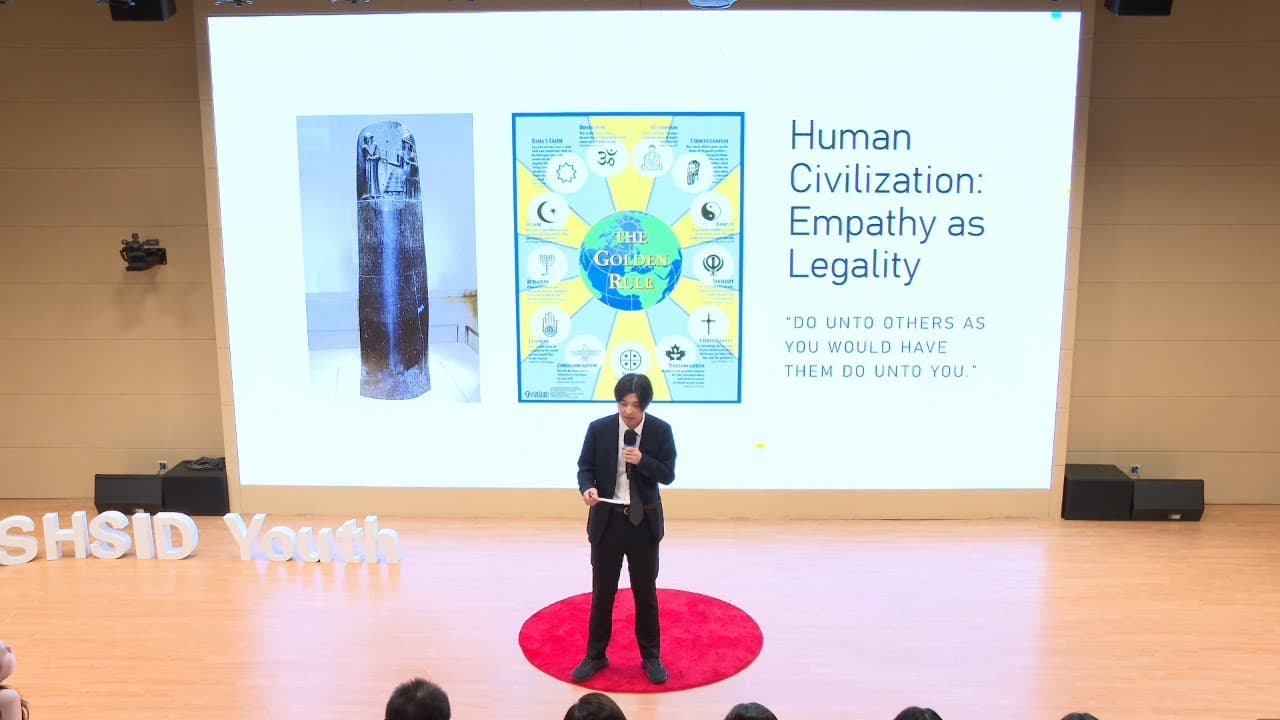
- The advent of agriculture and settlement led to the expansion of human society, the development of new social complexities, and the emergence of a new moral problem, which is how to live with strangers, and it was in this context that empathy was formalized, with the golden rule being a key concept that transforms empathy into a form of mental discipline 2m6s.
- The golden rule, which states that one should do to others as they would want others to do to them, is a simple yet important idea that has been found in various philosophical traditions, including Buddhism, where compassion is a central aspect of liberation, and was also codified into laws and regulations, such as Hammurabi's code 2m6s.
Interdependence in Modern Society and the Role of Empathy
- As civilization continued to expand and global commerce connected people on an unprecedented level, individuals became more independent and mobile, but also more collectively dependent, with modern technologies, such as phones, relying on a complex network of human interdependence, involving miners, laborers, engineers, programmers, and logistics personnel 2m6s.
- Adam Smith's work, "The Wealth of Nations", explains that material efficiency stems from a division of labor with each person pursuing their own self-interest, but he also emphasized the importance of empathy in his other work, "The Theory of Moral Sentiments", which maintained that social harmony must be maintained through compassion and sympathy 10s.
Empathy, Alienation, and the Call for Social Change
- The recognition of moral worth is crucial, and if not achieved, it can lead to alienation, as seen in the Marxist critique of capitalism, where workers are transformed into utilitarian purposes and not seen as human beings, but this shared recognition can also lead to class consciousness and prompt change to return society to an equilibrium 42s.
Empathy and the Formation of National Identity
- The concept of a nation is a significant effect of empathy, as historian Benedict Anderson describes it as an imagined community of millions of people who have enough emotional depth to mourn, fight, and celebrate together, as seen in the French Revolution, which transformed the rule of France and the underlying self-conception of the French population 2m6s.
- Nationalism, although powerful, also presents one of the greatest dangers of empathy, where we draw the line and exclude others, and the circle of morality must expand until there is no one else being left out, especially in modern society where human power has reached a global level and issues like nuclear weapons, climate change, and supply chain shocks can affect millions of people 2m6s.
Expanding the Circle of Morality and the Role of Human Rights
- The Universal Declaration of Human Rights after World War II formalized the idea that all humans are deserving of recognition, worth, and dignity, and as Peter Singer puts it, history can be understood as a pattern of expanding moral circles from the self to the entire world, which is the direction in which we must go to expand the circle of morality and consideration 4m30s.
- To undertake the task of expanding the circle of morality, individual human beings can learn more, take on new perspectives, and understand the world, and collectively come together to institute a paradigm shift, and empathy alone does not solve history, but it gives it direction and a line of morality 6m40s.
The Future of Empathy and the Possibility of a Better World
- The potential for peace and harmony is great, as seen in the Christmas troops during World War I, and the question is not whether we can empathize, but whether we can be willing and able to make the idea of empathy last and create a better world 8m50s.