
Introduction to Qafzeh and Skhul Caves
- The mountain of Mount Precipice, located outside the city of Nazareth, has a cliff face and is also known as Jabal Qafzeh, or Mount of the Leap, with a cave at its base called Qafzeh Cave, where French archaeologist René Neuville discovered burials of over 20 individuals around 100,000 years ago 10s.
- The Qafzeh Cave burials are significant as they are some of the earliest members of the Homo sapiens species to have left Africa, with some burials, such as Qafzeh 9 and Qafzeh 10, being particularly striking, featuring a young adult and a child buried head to foot 10s.
- Another cave, Skhul Cave, is located 30 km to the west in the slopes of Mount Carmel, where additional burials of a similar age were uncovered in the 1930s, although the Skhul burials were taken away from the site 2m6s.
Neanderthal Burials and Cultural Practices
- The Kebara Cave, located further to the south, contains the burial of a Neanderthal, with most of the skeleton preserved, except for the skull, which has been removed 2m6s.
- The Amud Cave, located to the north of the Sea of Galilee, contains additional burials of Neanderthals, including an adult and a child, highlighting the shared cultural practices of Neanderthals and modern humans, who have a common ancestry dating back over 700,000 years 2m6s.
Mortuary Practices Across Cultures and Species
- Every culture in the world today has mortuary practices, which are not limited to burying the dead in the ground, with examples including sky burial in Tibet, where the body is left for scavengers and vultures to consume, and is considered the highest form of respect for the dead 4m30s.
- Other animals, such as chimpanzees, orcas, and elephants, also exhibit mortuary practices, including reacting to dead bodies with curiosity, alarm, or emotional reactions, and sometimes attending to or carrying the bodies of their dead 5m30s.
Anthropological Connections Between Past and Present
- As an anthropologist studying skeletons, the focus is not only on the dead, but also on the connections between the past and the present, and the ways in which ancient people lived, related to their environments, and are related to us 6m40s.
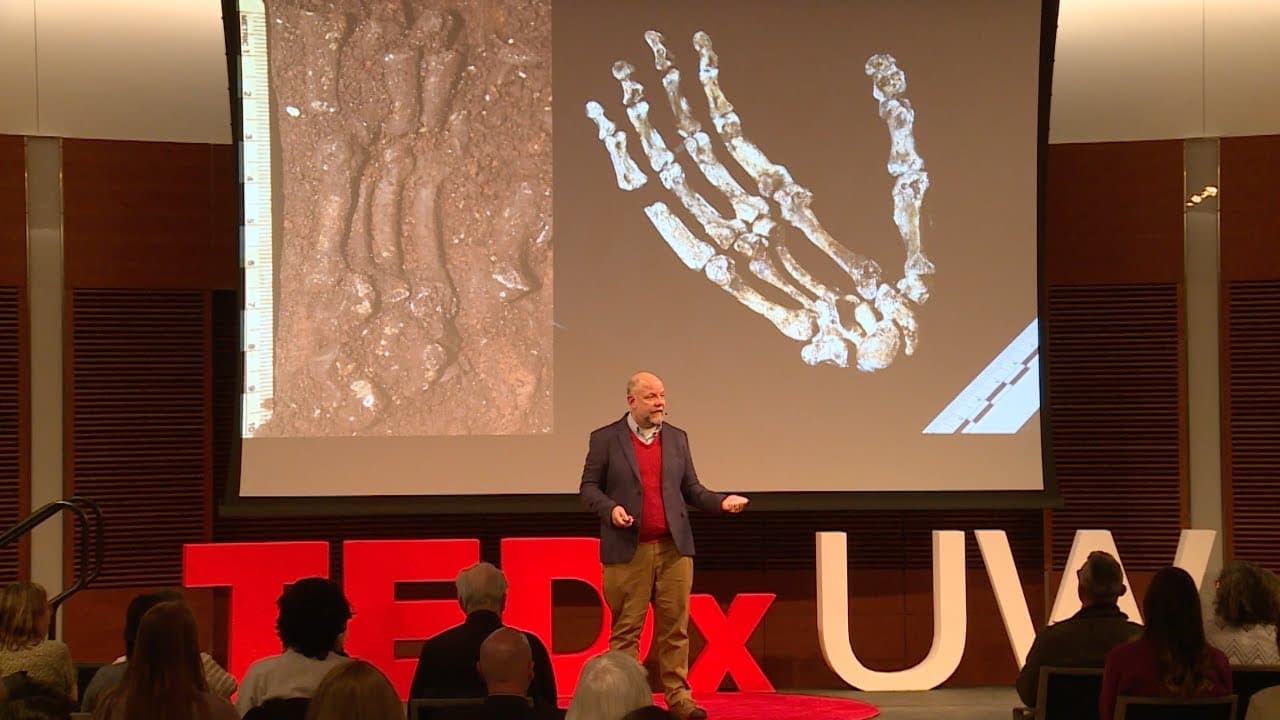
- The discovery of the species Homo naledi in 2013, in the Rising Star cave system outside Johannesburg, South Africa, is a significant example of the connections between the past and the present, and highlights the importance of studying ancient burials and mortuary practices 8m30s.
Discovery of Homo naledi in South Africa
- The discovery of ancient human relative bones was made by Steven, who squeezed himself down into a narrow passage in the Rising Star cave system and found bones at the bottom, which were later identified as belonging to a human relative, with the initial discovery sparking an expedition to recover the bones 10s.
- The area in South Africa where the discovery was made is known for its incredible fossil deposits, including skeletons that are 2 million years old, and the team was initially expecting to find a partial skeleton of a human relative, similar to the famous Lucy skeleton 1m42s.
Excavation Challenges and Site Characteristics
- The cave system has over 3 km of mapped passageways, and the bones were found in a passage that was 7 and 1/2 inches wide and 120 m into the cave system, requiring a special skill set to excavate, with Lee Berger recruiting a team of female archaeologists with caving and climbing abilities to excavate the site 2m6s.
- Over the course of a month, the team excavated over 1,200 fossil remains of an ancient human relative, which was the largest discovery of fossil hominins ever made in Africa, and the species was later named Homo naledi, meaning "star" in the local language 2m6s.
Unusual Findings and Interpretations at the Site
- The discovery was significant, but also strange, as the team found over 1,200 fossil fragments of Homo naledi, representing more than 25 individuals, with the only other animal bones found being seven bones from an owl, which is unusual as human relatives are typically found with the bones of many other animals 3m30s.
- The skeletons were found to be well-articulated in some parts, but also highly disturbed, with some parts missing, moved, or broken, and the team had trouble understanding the site until they excavated the edges of the cave, where they found relatively intact parts of bodies 4m20s.
Physical Characteristics and Behavior of Homo naledi
- Homo naledi lived around 250,000 years ago, which is relatively recent, and had a brain size of around 1/3 of that of modern humans, between 450 and 600 cubic centimeters, which is very different from modern humans and likely had a significant impact on its behavior 5m30s.
- The team found evidence that Homo naledi had intentionally placed bodies in holes, with the bodies being differentiated from the sediment around them, and the presence of small tunnels made by beetles that escaped the flesh, indicating that the bodies had decomposed in place 7m10s.
Evidence of Cultural and Symbolic Behavior
- The discovery of a species' remains in a cave system, with multiple visits to the same location, suggests that this species had a level of culture and planning, as evidenced by the presence of a second chamber with remains more than 100 meters away from the first, and the naming of one of the skeletons as Neo 10s.
- The species' ability to use underground spaces and share information about their location implies a level of complexity and human-like behavior, which is surprising given the species' differences from modern humans, and is the earliest known case of a human relative exhibiting such behavior 42s.
Symbolism and Significance of Burial Practices
- The discovery of burials in the cave system, which is a highly symbolic behavior in modern humans, raises questions about the species' abilities and behaviors, and has led to ongoing research and discoveries 2m6s.
Cosmic and Cultural Significance of Burial Sites
- The study of ancient burials and commemoration of the dead has led to the realization that many places of burial are chosen for their cosmic connections and significance, such as the pyramids, the tunnel passage burial of New Grange in Ireland, and the Appian Way in Rome 4m30s.
- The examination of cemeteries and burial sites, such as those in western Kansas, reveals a sense of connection and tradition, with the arrangement of exotic stones and the orientation of the head towards the rising sun, demonstrating a cultural creation of meaning and connection 6m40s.
Challenges and Power of Interpreting the Deep Past
- The problem of understanding the cultures and traditions of the deep past is that the only evidence available is physical, but these spaces still hold tremendous power and connection, as seen in the example of Klasies, where the cave beneath contains the skeletons of the earliest modern humans, and the connection of space across thousands of years 9m20s.
- Archaeologists revisit the same places from the past to understand the connection between the present and the past, and to find out what they can learn from the ancient people and their relatives 10s.
Purpose and Relevance of Archaeology
- The primary goal of archaeology is to establish a link between the present and the past, allowing researchers to gain insights into the lives of ancient people and their significance to modern society 10s.
Transition to a New Speaker
- After the discussion on archaeology, Adele Houten, a Harvard professor, is introduced as the next speaker, highlighting the transition to a new topic or presentation 42s.