

Introduction and Background
- Kevin Pereira is discussing the topic of artificial intelligence and its impact on jobs and future careers 0s.
- He shares his personal experience of working at City Group Private Bank in New York, where he enjoyed meeting new people, building relationships, and hearing life stories of ultra-high net worth individuals 42s.
- Pereira noticed that many successful individuals have high emotional intelligence (EQ), which is the ability to manage and perceive emotions, and understand what's happening 1m15s.
- He decided to improve his own EQ by attending MBA school, where he took soft skill classes that helped him develop useful skills 1m49s.
- Pereira believes that EQ will be useful in many ways going forward, and after finishing MBA school, he went to Myanmar, where he worked on internet infrastructure projects 2m31s.
- In Myanmar, he had various experiences, including working with colleagues and seeing the benefits of technology in people's lives, such as the use of modified tractor engines in boats 2m51s.
- Pereira's experience in Myanmar showed him how traditionally things have been done and the benefits of technology in improving people's lives 3m40s.
- His experience in Myanmar opened his eyes to how lucky people are to have access to technology and its benefits 3m59s.
- The contrast between developed and developing countries is highlighted, with the example of Hong Kong having access to air conditioning, electricity, and internet, whereas in places like Myanmar, these amenities are not always available 4m5s.
- The background of the individual is shared, who comes from a non-technical background but has managed to get into the AI industry, and emphasizes that anyone can be part of it 4m34s.
- The individual's motivation for joining the technology industry is to continuously learn and have new experiences, which is seen as key to embracing the changes that AI will bring 4m52s.
- The individual now works at a firm that does AI consulting and education, which was started seven years ago when AI was not as popular as it is today 5m12s.
Addressing Concerns about AI
- Initially, the firm struggled to attract clients due to people's confusion and fear about AI 5m29s.
- Confusion about AI arises from technical jargon and math, making it difficult for people to understand, and even the definition of artificial intelligence can be a challenge 6m3s.
- A simple definition of AI is a tool to achieve an objective, which makes it less scary and more controllable 6m38s.
- Fear about AI comes from two main areas: Hollywood movies that portray AI as a threat to humanity, and the idea that AI will take away jobs 7m4s.
- The fear of AI taking away jobs is a common concern, and it is the focus of the discussion 7m44s.
Impact of AI on Jobs
- Articles about AI and jobs often have sensationalist titles, but it's essential to read beyond the title and consider multiple perspectives 7m59s.
- A more balanced view of AI's impact on jobs reveals that while one in five workers may be significantly affected, four out of five workers will be less affected 8m26s.
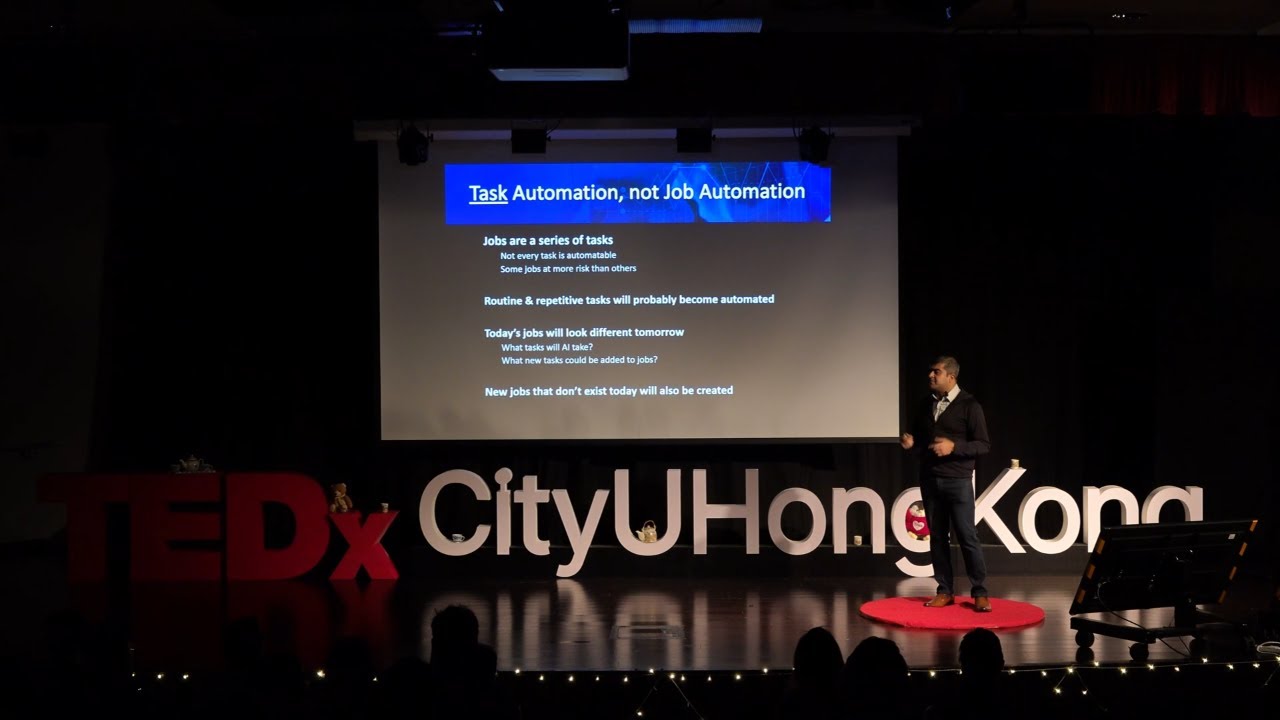
- The focus should be on task automation rather than job automation, as AI will likely take over routine, repetitive, and boring tasks, leaving more complex tasks for humans 9m3s.
- This shift may lead to new tasks being added to existing jobs, presenting a challenge for human resources and talent management functions in companies 9m57s.
- The introduction of new technology often creates new jobs that never existed before, a common theme and trend in technological advancements 10m26s.
- New jobs may emerge, such as AI ethicists, who will be responsible for deciding the right way for companies to use AI, considering its impact on employees, customers, and society 11m28s.
- The concept of AI ethicists was discussed with year 12 and 13 philosophy students at South Island School in Hong Kong, who demonstrated a deep understanding of the topic 11m21s.
- In the future, philosophy might become more popular than subjects like math and science due to the increasing importance of skills like moral frameworks and value judgments in jobs such as AI ethicist 12m3s.
- This shift could be partly due to the automation of STEM subjects by AI, making humanities and philosophy subjects more important 12m58s.
Essential Skills for the Age of AI
- The evolution of jobs and creation of new ones will require humans to prepare themselves, with one of the hardest areas to automate being human-to-human interaction skills 13m32s.
- Skills like creativity, trust building, and storytelling will become essential, with storytelling being an underrated but valuable skill 13m49s.
- Storytelling has physical effects on the brain, releasing oxytocin and cortisol, which can make the audience more likely to remember what is being said 14m48s.
- Practicing storytelling skills, such as through presentations and group work, will be crucial for university students 14m13s.
Adapting to Evolving AI Tools
- New tools from AI will emerge, and it is essential to consider what skills will be needed to work with these tools effectively 15m37s.
- As AI improves, it will be necessary to adapt and develop skills that complement its capabilities 16m2s.
- AI typically gets better exponentially, meaning small increases at the beginning that eventually lead to significant improvements, and this trend is expected to continue in the future 16m11s.
- As AI improves, it will be able to perform tasks that are currently hard to automate, which may lead to job displacement, emphasizing the need to revisit and update skills regularly 16m27s.
- In addition to soft skills, AI tools will also improve in the future, with many becoming no-code and low-code tools that don't require coding or programming skills to use 17m10s.
- Examples of these tools include AI image generation tools that can produce high-quality output, such as aging a person's photo by 10 years with a specific hairstyle 17m37s.
- The tools used today will be different from those used in the future, highlighting the importance of embracing continuous learning to stay up-to-date 18m15s.
Responsible AI Usage
- There is a risk of using AI tools in a sloppy way, such as relying too heavily on them without proofreading, which can create a negative impression and undermine credibility 18m29s.
- A personal example illustrates this risk, where a student used AI to write an email but failed to proofread it, resulting in a typo that could have negative consequences 19m6s.
- It is essential to use AI tools responsibly and carefully, including proofreading output to ensure accuracy and quality 19m29s.
- The use of AI tools comes with great responsibility, and it is crucial to use them well, as they can be either fantastic or hinder progress, depending on how they are utilized 20m10s.
- Knowing the right tools and the right situation to use them is going to be a skill in itself, and it is essential to master this skill to achieve objectives 20m27s.
The Future of Work with AI
- The key to success lies in being able to use AI effectively, as it is more likely that someone who knows how to use AI will replace those who do not, rather than AI itself replacing humans 20m51s.
- Upskilling and continuously learning are essential to stay on the right side of the line and take advantage of the opportunities that AI presents 21m11s.
- The future of work will depend on how individuals use AI, and it is up to each person to ensure they are prepared to make the most of this technology 21m21s.