
AI Industry Growth and Market Leaders
- Corporate America is highly convinced of the return on investment (ROI) of Artificial Intelligence (AI), with companies like Antropic and Open AI achieving significant growth, and Antropic is expected to surpass Open AI in the near future, becoming visibly and obviously ahead, profitable, and growing more quickly 10s.
- Open AI has confidentially filed their S1, which may impact Anthropic's plans to go public, and SpaceX has also filed their S1, which is expected to be the largest IPO in history, while Anthropic has reached $44 billion in Annual Recurring Revenue (ARR) and has surpassed Open AI in revenue 42s.
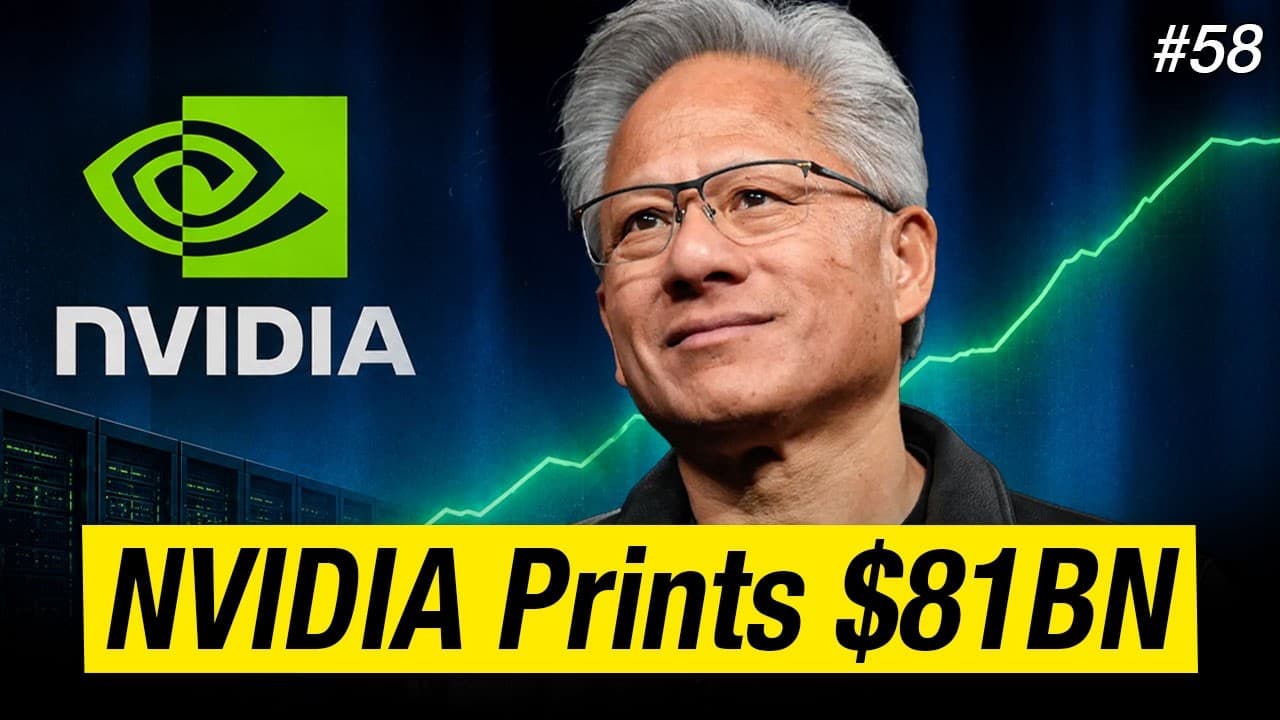
- Nvidia has reported $81.6 billion in revenue and $50 billion in profits, making it the most profitable company on the planet, with an operating margin that is wildly profitable and growing at 80%, and the company has also announced an $80 billion buyback 2m6s.
- The stock market has reacted calmly to Nvidia's quarterly results, with the stock barely moving, but over the last 12 months, the stock has grown by 20%, and the market is happy with Nvidia's performance, trading at a mid-20s Price-to-Earnings (PE) ratio 4m30s.
Nvidia's Financial Performance and Market Reaction
- The recent news and developments in the AI industry, including layoffs at companies like ClickUp and Cloudflare, have been compared to the Geocities deal of the AI era, with some investors expressing optimism and others expressing caution, warning that the current valuations may be overpriced, with some companies trading at 100 times their trailing sales 6m40s.
- The current market expects insane growth, and any company that can just meet expectations is considered to be doing well, especially when many people's life savings are invested in companies like Nvidia, which has a significant impact on the market, with 7% of all Americans' life savings essentially invested in it 10s.
- The mantra for companies today is to "beat, raise, and accelerate," and even just trading flat is considered a good quarter, with AI capex expected to be around $100 billion this year and Nvidia having a commanding market share, which could lead to a $300 billion a year run rate 2m6s.
AI Industry Challenges and Valuation Concerns
- Jensen Wang's statement that AI capex infrastructure spend will reach $3 to $4 trillion by 2030 is seen as potentially feasible, but it raises questions about whether the growth will continue and if there will be an economic return on investment for the next $2 trillion, with some companies like Uber already expressing concerns about the ROI 4m42s.
- The Uber COO has stated that they spent their entire year's worth of anthropic credits in 4 months but didn't see measurable gains or productivity improvements, which raises concerns about the economic viability of continued investment in AI capex 6m15s.
- The discussion highlights the importance of considering the economic constraints and potential ROI of investing in AI capex, with some companies already starting to move away from certain AI technologies due to high costs, and the need for companies to demonstrate measurable gains from their investments 8m10s.
Leadership and Organizational Challenges in AI Adoption
- The Chief Operating Officer (COO) of a company may not always be the most creative person or have a deep engineering and product background, which can lead to a lack of understanding of the need for more engineers and product development, and this is particularly relevant in a pre-AI world where products are static, such as Uber and its various services 10s.
- The increasing use of AI is likely to lead to a bifurcation in the business world, where companies that are already efficient and have a high revenue per employee will continue to invest in AI and see significant gains, while less efficient and traditional organizations may become more skeptical, especially if prices for AI services increase 2m6s.
- The question of whether a company will get a return on its investment in AI is a crucial one, and it may not always be the case that the marginal dollar spent on AI will generate a return, which is a concept that is being explored in research papers, such as one titled "The Price of Progress" that benchmarks the price and performance of AI 4m42s.
ROI and Economic Viability of AI Investments
- The cost of using AI is increasing exponentially as the technology advances and becomes more complex, with the cost per token decreasing but the total compute cost and token consumption increasing, which means that the net cost of serving customers is going up, and this trend is likely to continue as AI models become more advanced and capable of agentic reasoning 6m15s.
- The idea that companies will need to consider the return on investment (ROI) of their AI spending is becoming more important, and it is necessary to look at benchmarks and pricing together to get a clear understanding of the costs and benefits of AI, rather than just focusing on abstract benchmarks or cost per token 8m20s.
- The importance of understanding the return on investment (ROI) of artificial intelligence (AI) is highlighted, particularly for businesses spending large amounts of money, such as $300 million, where someone needs to know if they are getting a return, 10s.
Business Margins and AI Investment Strategies
- Uber's gross profit margins are mentioned as 39.75%, which is considered a good business, but companies with high margins like this may be more focused on protecting them and could be skeptical of spending too much on AI, 2m6s.
- The perspective on the ROI of AI may vary depending on the business, with companies like Uber potentially being more cautious due to their high profit margins, whereas companies like Door Dash, which is still founder-led and aggressive, may be more willing to invest in AI, 4m30s.
- The idea that AI gives leverage to software developers across different industries is discussed, suggesting that the impact of AI on software development should be similar across entities, regardless of the company's core business, 6m20s.
AI Investment Burden and Market Dynamics
- The burden of proof for AI investment may not be imposed by companies with high margins or those ideologically committed to the program, such as Facebook, which may assume they are getting value from their AI investments without requiring proof, 8m40s.
- Companies with similar ideas and software engineers may have different business approaches due to their overall margin structure, which can lead to varying levels of spending and willingness to invest in AI, with some being more cautious than others 10s.
- The current willingness to spend on AI is significant, with corporate America being highly convinced of its ROI, similar to the internet in the mid-90s, and this is evident in companies like Entropic, which has seen a significant increase in revenue, from $5 billion to $10 billion 2m6s.
Anthropic's Financial and Strategic Position
- Anthropic's revenue growth is notable, with gross margins expanding from 38% to 70%, and the company is projected to have a $559 million operating profit in Q2, indicating a strong trajectory and improving margin profile 4m30s.
- The improvement in Anthropic's margins is not surprising, given the company's high growth and increasing pricing power, which has allowed it to recover fixed costs and increase profitability 5m20s.
- Anthropic's success may be partially due to its premium product and pricing strategy, which has resulted in the company charging twice the price of its competitor, particularly for enterprise customers, and its decision not to invest in video, which ended up being a significant cash sink for OpenAI 8m40s.
Market Competition and Product Positioning in AI
- The growth of Claude, a premium product, may be impacted if half of the world, including companies like Uber, says the return on investment (ROI) for such products is not there, which could force Claude to either cut its prices or maintain its premium status but lose market share 10s.
- The revenue traction of Claude from Q1 to Q2 is strong, indicating that it is currently the premium product with good revenue, but this may require a change in behavior from corporate America for the numbers to change 2m6s.
- The competitive dynamics in the market, including companies like Open AI and Gemini, will play a crucial role in determining the future of Claude, and something would have to change in terms of these dynamics for the trend to shift 4m30s.
Corporate AI Budgeting and Pricing Power
- As more companies start spending large amounts on AI tokens, they will have to have a discussion about the ROI and quantify the benefits to justify the expenses, which could lead to better management of token budgets and potentially degrade pricing power for companies like Anthropic 6m40s.
- The bare case scenario is that companies will get better at managing their token budgets, and as they struggle to do so, they may use a combination of different tools, such as GPT4, Sonnet, and Deepseek, to spend their budget more efficiently, which could benefit them but impact the pricing power of premium products 8m20s.
- Once AI spend starts to account for a significant portion of a company's expenses, they will have to have a more quantitative discussion about the ROI and make decisions based on provable benefits, rather than just relying on intuition or vibes 10m30s.
Layoffs and Workforce Management in the AI Era
- The recent layoffs in the tech industry are being attributed to overhiring during the COVID-19 pandemic, but this reasoning is being disputed as it does not take into account natural attrition rates, which can be as high as 20% per year 10s.
- The argument is that with such high natural attrition rates, the recent layoffs cannot be solely blamed on overhiring, and that companies had ample time to manage their low performers out through performance reviews 2m6s.
- The idea that companies are laying off employees due to AI efficiency is also being questioned, with some arguing that it is an excuse and that the real issue is the failure to adapt to changing circumstances 4m30s.
- The layoffs at companies like ClickUp and Cloudflare are being publicly explained through lengthy tweets, but the reasoning behind these layoffs is not entirely clear, and it is perceived that the companies are blaming the employees for not being able to adapt to AI and organizational changes 6m40s.
- The vibe from these companies has shifted from praising their employees as the best to now letting them go, which is seen as ruthless and unfair, with some arguing that the layoffs are not based on performance but rather on arbitrary decisions 8m50s.
- The discussion highlights the need for companies to re-evaluate their hiring and management strategies, and to consider the impact of natural attrition and AI efficiency on their workforce, rather than simply blaming overhiring or employee performance 10m20s.
Layoff Strategies and Talent Retention
- Companies are being more direct about layoffs, with Cloudflare laying off 20-21% of its employees, and this trend is expected to continue as the world is not static and growth is slowed due to the lack of agentic products or competition from other companies, particularly those utilizing AI 10s.
- The CEO of ClickUp, Zeb, was transparent about laying off 22% of the company's employees to pay high performers, such as 10x engineers or sales reps, up to $1 million, as they deliver significant value to the company 4m30s.
- This approach is seen as a way to retain top talent and pay them accordingly, with the understanding that the company's productivity and value can increase with a smaller, more skilled team, and this trend may happen across startups, not just large companies like Uber 6m40s.
- The discussion highlights the impact of AI on companies, with some CEOs choosing to lay off employees to make room for new talent with different skills, while others, like Zeb, focus on paying their current high performers to keep them from leaving 8m50s.
AI's Impact on Productivity and Compensation
- The topic is related to a previous discussion on whether spending 20% of R&D budget on tokens makes sense, and the current conversation is seen as a counterargument to that, with companies needing to adapt to the changing landscape and prioritize their spending and talent acquisition strategies 11m20s.
- The discussion revolves around the impact of AI on companies, including the potential for 20% layoffs due to increased efficiency, and how this efficiency gain can lead to higher revenue per employee, with top performers potentially earning two to three times their current salary 10s.
- The new paradigm suggests that as companies scale, revenue per employee will increase, allowing high performers to earn significantly more, with examples like Anthropics hiring a social media manager for $450,000 a year, and ClickUp funneling compensation to high performers 2m6s.
- The introduction of new tools in the last two or three years has increased productivity, making it possible for companies to afford to pay high performers significantly more, with the potential for revenue per employee to reach 2 million, 4 million, or even 5 million 4m30s.
Future of Work and Adaptation to AI
- There are concerns that the gap between agentic experts and others will continue to grow, leading to unemployability and exhaustion, as the knowledge frontier keeps growing every year, making it hard for people to keep up 6m40s.
- The conversation touches on the idea that people may struggle to adapt to new technologies and ways of working, with a quote from Max Planck suggesting that science advances as older generations with outdated views pass on, and the importance of retraining and learning new skills 8m50s.
- The discussion also mentions the potential for significant changes in the job market, with some roles becoming obsolete and others requiring continuous learning and adaptation to stay relevant 10m40s.
OpenAI and Anthropic's IPO Strategies
- The conversation shifts to the topic of S1, starting with Open AI, and the potential for significant productivity gains and changes in the way companies operate 12m30s.
- OpenAI is considering going public with an S1 filing, aiming for a Q4 listing and a valuation of $852 billion to $1 trillion, and the main question is whether they are forcing their way out before Anthropic, given that Anthropic has been gaining ground 10s.
- OpenAI's revenue has been higher than Anthropic's, with $13 billion in revenue last year and $5.4 billion in Q1, but Anthropic has been growing more quickly, with $4.5 billion in revenue last year and $5 billion in Q1, and if this trend continues, Anthropic could surpass OpenAI in revenue 2m6s.
- The concern is that if OpenAI waits to go public, they may be overshadowed by Anthropic, which could be profitable and growing more quickly, and it would be better for OpenAI to go public first and tell their story as the first foundation model in the category 4m30s.
- Going public first would allow OpenAI to establish themselves as the leader in the category, and waiting could result in being seen as a smaller, less profitable version of Anthropic, which would be a poor strategic position 6m15s.
Strategic Considerations for Going Public
- There is also a risk that going public later could exhaust the available capital pool, as the investor pool for IPOs is relatively thin, and going public first could help OpenAI to avoid this issue 8m40s.
- OpenAI is entitled to tell their story and establish themselves as the leader in the category, given their trajectory over the last 5 years and their role in building the category 10m50s.
- If the leaked numbers are correct, and a company is visibly number two, losing money, and growing more slowly by the middle to latter part of the year, it would be wise not to wait until this becomes painfully obvious, especially for a company like Anthropic, which may consider changing its strategy in response to OpenAI's actions 10s.
Leadership and Market Positioning in AI
- Being the number one company, such as Anthropic, means having the freedom to do whatever is desired, without needing to change strategy based on what other companies, like OpenAI, are doing, and this is analogous to the historical example of the British Navy ruling the world 1m42s.
- If a company is profitable and growing nicely, with attractive metrics, it will have more strategic independence and freedom to make decisions, such as choosing when to go public, and investors will be more likely to put money into the company, even if another company, like OpenAI, is going public first 2m6s.
- Anthropic may not need to go public at all if it is truly profitable and has infinite demand for its shares, and its CEO, Dario, may choose to stay private and focus on the company's altruistic mission, rather than dealing with the headaches of being a public company 3m30s.
Capital Needs and Public Market Access
- However, the dynamics of staying private longer are different for companies like Anthropic, which have high capital needs, compared to companies like Stripe, which have a more predictable business model and lighter capital needs, and Anthropic may be wise to access the public markets when it can to raise the necessary capital 4m40s.
- The capital needs for Anthropic are significant, with high capex requirements for every dollar of revenue added, and the company may need to raise hundreds of billions of dollars to achieve its revenue goals, which may only be possible through the public markets 6m10s.
- OpenAI going public would provide the company with independence and allow it to utilize the massive amount of capital it has, with Nvidia having $200 billion in cash that needs to be recirculated, and this could lead to a positive reception in today's market due to the current risk-on attitude and the desire to invest in AI 10s.
Public Market Reception and Investment Strategy
- The reception to OpenAI's potential IPO would likely be overwhelmingly positive, as the company is a leader in the AI category and has built a well-known product in ChatGPT, and the public currently lacks a pure-play AI investment option 2m6s.
- A potential IPO for OpenAI could be influenced by the success of SpaceX's IPO, particularly if SpaceX's retail demand is high, and OpenAI could copy this strategy to benefit its own stock price by allowing its fan base to invest 4m30s.
- Investing in both OpenAI and other AI companies, such as Anthropic or Entropic, could be a good strategy for public market equities investors, as the overall trends in the AI industry are strong and it's difficult to predict which company will come out on top 6m40s.
Leadership and Innovation in the AI Sector
- The CEOs of OpenAI, SpaceX, and Entropic are all trying to stay on top of the rapidly evolving AI industry, and while none of them have made perfect decisions, they have all built incredibly valuable companies and are well-positioned to ride the trend of AI growth 8m50s.
- OpenAI, SpaceX, and other companies have created a significant amount of value in AI over the last 5 years, with each creating around a trillion dollars, despite potential drawbacks and areas for improvement 10s.
Elon Musk's Ventures and Their Financials
- Elon Musk founded both OpenAI and SpaceX, and his involvement in various projects, including Neuralink and Tesla, demonstrates his commitment to innovative technologies 1m5s.
- SpaceX's S1 dropping revealed important numbers, including a low-growth but tech-enabling space business, a profitable Starlink business with a large total addressable market (TAM) and 30-40% growth, and an X.AI business that initially had a $15 billion capex hole but has since secured revenue-generating deals 2m6s.
- The sum of SpaceX's parts, including its launch, Starlink, and X.AI businesses, is valued lower than the proposed valuation, with the difference attributed to the "Elon premium" 3m20s.
SpaceX's Business and Valuation Analysis
- Twitter's growth has fallen off since Elon Musk's acquisition, with revenue shrinking 50%, while SpaceX's launch business is stable and boring with amazing technology, and its Starlink business has a large TAM and 30-40% growth rate 5m30s.
- SpaceX's TAM analysis reveals that 90% of the company's identified opportunities are not in its traditional launch and communications sectors, but rather in AI, indicating a significant shift in the company's focus 7m10s.
- OpenAI and SpaceX have filed their S1, which provides insight into their business and financials, including a deal where they sold Colossus to Antropic for $1.25 billion a month with a 90-day cancellation clause, resulting in $15 billion a year 10s.
Valuation Concerns and Financial Engineering
- The S1 also highlights the company's ability to build faster than anyone else and their organizing principles around engineering, which have contributed to their success over the past 20 years 42s.
- The valuation of the company is questioned, with some estimates ranging from $2 to $3 trillion, which seems excessive and may be the result of financial engineering, combining disparate assets with no connection, including Twitter and SpaceX 2m6s.
- The company's history and achievements are notable, with Elon Musk being one of the most talented entrepreneurs, and the S1 provides a great read, showcasing the company's optimism and ability to innovate 10s.
SpaceX's Strategic Direction and Financial Risks
- However, the combination of businesses, including SpaceX, Twitter, and OpenAI, makes no sense financially, and the valuation seems to be bailing out failed acquisitions and ideas, such as the Twitter acquisition and competing with OpenAI by buying chips 2m6s.
- The launch business is expected to enable Starlink and data centers in space, which could provide a significant source of revenue, but the current valuation and combination of businesses seem unrealistic and overly optimistic 2m6s.
- The concept of data centers in space is crucial as it connects various aspects together, and if this idea works, it would make sense for a company to have both a launch business and a data center business, with the potential to build 100 gigawatts of capacity per year, five years from now 10s.
SpaceX's Data Center and Launch Business
- The acquisition of Twitter for $44 billion is considered a miserable deal, with the company's value being less today than at the time of purchase, and Elon Musk has chosen to roll it into X.AI, which will then be rolled into SpaceX 2m6s.
- X.AI's financials are notable, with $12 billion and $7.19 billion in total capex over the last two years, and $1.25 billion in monthly revenue, which could lead to a high return on cash for a data center project 2m6s.
- By 2030, the core business of the company is expected to be Starlink, with data centers in space not being a significant percentage of revenue, and the existing data center business being high-revenue but relatively low-return 4m30s.
Elon Musk's Vision and Financial Strategy
- The narrative of spending $3 trillion a year and the potential return on equity is crucial to the success of the data centers in space concept, and if this narrative tracks, it could lead to a significant value for the company, with Elon Musk being the one person who can make this bet work 6m40s.
- To make the math work, Elon Musk may have to build a $50 billion Coreweave business, give up on going to Mars, and focus on more practical goals, such as taking the company public and mashing all the different aspects together 8m50s.
- Elon Musk has to commit to building a $50-100 billion core and going to the moon, but he could also dump the core business if the world changes, allowing him to write off the chips and other investments 10s.
Anthropic's Market Position and Growth Potential
- If other companies prove mediocre at building new data center capacity, Anthropic could continue to grow and make a ton of money by providing compute capacity, similar to a consumer storage solution, with a high return on equity 2m6s.
- Elon Musk has a history of doing things that are at the cutting edge and radically more efficient, such as producing EVs, and he could potentially build his own massive fabs in the US and accelerate past everybody in the data center industry 4m30s.
Elon Musk's Financial Leverage and Strategic Moves
- Musk's low cost of capital, with a $2 trillion pre-money valuation, gives him the ability to invest in and sell companies, such as Colossus, and make significant profits 6m40s.
- There are private market stories, including a company called Pulsia, which enables a single person to build a business run by AI, although it is not very popular 9m20s.
AI Startups and Venture Capital Trends
- OpenAI and SpaceX S1 drops have been announced, and there have been layoffs at Cloudflare and ClickUp, while OpenRouter and Polsia have raised mega rounds, with Polsia raising $30 to $40 million at a $250 million valuation 10s.
- The founder of Polsia has been able to raise a significant amount of money, which has sparked discussion about whether the valuation is justified, and some people have expressed skepticism about the company's potential for success 1m20s.
- The discussion also touches on the topic of AI startups, with one person expressing frustration about the number of unsolicited emails they receive from these companies, and the founder of OpenClaw, Peter Steinberger, has also spoken out against these emails 30s.
- One person mentions that they could potentially create a similar product to Polsia, which they jokingly refer to as "AI swap", and they question whether they could raise $40 million in funding if they were to create such a product 1m40s.
- The person also expresses concern about the potential downsides of raising money from venture capitalists and the moral obligation to turn the company into a billion-dollar business 2m20s.
Product Evaluation and Market Skepticism
- The conversation also mentions that the person has tried out Polsia's product and was impressed with the initial experience, but was then asked to pay $49 a month before receiving any value, which they see as a red flag 3m30s.
- The person gives Polsia a 10 out of 10 for the initial journey, but expresses skepticism about the company's ability to deliver value, and they prefer products that give them value before asking for payment 4m10s.
- It is also revealed that Polsia is a one-person company, which is impressive given the aesthetics and initial experience of the product, but also raises questions about the company's potential for long-term success 5m0s.
AI Infrastructure and Investment Opportunities
- OpenAI and SpaceX's S1 drops have been announced, and there have been layoffs at Cloudflare and ClickUp, with OpenRouter and Polsia raising mega rounds, indicating a significant trend in the AI infrastructure space 10s.
- OpenRouter has raised $150 million at a $1.3 billion valuation, led by Capital G, to build a platform that allows customers to switch between various AI models, including foundation models and open-source models, hosting over 50 models to provide access to the lowest-cost model 2m6s.
- Exa is another company that has raised $250 million at a $2.2 billion valuation to build a search engine for AI agents, catering to the need for structured web search when building internal agents, and has developed a great product that is used by some investors before they invested 2m6s.
- The trend of investing in AI infrastructure companies is seen as a good place to be, with companies like OpenRouter and Exa providing value propositions such as cheaper costs and easier access to AI models, and strong, interesting teams doing good work in building the next generation of agents 2m6s.
Agent-Centric Tools and Market Potential
- The idea of using pick and shovels of the agentic revolution as an investment strategy is seen as a viable option, with companies like OpenRouter and Exa providing innovative solutions to the needs of enterprises building their own AI agents 2m6s.
- The concept of agents and their workflows is crucial, as they have different needs and tools compared to humans, and products like Exa are designed to cater to these needs, providing a unique insight into the future of technology 10s.
- Agents require access to current information, but they don't use traditional tools like Google, Zoom, or Dropbox, instead needing specialized tools that can provide them with the necessary data and functionality 42s.
Future of Agent Tools and Market Structure
- The idea of managing more agents than humans is becoming a reality, and this shift may lead to a greater focus on investing in tools designed for agents, rather than traditional human software 1m6s.
- The upside case for Exa, valued at $2.2 billion, is that it could become a key player in the market for agent-focused tools, potentially reaching a valuation of $100 billion, although it's unlikely to be a winner-take-all scenario 2m6s.
- The market composition for agent-focused tools is expected to be more like the AWS and Google Cloud landscape, where multiple players can coexist and be successful, rather than a single dominant player like Uber or Lyft 3m10s.
Growth Projections and Market Demand
- The success of Exa and similar companies depends on the growth of the agent market and the increasing demand for structured information and reasoning capabilities, making it a derivative bet on the adoption of agents 4m20s.
- To reach a valuation of $10 billion, Exa would likely need to achieve $1 billion in revenue, which is not an unrealistic goal considering the potential size of the market and the growing investment in agent-focused technologies 5m40s.
- The majority of the market is focused on AI, with 90% of AI spend being directed towards enterprise, indicating a significant need for products that allow structured information to be accessible to AI agents, particularly in areas such as web search, curated lists, and internal information 10s.
Investment Strategies in the AI Sector
- A fund is expected to be one of the best performing funds in history, with an extraordinary number of successful exits, including a 700% return, and is considered an epic fund due to its early investments in companies with traction 2m6s.
- Investing in AI companies at the right moment, such as when they are about to experience rapid growth, is crucial, and getting in early can lead to significant returns, as seen in the case of Monaco, which was marked up almost 2x from the founders' fund investment 2m6s.
- There is a quantum reduction in risk when a company goes from having no revenue to generating revenue, and then a linear reduction in risk thereafter, making early product market fit a sweet spot for investment 4m30s.
- The time it takes for AI companies to go from early product market fit to rapid growth has decreased significantly, sometimes happening in weeks or months, requiring investors to be prepared to act quickly and abstract away competitive risk 6m40s.
Risks and Rewards in AI Investing
- Investors need to be willing to take risks and not worry about competitive risk from large companies like Google, as well as unknown data points such as renewal rates, in order to make successful investments in AI companies 8m50s.
- The current market and traction are moving quickly, with big returns for those who make the right bets, and investors need to be willing to pay more with less information to capitalize on these opportunities 10s.
AI Adoption and Market Growth
- To succeed, companies need to achieve traction, and those that do will see significant growth, while those that miss out will regret not being more aggressive in their pursuit of traction 42s.
- The adoption of AI is happening rapidly, with Corporate America having "flipped the switch" and committed to implementing AI in 2026, creating a large and immediate market for companies that can help them do so 2m6s.
- The number of apps being built is exploding, with workflows and agents being constructed everywhere, and while this may not benefit all companies, such as Dropbox, it is creating new opportunities for other businesses 2m6s.
Agent-Driven Development and Market Opportunities
- The use of agents is becoming increasingly prevalent, with over 90% of databases at Databricks' Neon being built by agents, rather than humans, and companies like Superbase and Exa are well-positioned to capitalize on this trend 2m6s.
- Investors will need to identify the core primitives that are necessary for building agents and focus on those areas, as they will be in high demand, rather than trying to capitalize on niche or corner-case products 4m30s.
- There are likely to be five or six key areas, such as databases, search engines, and observability, where standalone companies can be built to provide essential tools for developers, and companies like XA and Open Router may be well-positioned in these areas 6m40s.
Custom Solutions vs. SaaS in AI Adoption
- A CEO claimed that their company replaced a $600K Salesforce contract with a custom-built CRM in just 3 weeks, plans to get rid of 80% of the SaaS they use internally, and would not change their usage of Anthropic even if the pricing doubled 10s.
- The idea of replacing Salesforce with a custom-built CRM is considered "rage bait" and not a viable option for most companies, as it would require significant maintenance and integration efforts, unless the company has a strong vertical focus and is willing to forgo collaborative features and third-party app integrations 2m6s.
- The CEO's statement about not changing their usage of Anthropic even if prices doubled is seen as an indication that the ROI on the AI is very high, and the company should consider using more of the service if they are willing to pay twice as much, with the suggestion being to use twice as much and prioritize more projects that can take advantage of the AI's capabilities 4m30s.
- The company in question has a high revenue per employee, at $2 million, which means they can afford to invest in AI and other technologies, making their situation unique and not necessarily applicable to other companies 6m20s.
- The discussion highlights the importance of considering the trade-offs and ROI of using custom-built solutions versus established SaaS products, and the need to prioritize investments based on economic viability and potential returns 7m10s.
AI Utilization and Human-AI Balance
- The discussion revolves around the idea that if a company is efficient and has a high budget, it can afford to spend more on tokens, and the issue becomes idleness, with agents having too much idle time, 10s
- The problem is not about spending more money, but rather about the human brain's ability to process the output, with too many ideas being generated and not enough time to implement them, 2m6s
- The AIVPN marketing customer success costs $257 a month, but the company doesn't care if it's $500, as the issue is not the cost, but rather the ability to process the ideas generated, 42s
- The solution to this problem is to hire another human who can process the ideas generated by the AI, but the human needs to be a high-value person who can turn the ideas into significant returns, 7m13s
- The optimal spend between humans and tokens is a recurring question, with the company needing to find the right balance between the two to maximize returns, 10m0s
Personal Relationships and Social Limits
- Jason and Harry have different personalities, with Jason being perceived as not liking other humans, while Harry is seen as a people person, 12m0s
- A meeting took place in London with Harry Steppins, who is referred to as a best friend, and this type of encounter is a common occurrence 0s.
- The idea that someone can have multiple best friends is discussed, with the notion that it is unlikely to have a large number of genuine best friends, and a humorous comment is made about having 300 best friends 10s.
- The Dunbar number, which is 150, is mentioned, but in this context, it is stated as 160, and it is referenced in relation to the number of best friends one can have, implying that it is not possible to have a large number of close relationships 42s.