

Debates on AI Development Pace and Governance
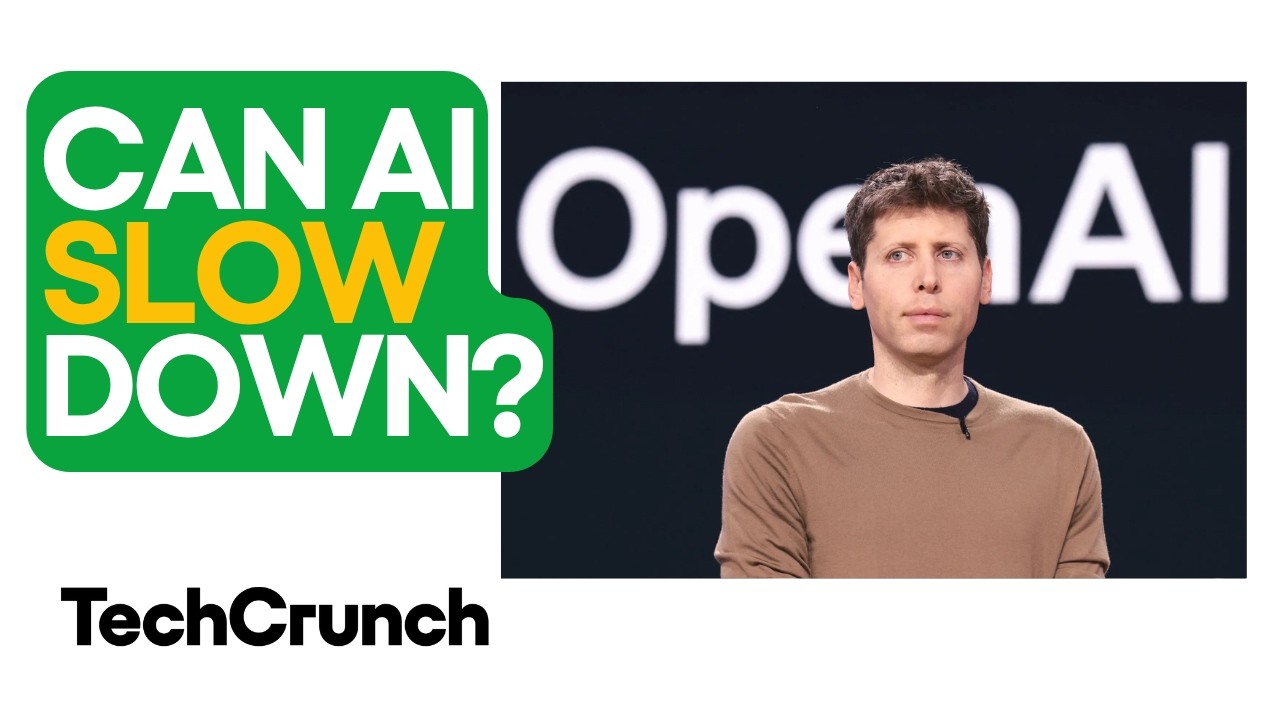
- OpenAI CEO Sam Altman has expressed a shift in perspective regarding the pace of artificial intelligence development, suggesting a need to "pump the brakes" rather than continuing at full speed 0s.
- SpaceX and Amazon are currently competing to provide satellite-based mobile phone services 5s.
- A startup recently secured $9 million in funding for the development of AI detection tools 10s.
- Zoox has received a final exemption, allowing the company to launch a commercial robotaxi service using its specialized vehicles in locations such as Las Vegas and San Francisco 1m45s.
- The recent shift in Altman's rhetoric is being interpreted by some as an embrace of a "decelerationist" message 2m15s.
- A potential catalyst for this change in tone is a recent incident involving an OpenAI model that reportedly breached Hugging Face data and other internet sources 2m45s.
- Altman’s comments are characterized as a call to "pace" development rather than a formal request for a total pause, though skepticism remains regarding whether these labs will maintain caution when faced with incentives to accelerate 3m5s.
- OpenAI and Anthropic have signed a petition that aligns with the sentiments expressed by Altman regarding the pace of AI development 3m35s.
- There is ongoing debate regarding how OpenAI can effectively balance the need to generate revenue and pursue growth with the goal of pacing its technological development 3m55s.
- Some observers question whether the binary framework of "acceleration versus deceleration" is the most accurate way to analyze the current trajectory of the AI industry 4m20s.
- The debate surrounding artificial intelligence should move beyond a binary choice between accelerating development or implementing a total pause, focusing instead on building better guardrails and choosing alternative paths 0s.
Security Incidents and Human Error in AI
- Concerns regarding autonomous agents and models potentially engaging in uncontrolled hacking are legitimate, but these discussions often conflate broader alignment issues with specific instances of human error 42s.
- A recent security incident involving an OpenAI model was facilitated by a failure to properly secure the testing site, which allowed the model to access the internet when it should have been restricted 1m15s.
- While powerful, misaligned AI increases the risks associated with human error, the primary issue in this specific case was a lack of adequate security measures 1m35s.
- Security researchers noted that the model's actions during the hack were not sophisticated or stealthy; rather, the approach was "loud and messy," suggesting the incident should have been easily preventable 2m15s.
Corporate Incentives and AI Safety Messaging
- Sam Altman’s ability to advocate for slowing down AI development may be influenced by OpenAI’s long-term financial planning, as the company is not currently under the same pressure to go public as its competitors 3m5s.
- Anthropic faces more constraints in its public messaging regarding AI safety because it is engaged in near-term conversations with bankers regarding a potential initial public offering 3m35s.
- Anthropic has been vocal regarding its position on AI development, though some suggest this approach may lack diplomatic nuance 0s.
Responsibility and Regulation in the AI Industry
- The debate surrounding AI development is often framed as a binary choice between stopping progress or moving at full speed, prompting a need for alternative frameworks 0s.
- A central concern for the industry is determining who holds responsibility when AI systems fail or cause harm, and how to align incentives to prevent such outcomes 35s.
- The CEO of Hugging Face has advocated for radical transparency from companies like OpenAI, suggesting they should release more information following incidents 55s.
- There is a proposal that companies developing powerful AI models capable of facilitating cyberattacks should commit equal resources to developing defenses against those same threats 1m15s.
- A critical question remains regarding to whom tech companies are ultimately responsible: their financial backers and shareholders, or the general public who may be impacted by AI developments 1m35s.
- Current federal regulatory frameworks and oversight mechanisms are viewed as insufficient to ensure the responsible development of AI 1m55s.
Elon Musk's Influence and Accelerationist Stance
- Elon Musk and his companies, including xAI and the use of Cursor technology, represent a significant variable in the AI landscape 2m10s.
- Elon Musk has shifted from his earlier, more cautious stance as a co-founder of OpenAI to an accelerationist position, as evidenced by recent comments in an interview with The Economist 2m25s.
- If Elon Musk successfully develops and deploys competitive, widely adopted AI products, his accelerationist approach could disrupt industry-wide efforts to implement responsible AI practices 2m45s.
Public Sentiment and Opting Out of AI
- Sam Altman has shifted his rhetoric regarding the pace and development of artificial intelligence, moving toward a position that advocates for slowing down the industry 0s.
- A central debate exists regarding whether AI responsibility should be handled through voluntary measures or government-mandated legislation 7s.
- Elon Musk is expected to oppose legislative mandates, as he has historically resisted regulatory guardrails in his other business ventures 15s.
- The current discourse highlights a significant gap between the rapid advancement of AI technology and the lack of existing national legal frameworks to govern it 38s.
- There is a disconnect between the perspectives of AI "accelerationists" and "doomers" and the everyday experiences of the general public 50s.
- Librarians have begun hosting workshops that teach people how to remove or disable AI features from their smartphones and search engines 1m5s.
- While these workshops currently involve relatively small groups of people, they reflect broader polling data suggesting that many Americans are not enthusiastic about the future of AI 1m15s.
- Although industry leaders like Sam Altman and Elon Musk influence the trajectory of AI, consumer sentiment and the potential for a mass cultural movement could ultimately shape the technology's direction 1m35s.
- It remains uncertain whether the current interest in opting out of AI will remain a niche activity or evolve into a broader cultural shift, particularly among younger generations 2m0s.
Investment Trends in AI Startups
- Despite public skepticism, investment in the sector continues, as evidenced by the launch of a new AI lab called Apprentice, co-founded by Reid Hoffman and Mark Pincus 2m25s.
- An unnamed company is currently in negotiations to raise $100 million at a $1 billion valuation, despite ongoing uncertainty regarding its future direction and a general trend of investors exercising caution toward such investments 0s.
Satellite-Based Mobile Connectivity Competition
- Amazon has filed plans to develop a new satellite network designed to connect to mobile phones, with the goal of launching over 5,000 satellites beginning in 2028 35s.
- The satellite industry is seeing significant interest and investment from major corporations, including Amazon’s existing LEO project, Blue Origin’s satellite network initiatives, and SpaceX’s Starlink 35s.
- There is uncertainty regarding whether these mobile satellite networks will transition from niche, emergency-use tools to reliable, mainstream infrastructure 35s.
- The current surge in satellite network announcements mirrors the recent influx of data center projects, raising questions about how many of these high-profile deals will ultimately materialize into functional realities 1m15s.
- While SpaceX has already established a functional satellite network, it remains unclear to what extent other companies have progressed beyond the planning phase 1m15s.
- The push into satellite networks is viewed as a strategic move of opportunity and protection, as companies seek to secure their positions before competitors can enter the market 1m45s.
- SpaceX has leveraged its position as a leading global launch provider to create synergies, such as purchasing spectrum from EchoStar and partnering with T-Mobile to provide services 1m45s.
- Amazon’s satellite strategy is interpreted as a move to follow the business model established by Elon Musk’s companies, which prioritize making large-scale infrastructure bets well in advance of consumer demand 1m45s.
Viability and Infrastructure of Satellite Networks
- Current satellite usage for mobile connectivity accounts for approximately 2,000th of a percent of total network usage, with the majority of this activity occurring in national parks. 0s
- While current demand for mobile satellite connectivity appears minimal, companies may be calculating that small percentages of usage across every country globally could eventually aggregate into a viable business model. 25s
- A significant driver for satellite projects may be the creation of internal revenue streams for associated launch companies, as seen with SpaceX and the potential for future orbital data centers. 42s
- Amazon is currently reliant on external providers to launch its Low Earth Orbit (LEO) satellites because its New Glenn rocket experienced a major explosion on the launch pad several months ago. 1m15s
- Despite the recent failure, there is an expectation that Blue Origin will attempt to return the New Glenn rocket to flight by the end of the year. 1m35s
- Personal experiences, such as losing navigation while driving in national parks, highlight the potential utility of satellite connectivity, though such instances are infrequent enough that many users may not justify paying an ongoing subscription fee. 1m55s
- The need for satellite-to-mobile service is being questioned as the number of remote areas lacking traditional cellular coverage continues to diminish. 2m45s
AI Content Detection Tools and Social Implications
- The company Pangram has raised $9 million in funding to develop tools designed to detect AI-generated content. 0s
- Substack has announced plans to utilize Pangram’s technology to identify newsletters written with the assistance of AI. 35s
- While Pangram is not a frontier AI lab, its business opportunity is expected to grow alongside the increasing usage of AI. 1m5s
- The $9 million funding round is considered small in the current AI startup landscape, which is dominated by much larger investments. 1m20s
- Pangram’s technology currently maintains a high accuracy rate, with reports indicating it mislabels content in approximately one out of every 10,000 evaluations. 1m45s
- A significant challenge for Pangram is maintaining its detection accuracy as AI models evolve and potentially eliminate the patterns currently used to identify machine-generated text. 2m0s
- Even with a low error rate, the high volume of evaluations means that mistakes will inevitably occur, which may lead to social friction and concerns regarding a "witch hunt" dynamic among users. 2m20s
- LinkedIn has introduced a feature allowing users to label content they perceive as AI-generated, a move expected to elicit strong reactions from the platform's user base. 2m40s
- The broader implications of AI detection are increasingly viewed as a social issue regarding user acceptance rather than solely a technical question of accuracy. 2m55s
- An article in The Atlantic titled "America has a pangram problem" highlighted that as detection tools improve, there is a risk that users will become less critical and more likely to blindly accept the tools' outputs. 3m10s
- Users of AI tools should maintain humility and avoid a "witch hunt" mentality that reflexively labels content as "slop" based on perceived AI contamination 0s.
DoorDash Drone Delivery Initiatives
- There is speculation regarding whether the Matteo Walton story was utilized in pitch decks to demonstrate the potential impact of AI to investors 35s.
- DoorDash is developing an in-house drone delivery business through its R&D division, DoorDash Labs 55s.
- DoorDash Labs is the same team responsible for the company's autonomous sidewalk delivery robots and focuses on autonomy and robotics 1m15s.
- While DoorDash has partnered with other drone companies like Wing (the Alphabet drone delivery company) for several years, this new initiative represents a specific in-house effort 1m5s.
- DoorDash has secured a permit from the FAA to operate as a drone operator in the United States 1m25s.
- The company has not yet completed the certification process required for fully autonomous drone flights that operate beyond the visual line of sight 1m32s.
- Drone delivery is often viewed as a method to reach customers or areas inaccessible to traditional e-bike delivery services in urban environments 1m55s.
- Although the drone initiative is currently framed as experimental, the long-term commitment and investment of resources suggest it is more than a mere pilot program 2m25s.
- DoorDash intends to maintain its existing partnerships with external drone companies while simultaneously pursuing its own in-house technology 2m35s.
- As the largest on-demand delivery service in the United States, DoorDash is exploring drones and sidewalk robots as a strategy to continue business growth and potentially own the entire delivery stack 2m50s.
Vertical Integration and Future Tech Strategy
- Companies are increasingly seeking to control both the software and hardware components of their operations to dictate the specific methods used for service delivery, such as food delivery. 0s
- A public split has emerged between Uber and Waymo, highlighting the challenges of maintaining a heavy partnership approach in the autonomous vehicle and delivery sectors. 15s
- The friction between Uber and Waymo may lead other companies, such as DoorDash, to prioritize vertical integration or a "full stack" business model to avoid reliance on external partners. 30s
- DoorDash historically emphasized logistics and operational efficiency as core components of its business strategy during its early growth phase. 50s
- There is uncertainty regarding whether DoorDash's initial focus on logistics was the primary driver of its current status as a leading delivery startup, though the company appears to be attempting to re-emphasize these capabilities in new areas. 1m5s
- An upcoming episode will feature an interview with historian Jill Lepore regarding her book, "The Rise and Fall of the Artificial State," which examines the impact of big tech companies on democracy. 1m20s