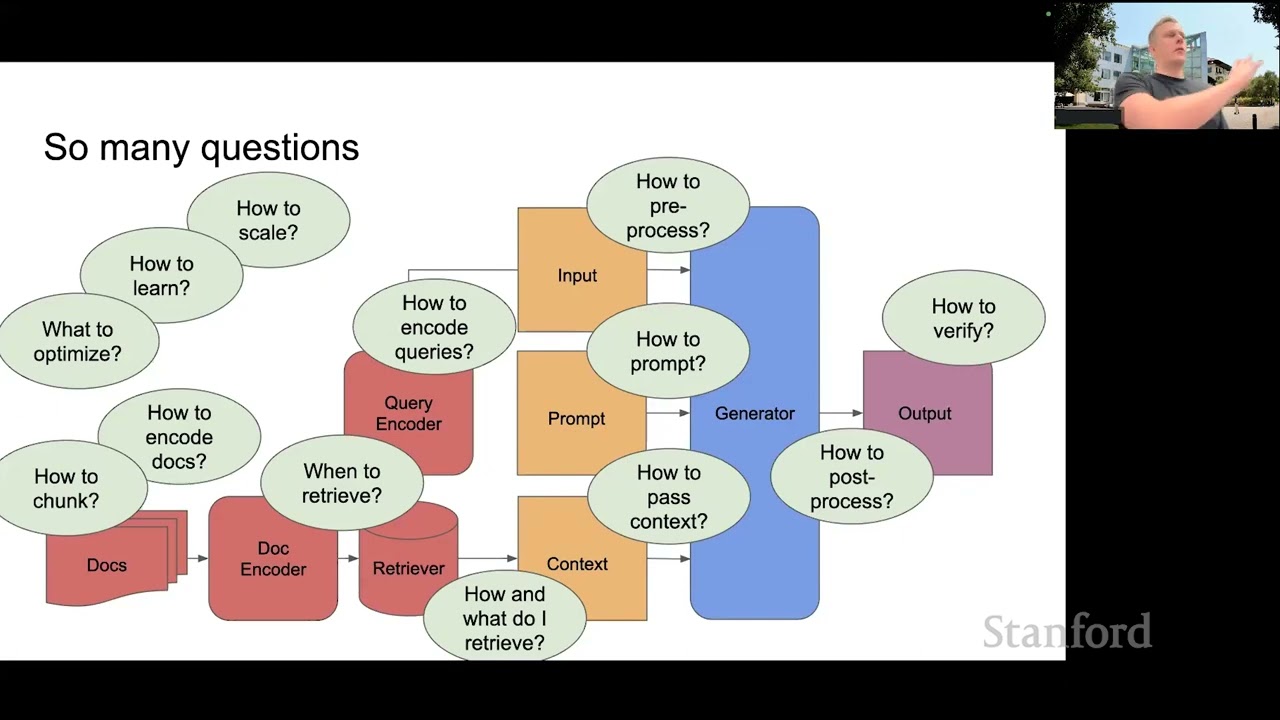


Retrieval Augmentation in Language Models
- Retrieval augmentation involves using an external memory (retriever) to retrieve relevant information and provide it as context to a language model (generator).
- Different variations of retrieval augmentation include updating the query encoder, updating both the query and document encoders, and using in-context retrieval.
- Instruction tuning and training the retriever and generator together are important in retrieval augmentation.
- Open questions and areas for future research include pre-training of retrieval augmented systems, scaling laws, and measuring the effectiveness of retrieval.
- There is potential for multimodal retrieval augmentation and the use of retrieval augmentation in other domains beyond text.
- Optimizing the entire retrieval augmentation system is emphasized over optimizing the language model alone.
Tuning Transformer architecture like convolution layers
- Can we optimize Transformer architecture similar to how we optimize convolution layers?
- Paper on light convolutions suggests the computational model is slightly better than the Transformer for GPU computation.
Two-stage process for retrieval
- Use bm25 as the first stage to cast a wide net for retrieval.
- Use a dense model as the second stage to narrow down the results.
Adapting models to domain-specific areas
- Two potential ways: instrumental tuning or meta-tuning.
- All approaches will likely come together in the end, with fine-tuning on the specific use case.
Hardware for efficient retrieval
- There are dedicated retrieval hardware solutions in development or already available.
- Efficient dense retrieval is a significant market.
Hallucination in language models
- Hallucination refers to when the language model produces output that does not correspond to the retrieved information.
- Often misinterpreted as a mistake or incorrectness, but it's more specific to counterfactual ground truth.
Defining ground truth and controlling hallucination
- Ground truth can be defined differently based on the index used.
- Architecture can be designed to control the level of hallucination and the reliance on the ground truth.
Tuning the temperature for sampling
- Temperature affects sampling by controlling how flat the distribution is.
- Even with a low temperature, random outputs can still occur.
- More sophisticated methods are needed to control sampling.