

Introduction and Overview of the Discussion
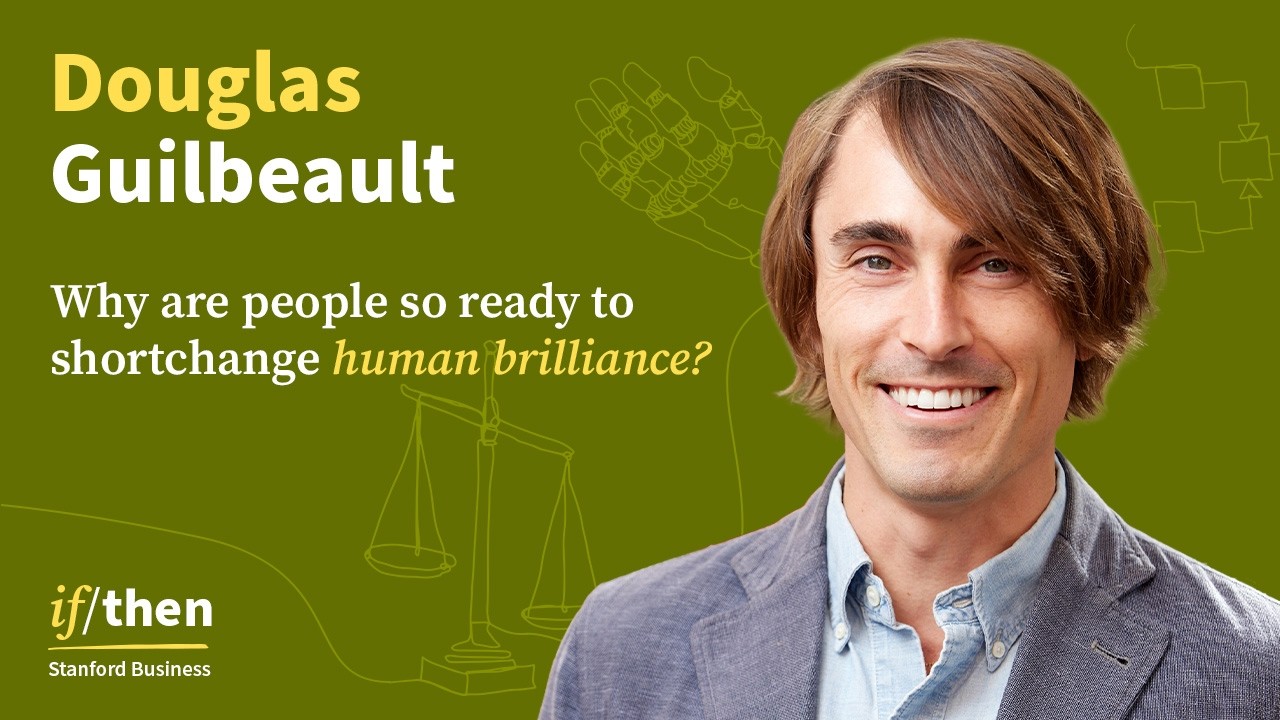
- The conversation revolves around the topic of what AI can't do and may never be able to do, with a focus on how AI learns in comparison to human learning, and the discussion is led by Kevin Cool and Michael McDowell, who spoke with Douglas Guilbeault, an assistant professor of organizational behavior at the Stanford Graduate School of Business 10s.
- Douglas Guilbeault's research looks at how humans learn and achieve a lot from surprisingly little, despite having many constraints, such as limitations of memory and attention, and how this is different from the current AI approach, which relies on a lot of computing power, engineering, and data 2m6s.
- The puzzle of human learning is an age-old puzzle that is relevant to AI development, as it tries to understand how humans manage to achieve so much with so little, and how this can inform the development of AI systems that can learn and adapt in a more human-like way 4m30s.
- Guilbeault's paper, "A Simple Threshold Captures the Social Learning of Conventions," may not explicitly mention AI, but it has big implications for AI development and its applications, as it sheds light on the unique aspects of human learning and how they can be applied to AI systems 5m30s.
Contrasting Human and AI Learning Strategies
- The current AI approach is seen as the exact opposite strategy to human learning, as it relies on brute force and a lot of resources to achieve its goals, whereas humans are able to achieve a lot with surprisingly little, and this difference is at the heart of the discussion about what AI can't do and may never be able to do 6m40s.
- Optimization-based models of human behavior may overlook simple categorical processes that characterize human social learning, which can be described as satisficing, a concept introduced by Nobel Prize-winning Herb Simon, referring to the idea that people pursue satisfactory models or beliefs and wait until something is good enough before proceeding 42s.
- Satisficing is based on the idea that people face limitations, such as limited information, laziness, tiredness, or multitasking, and have to make decisions under time pressure, leading them to adopt vague but effective enough approximations and adapt in real-time 2m6s.
- The accelerating embrace of AI methodologies, specifically Large Language Models (LLMs), is likely to maintain a blind spot in simulating human learning, as these models are primarily designed to emulate human behavior through a brute force, statistically optimized approach 4m30s.
- LLMs work by looking at every sentence ever created on the internet to predict what word is most likely to fill a given slot, which is a fundamentally different approach from how humans learn, as humans rely on intuitions, familiarity, and experience 6m10s.
- The difference in approach between humans and LLMs is significant, with LLMs requiring massive amounts of data to make predictions, whereas humans can make decisions with limited information, highlighting the need for a better understanding of human cognition and the integration of cognitive science with neurobiology and other fields 8m40s.
The Current State and Limitations of AI
- The current state of artificial intelligence (AI) is not yet at a point where it can be said that AI is solving problems or doing things in a way comparable to humans, and it is certainly not in a position to replace humans 10s.
- There is a pervasive sense of disempowerment and fear among people due to the grandiose narrative being put out by companies and AI researchers that a superintelligence is being created that will automate all cognitive work done by humans 2m6s.
- Some AI companies and researchers are making claims that AI will be able to learn all the social world and its complexity, and have control and influence possibilities, which is causing people to be concerned and afraid about becoming obsolete 2m6s.
- Despite these claims, it is argued that humans are a magnificent form of intelligence that has managed to figure out profound things about the universe under remarkable constraints, such as the nature of infinity and quantum physics 4m0s.
- The achievement of humans in developing a serious level of understanding about the universe, including predicting the movement of particles to high precision and understanding mathematical paradoxes, is not being fully appreciated 4m0s.
- There are ads from startup companies that are perpetuating the narrative that humans are becoming obsolete, with one ad saying "Humanity has had a good run", which is seen as a bad public-facing message 6m0s.
- It is argued that this way of thinking, which sees humans as just prediction machines, is growing and needs to be responded to, and that people need to figure out how to address this perspective 8m0s.
Human Intelligence and Its Unique Capabilities
- Douglas Guilbeault is trying to speak to every person who is trying to understand their place and purpose in the age of AI, and is hoping that through his research and perspectives, people will appreciate the brilliance of human intelligence 10s.
- Machines are better at crunching numbers, but this does not capture the complexities and capabilities of human intelligence, which cannot be reduced to just prediction and number crunching 10s.
- The human brain has a nuanced process that AI has not yet achieved, involving a combination of intuition and experience, although the term "intuition" is not clearly defined scientifically 42s.
- Intuition is often associated with "aha moments" or epiphanies, where a person is struck by a new way of thinking about something, and this kind of leaping or insight is characteristic of human learning 2m6s.
- Current large language model architectures in AI are not capable of making these kinds of leaps because they have to move step by step in a smooth and continuous way 2m6s.
- Humans use counterintuitive mechanisms such as metaphors, analogies, and developing feelings towards ideas, which allows them to have an aesthetic sense or "vibes" about certain concepts 4m30s.
- This aesthetic sense or intuition is often ineffable, meaning it cannot be put into words, but it is a real experience that many people can relate to, such as knowing something is a good idea without being able to explain why 6m15s.
- Mathematicians often have intuitions about solvable problems or solutions, and they may spend years working on them, even if others think they are crazy, demonstrating the importance of intuition in human reasoning and problem-solving 8m45s.
Human Intuition and the Limits of AI Replication
- Human learning is a profound and fascinating topic that is not yet fully understood, and it does not fit into the current statistical framework, which is a problem that researchers are trying to address 10s.
- The research focuses on how humans manage to learn and do a lot with a little, and it has found a simple mathematical regularity that characterizes how children learn grammatical rules, mathematical rules, and behavioral patterns, as explained by Douglas Guilbeault 2m6s.
- This regularity also applies to how humans learn social norms, such as what to wear to work, greetings, and conversation topics, and it can even be used to make inferences about what others are thinking or feeling 2m6s.
- The findings suggest that there may be an upper limit to what AI can know or do, particularly when it comes to understanding human behavior and creativity, which is a topic of discussion between Kevin Cool and Douglas Guilbeault 2m6s.
- The research shows that optimization frameworks, such as those used in large language models (LLMs), are limited in predicting human behavior and may not be able to fully understand the underlying human nature 4m30s.
- Humans have the ability to harness randomness and make meaning from chaotic and disordered states, which is not yet something that LLMs or current AI approaches can replicate, and this may be a fundamental limit to their understanding of human behavior 8m40s.
- The ability of humans to leap from a random state to an ordered state, such as when having an insight or making a creative breakthrough, is something that is not yet fully understood and may be difficult for AI to replicate 10m50s.
Challenges in AI Understanding Human Behavior
- The current approach to artificial intelligence (AI) development involves providing highly structured data for machines to learn from, which is different from how humans learn and understand the world, as humans have to navigate chaos, randomness, and ineffability to make meaning 10s.
- Humans do not have the same learning crutches as AI systems, which are given sentences and language that are perfectly designed to be learned from, allowing them to fill in gaps and solve problems in a way that is not available to humans 42s.
- The problem that humans have to solve is fundamentally different from that of AI systems, as humans have to figure out if there is regularity and order in the world, and then establish strong understandings from within that chaos and noise 1m6s.
- If everything is assumed to be a matter of optimization, what is lost is the sense of awe and wonder that powers science, art, and spirituality, which is driven by a sense of fundamental strangeness and complexity in the world 2m6s.
- The optimization approach to understanding the world is a mechanization approach that can dismiss the importance of feeling the strangeness and weirdness of human experience, which is quirky, creative, and beautiful 3m40s.
- The mystery of human existence is not what exists, but that it exists, and this mystery is what matters at a foundational level, and it is what will ultimately be pointed out by developing an understanding of human nature and the world 4m20s.
- Biology is an example of a system that is crazy, quirky, and beautiful, with many different life forms, and this is the kind of system that humans are, rather than an orderly machine 5m0s.
The Philosophical and Existential Implications
- The conversation about the limitations of AI and the importance of understanding human nature and the world is an important one to be having, and it is hoped that it will continue and have an impact on how people think about these things 6m0s.
- The Stanford Graduate School of Business can be found online at gsb.stanford.edu for more information on their faculty and research 0s.
- Additionally, the Stanford Graduate School of Business is also available on social media at @StanfordGSB 0s.
- Listeners are thanked for their time and are informed that another episode will be available soon 0s.