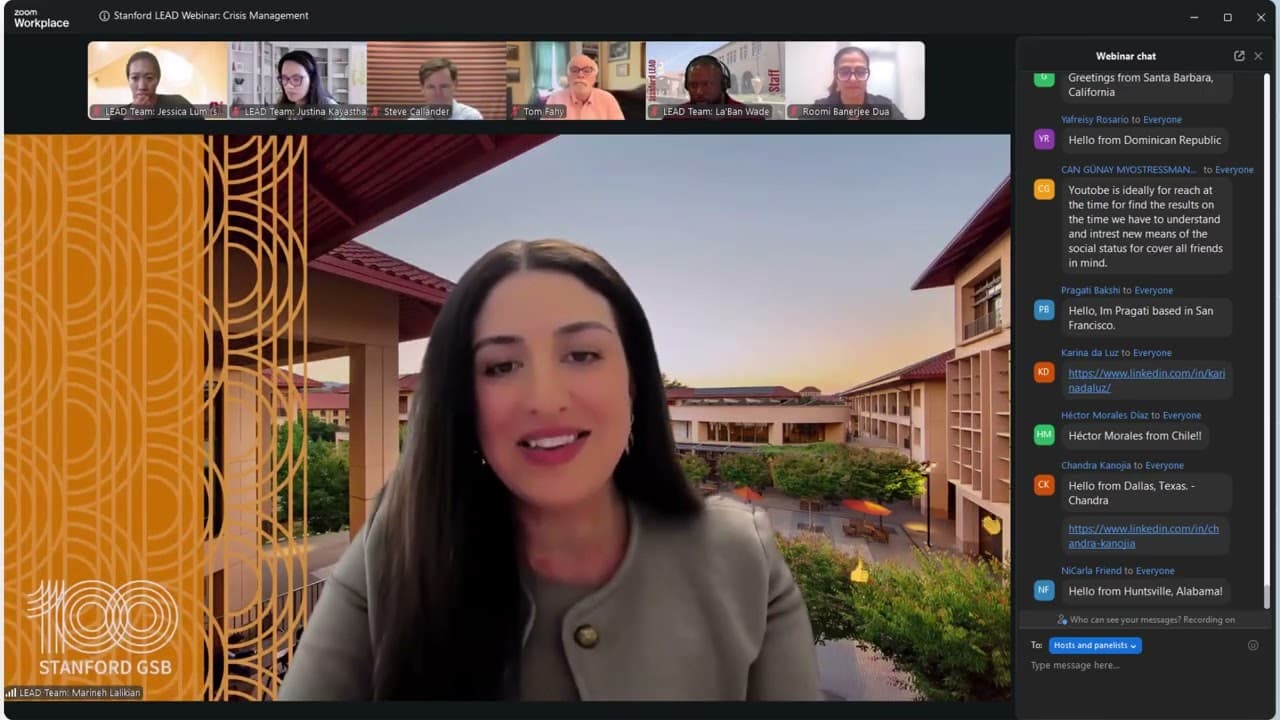

Introduction to the Stanford LEAD Program
- Attendees are invited to join the session on camera by using the "Raise Hand" icon to receive permissions from the event team 0s.
- Participants are encouraged to use the chat box to introduce themselves and share their global locations, with attendees currently joining from various countries including Ecuador, Spain, Turkey, Greece, the Philippines, Armenia, the United States, France, New Zealand, various African nations, Mexico, Argentina, Bulgaria, Saudi Arabia, and the United Arab Emirates 25s.
- Marineh Lalikian and members of the Stanford Graduate School of Business (GSB) LEAD program team are hosting the webinar to provide an overview of the LEAD program and the topic of crisis management 1m35s.
Program Structure and Curriculum
- Stanford LEAD is the GSB’s flagship online program, which has been operating for over a decade and is designed to balance academic rigor with a flexible, supportive environment for working professionals 2m6s.
- The program curriculum requires the completion of eight courses, consisting of two foundation courses, one leadership core course, and five electives chosen from 15 available options 2m45s.
- The coursework focuses on business, leadership, and innovation to assist professionals in navigating complexity, change, and decision-making in an environment impacted by AI disruption 2m35s.
- Courses in the LEAD program are taught by the same senior tenured faculty who instruct in the GSB’s MBA and executive programs 3m15s.
- The program utilizes an experiential learning model that emphasizes hands-on assignments and the immediate application of concepts, often culminating in a final project or course capstone 3m25s.
Community and Facilitator Support
- Course facilitators in the LEAD program function as a hybrid between teaching assistants and executive coaches, providing personalized feedback and tracking student progress to maximize the learning experience. 0s
- The LEAD community is a primary strength of the program, consisting of a global network of over 6,000 participants across more than 110 countries. 22s
- Although the program is delivered entirely online, it is designed to be interactive and social, fostering a diverse environment of professionals from various industries and backgrounds. 35s
- Participants often value the opportunity to engage with peers outside of their own fields, which helps broaden perspectives and generate new ideas by exposing them to different professional contexts. 53s
Flexibility and Career Impact
- The program is designed for flexibility to accommodate the schedules of busy professionals, allowing them to balance a rigorous Stanford education with personal and professional responsibilities. 1m15s
- The LEAD program spans one year on a part-time basis, requiring an average commitment of five to 10 hours per week to complete the eight courses necessary for a professional certificate. 1m28s
- Participants have the option to scale back their course load and extend their enrollment period if a slower pace is required for their schedule. 1m40s
- The program is intended to serve as a career inflection point, helping individuals transition from functional expertise to broader, more confident leadership roles. 1m48s
Crisis Management Fundamentals
- Steve Callander is a professor at Stanford GSB who has been researching and teaching crisis management for over 20 years and currently teaches the crisis management course within the LEAD program. 2m35s
- The crisis management course material taught in the LEAD program is the same content used in the full-time MBA program and executive programs conducted on campus at Stanford. 3m15s
- Crisis management involves developing frameworks and tools to navigate significant organizational challenges 15s.
- Crises are not rare or unusual occurrences; they happen continuously, manifesting on a daily, weekly, monthly, and yearly basis 35s.
- Crisis events are significant rather than minor distractions, as they can have substantial, long-term impacts on both the value of an organization and the people within it 1m5s.
- It is predicted with 100% certainty that individuals in leadership or management roles will face at least one, and potentially many, crises during their careers 1m35s.
- While the specific nature and timing of a future crisis are generally unpredictable due to the complexity of the modern world, the inevitability of such events is certain 1m50s.
- Because crises are inevitable and impactful, managers and leaders have a professional responsibility to prepare themselves and their organizations to handle these events effectively 2m15s.
- Relying on the excuse that a crisis was unpredictable is insufficient, as the predictability of the occurrence itself necessitates proactive preparation 2m30s.
- Examining a variety of real-world examples helps illustrate the frequency and diverse nature of crises, as well as the inherent difficulty in forecasting specific events 3m35s.
Case Studies in Corporate Crisis
- The company Astronomer experienced a significant crisis after its CEO, Andy Byron, and its head of HR were filmed on a Jumbotron "Kiss Cam" at a Coldplay concert. 0s
- As a result of the incident, both the CEO and the head of HR were fired, illustrating how crises can have severe personal and professional consequences for leadership. 25s
- The crisis caused Astronomer to lose valuable human capital and resulted in severe embarrassment and a tarnished reputation for the company. 45s
- While the crisis was unfolding, Astronomer launched an advertising campaign featuring Gwyneth Paltrow as a temporary spokesperson. 1m5s
- The choice of Gwyneth Paltrow served as an in-joke due to her status as the former spouse of the Coldplay lead singer, which helped generate public interest and attention. 1m15s
- The advertising campaign was a strategic effort to educate the public about Astronomer’s products and the company's serious operations, leveraging the attention gained from the crisis to improve brand awareness. 1m25s
- In 2024, Boeing faced a major crisis when a door plug fell off an Alaska Airlines flight while the aircraft was over Washington State. 2m6s
- The incident, which included the discovery of the door plug in a residential front yard, severely damaged public confidence in Boeing as an aircraft manufacturer. 2m25s
- Boeing CEO Dave Calhoun made the strategic choice to publicly admit the mistake and apologize on behalf of the company. 2m45s
- Despite the apology, the crisis ultimately led to the departure of Dave Calhoun, who became the former CEO of Boeing. 3m5s
Financial and Strategic Consequences of Crises
- Crisis events can result in significant financial consequences for companies, as evidenced by the loss of tens of billions of dollars in valuation for Boeing during its period of crisis 0s.
- Dave Calhoun assumed the role of CEO at Boeing following the termination of his predecessor, Dennis Muilenburg, who was fired due to the 737 Max crashes 25s.
- Crises can occur even in situations where a company has not committed wrongdoing, caused physical harm, or engaged in deception 1m5s.
- Bud Light experienced a significant brand boycott in 2023 after partnering with a transgender social media influencer as part of an effort to connect with a younger demographic 1m25s.
- The Bud Light boycott gained traction because the brand's marketing choice coincided with intense cultural and political debates regarding transgender issues in the United States 2m0s.
- Conservative groups utilized the boycott as a tool to punish the brand and advance their own political objectives 2m15s.
- Following the boycott, Bud Light lost its long-standing position as the leading beer brand in America, falling behind Modelo and eventually Michelob Ultra 2m45s.
- The BP oil rig explosion in the Gulf Coast serves as a notable example of a major crisis in the United States 3m15s.
- Tony Hayward, the former CEO of BP, attempted to manage the crisis personally by engaging with the media, politicians, and the public, but was ultimately fired following his performance and testimony before Congress 3m25s.
Global Crisis Examples and Structural Reorganization
- Crises are characterized not only by their significant scale and duration but also by the intense personal experiences they create for the executives involved 0s.
- The Sanlu baby formula contamination in China serves as a notable example of a global crisis that resulted in illness and the deaths of approximately a dozen infants 25s.
- The contamination incident was considered a tragedy and a crime, as it involved the failure to ensure the safety of a product that parents relied upon for their children's sustenance 45s.
- Following the contamination, Sanlu experienced a total collapse in sales, and the entire baby formula market in the region faced a significant decline in consumer trust 1m15s.
- The crisis led to widespread public outrage and protests, and it created a secondary market where individuals purchased baby formula in other countries to resell in China at higher prices 1m25s.
- The Chinese government intervened by prosecuting Sanlu, which resulted in the company being driven into bankruptcy 1m45s.
- Legal consequences for the company's executives included prison sentences for half a dozen individuals and the execution of two people found guilty in connection with the crisis 2m5s.
- The baby formula industry underwent a structural reorganization following the crisis, shifting from a fragmented model to one that is vertically integrated 2m25s.
- Companies recognized that they could not rely on external supply chain partners to maintain safety standards, as the brand owner ultimately bears the legal and reputational risk for product failures 2m40s.
- The potential for a crisis can fundamentally alter the strategic logic regarding the scope of a business and the structure of an entire industry 3m0s.
- Crisis management involves understanding the nature and evolution of crises, identifying available strategies, and integrating these considerations into broader corporate strategy 3m10s.
- Managers must recognize the frequency of crises and take responsibility for preparing themselves and their organizations to effectively manage such events 3m35s.
Stakeholder Management and Crisis Complexity
- Crises manifest in various forms, including those caused by an individual's own actions, accidental events that may or may not be anticipated, and situations where an individual is drawn into a crisis occurring within their community, country, or industry despite having no personal involvement 0s.
- A third, particularly challenging category of crisis involves situations where a crisis is deliberately generated against an entity, such as the actions taken by conservative activists against Bud Light 25s.
- Activists often utilize crises as a strategic tool to advance their own objectives, making it essential for managers to anticipate and prepare for such scenarios 35s.
- Crises are difficult to manage because they expand the scope of concern beyond the firm and market to include society at large, drawing in a wide array of stakeholders 50s.
- Stakeholders involved in a crisis can include the media, the general public, activists, regulators, and politicians, all of whom may choose to engage with the situation 1m15s.
- Effective crisis management requires understanding the goals, motivations, and strategies of the full array of potential stakeholders to better inform a firm's own strategic response 1m30s.
- While large-scale, existential crises often involve the CEO, many crises occur on a smaller scale within specific departments, communities, or regions, making crisis management a responsibility for managers at all levels 1m45s.
- Corporate-level crises often originate from decisions made within smaller subunits, as demonstrated by the Bud Light marketing team's decision to use an influencer for a campaign without anticipating the resulting company-wide crisis 2m15s.
- Frameworks and tools for crisis management are applicable across various scales, ranging from small, internal team issues to large-scale corporate events 2m35s.
Strategic Leadership During Emergencies
- Crisis management is a difficult task that often leads to the downfall of highly intelligent and successful executives, such as former CEOs of Boeing and BP 0s.
- Common advice, such as being transparent or getting ahead of an issue, fails to serve as an effective strategic logic for managing crises 32s.
- Successful managers often struggle during crises because they attempt to apply standard operational management techniques to events that require a fundamentally different approach 42s.
- The primary mistake organizations make is assuming that their existing management talent can handle a crisis without specialized frameworks or tools 1m15s.
- Crisis management is a core responsibility of managers and cannot be delegated to other functions like public relations, legal, engineering, or human resources 1m35s.
- Decisions such as grounding aircraft, shutting down plants, or recalling products are company-wide or unit-wide issues that require the perspective of a manager who understands the entire structure of the problem 1m48s.
- Managers must act as active, strategic participants rather than passive observers during a crisis 2m6s.
- Because there is no time to consult textbooks during an actual emergency, managers must practice crisis skills and frameworks in advance to be prepared 2m15s.
Toyota Crisis Analysis
- Around 2011, Toyota faced a significant crisis involving allegations of sudden acceleration, where owners reported that vehicles would accelerate unexpectedly, leading to numerous accidents and crashes 2m45s.
- Toyota conducted an investigation into reports of sudden acceleration and concluded that the issue was not occurring, though they did identify and fix problems related to floor mats. 0s
- The crisis escalated as the company faced public ridicule, negative media coverage that utilized Toyota's own marketing slogans against them, and a stock price decline of approximately 20%, representing a loss of tens of billions of dollars. 10s
- Toyota responded to the crisis by issuing an apology and recalling millions of vehicles, which included senior executives testifying before the U.S. Congress. 42s
- While the external response addressed the crisis, it triggered a parallel internal crisis, as Toyota engineers were outraged that senior executives apologized for a problem the company did not believe was real. 1m5s
- Managing a crisis often involves accepting that all possible outcomes may be negative and strategically attempting to achieve the best result within that limited range. 1m20s
- Crisis management is a strategic responsibility that requires frameworks and tools to mitigate the risks posed to an organization. 1m35s
Facilitator Roles and Personalized Learning
- The LEAD program at Stanford aims to provide academic rigor and build a global community for individuals who cannot attend campus in person. 1m55s
- Roisin Ryan, an alumna of the Stanford Graduate School of Business, serves as a course facilitator for the LEAD program and met the instructor, Steve Callander, through the online course. 2m25s
- The LEAD program has maintained a consistent group of course facilitators since its inception, many of whom have long tenures due to their belief in the quality of the online learning experience 0s.
- Course facilitators are located globally and serve as a key differentiator for the program by providing personalized support to participants 35s.
- Facilitators function as a hybrid between teaching assistants and executive coaches, offering both academic guidance and professional mentorship 1m15s.
- In their capacity as teaching assistants, facilitators are experts in course content and requirements, helping busy professionals navigate assignments and deadlines with flexibility 1m30s.
- Facilitators provide various forms of assessment, including individual feedback, team-based feedback, and summary guidance for groups to highlight module themes 2m5s.
- Many facilitators are professional executive coaches and industry practitioners with extensive experience, such as corporate strategy or brand reputation management 2m25s.
- Facilitators apply their practitioner experience to help participants understand how to implement course concepts within their own organizations and industries 2m50s.
- To ensure personalized support, the number of participants assigned to each facilitator is capped, allowing for close interaction over the eight-week course duration 3m10s.
- Facilitators review participant profiles to understand their specific industry, regulatory environment, role, and geographic location, accounting for cultural differences in their approach 3m25s.
Interactive Learning and Course Structure
- The program emphasizes a personalized learning experience where faculty get to know participants over an eight-week period by reading their assignments and experiences to provide tailored feedback 0s.
- Many leadership courses within the program offer one-on-one coaching sessions with dedicated coaches 25s.
- Participants have access to group discussions and office hours, which serve as opportunities to discuss course materials, prepare for assignments, and engage in rich, interactive conversations 33s.
- The role of the course facilitator is to support community engagement, ensure interaction between peers and the program team, and help participants integrate module learning into their specific professional circumstances 55s.
- Facilitators aim to constructively challenge participants by encouraging them to think outside the box and apply course concepts to their everyday work 1m15s.
- An introductory period occurs before the modules open, allowing participants to familiarize themselves with the content, understand assignment deadlines, and plan their time effectively 1m45s.
- The course structure varies, with some courses featuring one module per week and others spanning two weeks per module 1m55s.
- The introductory phase provides an opportunity for participants to meet one another and for faculty to reach out personally to establish connections 2m15s.
- The crisis management course incorporates teamwork, as working in teams is considered essential for responding to crises 2m35s.
- Teams are assigned by the program rather than self-formed, with careful consideration given to time zones to facilitate easier collaboration among members 2m45s.
- The first four weeks of the crisis management course are dedicated to establishing the foundational building blocks required to create a crisis management response 3m5s.
Crisis Management Course Modules and Simulations
- Crisis management skills are applicable to individuals at all professional levels, as the core objective is the management of personal, team, or company reputations 0s.
- Modules one through four establish a foundational playbook for crisis management, covering techniques for interpreting events, storytelling, managing media responses, and addressing intentional crises where actors manipulate narratives for their own purposes 15s.
- Module five features an experiential crisis simulation designed to integrate the concepts learned in the first four modules 42s.
- The program emphasizes active, real-time application of knowledge rather than passive content consumption 55s.
- Modules six through eight shift focus toward internal mobilization during a crisis and personal leadership reflections regarding how an individual chooses to conduct themselves during challenging situations 1m20s.
- During the module five simulation, participants are instructed to organize early and collaborate with their teams, utilizing previously established team dynamics 1m55s.
- Preparation for the simulation involves reviewing provided materials and having frameworks and tools from the first four modules readily available, as lack of preparation often leads to poor performance 2m15s.
- The simulation requires teams to produce a crisis strategy document, which is evaluated upon completion 2m35s.
- The simulation is a 70-minute, dynamic online event where the crisis evolves in real time, requiring teams to synthesize their learning and submit a response strategy before the time expires 2m55s.
Practical Application and Real-World Exercises
- The reputation management course is designed for practical application in everyday professional roles. 0s
- The curriculum includes a live session each week where the professor dissects a case study to provide learning opportunities. 5s
- Students participate in mock town hall exercises throughout the course, where one team presents a crisis response while others participate in the simulation. 15s
- The program emphasizes experiential learning rather than passive instruction, with the goal of challenging participants to apply concepts to their own work. 25s
- Interaction in the online course occurs through live sessions, message boards, Zoom-in sessions, and assignments facilitated by course staff. 55s
- Tom Fahy, a lobbyist in Washington, D.C., describes the course as a significant investment for career and company development. 1m25s
- The course cohort provides a global perspective, with participants in Fahy’s team based in locations including British Columbia, Chile, Brazil, and Northern India. 2m6s
- During the crisis management exercise, participants are assigned specific roles, such as CEO or media manager, to simulate corporate crisis response. 2m25s
Case Studies and Professional Perspectives
- The crisis management course at Stanford is described as a highly practical, real-world learning experience that addresses complex executive decision-making 0s.
- One notable case study involved a food company in South America navigating a crisis that required executives to balance profit considerations against the life and safety of their employees 25s.
- The curriculum includes case studies that are also utilized in similar crisis management programs at other institutions, such as Harvard, allowing for comparative analysis of decision-making outcomes 1m5s.
- Roomi Banerjee Dua, the Global Safety and Recall Management lead at Roche Diagnostics, completed the Stanford LEAD crisis management course in 2025 2m15s.
- In her professional role, Roomi Banerjee Dua manages post-market safety, quality, compliance, and global recalls for diagnostic medical devices, working closely with regulators like the FDA and healthcare professionals 2m30s.
- For professionals in the medical device industry, a crisis involves not only business risk but also potential diagnostic crises and impacts on clinical outcomes and patient lives 3m5s.
- The course utilizes simulations where students are divided into groups to navigate through various crisis scenarios 3m35s.
- A primary benefit of the course is the provision of specific tools designed to help participants navigate and manage crises effectively 3m50s.
Tools for Crisis Preparation
- The premortem is a practical tool used to anticipate potential crises before they occur, allowing for better preparation and navigation of difficult situations 0s.
- When building a crisis management team, it is essential to carefully consider the composition of the group, including the size of the team and the specific individuals required for effective response 35s.
- A crisis is an event that can be transformed into an opportunity for oneself, or conversely, it can become an opportunity for competitors if not managed properly 52s.
- The LEAD course provides a playbook of frameworks and tools designed to help individuals navigate crises in both professional and personal contexts 1m15s.
- The curriculum emphasizes the application of theory to real-world scenarios, ensuring that managers across various industries and seniority levels can utilize these skills to improve their success 2m15s.
- The LEAD program aims to reach a global audience of managers, providing them with the knowledge and skills necessary to address their specific professional challenges 2m45s.
- A panel discussion featuring program ambassadors is scheduled to follow the presentation to share further experiences regarding the LEAD program 3m15s.
- The next cohort for the LEAD program is scheduled to begin in September 3m45s.
Admissions and Program Enrollment
- Applications for the LEAD program are due on August 5th, providing approximately three weeks for prospective students to prepare their materials 0s.
- Prospective students with questions regarding tuition payment options, the application process, or other administrative matters are encouraged to contact the LEAD team directly 7s.
- The program aims to welcome new participants to the Stanford Graduate School of Business (GSB) community in September 35s.
- A panel discussion featuring program ambassadors Roomi Banerjee Dua and Tom Fahy is scheduled to last approximately 20 minutes, focusing on their experiences, professional growth, and strategies for balancing the program with busy schedules 1m5s.
- Roomi Banerjee Dua, who had 16 to 17 years of experience in the healthcare industry, decided to pursue the LEAD program to transition from a functional leadership role to a broader understanding of the business side of her industry 2m15s.
- The decision to enroll was influenced by observing the professional and personal growth of her spouse, who completed the LEAD program during the pandemic 2m35s.
- The program's online format and the ability to select electives, such as neuroscience, were key factors in Roomi Banerjee Dua's decision to enroll while continuing to work 3m5s.
- The reputation of Stanford as a global educational institution served as a primary motivation for choosing the program 3m15s.
Alumni Experiences and Program Impact
- An individual was days away from enrolling in a different graduate program when they were contacted by Diane Farrell, an advocate for the Stanford LEAD program based in Dublin, Ireland 0s.
- After learning about the Stanford LEAD program, the individual decided to enroll, noting that the interaction with the program ambassador was the deciding factor in their choice 25s.
- The Stanford Graduate School of Business operates under the motto of changing lives, changing organizations, and changing the world 1m15s.
- Over the past decade, participants in the LEAD program have reported significant personal and professional growth, including the successful launch and scaling of new projects, initiatives, and ventures 1m35s.
- Some participants have utilized the program to transform their own mindsets as well as the mindsets of their teams and organizations 1m55s.
- Tom Fahy, who works in political risk and represents weather technology companies before Congress, found the coursework in strategic leadership and crisis management to be highly beneficial to his professional work 2m35s.
- Tom Fahy credits his success in the program to his cohort, specifically the "Pacesetter" cohort, and maintains ongoing communication and substantive professional discussions with former classmates such as Stephen Perkins 2m55s.
- Roomi Banerjee Dua reported experiencing both personal and professional growth through the program and has implemented specific tools, such as feedback from a leadership 360-degree course, within their team 3m45s.
- Implementing structured feedback practices, including both giving and receiving feedback, has improved communication within global teams operating across different time zones at Roche. 0s
- Participation in the "Intentional Leadership 360" course provided communication frameworks that were subsequently shared with team members to change internal thinking and team dynamics. 18s
- The "Power to Lead" course, taught by Professor Pfeffer, influenced how individuals present themselves, including aspects of professional appearance and communication style when addressing leadership during a crisis. 42s
- Framing a crisis as an opportunity rather than a catastrophe is a key shift in perspective gained from the program, which has influenced how participants interact with leadership. 1m5s
- Critical analytical thinking frameworks acquired through the program have been applied to team management, creating a positive "chain reaction" of influence that spreads throughout the organization. 1m15s
- The positive outcomes and influence of the LEAD program have encouraged other employees at Roche to enroll in the course. 1m32s
Balancing Coursework and Professional Life
- Tom Fahy noted a high level of engagement from webinar participants, many of whom requested to connect on LinkedIn to discuss the LEAD program. 2m15s
- The LEAD program is designed to be flexible to accommodate the professional and personal commitments of participants. 2m55s
- The program is a one-year, part-time, fully online commitment that requires an average investment of five to 10 hours per week. 3m15s
- The curriculum is structured into four quarters, with each quarter lasting eight to nine weeks and including breaks in between. 3m30s
- The program requires the completion of eight courses, which most participants finish in one year by taking two courses at a time 0s.
- Participants have the option to scale back to one course at a time, reducing the time commitment to approximately three to five hours per week 10s.
- Enrollment can be extended for up to two years, and participants may take a temporary leave of absence if necessary 20s.
- The program structure is designed to accommodate individual schedules, and participants often develop their own methods for balancing the coursework with professional and personal commitments 35s.
- The initial phase of the program involves taking financial innovation and critical analytical thinking courses simultaneously, which helps participants establish a pace and learn time management skills 1m15s.
- Course facilitators organize groups and pairs for assignments based on time zones to minimize scheduling conflicts for participants 1m45s.
- Effective communication with course facilitators is recommended, especially when participants anticipate difficult periods at work or personal crises, as facilitators are available to provide support and flexibility 2m15s.
- Peer support is a significant component of the program, with team members often assisting one another with assignments during challenging times 2m35s.
- The curriculum features a mix of individual and group assignments, and many participants utilize weekends to complete their coursework 2m55s.
- Some assignments are designed to be integrated into daily life, such as a negotiation course that involves practicing skills during routine activities like grocery shopping 3m15s.
- The value gained from the program is proportional to the effort invested in studying the material, with assignments and team interactions serving as key mechanisms to keep participants on track 3m45s.
Flexibility and Financial Considerations
- Tom Fahy experienced significant life events during his enrollment in the LEAD program, including a period of illness due to RSV and a major professional promotion that required him to take two separate leaves of absence 0s.
- After being dropped from the program due to a year-long absence, Fahy was permitted to re-register and complete his studies, which he cited as evidence of the program's patience and flexibility 0s.
- The LEAD program aims to ensure that motivated participants can succeed, acknowledging that the program requires a significant investment of time, energy, and resources 42s.
- Over 95% of participants report that the program is worth the investment 42s.
- Program tuition is billed in four quarterly installments of $4,800, with options available to spread payments across multiple calendar years to assist with employer reimbursement caps or personal financial planning 42s.
- Fahy, who self-funded his participation through his own company, described the experience as outstanding and noted that the financial cost was inconsequential compared to the value of the experience 1m35s.
- Roomi Banerjee Dua expressed a strong desire to remain involved with the LEAD community, noting that she continues to take courses even after receiving her certification 2m6s.
Application Process and Closing Remarks
- Applications for the cohort beginning in September are currently being accepted, with a deadline of August 5th 2m28s.
- The application process for LEAD does not require GRE or GMAT scores, and there is no application fee 2m28s.
- The application requirements are designed to help prospective students clarify their goals and their motivations for pursuing the program 2m28s.
- Prospective students are encouraged to submit applications to share their goals with the program 0s.
- There is an anticipation of welcoming new members to the Stanford LEAD and Graduate School of Business community in September 0s.
- Rumi and Tom are acknowledged for their participation, insights, stories, and advice provided during the session 5s.
- Participants are thanked for their engagement throughout the discussion 5s.
- Individuals interested in learning more about the LEAD program are invited to contact the admissions team via email at LEADadmissions@stanford.edu 15s.
- The admissions team is available to discuss the program details with interested parties 15s.