
Initial Interview and Idea Pivoting
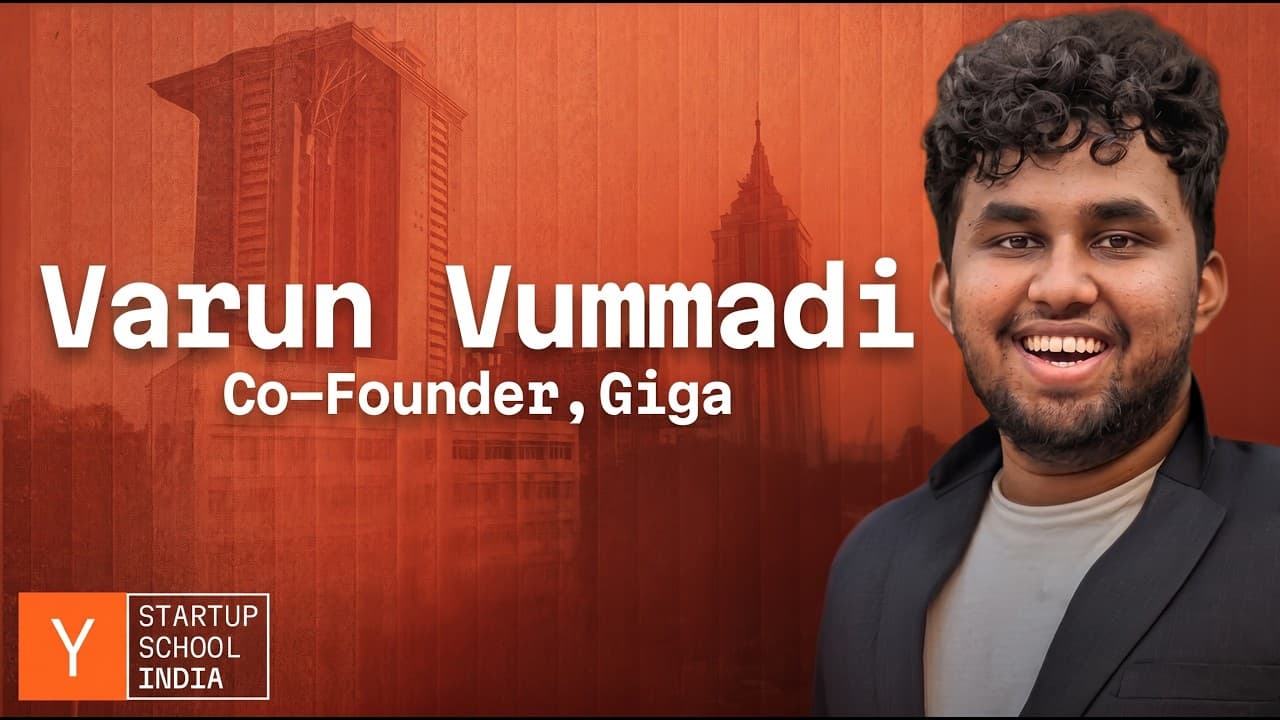
- Varun from Giga ML was initially panicked after an interview, but was advised by Hajj to pick a different idea and work on it, and this conversation took place after Varun had prepared extensively for the interview by chatting with various founders and learning about their ideas and Total Addressable Market (TAM) 10s.
- Giga ML builds AI agents for customer support, working with major companies such as Doash, a top crypto exchange, and top three telecom providers in the world, with the goal of achieving 90 to 95% deflection rates, providing a better experience for customers 2m6s.
- The traditional customer support process involves IVR or chatbots, followed by human support, with deflection rates of 10 to 15%, whereas AI-powered support can achieve deflection rates of 60 to 70%, and Giga ML aims to further improve this rate 2m6s.
Background and Early Career Decisions
- Varun's upbringing was in a small town in Andhra Pradesh, where his parents, both government teachers, encouraged him to become an engineer or doctor, and he eventually got into IIT, where he studied electrical engineering and later became interested in research on LLM at Stanford 4m42s.
- During his college years, Varun was offered a job at a leading quant firm in New York with a salary of $550,000, and was also accepted into a PhD program at Stanford, but he decided to pursue building a startup instead, inspired by reading Paul Graham's essays and the 2014 YC Startup School 6m15s.
- Varun and his co-founder, whom he met in freshman year, applied to Y Combinator (YC) and got in, despite having a different idea initially, which was an edtech platform using LLM, but were advised by Hajj to pick something else during the interview 8m30s.
Pivoting from EdTech to AI Fine-Tuning
- The individual was panicked when they were told to pick a new idea after their initial edtech concept was rejected, having never prepared for such a scenario and having focused heavily on preparing for the interview, which did not go as expected 10s.
- The co-founders have different backgrounds as engineers, with one being a book-oriented person who was highly ranked in IIT and the other being more of a hacker who participated in Kaggle competitions to win money, with the latter making around $50,000 from these competitions 2m6s.
- The experience with Kaggle competitions and experimenting with machine learning models eventually led to the decision to apply to YC, where they were advised to pivot from their initial edtech idea, and after a month, they decided to focus on fine-tuning, inspired by a research paper on caching LLMs to reduce costs 4m42s.
- The fine-tuning idea gained traction, with the open-sourcing of models, topping hugging face benchmarks, and raising a $4 million seed round, but it was noted that the market for fine-tuning is not ideal for various reasons 8m24s.
Founders' Background and Team Dynamics
- The co-founders have different backgrounds as engineers, with one being a book-oriented person who was highly ranked in IIT and the other being more of a hacker who participated in Kaggle competitions to win money, with the latter making around $50,000 from these competitions 2m6s.
- The experience with Kaggle competitions and experimenting with machine learning models eventually led to the decision to apply to YC, where they were advised to pivot from their initial edtech idea, and after a month, they decided to focus on fine-tuning, inspired by a research paper on caching LLMs to reduce costs 4m42s.
- The fine-tuning idea gained traction, with the open-sourcing of models, topping hugging face benchmarks, and raising a $4 million seed round, but it was noted that the market for fine-tuning is not ideal for various reasons 8m24s.
- The co-founders' journey involved pivoting from their initial idea, with guidance from Harge and others, including a meeting with the Coursera COO and other successful edtech professionals, who advised against pursuing edtech, leading to the exploration of new ideas and eventually the development of their current project 6m15s.
Fine-Tuning and Market Challenges
- The primary reason for fine-tuning is to reduce costs and increase speed, and another use case is to make a product more secure and sellable to big companies like insurance or healthcare firms, which often involves a sales process rather than an engineering one 10s.
- The discovery of the customer support use case came from existing customers, with Zeppto being the first customer for this particular product, and this discovery was made after about a year of operation 1m42s.
- The decision to focus on customer support was made despite the existence of other companies in the market, such as Sierra, but the founders were unaware of these competitors at the time and were more focused on delivering value to their customers 2m6s.
Early Success and Client Acquisition
- The company won a contract with Door Dash, a large and well-established company, despite being a small team of only eight people at the time, and this was partly due to the introduction from YC and the fact that Door Dash is a meritocratic company 4m10s.
- The company's success with Door Dash helped to establish trust with other large companies, and they have since worked with the biggest crypto exchange in the US and several Fortune 500 companies to automate their support 6m40s.
Company Evolution and Strategic Focus
- The company has evolved over the last few years, with a focus on working with large-scale companies and observing that the key to success for any agentic company is to boil down their operations to two fundamental things 8m20s.
- The founders of a startup iteratively improve their markdown file to affect business KPIs, such as support resolution rate, and apply the same fundamentals to compliance, ITM, and ITSD, with some of the biggest consumer companies in the US piloting their product for internal support, at 10s.
Advice for Young Entrepreneurs
- The advice given to college students and young people is to take a shot and see if their ideas work out, rather than playing it safe, and to focus on reaching their potential, as the founders did when they rejected a $550K job offer to build their startup, at 2m6s.
- The founders' decision to turn down the job offer was motivated by a desire to see how high they could go and to reach their potential, rather than by money, with one of the co-founders being fundamentally unmotivated by money, at 2m6s.
- The founders' parents were not excited about their decision to start a startup, with the father being super mad, but they eventually understood that their child could always go back to a job if the startup did not succeed, at 4m42s.
- The lesson from the founders' experience that applies to college students and young people is that it is not about the idea, but rather about taking a shot and seeing if it works out, and that it is okay to make mistakes and work on stupid ideas that do not make any revenue, at 8m10s.
Startup Mindset and Validation
- The approach to building a successful product involves determining if someone is willing to pay for it, and if the customer can actually pay, with a commitment from the customer before building the product 10s.
- Charging for a product early on is useful because if a problem is important enough, people will pay for its solution, either with money or time, and solving a fake problem is not worthwhile 2m6s.
- For B2B companies, people should be willing to pay money for a solution to an important problem, and social media networks are an example of a product that people pay for with their time 2m6s.
Company Growth and Location Strategy
- When expanding a company, it is essential to stay close to customers, and for research-based things, San Francisco is a good location due to its access to researchers and innovation, while India is suitable if the customer base is primarily there 4m30s.
- The company's future involves evolving and continuing to innovate, with a focus on building an AI forward deployed engineer to tackle AI adoption in enterprises and automate the work of forward deployed engineers 8m30s.
Operational Automation and Internal Use of AI
- The company runs internally using AI, with a value of "automate, automate, automate," and uses various automation tools to streamline the work of engineers, salespeople, and other employees, with the goal of automating all of the world's work 10m50s.
- The company's product, Cloud Code, has been used innovatively by people to drive specific insights, such as salespeople using it to analyze transcripts and identify trends, and it has turned many people into builders 10s.
Productivity Tools and Engineering Efficiency
- Without coding agents, the company would likely need six to seven times more engineers, but using this tool allows them to work more efficiently and ship products faster, without the need for context switching 2m6s.
- The company's interview process is designed to test candidates' coding abilities, asking them to write code and then remove AI access to change the code, in order to understand how the code works 4m42s.
Hiring and Talent Strategy
- The company looks for candidates with extraordinary abilities and spikiness, such as exceptional coding skills, and this approach has been successful for the founders, who themselves had high-paying job offers before starting the company 6m15s.
- The founders, who are computer scientists, did not have a business background before starting the company, but they have learned as they go, and they believe that finding the right buyer and having a good product is more important than having prior business experience 10m30s.
- The founders' technical abilities have allowed them to build a successful company, and they have learned to navigate the business side of things through experience, with a bias towards builders and sellers 12m40s.
Product Focus and Business Philosophy
- The importance of a company's product is highlighted, with the example of successful companies like Anthropic and OpenAI, which do not prioritize sales, and instead focus on delivering value to customers, as the co-founder was initially mistaken in thinking sales was the most important aspect 10s.
- The co-founder reflects on their experience, having spent 2 or 3 years working on their startup, splitting time between San Francisco and Bangalore, and realizes that getting started and taking the leap is crucial, as it forces individuals to make things work and creates a sense of urgency 2m6s.
Startup Journey and Risk-Taking
- The co-founder advises that burning one's bridges, or in this case, turning down job offers, can be beneficial as it forces individuals to make their startup successful, and notes that having a job to fall back on can make one less motivated to take risks 2m6s.
- The co-founder emphasizes the value of taking action and building things, especially with AI, where the cost of building is low, and encourages people to deliver value to a small set of customers and see if they can generate revenue 2m6s.
- Varun, the co-founder, shares his parting thoughts and reflections, highlighting the importance of taking the leap and trying to deliver value to customers, and is thanked for sharing his insights 2m6s.