

Introduction to Organizational Culture and the Book
- The book on organizational culture was written by Jenny Chatman, a social psychologist and dean at the Haas School of Business in Berkeley, and a sociologist, who have known each other for a long time and have finally collaborated on this project, bringing their unique perspectives to the table 10s.
- The authors' goal was to write a book for a general audience, including managers and executives, as they believe that despite the importance of organizational culture being widely recognized, many business people and managers have received very little formal training on the subject 2m6s.
- The book aims to inform people about what social scientists think about organizational culture and why it's important, by addressing five common beliefs or myths that are pervasive in the world, with each chapter confronting one of these myths in some length 2m6s.
The Importance and Recognition of Organizational Culture
- The importance of organizational culture is widely acknowledged, with 80 to 90% of top executives, including CEOs, stating that culture is a very important part of their business and a key factor in their success, according to surveys conducted by top consulting firms 4m42s.
- Despite this recognition, there is still a noticeable discomfort and uncertainty among business people and managers about how to effectively manage and utilize organizational culture, leading the authors to try to provide a clear and informed perspective on the subject 6m15s.
Building and Sustaining a Strong Organizational Culture
- The concept of building and sustaining a strong organizational culture is crucial, and there are various levers that managers can utilize to achieve this, which will be discussed later, including a managerial how-to playbook 10s.
- A strong organizational culture can empower employees to make decisions, reducing the need for managerial intervention, as seen in the example of Reed Hastings, the founder and previous CEO of Netflix, who wrote about the culture of Netflix in his book "No Rules Rules" 2m6s.
- Research has shown that strong culture organizations have fewer managers and administrators, resulting in lower managerial overhead, as the managerial work is often done by peers and workers themselves, eliminating the need for managerial intervention 4m42s.
Key Topics and Structure of the Discussion
- The discussion will cover four key topics: defining a good culture, how culture affects performance, the five core beliefs, and the managerial levers for culture, with the goal of understanding what makes a good culture and how to evaluate it 6m15s.
- Evaluating an organization's culture involves assessing its alignment, which is a key factor in determining whether an organization has a good culture, and this can be applied to various organizations, including Stanford, to understand its culture and identify areas for improvement 8m40s.
Culture and Strategy Alignment
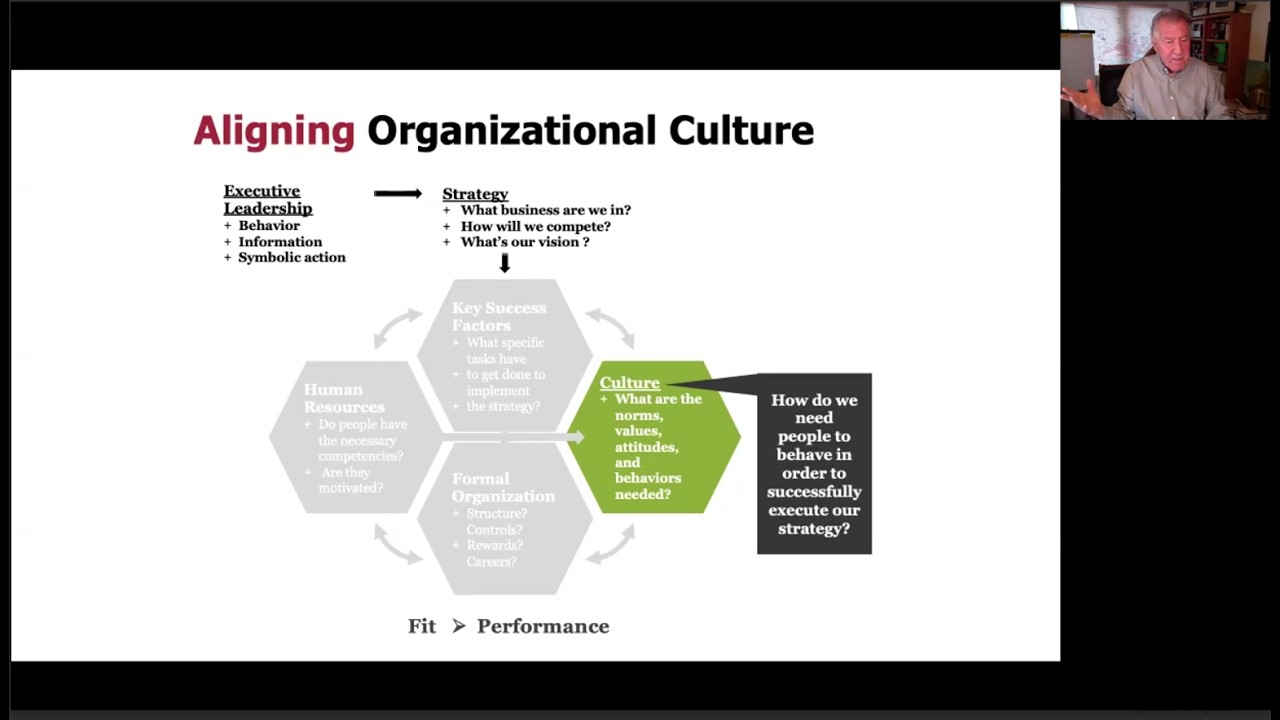
- The culture of an organization is aligned with its strategy, and the strategy precedes the culture, with executive leaders laying out the vision, imperatives, and key success factors for the organization 10s.
- To achieve the strategy, organizations need to break it down into specific accomplishments and tasks, and design the formal structure, including human resources, to support it, with culture playing a crucial role in how people behave to execute the strategy 42s.
- Culture is essential in guiding employees' decisions and behaviors when they encounter uncertain situations, and it helps them determine what is the right thing to do for the organization, with a highly aligned culture being critical for successful strategy execution 1m26s.
Cultural Messaging and Alignment Evaluation
- A cultural messaging statement, such as the "Grooves" developed by a multi-billion dollar company, can outline the core values and principles of an organization, including human empowerment, respect for individuals, and a bias for action, and can be highly embraced by employees 2m6s.
- To determine if a culture is good and aligned, it is necessary to evaluate whether it supports the organization's strategy, and a highly aligned culture should be able to convey the company's strategy, industry, and competitive approach through its cultural messaging statement alone 3m30s.
- The "Grooves" cultural messaging statement, despite being highly embraced by employees, does not clearly convey the company's strategy or industry, making it a challenging task to guess the company's business or strategy based on the cultural statement alone 4m40s.
Examples of Cultural Alignment and Misalignment
- Dreyer's Grand Ice Cream, now part of Nestle's, is an example of a company with a cultural message that is not negatively aligned, but could be more tightly aligned by incorporating aspects such as customer service and product innovation, which are important to the company's manufacturing business and interactions with people 10s.
Nature and Management of Organizational Culture
- Organizational culture is a naturally occurring phenomenon that exists in every organization, similar to the personality of an individual human, and can be likened to a dynamic process that is socially reactive and can be managed by leaders, but is entirely optional, except in cases such as sexual harassment 2m6s.
- High-tech companies, such as Google, Netflix, and Meta, consider culture to be the secret sauce that determines their success and spend a lot of time working on it, recognizing the importance of culture in achieving their goals 4m42s.
- Cultural behavior in an organization is behavior that occurs without thought, almost automatically, as opposed to deliberative behavior, which requires thinking and cognition, and can be understood at various levels of abstraction, including norms and expectations 6m10s.
- The concept of organizational culture can be complex and multifaceted, and leaders can choose to manage it or leave it unmanaged, but doing so can result in leaving many opportunities on the table, and companies like IBM, under the leadership of Lou Gerstner, have recognized the importance of culture in driving success 5m30s.
Dimensions and Content of Organizational Culture
- Culture is not just about fun and games, but rather it has three big dimensions, with the first dimension being content, which refers to the description of norms, expectations, values, and beliefs, such as eating habits, intermarriage habits, and property ownership, and can be described as the actual description of a group's or organization's culture 10s.
- The content dimension is the most natural way to think about culture, and examples of content descriptions include Google's lack of vacation policy, flexible work hours, and provision of free food and laundry services, but content is not considered important on its own 1m42s.
- A strong culture is defined by the combination of high intensity and high agreement, where intensity refers to strongly holding a particular norm or belief, and agreement refers to a shared understanding of core values and beliefs that are essential for the organization's success 4m6s.
- In a strong culture organization, individuals feel strongly about certain norms or values and will intervene to help others do things the right way, without being prompted by a boss, and there is a high level of agreement on core beliefs and values 6m3s.
- Content is considered irrelevant because any type of content can be used to build a strong culture, and examples of organizations with strong cultures include SWAT teams, Navy SEALs, religious cults, and social movements, which all rely on high intensity and high agreement 8m42s.
Culture as a Social Control System
- Culture is not just a soft concept, but rather a social control system that can be very powerful, and it is a set of techniques for producing strong intensity and agreement, which can be used for good or bad, depending on the organization's goals and values 12m10s.
- Strong culture companies often make tough decisions, including terminating employees who do not conform to the company's values, which can be a difficult but necessary decision for the benefit of the organization as a whole 10s.
Benefits of a Strong and Aligned Culture
- A well-aligned and strong culture can bring numerous benefits, including increased employee commitment, easier execution of tasks, more agility, and greater resilience 2m6s.
- There are two basic ways that culture affects organization performance: content alignment, where the culture guides employees in executing the company's strategy, and commitment, which enables smoother coordination among employees 2m6s.
- Companies like Walmart and Amazon are examples of content alignment, where Walmart's culture is focused on everyday low costs and Amazon's culture is innovation-oriented and customer-centric 2m6s.
Content Alignment and Cultural Strategy
- To achieve content alignment, companies must define their strategy and identify the cultural attributes needed to execute it, such as being a low-cost provider or offering high-perceived quality 2m6s.
- Some companies, like Amazon, may have a bifurcated culture, where different parts of the organization have different cultural attributes, and understanding these nuances is important for effective culture alignment 2m6s.
Commitment and Coordination in Strong Culture Organizations
- A strong organizational culture can deliver on performance through increased commitment and enhanced coordination, where individuals with shared values, norms, and beliefs create solidarity and develop loyalty to each other, leading to intrinsic motivation, which is a powerful motivator 10s.
- Intrinsic motivation is considered more powerful than extrinsic motivation, which is driven by material rewards, and is often the focus of strong culture organizations, allowing for efficient coordination and decision-making without the need for extensive debate or involvement from management 2m6s.
- Enhanced coordination in a strong culture organization enables individuals to act in similar circumstances when faced with new situations, without needing to debate or worry about it, and can lead to content alignment or enhanced communication and coordination, ultimately impacting the company's bottom line 2m6s.
Leadership and Cultural Influence: The Mary Barra Example
- The story of Mary Barra, the CEO of General Motors, illustrates the importance of a strong culture, as she simplified the company's dress code from a 10-page document to just two words, "Dress appropriately", demonstrating her commitment to creating a more efficient and trusting work environment 10s.
- Mary Barra's approach to leadership and culture is shaped by her experience working at General Motors, where she was rotated through different functions and locations, giving her a broad perspective of the company, and ultimately leading her to make decisions that promote a strong and efficient organizational culture 10s.
- A company's culture can be revealed through small things, such as a dress code, and empowering employees to make decisions is important, as seen in a story where an executive insisted on a simple "dress appropriately" policy, allowing employees to use their judgment 10s.
- The simplicity of the dress code policy has worked for the company, with employees understanding the need to dress appropriately for interactions with clients and customers, and the company has not encountered any issues with this approach 2m6s.
Implementing and Embedding Core Values
- An overarching mission is important in guarding culture, but it is also crucial to translate core values down to the unit, work group, and individual levels, as simply advertising a set of values or norms is often not enough 8m42s.
- Most big companies fail to effectively implement their core values, as it requires a continuing process of working through what the values mean in each particular unit, which is hard work and takes a long time 10m15s.
- The process of developing and implementing core values is illustrated in a chapter of the book, where Jennifer Cook at Intact works through this process in a unit she takes over, providing a detailed example of how to effectively develop and implement core values 12m30s.
Changing Organizational Culture
- The speed at which a culture can be changed depends on various factors, including the culture itself, the people involved, and the urgency of the situation 15m45s.
- Changing a company's culture can take around 5 years, as seen in the example of Agilent, which was started by Ned Barnholt to build upon the existing HP culture and add speed, focus, and accountability, although some companies like Ford Motor Company, led by Alan Mulally, have achieved radical cultural changes in under a year 10s.
Mission and Core Values in Culture
- The importance of having an overarching mission is highlighted, as it provides a big vision that is consistent with the company's values and helps to avoid conflicts in the culture, with the goal of having a unified and explicit reason for any deviations from this mission 2m6s.
- A company's stated core values, such as "be curious" and "put people first", are not sufficient to define the culture's content, as they need to be accompanied by specific examples to make them meaningful and avoid ambiguity 2m6s.
- Having a unified statement, such as "always low prices", on top of core values can be beneficial, but it is essential to go beyond just a statement and ensure that the cultural message is embedded in various aspects of the company 4m30s.
Empowerment and Ownership in Culture
- Individuals need to be empowered by others to act like owners, as many people are afraid to take bold decisions due to fear of getting in trouble, and empowerment involves creating a safe environment where people can make decisions without being punished for their efforts 6m30s.
- Empowerment is not a contradiction to the notion of acting like an owner, but rather a way to encourage people to take ownership and make decisions that benefit the company, as long as their intentions are right and they are trying to help the company 8m0s.
Success Without a Strong Culture
- Some teams can be dysfunctional yet still achieve success, and having a good culture is not necessarily a requirement for success, as companies can succeed due to factors such as being in the right place at the right time, having the right technology, or structural opportunities 10s.
- The example of the Ryder Cup golf match between the US and Europe is often cited, where despite the US having better talent, the Europeans often win due to their ability to function more like a team, with involvement in planning, assistance, and a year-long effort 2m6s.
Fixing Cultural Issues and Cultural Change
- A new CEO can fix maladaptive practices, such as meetings starting late, by refusing to meet on the old rules and pointing out what's not working, and this can be turned around relatively quickly, potentially in months or weeks 42s.
- However, fixing larger cultural issues in an organization is much harder and takes more time, as it involves realigning customers, investors, and entire departments 42s.
Risks of Cultural Alignment: Groupthink
- Alignment in an organization can also pose a risk of groupthink, where everyone is wrong, as seen in the case of Uber, which had a culture that was aggressive and hard-nosed, allowing them to break into the established taxi business, but also produced negative byproducts, such as the mistreatment of women 2m6s.
- The Uber case highlights the importance of balancing alignment with diversity of thought and opinion to avoid groupthink, and the company has since revised its culture under a new CEO 2m6s.
Examples of Groupthink and Cultural Misalignment
- The company Lyft was the first to break the law in the market where Uber was also operating, but Uber received the blame due to its reputation, despite not breaking the law and abiding by regulations as a black car service 10s.
- Eastman Kodak had the technology for digital photography before others, but the company's commitment to film and group think led to its decline as digital photography became dominant, making it a notable example of how group think can negatively impact a company 2m6s.
- The example of Synanon, a religious cult, illustrates how group think can lead to harmful outcomes, as the cult's members were convinced of their rightness despite being considered evil by most people 4m42s.
Political Beliefs and Corporate Culture
- The political polarization in recent years may have an impact on corporate cultures, with some companies allowing employees to hold their own political beliefs without affecting work, while others, like Google, have faced problems related to political beliefs and government contracts 6m15s.
Balancing Cultural Alignment and Diversity
- A strong culture organization can be considered a problem by advocates of diversity, who point to studies showing that diverse groups make better decisions, but it is also important to have agreement and homogeneity within a team to execute tasks efficiently 8m50s.
- Ideally, a company should have a culture where everyone is aligned on key values, but also allows for heterogeneity in other aspects, such as having assertive, bold, and curious people, which can lead to a diverse workforce, for example, with a high percentage of female employees 11m30s.
Challenges in Diversifying the Workforce
- Diversifying an employee base, including the executive base, can be challenging, especially when trying to find people with specific characteristics in smaller populations, and it takes a lot of money and effort to do so 10s.
- Leaders in Silicon Valley are generally honest and want to diversify their employee base, but they are not willing to spend the money to find the right types of people, such as assertive, bold, and curious individuals 42s.
- Certain characteristics are not randomly distributed among groups, and some groups have certain features in more predominant numbers than others, making it difficult to achieve diversity without spending time and money 1m6s.
Impact of AI on Organizational Culture
- The impact of AI on organizational culture is not just about who gets hired, but also about how jobs are defined, how people hear about those jobs, and how applicants produce their application materials, which can lead to a more homogeneous applicant pool 2m6s.
- The hiring process has become more difficult due to AI, despite the ability to process more applicants, and a solution to this problem needs to be found 3m4s.
- A book discusses five common beliefs about culture, including the idea that culture is inert, that it only comes from leaders, and that it is soft and fuzzy, but these beliefs are not entirely accurate 4m30s.
- Having too much cultural fit can lead to conformity, and it is ideal to have some diversity and descent to encourage discussion and innovation 5m40s.
- Researchers like Isabel Fernandez-Mateo have studied the impact of AI on organizational culture and found that it affects not only the selection process but also the definition of jobs and the attraction of candidates 2m30s.
Benefits of a Strong Culture
- Strong culture organizations can help lower managerial intensity, drive innovation and customer experience, and mitigate risk, with many companies achieving high execution through a strong culture, although it is not the only way to do so 10s.
Cultural Integration in Mergers and Acquisitions
- When cultures collide, such as in the case of acquisitions, it can be challenging to merge the two cultures, and the rationale for the merger is often driven by strategic considerations like increasing scale, access to capital, employees, and markets 2m6s.
- Merging organizations technically is feasible, but integrating the values and norms of different cultures is difficult, and often one side may need to win out over the other, or a combination of the two cultures may be necessary 2m6s.
Diversity of Thought and Cultural Fit
- Many CEOs seek diversity of thought, but within a limited set of ideas that align with the company's basic plan and strategy, and they want imagination and creativity within those boundaries 4m42s.
Assessing Cultural Fit in Hiring
- To determine if someone will fit into a company's culture, many organizations use a series of interviews with various people from the company, and ask questions that assess whether the person understands and aligns with the company's values and norms, such as whether they would be a good fit for the company's social environment 6m17s.
- The process of evaluating a person's fit with a company's culture involves assessing whether they would be a good match for the organization, with questions that go beyond technical qualifications, such as whether they would be someone you would like to have a conversation with or socialize with 8m30s.
- Organizations often have a difficult time articulating why a particular individual is a good fit for their culture, relying on global judgments rather than specific criteria, which can be fascinating to observe 10s.
Examples of Strong Cultural Organizations
- Apple is an example of a company with a strong culture, where employees have bought into the idea of the company being an innovator with exceptional customer service, and while they may debate and discuss, they do not question the basic strategy 2m6s.
- The concept of "disagree and commit" is a core value at Apple, where employees can disagree but once a decision is made, they commit fully, a concept also used by Intel, which allows for open discussion and debate before a decision is made 2m6s.
Incentives and Staff Engagement in Culture Building
- In organizations, incentives, employee perks, and staff incentives play a significant role in shaping the culture, and managers often focus on aligning incentives, training, and communicating with staff to build and sustain a strong culture 8m30s.
- A significant percentage of people, around 80%, feel that their organization's culture needs to change, and when asked what they would do to change it, the top three things that rise to the top are agreeing on cultural attributes, aligning incentives, and training and communicating to the staff 10m30s.
Levers for Improving Organizational Culture
- Training programs are set up to help organizations improve their culture, and meetings are held to get agreement on the programs, which typically involve activities that people are comfortable with and don't require them to step out of their comfort zone 10s.
- A list of 20 different specific levers for improving organizational culture is available, and individuals are encouraged to choose more than three of these levers to implement, as using only a few may not be enough to achieve significant cultural change 42s.
- Some of the levers that can be used to improve organizational culture include rotating jobs, broadening job design, and firing cultural misfits, and strong culture organizations often draw from a variety of these levers to achieve their goals 1m6s.
- The importance of implementing multiple levers to improve organizational culture is emphasized, and it is suggested that any strong culture organization, regardless of its strategy or goals, can benefit from using these levers 1m30s.
Conclusion and Call to Action
- The discussion is concluded by inviting viewers to reach out with questions and providing contact information, and the presentation is wrapped up with a lighthearted comment about the potential for the talk to induce insomnia 2m6s.