

Introduction and "All Else Equal" Thinking
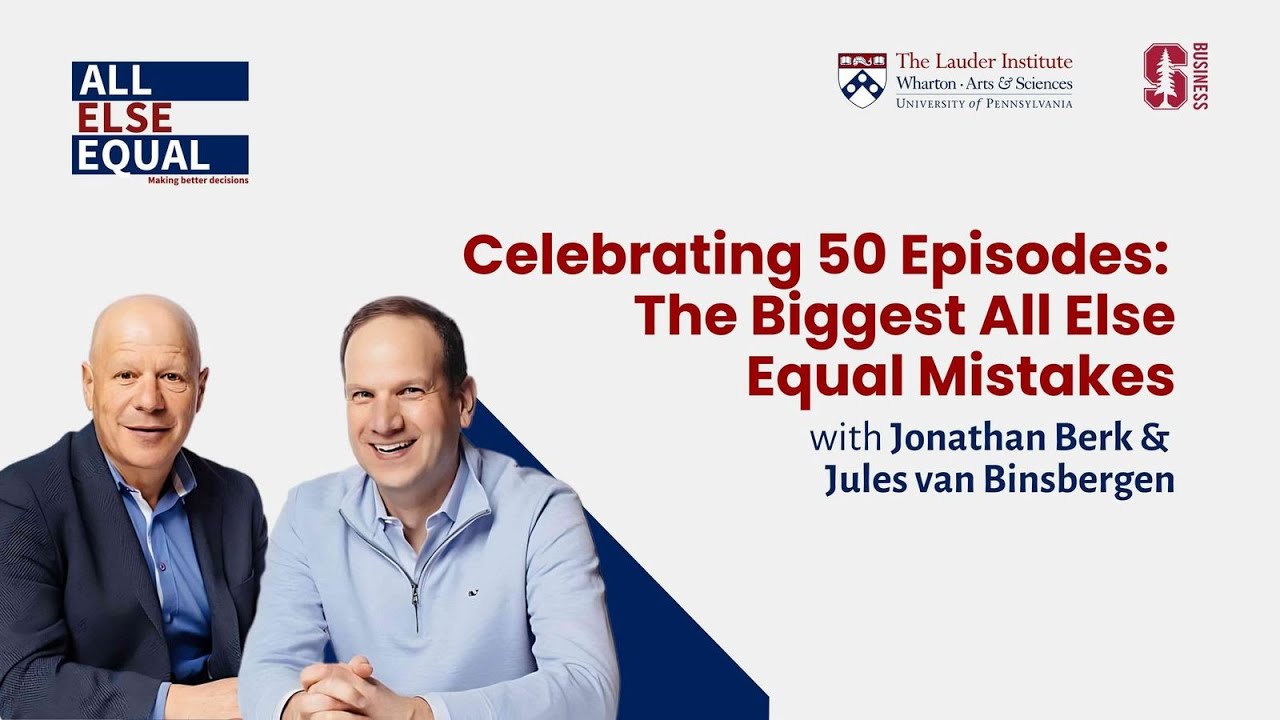
- The Lauder Institute at the University of Pennsylvania and the Graduate School of Business at Stanford University collaborate on the "All Else Equal" podcast, which has reached its 50th episode and is approaching a million listens 33s.
- The podcast's name "All Else Equal" refers to a common thinking pattern where people assume that all other factors remain constant, which can lead to mistakes in decision-making 58s.
- The reason people engage in "all else equal" thinking is that it's easier than considering all the dynamic factors that can affect a situation 1m38s.
- One type of mistake that occurs due to "all else equal" thinking is when people ignore the overall environment and the actions of others, which can affect the outcome of their decisions 2m6s.
Mistakes Due to "All Else Equal" Thinking
- An example of this mistake is when someone buys a stock they think is underpriced, assuming they're the only one who has noticed its potential, but in reality, many others have already acted on the same information, making the stock's price reflect its true value 2m32s.
- This type of mistake can also occur when investing in mutual funds, where people ignore the fact that others have also seen the fund's good performance and are investing, driving up the fund's assets and potentially reducing its future performance 3m45s.
- Specific episodes of the podcast that discuss this type of mistake include the episodes with TFF Asess, Pete Breer, and the episode on mutual funds 3m34s.
- To avoid making mistakes, it's essential to question whether you have a competitive advantage, and if not, reassess your decisions 4m5s.
Regulatory Arbitrage and Unintended Consequences
- Some mistakes occur when decisions affect behavior directly, such as when regulators implement rules without considering how people will change their behavior in response 4m41s.
- Regulating public financial markets can lead to regulatory arbitrage, where people try to avoid regulations by taking firms private, turning publicly traded debt and equity into privately traded ones 5m17s.
- Jay Clayton, former SEC chair, notes that regulatory arbitrage is as old as regulation, and people will find ways to avoid regulations, such as using swaps instead of leverage in equity markets 5m43s.
- Regulatory interventions may not always be successful, and it's essential to ask whether the government has enough information to make things better 6m30s.
The Problem with Excessive Disclosure
- Disclosure can sometimes be bad, as forcing people to disclose everything can lead to important information being buried and hidden 6m53s.
- The more people are forced to disclose, the more they will disclose everything, making it harder to find important information 7m32s.
- The best analogy for this is that people will always try to find ways to avoid regulations, just like water flowing from the highest point to the lowest point 7m43s.
- The concept of trying to control or regulate something by blocking or plugging all possible ways it can happen is often flawed, as it is impossible to anticipate and block every possible route, much like trying to hold back water with a colander 7m55s.
The Futility of Trying to Control Everything
- The level of human capital that can be brought to bear against any attempt to regulate or control something can be overwhelming, making it impossible to match the level of effort and resources that can be devoted to finding ways around the regulations 8m27s.
- Corporations, for example, will invest significant human capital in finding ways to avoid paying taxes, making it impossible for regulators to keep up with the various loopholes and strategies that are developed 8m40s.
- It is often an "all else equal" mistake to assume that it is possible to plug all the holes and anticipate every possible way that someone might try to circumvent the regulations 9m7s.
- The resources available to those trying to regulate or control something are often vastly outnumbered by the resources available to those trying to find ways around the regulations, making it a battle that cannot be won 9m22s.
Aligning Incentives vs. Direct Control
- Instead of trying to regulate or control something directly, it may be more effective to try to align incentives so that people's behavior is naturally guided towards the desired outcome 9m45s.
- Aligning incentives can be extremely difficult and may require making compromises that are not ideal, but it is often the most effective way to achieve the desired outcome 10m9s.
- Policy makers may not always have the same incentives as the people they are trying to regulate, and may be more interested in appearing to take action than in actually solving the problem 10m50s.
- The distinction between short-term and long-term incentives is another important consideration, as policies that are designed to address short-term problems may ultimately create long-term consequences that are not desirable 11m21s.
Short-Term vs. Long-Term Incentives
- Organizations may prioritize short-term gains over long-term effectiveness by undermining people's ability to work effectively, as seen in the example of doctors promoting COVID-19 vaccines as a means to stop the spread of the virus, rather than just alleviating symptoms, which led to greater vaccine uptake but ultimately undermined people's confidence in vaccines and modern medicine 11m25s.
- Universities can also fall victim to this mistake by prioritizing social objectives over the pursuit of truth, which can damage their reputation and lead to a loss of public trust, as people begin to question whether universities are still a platform for debating truth and generating knowledge 12m57s.
- The same concept can be applied to other institutions, such as those involved in student debt forgiveness, where forgiving debt can create unrealistic expectations and undermine the ability to lend to people in the future 14m39s.
- Establishing a reputation and then acting in a way that contradicts it can be damaging, as it destroys the reputation that has been built up, and this is a common mistake that can be seen in various institutions 14m20s.
- To avoid these mistakes, institutions can put procedures in place to prioritize long-term goals and maintain their reputation, such as being transparent and honest about their objectives and actions 15m4s.
- Individuals can also impose self-regulation to avoid falling into the same trap, such as being aware of the potential consequences of their actions and prioritizing truth and transparency 15m12s.
The Importance of a Devil's Advocate
- A "blameless postmortem" is a protocol used at Google to analyze what went wrong in a situation without blaming anyone, with the goal of learning from the experience and improving outcomes in similar situations in the future 15m32s.
- This approach relies on pattern recognition and taking the time to deconstruct what was learned from the experience, but it can be undermined if a Devil's Advocate does not take their job seriously 16m5s.
- The Devil's Advocate role is important in challenging assumptions and ideas, but it can be difficult to maintain this role in a culture where people are hesitant to play the Devil's Advocate due to fear of being associated with the "devil" 17m45s.
- This hesitation can lead to "softballing" and a lack of intellectual debate, which can undermine the effectiveness of the Devil's Advocate role 17m56s.
- Creating a culture that admires and encourages the Devil's Advocate role is important, and this requires a delicate balance of authority and freedom in institutions such as classrooms 18m0s.
- Professors should be empowered to challenge students with difficult questions and contrarian views, while also being mindful of the potential risks of being taken out of context 18m34s.
- Freedom of expression and intellectual debate require institutional frameworks and constitutional protections to thrive 19m1s.
Disciplined Thinking and Understanding the World
- Being disciplined in thinking is crucial to avoid making "all else equal" mistakes, which can be achieved by carefully considering what is causal and what isn't, as discussed in an episode with Gido Imbens on correlation and causation 19m13s.
- There are two perspectives to view the world: one where the world is chaotic and needs to be fixed, and another where the world is a well-optimized system that needs to be understood before making changes 19m38s.
- Understanding the world as a complicated dynamic system makes it harder to make changes, as it involves contending with other optimizing agents that are not stupid and know what they're doing 20m15s.
- A good example of this is raising children, where it's unlikely that someone would come along and say they know how to raise children better, ignoring the fact that many smart people have thought about the same problem before 20m30s.
- It's essential to discipline thinking by considering how one can think about something new that nobody else before has thought about, and recognizing that there may not be a comparative advantage over others 21m0s.
Progress vs. Regression and the Allure of New Ideas
- People often assume that everything done is progress, but history has shown that it's not always the case, and there have been periods of regression 21m25s.
- It's possible that new things being tried today may not be necessarily better, and there may be a lack of recollection of past failures, leading to the recycling of old, bad ideas 21m58s.
- Capitalism is an example of a system that has worked better than others, but people often try to make it more fair, ignoring the fact that every time this has been tried, it has been a failure 22m18s.
- The "all else equal" constraint may mean that the unfairness of capitalism is what makes it work, as there needs to be inequality to provide incentives 22m40s.
Capitalism, Fairness, and Trade-offs
- The concept of "all else equal" mistakes is discussed, highlighting the idea that there are no solutions, only trade-offs, and that changing one aspect of a system can have unintended consequences elsewhere in the system 23m39s.
- The idea of a reward for risk is mentioned, suggesting that if everyone receives the same amount regardless of their abilities or needs, nobody will work hard or take risks, leading to a lack of innovation and progress 23m2s.
- The concept of budget constraints is introduced, emphasizing that it is impossible to have everything one wants, and that this is a hard truth to swallow 23m23s.
"All Else Equal" Mistakes in Various Contexts
- The discussion touches on the idea that people often assume that making one change will have only positive effects, without considering the potential negative consequences, and that this mindset can lead to "all else equal" mistakes 24m1s.
- The environment and ESG (Environmental, Social, and Governance) space are mentioned as areas where people often make "all else equal" mistakes, assuming that it is possible to make the environment better and increase profits at the same time 24m15s.
- The idea that companies were previously unaware of profit-maximizing opportunities in the ESG space is questioned, suggesting that it is unlikely that companies were not already aware of these opportunities 25m4s.
- The discussion also touches on the idea that pension plans are now arguing that making alpha (a measure of investment return) is easy by investing in ESG companies, which is seen as an "all else equal" mistake, as it assumes that active investing is easy and that ESG companies will automatically generate higher returns 25m59s.
- The concept of active investing and the idea that making alpha is not as easy as some pension plans claim is discussed, highlighting the potential for "all else equal" mistakes in this area 26m10s.
Conclusion and Call to Action
- The audience is encouraged to revisit past episodes if they found the topics interesting and look forward to future episodes 26m27s.
- The experience of creating the podcast has been a great pleasure so far 26m38s.
- Listeners are thanked for tuning in to the All Else Equal podcast and are asked to leave a review at Apple Podcasts 26m43s.
- To stay updated, listeners can subscribe or follow the show wherever they listen to podcasts 26m53s.
- For more information and episodes, listeners can visit all else equal podcast.com or follow the podcast on LinkedIn 26m58s.
- The All Else Equal podcast is a joint production of Stanford University's Graduate School of Business and the Lauder Institute at the University of Pennsylvania 27m7s.
- The podcast is produced by University FM 27m14s.