
DNA Test Discoveries and Family Surprises
- The most interesting discovery made through a DNA test was finding that LL CoolJ's mother was adopted and did not know it, and her biological parents were identified through her DNA alone, which was a significant discovery for the family, especially since LL CoolJ was partly raised by his maternal grandparents who were not his biological grandparents 10s.
- Investigative genetic genealogy involves reverse-engineering someone's identity from their DNA alone by identifying their ancestors through the people they share DNA with, and then piecing their family tree back together little by little, which can be done even if the DNA contributor is unknown 2m6s.
DNA Testing and Law Enforcement
- A person's innocence or guilt cannot be proven directly through genealogy tests like Ancestry.com, as the three largest DNA databases have barred law enforcement from using their services for criminal research, but smaller databases like Family TreeDNA, Jed Match, and DNA justice have decided to work with law enforcement to help identify violent criminals and John and Jane Does 4m42s.
- Over 54 million people have taken direct consumer DNA tests, but for law enforcement cases, the number of people available to run comparisons is limited to about 2 million, which can make it challenging to identify the contributor of a DNA sample 6m15s.
DNA Matches and Identity Reveal
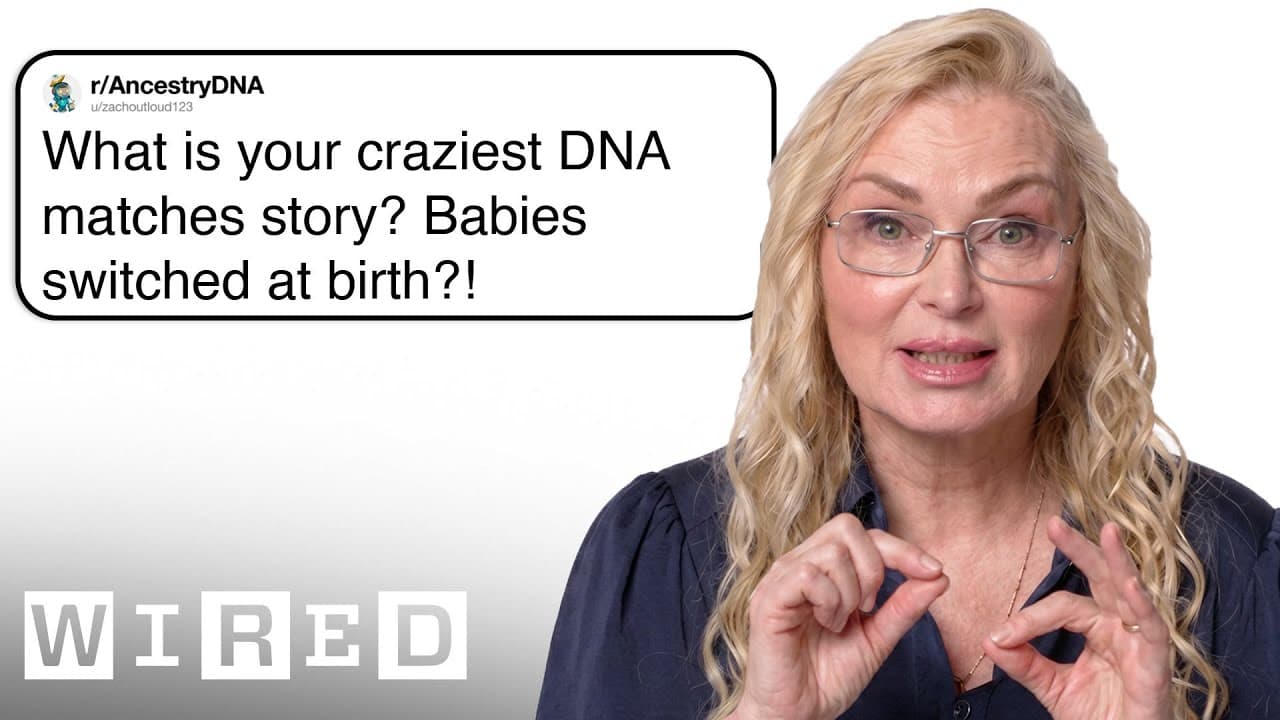
- One of the craziest DNA matches stories involves baby switches, where someone's DNA results do not match up with their family tree, and it is discovered that they were switched at birth, which can be due to accidents or intentional switching, especially in cases where a rich couple had a sickly baby and a poor single mother had a healthy newborn 8m10s.
History and Impact of Genetic Genealogy
- Genetic genealogy is the combination of documentary research and DNA, which has been used for genealogical purposes for about 25 years and has helped to inform genealogy by breaking down brick walls, where individuals are unable to find the paper trail records to identify a particular ancestor 10m40s.
- Genetic genealogy has been used to solve over a thousand violent criminal cases in the last eight years, with one notable case being the identification of John Miller, who kidnapped and murdered April Tinsley in Fort Wayne, Indiana, and was later convicted and sentenced to 80 years in prison 42s.
Genealogical Lineage and Historical Figures
- Many Europeans are descended from Charlemagne, who was the king of the Franks from 768 and had at least 18 known children, and this is also true for any person who lived in the 9th century in Europe and has descendants today 2m6s.
- Tracing lineage or family history can be difficult due to the availability of records, which varies depending on the population group and region, with some places like Iceland and Switzerland having extensive records, while others like Ireland and Ashkenazi Jewish communities have had records destroyed 4m30s.
Ethnicity and Genetic Terminology
- The concept of ethnicity is often misunderstood in the context of DNA, and scientists prefer to use terms like ancestral origins or biographical ancestry, as ethnicity implies culture and traditions, whereas ancestral origins refer to the scientific aspect of genetics 6m15s.
Genetic Relationships and Reproduction
- A distant relationship, such as a great grandpa being the uncle of a spouse's grandma, is not a cause for concern in terms of pregnancy, as the relationship is too distant to pose a significant risk 8m45s.
- First cousin marriages have occurred throughout history, typically without issues, and there is only about a 10% likelihood that it will have a negative impact on the offspring of that couple 10s.
Tracing Ancestry Through Mitochondrial and Y Chromosome DNA
- Mitochondrial DNA is passed directly from mother to child, and it can be used to trace ancestry back hundreds of thousands of years, while the Y chromosome can be used to trace paternal ancestry back to a common ancestor who lived about 200,000 to 300,000 years ago 42s.
Time and Complexity in DNA-Based Investigations
- The time it takes to solve a case using genealogy and DNA testing can vary greatly, ranging from 30 minutes to 8 years or more, depending on the complexity of the case and the availability of genetic data, particularly for underrepresented populations such as African-Americans 2m6s.
Autosomal DNA and Genetic Inheritance
- Autotosomal DNA is primarily inherited from closer ancestors, and while it can be used to trace ancestry back several generations, it is limited by the fact that not all ancestors contribute to an individual's genome, with some ancestors falling off the genetic family tree as you go further back 2m6s.
- Siblings can receive different DNA percentages, particularly in the ethnicity portion of the results, because they inherit different DNA from their parents, with about 50% of their DNA overlapping 2m6s.
Accuracy and Limitations of Ancestry DNA Tests
- Ancestry DNA tests have two main parts: finding relatives, which is highly accurate, and ethnicity estimates, which are less reliable and still a developing science, with continental-level estimates being more accurate than granular, specific labels 2m6s.
DNA Sharing Among Relatives
- The amount of shared DNA varies among relatives due to significant migration throughout history 0s.
- On average, individuals share 12.5% of their DNA with their first cousins, whereas with third cousins, the average shared DNA is less than 1% 0s.
- It is also possible for individuals to not share any DNA at all with their third cousins, highlighting the unpredictability of DNA sharing among more distant relatives 0s.