
Ancient Greek Astronomy and Navigation
- Modern astronomy recognizes 88 constellations, while the ancient Greeks identified 48. 0s
- Ancient Greeks utilized the stars for navigation, agricultural planning, organizing festivals, and storytelling. 5s
- Greek mythology centered on eight primary groupings of constellations, including the hunter Orion, the hero Hercules and his 12 labors, and the family of the African princess Andromeda. 18s
- The zodiac, a system of 12 animal-represented sections, originated with the Babylonians, who divided the 360-degree arc of the heavens into 30-degree segments to organize time. 42s
- Homer’s Odyssey contains early literary references to celestial navigation, specifically mentioning the Big Dipper (the plow) and the star Sirius as tools used by Odysseus to navigate the open sea. 1m8s
- While scholars have debated the specific route taken by Odysseus, the text highlights the necessity of star-based navigation in ancient seafaring. 1m25s
The Mythology of Orion
- Many ancient Greek constellations remain visible today, though their appearance varies based on the observer's global location and the time of year. 1m38s
- Orion is identified by the three stars in his belt and is sometimes associated with the Mesopotamian figure Gilgamesh. 1m48s
- Depictions of Orion vary, showing him with a bow, a lion skin, a shield, a hunter’s sling, or a sword, the latter of which served as a navigational tool for the Greeks. 1m58s
- Mythological accounts describe Orion as a giant hunter whose excessive hunting threatened to deplete the earth of animals, leading Gaia to place him in the stars. 2m18s
- Other myths detail Orion’s blindness, which was caused by a king and later cured by the sun god Helios, as well as his complex relationship with the goddess Artemis. 2m32s
- In one version of the myth, Apollo tricks Artemis into killing Orion with an arrow, leading her to place him in the sky after discovering his body. 2m48s
- Orion’s emergence in the late fall signaled the beginning of winter for the ancient Greeks. 3m5s
- Orion is positioned in the sky near his hunting dogs, the constellations Canis Major and Canis Minor. 3m12s
Canis Major and the Dog Days
- Canis Major is depicted as a dog that always catches its prey, with Sirius serving as its key star. 0s
- Sirius was so bright in antiquity that it was visible during the day, particularly around midsummer in August, which is the origin of the term "dog days of summer." 7s
- During the festival of Skira, a person would climb to a high point to look for Sirius and call out the "Olgamos," a luluation that women would join to welcome the star. 17s
- The period associated with Sirius was a time of great heat and aridity, marking a transition between the old year and the new year. 30s
- In democratic Athens, the time of Sirius was when yearly officials transferred power, while in Greek tragedy, it was a period associated with the downfall of kings and tyrants. 37s
- In the tragedy of Aeschylus, Clytemnestra invokes Sirius to bless her act of killing Agamemnon as he prepares for a bath following his return home. 50s
Canis Minor and Taurus
- Canis Minor, referred to by the Romans as the "small dog," was viewed by the Greeks as the Teumessian fox, a creature destined never to be caught. 1m13s
- Orion is depicted as hunting with these two dogs, engaged in a futile pursuit across the universe. 1m23s
- Taurus, the bull, is a large constellation that shows only half of the animal's body, possibly referencing the myth where Zeus disguises himself as a bull to carry off Europa. 1m36s
- Because the bull was the most expensive animal to sacrifice in Greece, it was considered a highly significant creature. 1m51s
- Orion is imagined as attempting to wrangle or bring the bull to heel, and the constellation appears in various myths, including those of Heracles, while also serving as a zodiac symbol. 1m58s
Lepus and Scorpius
- Lepus, the rabbit or hare, is positioned directly beneath Orion and is depicted with visible ears, a tail, and a body. 2m13s
- According to legend, rabbits were introduced to a Greek island and multiplied until they consumed the island's resources, necessitating a cull; the survivors were taken by the gods and given to Orion as eternal prey. 2m22s
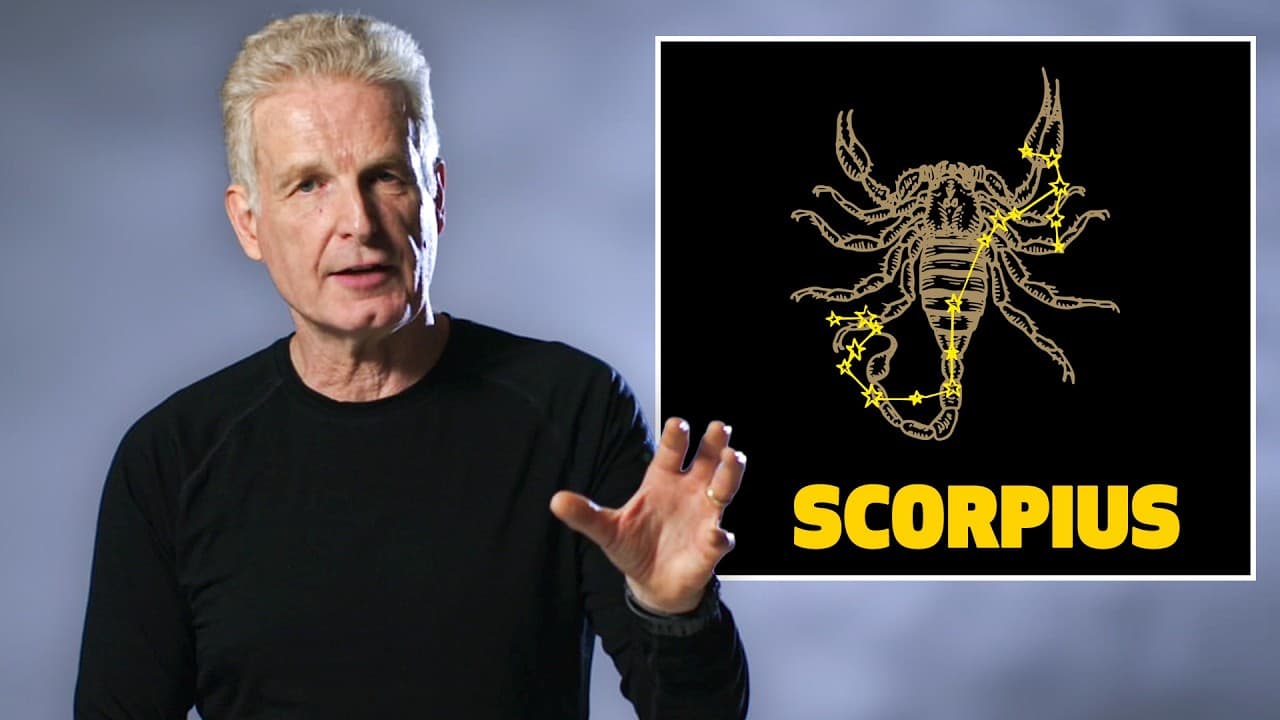
- Scorpius is considered one of the most frightening constellations, featuring the star Antares in its pincers and Shaula at the tip of its stinger. 2m38s
- Gaia created the scorpion to kill Orion because his hunting prowess was depleting the earth of animals, representing a mythological pushback against ecological destruction. 2m50s
- Gaia placed Orion in the heavens after his death as a lesson to humanity regarding the importance of living with moderation. 3m10s
Lupus and Centaurus
- The constellation Lupus, representing a wolf, is located in the southern sky and is associated with Orion. 0s
- The depiction of Lupus shows a triangular head, body, tail, and legs, with the figure positioned upside down, possibly suggesting it has been dispatched or sacrificed. 0s
- Wolves in Greek mythology are linked to themes of transformation, with historical roots potentially extending to Bronze Age Yamna cultures that may have utilized wolf-boy hunters. 15s
- Centaurus is a southern sky constellation representing a centaur, a creature described as half-man and half-horse. 42s
- The origin of centaur myths likely stems from pre-Bronze Age Greek encounters with Scythian mounted warriors, as horses were not native to Greece. 55s
- Centaurus is identified as Chiron, a wise centaur known for teaching figures such as Achilles, Jason, and Asclepius. 1m12s
- Chiron is characterized as a healer who suffered an incurable, painful wound from an arrow of Heracles that had been dipped in the poisonous blood of the Hydra. 1m30s
- Chiron utilized his own chronic pain as a tool to educate other healers. 1m45s
- The name Achilles translates to "he who brings pain to others," while the name Jason is derived from a Greek word meaning "healer." 1m55s
- Asclepius, the mortal son of Apollo and a god of healing, is associated with the symbol of a snake wrapped around a staff. 2m5s
- While Chiron is considered civilized, centaurs are generally depicted in mythology as wild, fringe-dwelling creatures prone to destructive behavior, such as the battle against the Lapiths depicted on the Parthenon. 2m20s
The Labors and Mythology of Heracles
- Heracles, known as Hercules to the Romans, is a hunter-warrior constellation located in the northern sky. 2m45s
- The constellation of Heracles is depicted with a lion skin, a club, or a bow and arrow. 2m55s
- Heracles is linked to the "lion man" archetype, which is considered one of the oldest mythological characters, with early physical representations dating back to mammoth tusk carvings. 3m5s
- The name Heracles means "famous to Hera," which is ironic because Hera, the wife of Zeus, detested him. 3m25s
- Similar to Orion, Heracles was the son of Zeus and a mortal woman, characterized by great strength, power, arrogance, and a lack of moderation. 3m35s
- Heracles is characterized by a gluttonous nature and a tendency toward a berserk state, which leads Hera to prevent him from maintaining a family 0s.
- The tragedy of the Heracles constellation is linked to his destruction of his family, an act that drives him to perform 12 labors as atonement, though some versions of the myth suggest he completes the labors before destroying his family 12s.
- Despite his destructive history, Heracles is a beloved demigod and the only mortal to ascend to Olympus as a god 35s.
- Heracles’ transformation into a benevolent hero occurred after his friend Theseus took him to Athens to be initiated into the Eleusinian mysteries, where he learned to set aside his violence and temper to become a protector 45s.
- The Hydra, a multi-headed water serpent, represents the second labor of Heracles 1m15s.
- The Hydra dominated the community of Lerna, and because two heads grew back for every one severed, Heracles used a combination of strength and cunning to cauterize the stumps 1m35s.
- Heracles defeated the immortal head of the Hydra by cutting it off and burying it under a large rock, effectively encapsulating rather than killing it 1m55s.
- Some interpretations suggest the Hydra myth symbolizes the control of waterways and the development of irrigation for crops in the region of Argos 2m10s.
- Hera, viewed as an anthropomorphic version of the earth mother Gaia, opposes Heracles because she perceives his taming of the wilderness as an ecological disaster 2m25s.
- The first labor of Heracles involved slaying the Nemean lion, which is represented by the zodiac constellation Leo 1m25s.
Celestial Myths of Apollo and Draco
- The constellations Crater (a drinking cup) and Corvus (a crow) are associated with a myth where Apollo sent a crow to fetch water in a cup 2m40s.
- In the myth of the cup and the crow, the bird was delayed by waiting for figs to ripen and falsely blamed the Hydra for guarding the spring, leading Apollo to cast the snake, the cup, and the crow into the heavens 2m55s.
- Draco, Latin for dragon, is a chthonic, serpent-like creature that serves as a female protector of the earth against heroes like Heracles 3m25s.
- In the myth of Heracles, Draco guards the golden apples in the garden of the Hesperides, which was the second-to-last task Heracles had to complete 3m45s.
- The golden apples guarded by Draco were originally a wedding gift from Gaia to Hera 4m5s.
- Heracles was tasked with stealing the golden apples from the secret gardens of the Hesperides, which were guarded by the dragon Draco 0s.
- To bypass Draco, Heracles sought the assistance of the titan Atlas, who was tasked with holding up the world 7s.
- Heracles and Atlas struck a deal where Heracles would hold the world while Atlas retrieved the golden apples 15s.
- Atlas successfully retrieved the apples, though the method of dealing with Draco remains unknown 35s.
- Upon returning, Atlas attempted to leave Heracles with the burden of the world, but Heracles used trickery by asking Atlas to hold the world briefly while he adjusted a pillow, subsequently taking the apples and departing 45s.
Zodiac Constellations: Aries, Taurus, and Gemini
- The Greeks adopted the zodiac system from Mesopotamian cultures, specifically the Babylonians and potentially the Sumerians, who divided the universe into a 360-degree circle containing 12 symbols of 30 degrees each 1m15s.
- Aries, the ram, represents the transition from winter to spring, coinciding with the lambing season and the return of vegetation 1m28s.
- The Greek festival of Dionysus occurred in late March, and the term "tragedy" is believed to mean "song of the goats," potentially linking the festival to the ram and goat imagery of Aries 1m45s.
- Taurus represents the bull, though it may also symbolize the cow, an animal considered sacred in Greek mythology and associated with the queen of the gods 2m5s.
- The cow is also a significant symbol in Egyptian mythology, notably associated with the goddess Hathor 2m20s.
- In ancient Greece, owning a bull was a sign of wealth due to the difficulty of raising cattle on the Greek landscape, making the sacrifice of a bull a highly significant act 2m35s.
- Zeus frequently appeared in the form of a bull in mythology, such as when he carried off Europa or traveled with Io 2m50s.
- Gemini represents the celestial twins, Castor and Pollux, who were brothers to Helen and Clytemnestra 3m5s.
- The birth of the twins resulted from Zeus visiting Leda, the queen of Sparta, in the form of a swan on the same night she was with her husband, Tyndareus, resulting in four children with mixed divine and mortal parentage 3m15s.
- The constellation Gemini represents the brothers Castor and Pollux, who are associated with Helen of Troy as descendants of Zeus. 0s
- Myths regarding the brothers' parentage vary, but the narrative describes one brother as mortal and the other as immortal. 5s
- The brothers share their divinity by alternating immortality, with one brother giving up his status so the other may live, leading to their placement in the stars as celestial twins. 12s
Zodiac Constellations: Cancer, Leo, and Virgo
- Cancer the crab is depicted in the stars by its pincers, eyes, and body. 30s
- During the battle between Heracles and the Lernean Hydra, Hera sent the crab to distract Heracles by nipping at his toes. 42s
- Heracles defeated the crab by smashing it with his club or stamping on it, after which Hera placed the crab in the sky. 50s
- Leo the lion is represented in the stars by its head, mane, body, and hindquarters. 1m3s
- The constellation is linked to the first labor of Heracles, which involved defeating the Nemean lion that was ravaging the countryside. 1m12s
- Because the Nemean lion had an impenetrable hide, Heracles was forced to wrestle and choke the animal to death. 1m23s
- Heracles used the lion's own claws to skin it, subsequently wearing the hide as a protective shield. 1m30s
- The lion skin symbolizes Heracles's status as a berserker, a term related to the concept of theanthropic animal-men, similar to Norse warriors who wore bear skins in battle. 1m40s
- Lions were once indigenous to Greece during the pre-Bronze Age. 1m58s
- Virgo, also known as Parthenos or the virgin, is depicted with her arms raised and legs visible. 2m3s
- The constellation rises in September and October, coinciding with the timing of the secret Eleusinian mysteries. 2m10s
- The Eleusinian mysteries were highly secretive, with revelation of their details punishable by death, yet they involved a significant portion of the Athenian population and notable figures such as Plato, Aristotle, Sophocles, Marcus Aurelius, and Julius Caesar. 2m18s
- It is believed that the culmination of the nine-day ceremony involved the appearance of Demeter, potentially represented by the Virgo constellation in the dark sky. 2m35s
- The star Spica, meaning "germ of wheat," was significant to the mysteries, as initiates were likely shown an ear of wheat to symbolize celestial reincarnation or the gift of agriculture from Demeter to humanity. 2m48s
Zodiac Constellations: Libra, Scorpio, Sagittarius, Capricorn, Aquarius, and Pisces
- Libra, the scales, represents the concept of equilibrium and was essential in antiquity for weighing goods and products. 3m5s
- The Greeks associated the scales with the weighing of souls and the pursuit of justice, serving as a reminder to lead a good life by balancing one's good and bad deeds. 3m15s
- Scorpio is a zodiac constellation sent by Gaia to defeat Orion after Orion boasted that he would rid the world of all animals. 3m30s
- Gaia created the scorpion to kill Orion after he became an overly successful hunter, serving as a reminder of the consequences of challenging Gaia 0s.
- Sagittarius is depicted as a centaur holding a bow and arrow, with the constellation appearing to aim at Scorpius 15s.
- While archery was featured in Greek mythology—notably through Heracles’s unerring bow, the archer Teucer, and the death of Achilles—the ancient Greeks generally viewed archery as "dirty fighting" and preferred close-quarters combat 35s.
- Centaurs were renowned archers, and Sagittarius may represent early Greek contact with the Scythians, who were skilled horsemen capable of shooting arrows while riding 1m15s.
- Capricorn is represented as a goat with a fish tail, a hybrid form common in Greek mythology 1m35s.
- Capricorn may embody the god Pan, who transformed into a sea creature to escape the monster Typhon 1m55s.
- Aquarius, the water carrier, is identified as Ganymede, a beautiful young man abducted by Zeus—either by Zeus himself or his eagle, Aquila—to serve as the god's cupbearer 2m15s.
- The constellation Pisces consists of two fish connected by their bodies, a myth derived from Syrian traditions where fish were considered sacred for protecting a fertility goddess 2m50s.
The Myth of Andromeda and Perseus
- The Andromeda constellation depicts the Ethiopian princess chained to a rock as a sacrifice to appease Poseidon, who had flooded her land 3m15s.
- Cetus, also known as the whale, is a sea monster constellation depicted as a massive, long-necked creature that threatened to devour Andromeda 3m45s.
- The hero Perseus, returning from decapitating Medusa, arrives to save Andromeda 4m10s.
- Pegasus, the winged horse, is depicted near Andromeda and is the offspring of Medusa and Poseidon, having emerged from Medusa's neck after her death 4m25s.
- Earthquakes are attributed to Poseidon thundering across the seabed, which explains why one of his offspring is a horse. 0s
- Perseus is depicted riding a horse and swooping in to rescue Andromeda, an event described as one of the earliest Greek love stories. 7s
- In some versions of the myth, Perseus uses the head of Medusa to turn the sea monster Cetus into stone before marrying Andromeda. 20s
- Cassiopeia, the mother of Andromeda, is represented in the constellations as seated on a throne and is punished by eternally spinning in the sky. 36s
- Cassiopeia’s punishment stems from her arrogance in claiming that her daughter was more beautiful than the gods, and some myths depict her as eternally looking at her reflection in a mirror. 45s
- Cepheus is depicted as a king anchored to a throne, also suffering the punishment of eternal spinning due to his arrogance. 56s
- After marrying, Perseus and Andromeda returned to Greece, settled in the region of Argos, and became the ancestors of Heracles. 1m6s
- Perseus was aided in his quest to find the Gorgons by Hermes, who provided him with winged shoes, a cap of invisibility, and a polished shield to use as a mirror to avoid looking directly at Medusa. 1m15s
- The image of Medusa was frequently used in Greek art, including on warriors' shields and at the bottom of drinking cups, where the face would appear as the wine was consumed. 1m33s
- Medusa serves as a symbol of the power of goddesses to petrify those who do not treat them with respect. 1m52s
Ursa Major, Ursa Minor, and Boötes
- Ursa Major (the Great Bear) and Ursa Minor (the Little Bear) were essential constellations for navigation in the ancient world because they contain the Big Dipper and the Little Dipper, the latter of which includes the pole star. 2m0s
- One myth identifies the two bears as the nursemaids who protected Zeus when he was hidden from his father, Kronos. 2m20s
- Kronos, fearing a prophecy that he would be overthrown by his children, attempted to devour them, but his wife Rhea hid Zeus in the Idian cave on Crete and fed Kronos a rock wrapped in swaddling clothes instead. 2m30s
- The rock swallowed by Kronos was eventually vomited up and landed at Delphi, where it became the center of the world at Apollo’s shrine. 2m48s
- To protect the infant Zeus, the bear nursemaids organized the Curetes, bronze-clad warriors who clashed weapons and symbols to mask the sound of the baby crying. 3m0s
- Boötes, known as the plowman, is positioned next to the handle of the Big Dipper, which is referred to as the plow in many cultures. 3m15s
- The constellation Boötes, representing a plowman, is depicted with his feet or pushing a plow, and it was historically significant for navigation and as a signal for plowing in the late fall 0s.
- References to the plowman constellation appear in the Odyssey and the works of Hesiod from the 7th century BCE 0s.
Corona Borealis and the Voyage of the Argo
- Corona Borealis, also known as the northern crown or Stephanos, is identified as the crown of Ariadne upon her ascension as the queen of Argos 15s.
- The term Stephanoi refers to wreaths or crowns, and some ancient writers associated the wreath with the followers of Dionysus, the god of wine, ecstasy, and theater 25s.
- Wearing a myrtle wreath served as a sign of devotion to Dionysus, whose followers sought to step outside their daily routines through activities like dancing, singing, and attending theater 35s.
- Argo Navis is one of the largest constellations and is divided into sections including Puppis, representing the prow, and Vela, representing the sail 50s.
- The constellation is associated with the ship Argo, which was built for Jason and the Argonauts to search for the Golden Fleece 1m0s.
- Jason, a hero seeking to reclaim his position as a ruler, sailed the Argo to the kingdom of Colchis, where he encountered a dragon guarding the Golden Fleece 1m10s.
- Jason received assistance from the princess Medea, a native of Colchis with extensive knowledge of pharmacology, plants, and healing 1m25s.
- The term "medical" is linked to the name Medea, which signifies a "forethinker" or planner 1m30s.
- In various myths, Medea helps Jason secure the Golden Fleece by either lulling the dragon to sleep with an ointment or, in some accounts, by having the dragon swallow Jason before putting it to sleep 1m40s.
- Some versions of the myth state that the goddess Athena provided a figurehead for the Argo that assisted in the recovery of the Golden Fleece 2m0s.
- To facilitate their escape from Colchis, Medea reportedly killed her young brother, dismembered his body, and scattered the pieces across the prow of the ship to force her father to stop and collect them 2m10s.
Lyra and the Healing Cult of Ophiuchus
- Lyra, the lyre, is a small constellation associated with Orpheus, a musician and Argonaut who could charm gods and mortals with his singing and instrument 2m30s.
- The word "lyric" is derived from the lyre, an instrument the Greeks believed could charm the soul 2m40s.
- After his wife Eurydice died on their wedding day, Orpheus traveled to the underworld and convinced Hades to release her on the condition that Orpheus did not look back at her while leaving 2m50s.
- Orpheus failed to trust the condition, looked back at Eurydice, and caused her to be pulled back into the underworld 3m5s.
- Following his return, Orpheus was eventually destroyed by the Maenads, the followers of Dionysus, who tore him apart and threw his head into the sea, where it continued to sing 3m15s.
- Ophiuchus, the serpent handler, is a constellation in the northern sky that the Greeks likely associated with Asclepius, the mortal son of Apollo 3m30s.
- Asclepius founded a healing cult that spread throughout Greece starting in the fifth century, eventually becoming a dominant method for Greeks to seek medical treatment. 0s
- The Asclepieia served as hospitals, and writers of the Hippocratic corpus, which formed the basis of modern Western medicine, were priests of Asclepius. 0s
- Patients at these sanctuaries practiced incubation, a process where they slept in the sanctuary, received dreams from visiting serpents, and had those dreams interpreted by priests to determine necessary surgeries or treatments. 0s
- The snake was considered a symbol of life and death because it could shed its skin and survive, and it lived both beneath and on the earth. 0s
- Asclepius was famous for bringing a dead person back to life, an act for which he was punished by Zeus. 0s
- The constellation Ophiuchus, known as the snake handler, represents Asclepius holding a snake above the earth, symbolizing the restoration of life. 0s
Altars, Rivers, and Animal Constellations
- The constellation Ara, meaning the altar, is located adjacent to the constellation Lupus, which some stories suggest is being sacrificed over the altar by a centaur, possibly Chiron. 35s
- Altars were central to Greek and Roman mythology and actual cult practices, as sacrificing animals on an altar was the primary method of communicating with the gods. 35s
- According to a myth involving the Titan Prometheus, humans were instructed to trick Zeus by presenting him with the bones and guts of a butchered animal disguised as a reconstituted whole, while keeping the meat for themselves. 35s
- This myth served as an etiological explanation for why humans consumed the meat while burning the less desirable parts as a sacrifice to the gods, a practice that also helped maintain sanitation. 35s
- While the Greeks generally avoided human sacrifice, there is some archaeological evidence from the Peloponnese suggesting it may have occurred in specific situations, though the matter remains debated. 1m25s
- Greek mythology contains numerous accounts of human sacrifice, such as the killing of 12 Trojan boys during the cremation of Achilles. 1m25s
- The Trojan War was initiated after Agamemnon sacrificed his daughter on an altar to secure favorable winds for the Greek fleet. 1m25s
- The altar constellation serves as a symbol that reminds the Greeks of negative myths involving human sacrifice. 0s
- Eridanus, the great river, is depicted as meandering through the cosmos and is associated with the myth of Phaethon, the son of Helios. 7s
- Phaethon attempted to drive his father’s sun chariot, but the horses, recognizing his lack of skill, went out of control, scorched the earth, and eventually threw Phaethon into the river, which was also scorched by the event. 15s
- Piscis Austrinus, known as the big fish, is considered the parent of the Pisces constellation and is linked to a Syrian story regarding the protection of a fertility goddess. 45s
- Cygnus, the great swan, is associated with Zeus, who transformed into a swan to approach Leda, resulting in the production of a famous egg. 56s
- The swan is also the bird most closely linked to Aphrodite and serves as a symbol of eroticism and the power of erotic love. 1m8s
- Aquila, the eagle, is the sacred bird of Zeus and frequently serves as the form Zeus takes during transformations. 1m15s
- The eagle became an imperial symbol for Rome, where each legion carried a golden eagle as a sacred, divine emblem. 1m25s
- The aquilifer, the soldier responsible for carrying the eagle, was often protected by warriors dressed as lions or bears; losing the eagle in battle resulted in the decimation of the legion, where one in ten men would be executed. 1m32s
- Julius Caesar recorded that during his first invasion of Britain, his troops were hesitant to leave their ships until the aquilifer jumped into the English Channel, forcing the soldiers to follow him into battle to avoid the disgrace of losing the eagle. 1m48s
- The eagle remains a powerful symbol today, serving as the national emblem of the United States. 2m5s
Transformations and Minor Constellations
- Ovid, the Roman author of Metamorphoses, focused on the themes of human-to-animal and divine-to-animal transformations, which are reflected in many of these constellations. 2m8s
- Delphinus, the dolphin, is associated with Dionysus because dolphins were observed surrounding Greek ships like a chorus. 2m18s
- Monuments to Dionysus depict humans jumping into the water and transforming into dolphins. 2m25s
- A famous myth involves the poet Arion, who was captured by pirates, sang a song to summon a dolphin, and rode the dolphin to safety before successfully indicting his captors. 2m30s
- Dionysus was also saved by dolphins after being captured by pirates; he transformed the pirate ship into a vine and leaped into the sea, where the dolphins protected him. 2m45s
- Auriga, the charioteer, is closely associated by the Greeks and Athenians with Erichthonius, who is credited with inventing the chariot. 2m55s
- Erichthonius is considered the son of Hephaestus, the god of the forge and technology, and Athena. 3m2s
- The birth of Erichthonius is attributed to Hephaestus pursuing Athena; when his celestial sperm landed on Athena's thigh, she wiped it off with wool and threw it onto the ground, resulting in the birth of Erichthonius and establishing a mythological claim of descent from the virgin goddess for the Athenians 0s.
- The constellation of the Charioteer is linked to Erichthonius, who is credited with creating the first chariot through his connection with Hephaestus 35s.
- Triangulum, the triangle, represents a sacred shape to the Greeks, serving as a foundational element in their architectural temple building and holding significance in their cultural and religious life 42s.
- Equuleus, known as the little horse, appears as a horse's head in the sky and is possibly identified as the sibling of Pegasus 1m3s.
- Corona Australis, the southern crown, is mythologically associated with the crown of Dionysus 1m15s.
- Sagitta, the arrow, is depicted with stars representing its feathers and is associated with the arrow Heracles fired at the eagle that tormented Prometheus 1m24s.
- Prometheus, a Titan who gifted fire to humanity to balance the power between gods and humans, was punished by Zeus by being chained to a rock where an eagle consumed his liver daily 1m45s.
- Following the liberation of Prometheus by Heracles, Zeus sought to distract humanity from their technological advancements by creating Pandora, the first woman, intended to prevent humans from challenging the gods 2m15s.
The Philosophical Significance of Stars
- The 48 constellations cataloged by ancient Greek writers were likely based on an older Mesopotamian system and served as essential tools for navigation, agriculture, and the timing of rituals 2m45s.
- In the absence of light pollution, the ancient Greeks relied heavily on the stars for safety during dangerous sea voyages and observed them as markers for the changing seasons, as referenced in the play Agamemnon 3m15s.
- Ancient Greeks possessed a sophisticated understanding of stellar movements, utilizing their knowledge of when stars rose and set to govern their daily lives 0s.
- Plato proposed that the stars served as a reflection of humanity, suggesting a parallel relationship between individual lives and celestial bodies 7s.
- According to Platonic belief, individuals who lived virtuous lives were associated with a specific star, which they would become after death before potentially being reincarnated as a human on Earth 12s.
- A sense of reciprocity existed between human life on Earth and the stars in the sky, with the stars functioning as the natural order and the pulse of the world 21s.
- The Milky Way was interpreted as a pathway leading into the realm of the gods 30s.
- The stars were considered essential and impossible to ignore, holding great importance for all ancient peoples 35s.