

The Mediterranean as a Trade Hub
- The Mediterranean Sea is a crucial hub for trade and commerce, with 15% of global maritime traffic and 20% of the economic value of global maritime trade, totaling $800 billion in commercial exchanges in 2022 1m4s.
- The Mediterranean Sea covers only 1% of the world's water surface but plays a significant role in global trade, with some areas being more intense than others in terms of maritime traffic 58s.
- Marseille, the oldest city in France, founded by the Greeks in 600 BC, is a prime example of a Mediterranean city, with a high percentage of immigrant residents and a strong cultural connection to the Mediterranean 1m29s.
- The story of international trade begins with the Phoenicians, who initiated the diffusion of Mediterranean culture, which can be seen in the spread of olive trees along the Mediterranean coast 2m34s.
Historical Influence of the Roman Empire
- The Roman Empire's complex and well-structured trade network, which spanned the entire Mediterranean coast, was made possible by a single system of laws, an official language for bureaucracy, and the establishment of maritime law 3m34s.
- The concept of a united Mediterranean is not a reality, as it has not existed for over 1,500 years, despite the presence of people from diverse backgrounds coming together to trade and exchange ideas 2m18s.
- The diffusion of Mediterranean culture can be seen in the exchange of goods, ideas, and people, which began with the Phoenicians and continued through the Roman Empire, with the Mediterranean Sea playing a crucial role in shaping the region's history and culture 3m18s.
- The book "Memoria del Mediterraneo" by Fernand Braudel is a recommended read for understanding the history and culture of the Mediterranean region 3m0s.
- The Roman Empire was divided into two parts, with the Western part eventually collapsing, while the Eastern part continued to exist 4m11s.
The Rise of Islam and its Impact
- During this time, the Mediterranean Sea was home to various polytheistic religions, but the rise of monotheistic religions such as Islam led to significant changes 4m22s.
- Islam not only became a major religion but also a political entity, leading to conflicts with other powers, including the Battle of Poitiers and the expansion of the Islamic Empire 4m38s.
- In response to these changes, the Holy Roman Empire was formed, and the Western world was eventually divided into two main Christian denominations: the Catholic Church and the Orthodox Church 4m51s.
The Gravity Model of Trade
- An economist who only considers commerce when discussing trade is making a mistake, as commerce is influenced by various factors, including the size of a nation's economy, distance between nations, and cultural connections 5m12s.
- The gravity equation, also known as the gravity model of trade, is a formula used to calculate the expected trade between two nations, taking into account the GDP of each nation, the distance between them, and a gravity factor (G) that represents the intrinsic value of connections between the two nations 5m23s.
- The gravity factor (G) is influenced by various elements, including commercial agreements, language, cultural similarities, common borders, access to the sea, colonial history, shared history, commercial barriers, political stability, population demographics, and infrastructure costs 6m8s.
- To understand changes in trade between Mediterranean countries, it is essential to consider all these factors 6m51s.
The Divided Mediterranean
- The Mediterranean region has undergone significant changes throughout history, and to imagine what it was like 200 years ago, one can read "The Count of Monte Cristo," a novel set in the Mediterranean 7m9s.
- Today, the Mediterranean is a divided region, with three main religious blocks: Catholics, Orthodox Christians, and Muslims, as well as smaller populations of Jews and Anglicans 7m21s.
- The Mediterranean region has three critical points: the Suez Canal in Egypt, the Bosphorus Strait, and the Strait of Gibraltar, which is a British protectorate 7m44s.
- The Mediterranean region is often divided by a clear religious distinction, with religion having been a crucial point of identification for people throughout history, as seen in the example of Ukraine where people would identify as Orthodox rather than by nationality 8m13s.
Economic Disparities and Trade Patterns
- The Mediterranean region's wealthiest nations are primarily located in the northwestern part, including Spain, France, Italy, and Israel, which are considered outliers 8m56s.
- Economic exchanges between nations are more likely to occur when the nations have similar economic levels, as explained by Nobel Prize-winning economist Paul Krugman, which is why Italy's industrial production can satisfy French demand more effectively than Turkey's 9m20s.
- Prior to Krugman's theory, it was believed that economic exchanges were more closely tied to the cost matrix, which suggests that nations would trade with countries where production costs are lower; however, this is not always the case, as seen in the example of Tunisia's production not meeting the expectations of Italian, French, and Spanish consumers 9m50s.
Istanbul's Importance and Political Landscapes
- Istanbul is considered the largest and most important city in the Mediterranean, with a population of 13 million, and could be considered the capital of the region if one were to be designated 10m20s.
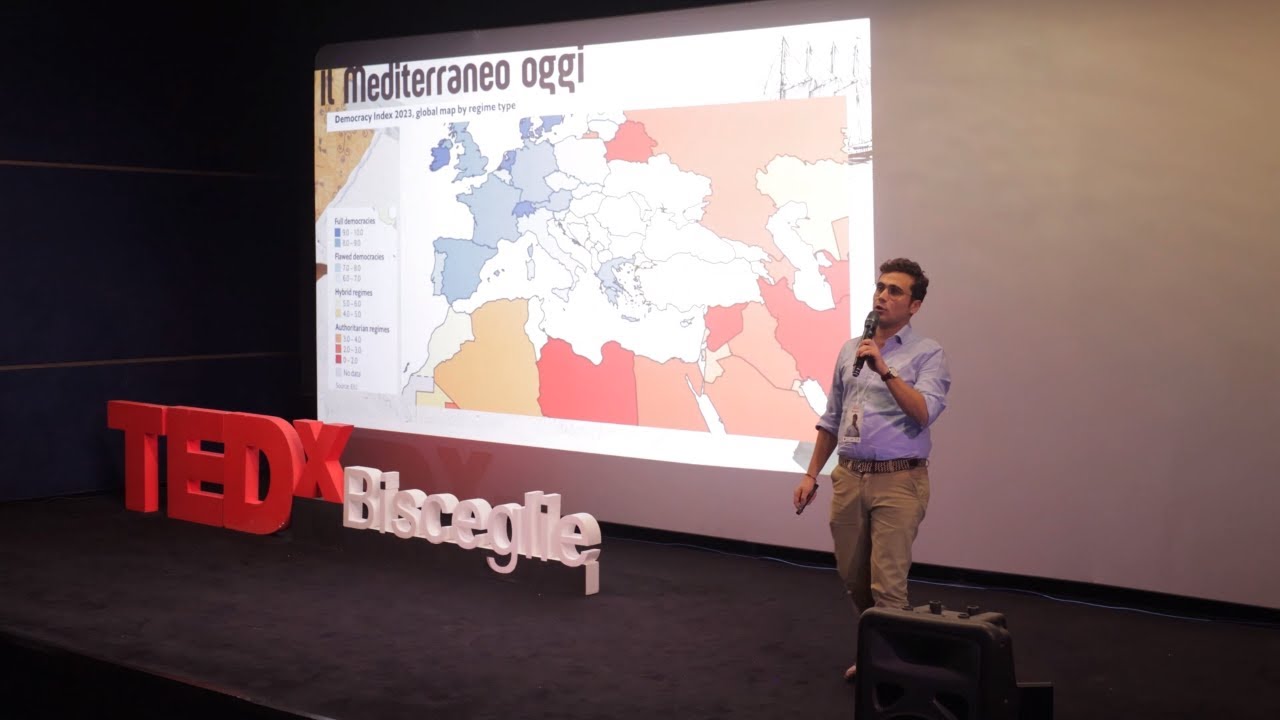
- The Economist's 2022 Democracy Index shows that European nations tend to be more democratic, while many nations in the surrounding region are not democratic, instead being hybrid or authoritarian regimes 10m38s.
- The lack of democracy in these nations is unfortunate, as it would be beneficial for them to be more democratic, especially considering the Arab Spring in North Africa, which had the potential to reverse this trend 10m59s.
- Similarity in political systems, as well as economic levels, can facilitate dialogue and trade between nations, as seen in the example of European nations, and it is hoped that this will be the case in the future for North Africa as well 11m28s.
- The need to trade with authoritarian regimes due to their possession of natural resources is a challenge, as noted by Mario Draghi, who stated that European nations are forced to deal with dictators and autocrats because they have resources that are essential to Europe 11m32s.
- Many economists study the high correlation between levels of democracy and levels of natural resources, but this topic is not the focus of the current discussion 11m46s.
Demographic Trends and Future Projections
- The future of the Mediterranean is mainly in the southeast, as shown in a graph illustrating the population pyramid, with a high number of children and a low number of elderly people, indicating a healthy demographic structure 12m5s.
- In contrast, Northern Europe has a nearly inverted population pyramid, with a low number of children and a high number of elderly people, indicating an unhealthy demographic structure 12m17s.
- The Mediterranean region is expected to become less European and more South-oriented in the future 12m35s.
Shifting Cultural and Economic Integrations
- The Roman Empire, with its unified bureaucratic system, official language, and Mediterranean culture, played a significant role in shaping the region's history, but this Mediterranean culture no longer exists as it once did 12m59s.
- Today, European countries are more integrated into a European culture than a Mediterranean one 13m7s.
- The total value of exports between European countries is around 5 trillion, while the total value of exports between Mediterranean countries is around 800 billion 13m26s.
- Although European countries are richer than Mediterranean countries, the percentage of exports within the same geographic area is higher for European countries, with a minimum of 50% in 2013, and a peak of 56% 14m24s.
- In contrast, the percentage of exports within the Mediterranean region is lower, with a peak of 34% and a current value of 29% 14m39s.
The Mediterranean as a Suboptimal Economic Area
- The Mediterranean region is considered an economically suboptimal area because it could achieve more through increased trade and economic cooperation 14m51s.
- The facilitation of trade between countries is often achieved through commercial agreements, which are simpler to establish when political and demographic factors are similar 15m5s.
- The Schengen Agreement, signed in 1985, is an example of a commercial agreement that has facilitated the free movement of goods, people, and capital within the European Union, contributing to the region's economic stability and social stability 15m27s.
- The Arab Free Trade Area was established in 2004, followed by the Agadir Agreement in 2008 and the Union for the Mediterranean in 2008, but these commercial agreements did not find fertile ground 15m49s.
Economic Growth, Crises, and Conflicts
- The Mediterranean region experienced growth from 2005 to 2008, driven by globalization and the removal of commercial barriers, including the Barcelona Treaty 16m9s.
- However, the 2008 subprime crisis and the 2010 European sovereign debt crisis, which particularly affected Greece, had a significant impact on the region 16m45s.
- The Arab Spring in 2010 and the subsequent crises led to a sharp decline in trade between Mediterranean countries, with a partial recovery in recent years 17m15s.
- The COVID-19 pandemic and the Russian invasion of Ukraine further affected the region, with the latest available data showing a decline in trade up to 2020 17m35s.
Impact of the War in Ukraine
- The countries most interested in the Mediterranean region are those in North Africa, with the exception of Albania, which has 65% of its exports going to other Mediterranean countries 18m12s.
- Ukraine is also considered a Mediterranean country, as it borders the Black Sea, and its economy is closely tied to the region 18m22s.
- The Russian invasion of Ukraine has significant consequences for the Mediterranean economy, particularly in terms of trade in grain, chemicals, palladium, nickel, and fertilizers 19m5s.
- Ukraine's main export markets were countries in North Africa, while Russia's exports went to various countries in the region 19m25s.
- Italy has never had a significant dependence on Ukrainian wheat, with only about 7% of its wheat coming from Ukraine, and instead relies on internal production and imports from countries such as Canada, Australia, Lebanon, Tunisia, Libya, and Egypt 19m34s.
- The war in Ukraine has led to a surge in prices, resulting in inflation in Italy, but for North Africa, it has meant scarcity and difficulty in obtaining products 19m50s.
- One of the main points of the war in Ukraine is the Crimea, located in front of the port of Odessa, and the cost of transportation by ship has increased significantly due to the war 20m12s.
- The Mediterranean is currently experiencing a new recession due to these reasons, and the situation is further exacerbated by the war in the Middle East and the genocide of the Palestinian population 20m37s.
Conclusion: The Dream of a United Mediterranean
- The idea of a united Mediterranean, as it was during the Roman Empire, is not a reality today, and it can only be dreamed of, with the hope that it may become a reality someday 20m55s.