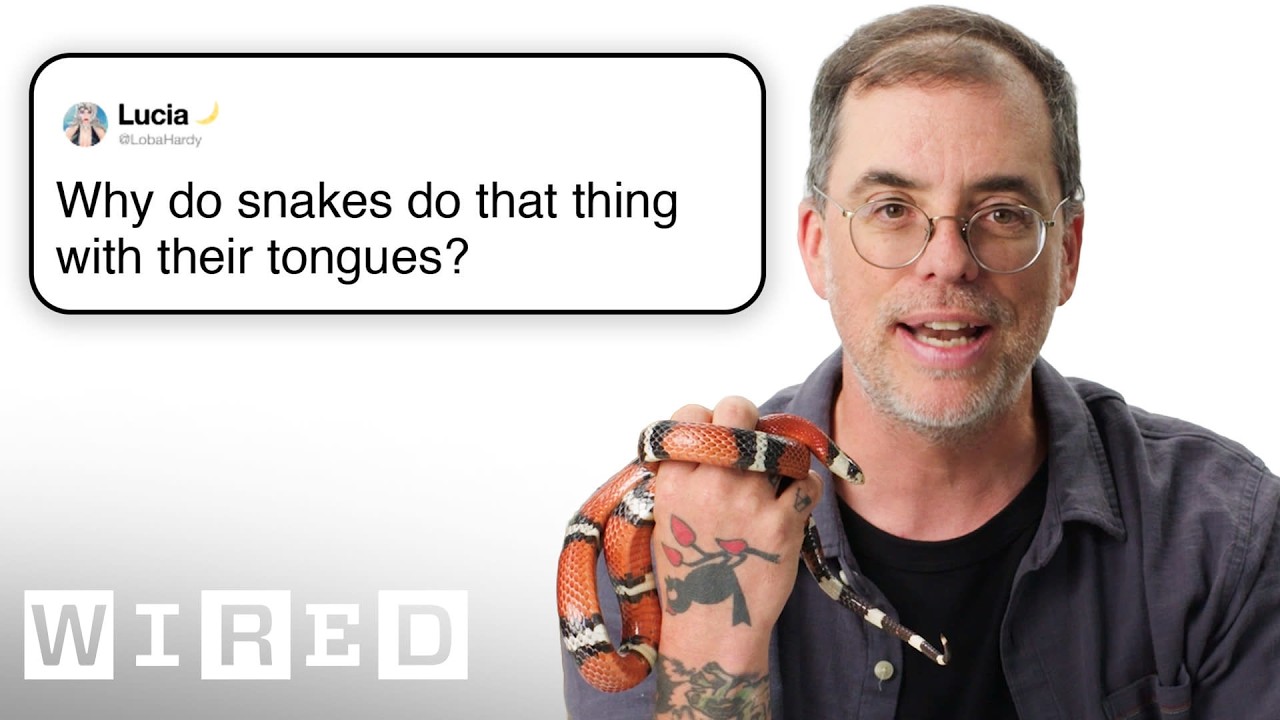


Snake Sensory Perception and Tongue Function
- Frank Burbrink serves as the Curator of Herpetology at the American Museum of Natural History. 5s
- Snakes flick their bifurcated tongues to collect chemical information from their environment, which helps them detect predators, prey, and potential mates. 25s
- The forked shape of a snake's tongue allows it to compare scent strength between the left and right sides, helping the snake determine which direction to move. 35s
- Increased tongue-flicking frequency in snakes is often a sign that the animal is nervous or upset. 45s
Venomous Snakes and Human Fatalities
- The Inland Taipan, found in Australia, is considered the most venomous snake on Earth based on the amount of venom required to kill prey relative to the prey's weight. 55s
- While the Inland Taipan is the most venomous, it is not the snake responsible for the highest number of human fatalities. 1m5s
- Globally, over 100,000 people die annually from venomous snake bites, with 40,000 to 50,000 of those deaths occurring in India. 1m10s
- In India, the saw-scaled viper, Russell's viper, and Indian cobra are the primary species responsible for human fatalities, often because they inhabit agricultural fields and residential areas. 1m18s
- These venomous snakes are ecologically necessary for controlling rodent and pest populations, though they pose risks to people who are not wearing protective footwear. 1m25s
- Snakes are generally not aggressive and typically only bite if they are stepped on or rolled over. 1m35s
Rattlesnake Behavior and Anatomy
- If a person encounters a rattlesnake, the recommended response is to remain calm, step back, and walk around the snake while giving it a wide berth. 1m45s
- Rattlesnakes are defensive rather than aggressive and use their rattle to warn potential threats of their presence and venom. 1m55s
- A rattlesnake's rattle is composed of interlocking segments of keratin that produce sound when the snake uses specialized muscles to vibrate its tail in a figure-eight motion. 2m10s
- An agitated rattlesnake can sustain the rattling sound for 20 to 30 minutes. 2m25s
- Some non-venomous snake species can mimic the sound of a rattlesnake by blowing air through their epiglottis. 2m35s
Snake Reproductive Biology
- Snakes possess a single opening called a cloaca, which is used for reproduction as well as the excretion of waste. 2m55s
- The term "cloaca" is derived from the Latin word for sewer. 3m5s
- While some snakes, such as the Mexican black kingsnake, lay eggs, others like boa constrictors and North American water snakes give birth to live young. 3m10s
- The method of reproduction in some snake species can be dependent on environmental factors. 3m20s
- Snakes living in harsh environments often give birth to live young, which allows the mother to move the offspring to warmer areas. 0s
- Male snakes possess two reproductive organs called hemipenes, which are stored in a deflated state inside the tail. 7s
- During reproduction, a male inflates the hemipenes and inserts one into the female, delivering sperm through external canals into the female's oviduct. 22s
- Female snakes can either fertilize eggs immediately or store sperm in specialized tubules for many years, which explains why captive snakes kept in isolation can unexpectedly produce offspring. 32s
- Female snakes have been discovered to possess two clitorises, referred to as hemiclitores. 55s
Snake Identification and Skeletal Anatomy
- The rhyme "red touches black, venom lack, red touches yellow, bite a fellow" is not a reliable way to identify venomous snakes, as it can be easily misremembered and does not apply to bicolored venomous snakes found in Central and South America. 1m2s
- Snakes possess extensive skeletons that include more vertebrae and ribs than those found in humans. 1m35s
- Snake skulls are kinetic, meaning certain skull components can move independently, and a ligament between the jawbones allows the jaws to separate to facilitate swallowing large prey. 1m43s
- Re-curved teeth in snakes are angled toward the mouth to prevent prey from escaping. 1m58s
- Viperids feature a modified maxilla with a swiveling fang connected to a venom gland, functioning similarly to a hypodermic needle. 2m6s
- Anacondas possess four rows of large, sharp teeth on the maxilla and palatine bones to assist in holding and consuming prey. 2m17s
Snake Classification and Evolutionary History
- New England is home to venomous snakes, specifically copperheads and timber rattlesnakes, the latter of which is the snake depicted on the "Don't Tread on Me" flag. 2m33s
- There are currently 4,229 known living snake species found on every continent except Antarctica, as well as in the Indian and Pacific Oceans. 2m53s
- Snakes are classified as lizards. 3m13s
- Snakes are classified as a group of lizards that have lost their limbs, and together with other lizards, they comprise approximately 11,000 species worldwide 0s.
- The loss of limbs likely occurred around 160 million years ago, potentially as an adaptation for burrowing underground or for aquatic environments 15s.
- Some snakes, such as the ball python, retain remnants of a femur in the form of small spurs located at the base of the tail 35s.
- Ancient fossil snakes from the Cretaceous period, such as Pachyrhachis and Najash, typically possessed only rear limbs 45s.
Snakes in Popular Media and Reality
- In the movie Snakes on a Plane, the depiction of snakes attacking people en masse is inaccurate, as snakes generally prioritize being left alone, breeding, and eating 1m15s.
- While some spitting cobras can accurately project venom toward a person's eyes, the snakes shown in Snakes on a Plane feature unrealistic color patterns and incorrect dentition 1m25s.
- The movie Anaconda inaccurately portrays the behavior of anacondas, which do not hunt humans, unlike reticulated pythons, which have been known to consume small humans 2m5s.
- The tomb scene in Raiders of the Lost Ark is fabricated, as it includes legless lizards—identifiable by their ear holes and eyelids—and mixes species from different regions, such as New World boas and cobras, which would not naturally coexist 2m35s.
Snake Infrared Vision and Brumation
- Snakes may hibernate together in a process called brumation, where species like copperheads, rattlesnakes, or rat snakes den together during the winter 3m5s.
- While most snakes do not see infrared, pythonids, boads, and pit vipers can detect heat signatures 3m25s.
- Pit vipers possess a single pit between their eye and nostril that contains a membrane suspended in air, which detects heat and converts it into a neural signal that the brain processes into an image 3m45s.
- Infrared vision allows snakes to detect warm-blooded prey, such as mammals and birds, which appear as distinct heat signatures 4m15s.
Locomotion and Movement Methods
- Snakes utilize undulatory movement to travel quickly by creating a wave that pushes against the roughness of the ground 0s.
- Concertina movement involves bunching the body together, stretching the head forward, and then pulling the rest of the body along, similar to an accordion 15s.
- Sidewinding is a method used on sand where the snake limits body contact with the ground by keeping most of its body in the air 23s.
- Rectilinear motion is used by large pythons and boas, which utilize belly muscles to pull themselves forward 31s.
- Certain snakes, such as the Chrysopelea in Southeast Asia, can glide by jumping from trees and spreading their ribs 42s.
- While snakes can reach speeds of approximately 18 miles per hour in short bursts, they are generally not capable of sustained running 53s.
- Sit-and-wait predators like ball pythons and rattlesnakes are typically slow-moving, though they are capable of striking very quickly 1m3s.
Venom Production and Defense Mechanisms
- An animal is considered poisonous if it causes sickness when ingested, whereas a venomous animal uses a delivery system, such as fangs and glands, to inject toxins 1m15s.
- All snakes and lizards belong to a group called Toxicofera, which possesses the ability to produce venom 1m36s.
- Snakes that consume mammals, such as rattlesnakes, cobras, copperheads, and coral snakes, are more likely to develop dangerous venoms compared to those that eat worms or insects 1m43s.
- The Rhabdophis genus of snakes sequesters toxins from the toads they eat into an organ on their neck, which they use as a defense mechanism to deter predators 2m6s.
Snakes in Human Environments
- Snakes can enter toilets by moving through external pipe openings and emerging through the U-bend 2m36s.
- If a snake is found in a toilet, it is recommended to leave the lid open so the animal can exit on its own, as there is no food source for it in the bowl 2m55s.
Fieldwork and Research Experiences
- Research in snake genetics, genomics, and taxonomy involves traveling to remote locations in South America, Madagascar, and American Samoa to collect DNA samples 3m23s.
- In South America, venomous snakes belonging to the genus Bothrops are frequently encountered and are widespread in regions like Brazil, though their taxonomy remains not fully established 0s.
- While the speaker has been bitten by thousands of non-venomous snakes and once by a copperhead—which resulted in no envenomation—they have never experienced a venomous bite 15s.
- Fieldwork can involve dangerous human interactions, such as being shot at, though the speaker views these experiences as part of their normal routine 35s.
Cobra Defense and Sensory Capabilities
- Cobras possess hoods to appear larger and more intimidating to predators 55s.
- The hood may serve as an honest signal of venomous capability or feature patterns that act as eye spots to deter predators from attacking from behind 1m5s.
- Snake charmers use flutes to provoke cobras, which react to the movement and perceived threat rather than the sound of the music, as snakes hear primarily through their jaws 1m20s.
Skin Shedding and Kingsnake Characteristics
- Snakes shed their skin because their outer layer, composed of keratin, does not grow alongside the animal 1m50s.
- During the shedding process, a hormonal response creates a new epithelial layer, and lymph fluid accumulates between the old and new skin, causing the snake's eyes to appear cloudy and impairing its vision 2m0s.
- To complete the shedding process, the snake rubs its nose against a rough surface and crawls out of the old skin, leaving it behind like an inside-out sock 2m15s.
- Mexican black kingsnakes are entirely black, while California kingsnakes exhibit various black and white patterns, but both are considered equally desirable 2m30s.
- Kingsnakes possess the ability to neutralize the venom of snakes like rattlesnakes and copperheads, allowing them to consume venomous prey without suffering ill effects 2m45s.
- Research is currently underway to identify the specific proteins that grant kingsnakes their resistance to venomous bites 2m55s.
- Agricultural workers in areas like South America often protect snakes that prey on venomous species 3m5s.
Arboreal Behavior and Sensory Perception
- The Spilotes pullatus, or Central and South American Tiger Snake, is a large, fast-moving species that is frequently found in trees 3m15s.
- Certain snake species are highly arboreal but are capable of descending to the ground and will inflate their necks when threatened or bite if handled 0s.
- While snakes lack external ears, they possess internal ears and primarily detect vibrations through their jawbones rather than through the air 15s.
- There is evidence suggesting snakes may also detect heavy vibrations through their bodies or the air 30s.
Digestion and Metabolic Adaptations
- Because snakes lack limbs to disassemble prey, they consume animals whole, utilizing powerful digestive acids to break down bone, skin, and muscle 42s.
- Hair and feathers are sometimes not fully digested by snakes 55s.
- Large snakes may require weeks or up to a month to digest a meal 1m0s.
- Snakes possess a major adaptation where their digestive systems downregulate and shrink significantly during periods of fasting 1m5s.
Venom Effects and Antivenom Production
- Snake venom can disrupt the nervous system by blocking nerve-to-muscle signals, destroy cells via cytotoxins, damage blood vessels, and prevent blood clotting to facilitate the spread of venom 1m20s.
- Antivenom is produced by collecting venom from snakes and injecting low doses into farm animals, such as sheep, which then produce antibodies 1m40s.
- These antibodies are extracted and administered to snakebite victims to neutralize the venom's effects 2m0s.
- Antivenom cannot be used as a prophylactic and must be administered after a bite occurs 2m5s.
- Antivenom production is a costly and dangerous process that involves housing venomous snakes and employing staff to milk them 2m15s.
- Some antivenoms are monovalent, targeting a single species, while others are polyvalent, targeting multiple species 2m10s.
Invasive Species and Ecological Impact
- The Florida Everglades face a significant ecological threat from the invasive Burmese python, with population estimates reaching into the hundreds of thousands 2m30s.
- Burmese pythons can reach lengths of 15 to 16 feet, with some individuals in Florida recorded at 19 feet and weighing several hundred pounds 2m40s.
- While the Everglades are a protected area where removing wildlife generally requires permits, organized roundups are held to help eliminate the invasive python population 2m50s.
- Florida’s subtropical climate has contributed to the introduction of more than 60 non-native reptile species, many of which were likely released by pet owners 3m10s.
- Historical evidence suggests that hurricanes have damaged enclosures where exotic pets were kept, leading to the escape of these animals into the environment 0s.
- The introduction of numerous exotic species from tropical regions into non-native environments creates a significant ecological risk 4s.
- The current situation regarding these introduced exotic species is considered irreversible, as there are no effective measures available to contain them 11s.
- During the period of Prohibition, janitors would consume the alcohol stored in specimen jars when other sources of alcohol were unavailable 32s.