

Start 0s
- A professor, Ian, was asked about potential students to work on a project, and he initially thought none of his students were suitable due to the project's unconventional nature 7s.
- Ian then mentioned a student, Richard Fineman, who might be a good fit for the project, describing him as a hard worker and possibly smart, despite not knowing much about computers 19s.
- Richard Fineman was hired for a summer job and made a strong impression on his first day, saluting and introducing himself as "Richard fan reporting for Duty" 38s.
How Danny and Kevin first met through Stewart Brand. 56s
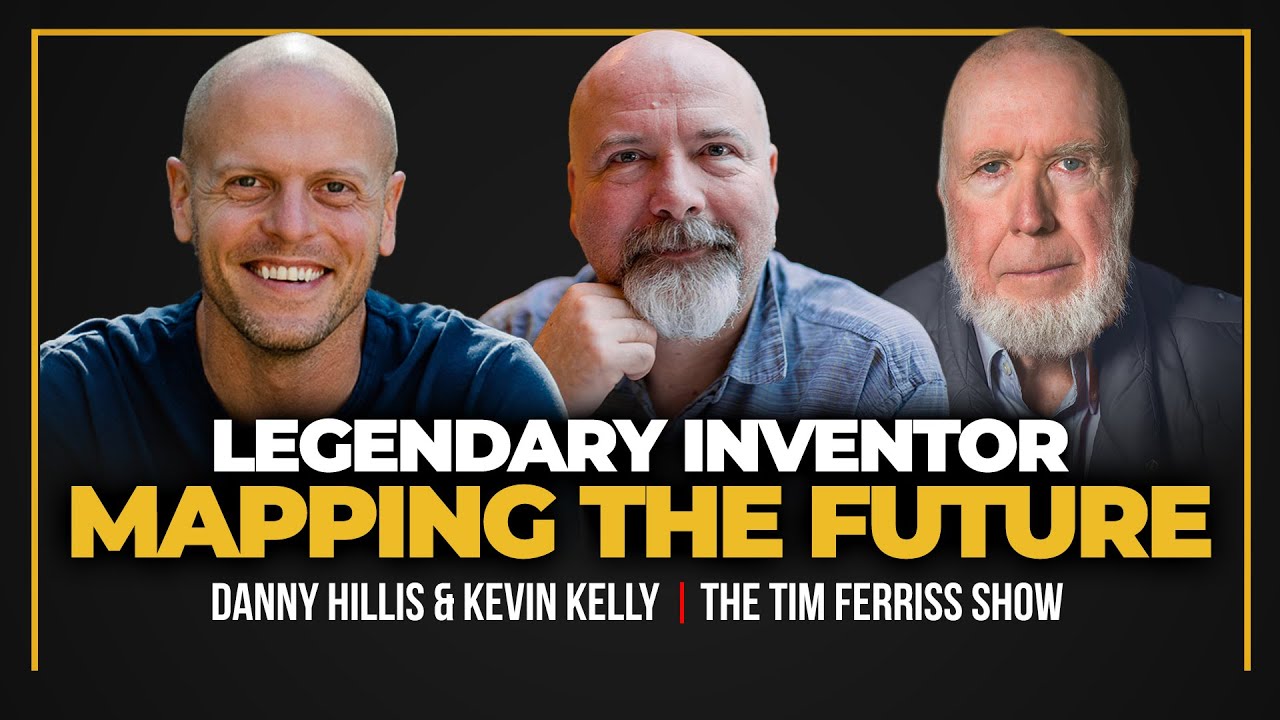
- Kevin Kelly and Danny Hillis were introduced through their mutual friend, Stewart Brand, when Brand went to MIT Media Lab to write a book, and Danny was part of that circle 1m36s.
- At that time, Kelly was editing the Whole Earth Review, and Brand brought Danny to visit him at Sausalito, where they first met, but it wasn't until later that they started working together 1m53s.
- Kelly was impressed by Danny's idea of a clock that would tick for 10,000 years as a way to think about the future, which was published in Wired, a magazine Kelly was running at the time 2m6s.
- Stewart Brand decided to help Danny build the clock and formed a nonprofit, initially called the Clock Library Foundation, with Kelly as part of the original group 2m36s.
- For almost 30 years, Kelly and Danny have been working together on the Long Now mission to encourage long-term thinking 2m51s.
- Danny confirms that Kevin's recollection of their meeting and collaboration is accurate 3m5s.
The funniest person who ever opened Danny's interview box of unusual objects. 3m9s
- The conversation begins with a mysterious device called a Mogan clamp, which is part of a collection of unusual objects in a silver briefcase used by Danny Hillis in the interview process for his company, Applied Invention. 3m34s
- The company, co-founded with Bran Ferren, worked on a wide range of projects, and the interview process involved showing candidates the box of unusual objects to gauge their curiosity and engagement. 4m7s
- The Mogan clamp is a device used for circumcision, and its inclusion in the box was intended to test the candidate's reaction and ability to think creatively. 5m38s
- The most memorable person to open the box was Robin Williams, who gave an elaborate and humorous description of the objects, including the Mogan clamp, which he jokingly referred to as a "space alien sex toy." 6m9s
- Danny Hillis met Robin Williams while working at the Walt Disney Company, where he held the position of Disney Fellow and Vice President of Imagineering. 6m32s
- Hillis' time at Disney was a unique experience for him, as it was the only job he ever had where he received a paycheck, and it provided him with a different kind of education than his time at MIT. 6m51s
Danny's transition to Disney as a Disney Fellow and Vice President of Imagineering. 7m17s
- Danny Hillis studied AI under Marvin Minsky at MIT and realized that AI required big, fast, parallel computers that didn't exist at the time, leading him to build one from scratch, designing chips and the operating system 7m55s.
- The project grew too big for a graduate student to handle at a university, so Hillis started a company, despite MIT forbidding him from doing so, and hired faculty members, including the ex-president of the university, Jerry Wiesner 8m41s.
- The company successfully built the first big parallel computer, which became the fastest computer in the world for many years, but Hillis and his team didn't know how to make a successful business out of it 9m41s.
- A former employee of one of their chip suppliers had a better idea for a business and went on to create Nvidia, which eventually achieved what Hillis' company had set out to do 10m4s.
- After the company didn't work out, Hillis got the hardware people jobs at Sun Microsystems and decided to do something different, leading him to join Disney as a Disney Fellow and Vice President of Imagineering 11m4s.
- Hillis had always had a childhood dream of being an Imagineer and was given the title of Disney Fellow, which had previously only been held by Salvador Dali, and was also made a Vice President to give him a title that people would understand 11m36s.
- When Hillis joined Disney, nobody knew what he was supposed to do, as the person who had approved his hiring, Frank Wells, had died in a helicopter crash before he started, but this allowed Hillis to attend meetings and learn about the company 12m16s.
- Hillis took advantage of the situation to get an education and insisted on being in meetings where important decisions were made, such as what to build in Florida, which became Animal Kingdom, and what to build in Paris 12m27s.
The contrast between engineering and artistic approaches to problem-solving. 12m47s
- Danny Hillis learned about the importance of storytelling and the artistic way of looking at things during his time at Disney, which differs from the engineering way of looking at things, where there is a focus on ground truth and understanding how things work 12m47s.
- In show business, people relate to each other differently, and success is often determined by who wins an argument rather than who is right, which is a different approach from engineering 13m32s.
- Hillis recalls an example where he was asked to contribute to the development of an online service for Disney, and while he drew a block diagram of the servers and services, others at the table drew pictures of magical castles and images, highlighting the disconnect between the engineering and artistic approaches 14m28s.
- Despite the initial disconnect, Hillis came to appreciate the importance of the artistic approach in show business, recognizing that it is crucial to the success or failure of a project 15m13s.
- The artistic way of looking at things involves seeing the world through the eyes of an artist, which is different from the scientific approach, and Hillis notes that this artistic approach has influenced his work after Disney 16m1s.
- Hillis learned about the concept of storytelling from his time at Disney, where designers think of a theme park as a story and a sequence of experiences rather than just a piece of architecture or a map 16m27s.
- The concept of creating an understandable emotional experience is crucial in designing theme parks, as it connects with people on a subjective level, making the experience more memorable and impactful 16m58s.
- This idea can be applied to various forms of art and entertainment, such as films and music, which have the power to evoke emotions and create a lasting impression on people 17m21s.
- The 10,000 year clock was initially designed with a focus on mechanical problems, but later shifted to considering the emotional experience and story behind the clock, which would determine its longevity and significance 17m36s.
- The clock's design was influenced by the idea of creating a unique experience for visitors, including a sequence of events that would evoke emotions and curiosity, such as showing the time and date of the last person who visited the clock 18m30s.
- The clock also features a unique souvenir option, where visitors can take a rubbing of the date they visited, creating a personalized and tangible memory of their experience 19m3s.
- The concept of creating an emotional experience and story behind an invention can be applied to various projects, including those in the field of technology and engineering 19m21s.
- The idea of creating a unique and personalized experience can be achieved through simple yet thoughtful design elements, such as the rubbing feature on the 10,000 year clock, which allows visitors to take a piece of their experience home with them 19m45s.
- The importance of storytelling and emotional experience in design is not always explicitly discussed with clients, as their priorities may lie in other areas, such as financial safety or reliability 20m17s.
- Most inventions and products are influenced by a story that makes them relatable to people, and understanding this story is crucial for their success 20m33s.
- This approach focuses on the experience of using a product rather than just its engineering, and it can lead to a deeper understanding of how people interact with technology 20m56s.
- Working with Steve Jobs on the Macintosh project was a significant experience, as it showed how a clear vision for how people would relate to a machine can be more important than technical details 21m5s.
- Steve Jobs had a unique ability to understand how people would interact with the Macintosh, even if he was wrong about some technical aspects, and this vision was a key factor in the product's success 22m15s.
- The story behind a product is essential, and if it is incorrect, no amount of technical excellence can fix it, whereas technical issues can often be resolved if the underlying story is correct 22m37s.
- The importance of the story behind a product was not immediately apparent, but it became clear after seeing how people related to the Macintosh 22m44s.
The development of parallel computing and founding Thinking Machines. 22m51s
- Danny Hillis made the first computers that were in parallel, which he called Thinking Machines, with the slogan "we want to make a machine that will be proud of us." 22m52s
- Hillis believes that the current focus on large language models (LLMs) and neuronets is not the whole story of AI, as these technologies are actually quite old. 23m12s
- Hillis shares a story he calls "The Songs of Eden," which is about the origin of human intelligence, where a group of monkeys developed the ability to distinguish sounds and notice the moods of other monkeys through grunts. 23m25s
- Alongside the evolution of the monkeys' ability to distinguish sounds, another phenomenon evolved, which is now referred to as memes – catchy tunes and ideas that get repeated. 24m11s
- The co-evolution of these two phenomena led to a symbiosis between the monkeys and the songs, eventually evolving into human culture and ideas. 24m42s
- Hillis predicts that artificial intelligence might evolve in a similar way, where machines are built that are powerful enough to be "infected" with human culture. 25m10s
- The internet has provided a substrate for human intelligence to live on, which is not human but allows human intelligence to thrive through the data it is trained on. 25m32s
- The current state of AI is in the imitation stage, where machines are able to imitate human intelligence but will eventually go beyond imitation and understand more. 26m5s
- Hillis believes that what we have is not artificial intelligence but human intelligence on an artificial substrate. 26m25s
- This is not the only possible form of AI, and other forms will likely be explored in the future. 26m33s
- The process of choosing what to work on next involves a guiding sense of where to direct attention, and it's not just about the individual, but also about the preconditions created by society that make an invention possible 27m2s.
- The inventor's role is often misunderstood, as they only play a small part in the process, and it's society that creates the preconditions for invention 27m52s.
- The example of parallel computers illustrates this point, as it seemed obvious in hindsight, but at the time, there were pieces missing, such as the ability to put multiple processors on a piece of silicon 28m29s.
- Parallel computing is a method of using multiple processors to solve a problem, either on a single chip or in the cloud, and it's a complex process that requires coordination and convergence 29m24s.
- The traditional way of computing was sequential, doing one thing at a time, whereas parallel computing does multiple things at the same time, which is more complex 29m42s.
- Despite initial skepticism and reasons why people thought parallel computing was impossible, it was made possible by advances in technology and the preconditions being in place 30m5s.
- The human brain's ability to process information in parallel was an inspiration for the development of parallel computing, and it was believed that this approach could be used to make AI more efficient 30m20s.
- The preconditions for parallel computing were in place, including the ability to design and make chips, compiler technology, and television cameras, which made it possible to build and test parallel computers 30m41s.
- The preconditions for converting audio to digital bits were already in place, including the ability to produce digital things and have digital eyes on machines 30m56s.
- The main obstacle to converting audio to digital bits was a prejudice that it was impossible, which was likely created for commercial reasons 31m13s.
- This prejudice made it a challenge waiting to be overcome, and having a reason to believe it would work was crucial 31m21s.
- The conversion of audio to digital bits required an enormous amount of work from tens of thousands of skilled engineers to reach that point 31m31s.
- The process involved taking advantage of the existing pieces and putting them together, which ultimately led to the achievement 31m42s.
- The conversion of audio to digital bits was a formal process that built upon the work of many engineers 31m46s.
The three criteria by which projects are chosen at Applied Invention. 31m47s
- Applied Invention uses three criteria to decide which projects to work on, with one of the senior partners needing to be really excited about the project, usually due to its potential for big impact or cool technology 31m52s.
- The project must also make financial sense, either by guaranteeing minimal financial loss or offering a small chance of making a lot of money, which is evaluated by partners other than the one most excited about the project 32m27s.
- The third criterion is the non-redundancy criterion, where the project must be something that won't get done otherwise, or won't get done for a long time, or won't get done right, to ensure Applied Invention is not wasting its time on a project that someone else will do anyway 33m8s.
- This non-redundancy criterion is the hardest to enforce and requires self-discipline, but it is essential in ensuring that Applied Invention only takes on unique and impactful projects 33m55s.
- The non-redundancy criterion is crucial in avoiding projects that are already being worked on by others, and instead, focusing on projects that require Applied Invention's unique expertise and approach 33m25s.
- The combination of these three criteria helps Applied Invention to maintain a portfolio of projects that balance financial risk and potential impact 32m40s.
- The application of these criteria has added a level of discipline to the project selection process, which was not always the case in the early days 32m52s.
Zero-trust packet routing (ZPR) and the future of cybersecurity. 34m6s
- AMD's Do's law indicated that parallel computing was impossible, but the human brain serves as a counterexample, and this led to the realization that there might be something wrong with the law, specifically that it assumed the same size problem would be used on larger, faster computers 34m6s.
- The flaw in Do's law is that it assumed the same problem size, but with bigger, faster computers, larger problems can be solved, which is why cloud computing and giant parallel machines work 34m32s.
- Cybersecurity is currently a major issue, with ransoms increasing and the defense losing against the offense, and the problem lies in the flawed foundation of the internet, specifically the Internet Protocol 35m20s.
- The Internet Protocol was designed with the idea that security was not the problem of the network, but rather the problem of the thing that received the packet, which has led to a situation where packets can claim to be from anywhere and the recipient has to guess which ones are good or bad 35m48s.
- The current system allows attackers to have the advantage due to anonymous packets, and the right approach would be for the network to have a policy of what it delivers, which is partially done with firewalls, but ultimately requires guessing 36m47s.
- A group of experts was gathered to design an alternative to Internet Protocol, assuming they knew what they know today about cybersecurity, and this led to the invention of zero-trust packet routing, where every packet is verified 37m25s.
- Zero-trust packet routing is a hypothetical solution that captures the imagination of smart people, but it is not a feasible replacement for Internet Protocol in the current commercial landscape 37m44s.
- The idea of zero-trust packet routing is to have the network verify every packet, rather than relying on the recipient to guess which ones are good or bad 37m58s.
- A new internet protocol is being developed, which carries a kind of "passport and Visa" that proves it has permission to go where it's going, allowing the network to have a policy of only delivering things that are allowed to go to where they're allowed to go 38m4s.
- This protocol can be built as an overlay to the current internet, and companies like Oracle are starting to use it, which could cause a big shift in the internet eventually 38m30s.
- The new protocol addresses a foundational problem that no sane company would have looked at as a business opportunity, but it could help make the world a better place 38m50s.
- The future of cyber security could have two completely different layers: the current endpoint protection layer, and a new layer of zero-trust packet routing where the network is aware of who's sending the message and their permissions 39m40s.
- The new layer of zero-trust packet routing would be a completely different system than the current one, and would give the defender the advantage instead of the attacker 40m25s.
- The two-layer system of cyber security would consist of the current endpoint protection layer, which would still exist, and the new layer of zero-trust packet routing, which would be independent of the current layer 40m4s.
Learning by "hanging out" with experts like Seymour Papert, Marvin Minsky, and Richard Feynman. 40m37s
- Danny Hillis has three criteria for deciding whether to pursue a project: being excited about it, having a viable means to keep it going, and whether it would happen without his involvement, which supposes having a unique ability or knowledge that others don't possess 40m38s.
- As a young graduate student, Hillis decided to design a chip, which required either a lot of knowledge about chip making or overconfidence, and he attributes his ability to enter this area to his willingness to learn new things and seek out people who really know the subject 41m20s.
- Hillis developed the ability to find and learn from people who are smarter than him, and he believes that knowing a different combination of things that others know is key to his success 42m6s.
- There are many ways to "hang out" with people, including group dinners with experts, and Hillis believes that interacting with people who are smarter than him is essential to his learning process 42m22s.
- Hillis gives the example of Marvin Minsky, who co-founded the field of artificial intelligence, and how he met him by reading Minsky's proposals and finding a way to get into the AI lab at MIT, which was physically locked and required a key to enter 42m58s.
- Hillis read Minsky's proposals, which were publicly available in the library lobby, and found an idea that resonated with him: teaching young kids to program computers, even those who couldn't read and write, which he thought was important and wanted to work on 44m26s.
- Danny Hillis invented a way for kids who couldn't read and write to program computers by manipulating blocks, which led to an interview with Seymour Papert, a pioneer in educational computing 44m39s.
- Papert was impressed by Hillis' idea and recognized its potential, as he had been looking for a way to make programming accessible to kids who couldn't read and write 45m30s.
- Hillis' invention was similar to Logo, a programming language invented by Papert, but Hillis created a physical way to program using pictures, which he called the "slot machine" 45m45s.
- The slot machine was a precursor to the Squeak language, an electronic version of Hillis' invention 46m1s.
- Logo was an early computer programming language designed for kids, which allowed them to create simple programs, such as moving a square around in a circle 46m10s.
- At the time, the idea that every school would have a computer was considered implausible, but Hillis and Papert believed it was a possibility 46m27s.
- Hillis gained access to a building where he could work on his project and eventually met Marvin Minsky, who was building a personal computer in the basement 46m43s.
- Hillis discovered a mistake in Minsky's computer design and pointed it out, which led to him being invited to work on the project 47m43s.
- Hillis started working with Minsky and his graduate students, fixing errors and contributing to the development of the personal computer 48m13s.
- Danny Hillis started working at Marvin Minsky's AI lab after Marvin offered him a place to stay in his basement, and eventually gave him a job, although Hillis still worked at Logo with Seymour 48m40s.
- Hillis learned by hanging around smart people, including Marvin Minsky, and considers this the "Hillis method" of learning 49m9s.
- Another example of learning by hanging around smart people is Richard Feynman, a Nobel Prize-winning physicist who invented Feynman diagrams and Quantum Electrodynamics 49m16s.
- Hillis visited Feynman and asked if he knew any students who would be interested in working on a parallel computer project, but Feynman said none of his students were "crazy enough" to work on it 50m1s.
- Feynman recommended a student who was a hard worker and smart, but didn't know much about computers, and Hillis hired him for a summer job, only to discover that the student's name was also Richard, Richard Feynman's son 50m41s.
- Richard Feynman, the son, showed up on the first day of work and was given the task of figuring out how to do Quantum Electrodynamics on a parallel computer, and later became the Quarter Master, getting supplies for the company 51m21s.
- Richard Feynman, the son, worked at Thinking Machines every summer and eventually started the first Quantum Computing project there 52m0s.
- When entering a new field, learning is best achieved through conversations and listening to people, rather than just reading papers, as it allows for asking questions that make experts think and spark interesting discussions 52m20s.
- Reading fundamental papers is still necessary to gain a basic understanding and identify interesting questions, but it's essential to do homework beforehand to prepare for conversations with experts like Marvin Minsky or Richard Fan 52m31s.
- Coming into a field from the outside can be beneficial, as it allows for a fresh perspective and the ability to identify significant gaps in knowledge that insiders may have overlooked 52m57s.
- Asking questions, even if they may seem dumb, can lead to valuable conversations and insights, and occasionally, they may be recognized as interesting and important questions 53m14s.
- Ultimately, learning from people and their conversations is more valuable than learning from papers alone, as it provides a deeper understanding and fosters meaningful discussions 53m32s.
Danny's work in biotechnology and cancer research with David Agus. 53m37s
- Danny Hillis got into biotechnology after an oncologist, Dr. David Agus, approached him with the problem of cancer diagnosis and treatment, which led to a collaboration and a new way of thinking about cancer as a process the body constantly does, rather than a disease it has 54m7s.
- Cancer is viewed as a verb, with the action happening at the levels of proteins being expressed and interacting, making it essential to look at proteins rather than just genes 55m11s.
- A method was developed to measure all proteins in a drop of blood or a cell and see how they change over time, which was initially tested on mice with cancer 55m42s.
- This approach allows for a runtime view of cancer, similar to debugging a computer program, where looking at the proteins is like using a debugger to see what's actually happening 56m31s.
- The National Cancer Institute became interested in this approach and provided funding to make progress 56m49s.
- When working with Dr. Agus, Hillis' approach was to learn from the expert and then find other knowledgeable people to work with, rather than trying to become an expert on proteins himself 57m7s.
- Hillis was introduced to other interesting people in the field by Dr. Agus and Marvin, allowing him to expand his knowledge and network 57m38s.
- Danny Hillis was introduced to his mentor, Dr. David Agus, by Richard Feynman, who told him to "keep him close" as Dr. Agus was his "arch enemy" Murray Gell-Mann's friend 57m42s.
- Dr. Agus, being a doctor who thinks outside the box, was looking for someone to explain his ideas to, and Danny, with his blank slate and lack of knowledge in the field, was the perfect person to help him go back to the fundamentals 58m18s.
- Dr. Agus found Danny through persistent phone calls, eventually getting John Doerr, Al Gore, and Bill Bergman to vouch for him, which led to Danny agreeing to meet with him 58m51s.
- Dr. Agus is an unusual doctor who is willing to reach out to people outside of his field to investigate questions and unpack issues, which is rare in the medical field 59m31s.
- Danny looks for opportunities that excite him, have a financial basis, and are not being pursued by others, and he also considers what he wants to learn about, which in the case of Dr. Agus, was biology 1h1m13s.
- Danny still receives opportunities that fit his criteria, but he has to make choices about how to spend his limited time, and he has not articulated a fourth criteria for decision-making until now 1h1m11s.
- The "make money" aspect is not a primary motivator for Danny, but rather a consideration in his decision-making process 1h1m43s.
- The approach to projects is not solely focused on optimizing for financial gain or creating a billion-dollar company, but rather having a sustainable financial model to support the work 1h1m49s.
- A sustainable financial model is necessary to pay for the projects and ensure their continuation, even if the goal is not to accumulate wealth 1h2m1s.
- Disney's approach to financing their projects is cited as an example, where the focus is on creating content, and the financial gain is a means to support that creative process 1h2m7s.
Staying sustainable with systems-oriented thinking in agriculture — as nature intended. 1h2m16s
- The importance of sustainability is emphasized, as relying on unsustainable methods can lead to constantly seeking support, and having a sustainable approach is crucial for long-term success 1h2m17s.
- An interest in agriculture was sparked during the COVID-19 pandemic while living on a farm in New Hampshire, where it was discovered that homegrown food was superior to store-bought options, prompting an exploration of the food supply chain 1h2m31s.
- The current food system is flawed, relying on underpaid labor, long-distance transportation, and energy-inefficient methods, which is not a sustainable future, and people are seeking better, more protein-rich food options 1h2m57s.
- The existing food system is also socially unjust and energy-intensive, with most grocery store vegetables being weeks old, having been shipped long distances, and having lost flavor and nutrients 1h3m40s.
- The rest of the world wants to eat better and have more protein, but cannot replicate the inefficient system used in some countries, and climate change is also affecting food production 1h4m10s.
- When exploring a new interest, it's essential to ask questions and consider the broader context, looking for ways to change the system rather than just solving individual problems within it 1h4m52s.
- A systems view of the world is necessary, recognizing that individual problems have been addressed, but the overall system needs to be re-examined and rearranged for more efficient and sustainable solutions 1h5m11s.
- Few people think about the entire process of food production, from growing to transportation, and considering these factors is crucial for creating a more sustainable food system 1h5m42s.
- The goal is to look at the system as a whole and find ways to rearrange it for better outcomes, rather than just optimizing individual components 1h6m20s.
- Permaculture is often viewed as a natural system, but it can be extended to include various aspects of food production, transport, and supply chain, making it a more comprehensive system 1h6m29s.
- Typically, people engineer things in terms of point solutions that are put together into systems, rather than designing systems from the start, due to commercial opportunities and the potential for competitive advantage 1h6m52s.
- However, this approach can lead to complicated and fragile systems, and sometimes it's necessary to take a step back and look at the bigger picture to identify areas for improvement 1h7m22s.
- In agriculture, there are many opportunities for improvement, such as growing food closer to where it's consumed, using more efficient labor practices, and developing greenhouses that work in colder climates 1h7m35s.
- To achieve these improvements, it's necessary to change multiple factors simultaneously, including the architecture of greenhouses, the jobs of workers, and the microbiome of the soil, to reach a new equilibrium point where many crops are grown closer to where they're consumed 1h8m38s.
- To tackle these complex issues, it's necessary to have a visionary source of funding, a patron who shares the vision and is willing to support the project, and a team of experts who can work together to find solutions 1h9m48s.
- In this case, a company was already working on a project to grow food closer to where it's consumed, but needed help to make it work, and with the support of a patron and a team of experts, the project was able to expand and become more comprehensive 1h10m1s.
- The approach to solving these complex problems involves a combination of exploratory learning, ranking and tackling individual issues, and parallel processing with teams of experts and contractors 1h9m14s.
- Creating a real system to solve a real problem can lead to an economic opportunity that can be exploited, but it requires visionary funders who are willing to take risks 1h10m37s.
- Visionary funders, such as those who initially supported AI research through DARPA, are necessary to bring innovative ideas to life 1h10m45s.
- The support of individuals like Jeff Bezos, who saw the vision and was willing to take a risk, has been crucial in making projects like the clock a reality 1h10m59s.
- Having many talents and being lucky enough to meet rare, visionary people who are willing to take a bet on one's ideas can be a key factor in achieving success 1h11m14s.
Danny's superpower. 1h11m16s
- The ability to not be afraid to learn new things is considered a potential superpower, possibly one that everyone is born with but often loses as they grow older 1h11m24s.
- This fearlessness to learn and explore new things is similar to the curiosity and openness of children, who are not afraid to approach and play with something new and strange 1h11m34s.
- One of Danny Hillis' kids described his superpower as being a "Mind Shifter," someone who can easily shift into different mindsets and view things from multiple perspectives 1h12m5s.
- Lateral thinking is also considered one of Danny Hillis' superpowers, which may have been developed during his childhood due to his father's work as an epidemiologist 1h12m18s.
- As a result of his father's job, Danny Hillis lived in many different places around the world, often in areas experiencing hepatitis epidemics, wars, and famines, which required him to adapt to new cultures and environments 1h12m23s.
- This experience of living in diverse and challenging environments may have helped Danny Hillis develop the habit of being willing to shift his mind and adapt to new situations 1h12m47s.
Homeschooling, education on the move, and the influence of Mrs. Wilner. 1h12m53s
- Homeschooling was a joint decision made by Danny Hillis and his wife, who also hired tutors and worked with other homeschoolers to provide a comprehensive education for their three children 1h12m53s.
- Danny's decision to homeschool was influenced by his own experiences in school, where he had both great and bad teachers, and he wanted to provide a better learning environment for his children 1h13m26s.
- One of Danny's favorite teachers was Mrs. Wilner, a librarian who encouraged his curiosity and introduced him to new subjects, such as electricity and science fiction 1h14m1s.
- Great teachers, like Mrs. Wilner, see where a student is and help them stretch to new places, which is something that can be more easily achieved in homeschooling than in a traditional classroom 1h14m42s.
- Through homeschooling, Danny and his wife aimed to cultivate aspects of cognitive development, curiosity, and other skills that might not be emphasized in traditional schooling 1h14m57s.
- Danny found that teaching his children made him realize how much he didn't know, and he learned to appreciate the value of admitting when he didn't understand something, a trait he admired in physicist Dick Feynman 1h16m13s.
- Feynman's approach to learning, which involved deriving concepts from first principles, inspired Danny to re-examine his own understanding of various subjects, including computer science 1h17m8s.
- The experience of teaching and learning alongside his children helped Danny appreciate the importance of acknowledging the things he didn't know and being willing to back up and explain concepts in a different way 1h16m10s.
The failure of Thinking Machines and other regrets/surprises. 1h17m26s
- Danny Hillis considers time as the most precious thing in his life, and he wishes he had more time ahead of him, realizing how much of it he squandered in the past 1h17m28s.
- One of his biggest failures was Thinking Machines, a company that didn't have to fail if he had paid more attention to financial sustainability and treated it as a serious problem 1h18m7s.
- Thinking Machines had 500 employees, mostly hired straight out of MIT, and was building the fastest computer, but the company failed due to poor business decisions, lack of attention to laws passed by competitors, and poor cash management 1h18m30s.
- Hillis learned from this experience and now manages his time and priorities differently, focusing on non-redundancy and not working on things that will happen anyway 1h19m51s.
- He still values hanging out with extraordinary people but has realized that many of his older friends have passed away, and he is now interested in meeting younger extraordinary people who think differently 1h20m2s.
- Hillis's 20-year-old self would be surprised to know that his life has worked out despite many failures and close calls, and he has learned to worry less about the future 1h20m51s.
- He has come to realize that he worried too much in the past, even when he was penniless and couldn't pay his mortgage, and now he worries less 1h21m25s.
The "Entanglement" that blurs natural and technological boundaries. 1h21m35s
- The concept of "entanglement" refers to the blurring of boundaries between natural and technological systems, making it difficult to distinguish between the two 1h22m3s.
- Historically, nature and technology were seen as separate entities, with technology being designed, understood, and controlled, while nature was mysterious and complicated 1h22m9s.
- However, with advancements in technology, natural systems like the atmosphere, genes, and minds are becoming technological artifacts, and technological systems are evolving to become more complex and less understood 1h22m52s.
- The internet and artificial intelligence systems like ChatGPT are examples of technological systems that are no longer fully understood, with their workings being a combination of design, evolution, and learning 1h23m11s.
- As a result, people's relationship with computers is becoming more like their relationship with nature, where they know the "magic incantations" to make things work, but don't fully understand the underlying mechanisms 1h23m52s.
- This blurring of boundaries between natural and technological systems is leading to a reevaluation of the distinction between the two, with some arguing that the idea of pure nature and pure technology may become obsolete 1h24m17s.
- Author Kevin Kelly's book "Out of Control" explores this concept of entanglement, and Danny Hillis's work on artificial life has also contributed to the idea that natural and synthetic systems are intertwined 1h24m47s.
- Kelly suggests that natural and synthetic systems are two faces of the same thing, and that we are now recognizing this unity, while Hillis might say that they are becoming entangled 1h25m14s.
- This moment in time is special, with rapid changes in population, climate, and technology, marking a qualitative shift in human history, where our technological power has enabled the creation of complex systems that are beyond our understanding 1h25m44s.
The current state of AI versus true intelligence. 1h26m39s
- The concept of AI can be compared to the discovery of electricity or fire, as described by Jeff Hawkins, and it is a discovery rather than an invention 1h26m45s.
- Intelligence is a complex and multifaceted concept, similar to life, and it is not just one thing 1h27m14s.
- In the early days of AI, researchers focused on tasks that were hard for humans to do, such as playing chess, solving calculus tests, and translating languages, which were thought to be intelligent 1h27m22s.
- However, it was later discovered that these tasks were actually the easy part, and the hard part was the things that humans were naturally good at, such as recognizing faces, jumping to conclusions, and having intuition 1h27m52s.
- Producing speech was thought to be hard, but listening to speech turned out to be way harder than producing speech 1h28m15s.
- The early AI systems had a box called the neural network or pattern recognizer that was supposed to guess the obvious thing that was going to happen next and recognize patterns, but it turned out that these neural networks had to be much bigger and trained with more data than expected 1h28m34s.
- The current AI systems are good at imitating human intelligence, but they are still just a small part of intelligence and are not yet capable of doing all the things that humans consider intelligent 1h29m22s.
- AI is currently at a stage where it can fake intelligence by using the right words and phrases, but it does not truly understand what it is talking about 1h29m49s.
- Despite its limitations, AI is expected to advance rapidly due to the large number of smart people working on it 1h30m22s.
How AI may help humanity better understand its place on the intelligence spectrum. 1h30m36s
- People tend to overestimate the current capabilities of AI and underestimate what can be accomplished in the long run, often getting mixed up on time scales, with many being short-term pessimists and long-term optimists. 1h30m36s
- The development of AI is compared to the early history of the discovery of electricity, where the smartest people of the time had wrong ideas about what electricity was, and it took many years of demonstrations and discoveries to understand its complexity. 1h31m21s
- Currently, there is no theory of intelligence, and it is believed that we are as far from knowing what intelligence is as people were from understanding electricity in the 1700s. 1h32m10s
- It is possible that we may never understand what intelligence is, but we can still make and use intelligent things without fully understanding them, just like we have used plants and the natural world without understanding how they work. 1h32m31s
- The term "intelligence" might be too broad and could be replaced with more precise labels or concepts as we discover more about how the mind works through AI. 1h33m10s
- Intelligence is likely a high-dimensional space with many different primitives or elements, and we are starting to discover some of these elements through AI, which will help us understand that intelligence is not a single dimension. 1h33m44s
- Human intelligence is compounded and made up of many different kinds of cognition, and we are on the path to unbundling these concepts and discovering more about how our minds work. 1h33m55s
- Even if we unbundle human intelligence, there may be other kinds of intelligence that we can't even imagine, and these are the ones that are of most interest, such as machines that are smarter than people but in different ways. 1h34m18s
- The space of all possible minds is huge, and human intelligence is likely on the edge of this space, with AI allowing us to explore other places in the high-dimensional space of thinking that we can't even imagine. 1h34m52s
- The main goal of AI is not to replace human thinking but to arrive at other kinds of thinking that we can't even imagine, and humans are currently in a transitional phase, halfway between monkeys and what we're going to become. 1h35m18s
What the future looks like to a short-term pessimist/long-term optimist. 1h35m58s
- Many people, particularly those in their mid-30s to 47 years old, are hesitant to have children due to concerns about climate change, AI, and the unpredictability of the future, which they believe makes the world a bleak place for the next generation 1h35m58s.
- Despite these concerns, there is value in optimism, and it is possible to put aside utilitarian functions of optimism to consider the long-term future 1h36m50s.
- Historically, every generation has had its own set of fears and concerns, such as the atomic bomb and childhood diseases, but the world has generally improved over time 1h37m5s.
- In the past, many people died from diseases like smallpox, which no longer exists, and most children were hungry and malnourished, but this is no longer the case 1h37m24s.
- The world has made significant progress in various areas, including the treatment of gay people, and it is likely that this progress will continue 1h37m42s.
- While it is possible that a catastrophic setback could occur, humans and nature are adaptable, and it is likely that the world will recover and continue to progress 1h39m4s.
- The Earth's future is likely to be fine, and it is possible that humans will continue to evolve and adapt to new challenges 1h39m23s.
- The concept of progress is not always steady and linear, but rather a series of steps forward and backward 1h39m53s.
- Many smart and interesting people are preoccupied with climate change and other existential concerns, but it is possible to rank-order these concerns and consider the bigger picture 1h40m7s.
- Climate change is viewed as a significant problem that requires immediate action, but there are differing opinions on its severity, with some considering it an overemphasis and others believing it's a top priority 1h40m31s.
- Some individuals argue that the focus on climate change is misplaced, citing other risks that may be more pressing, and that people tend to underestimate humanity's ability to adapt to problems 1h41m19s.
- Despite the challenges posed by climate change, there are many intelligent people working on solutions, and it's possible that some of these solutions will be effective in mitigating its effects 1h42m4s.
- The population explosion was once considered a major concern, but now the focus is shifting to the potential problem of population shrinkage or implosion 1h42m32s.
- Humans have a tendency to focus on dangers and negative events, which can create a skewed perception of the world, and good things often happen slowly and without much attention 1h42m46s.
- The world has been improving in many ways, such as a decrease in hunger among children, but these positive developments often go unreported 1h43m25s.
- When considering the biggest risks, AI is often mentioned, but it's also possible that AI could help humanity address various challenges, including climate change, epidemics, and population decline 1h43m54s.
- The development of AI and robots may coincide with the population implosion, potentially providing a solution to this issue 1h44m30s.
- The development of cell phone technology by Motorola was initially met with skepticism, with people envisioning problems such as constant phone calls in public places and interruptions at night, but failing to see the benefits it would bring 1h44m49s.
- Despite the concerns about the digital divide and unequal access to technology, the benefits of the internet and cell phones were seen as so significant that they would inevitably become widespread, and the focus should be on addressing the problems that arise when everyone has access to these technologies 1h45m46s.
- There is an asymmetry between imagining problems and imagining solutions, with the former being easier and requiring less energy, as people tend to focus on the potential drawbacks of new technologies rather than their potential benefits 1h46m24s.
- The example of a brain-augmenting chip is given, with most people initially expressing reluctance to adopt such technology due to various concerns, but it is predicted that once it becomes possible, people will eventually adopt it despite the potential problems, just like they did with cell phones 1h46m40s.
- The prediction is that people will put up with the problems associated with new technologies and work around them because the benefits will be so significant, and this will be a common pattern as new technologies emerge 1h47m11s.
The cone of silence we never heard from again. 1h47m18s
- A device called "Babble" or the "cone of silence" was created to address the issue of people overhearing conversations in open offices, and it worked by generating a masking sound of someone talking in the same voice but saying something different 1h47m47s.
- The device would listen to a person's voice for a while and then start talking in a similar voice and intonation, but with nonsensical words, effectively masking the original conversation 1h48m30s.
- The device was tested and found to be effective in making it difficult for people to eavesdrop on conversations, as the room would get slightly louder but the conversation would become unintelligible 1h48m51s.
- Herman Miller bought the technology with the intention of using it in offices, but the project was ultimately abandoned after the CEO had a heart attack and nobody had the motivation to continue 1h49m16s.
- Despite the project's demise, there was interest in the technology from various industries, including restaurants, healthcare, and pharmacies, which found the concept appealing for maintaining confidentiality 1h49m27s.
Debugging dementia and other diseases. 1h49m58s
- Danny Hillis is an inventor who could potentially work on solving neurodegenerative diseases, such as Alzheimer's and Parkinson's, given his background in inventing things 1h50m0s.
- The idea of applying Danny's skills to neurodegenerative diseases is of great interest, especially since the speaker has a family history of these diseases 1h50m51s.
- To tackle diseases like cancer and neurodegenerative diseases, it's essential to develop a way to read out proteins in the body dynamically, similar to how genes can be read out 1h51m30s.
- Currently, diseases are often treated too late, as the body is great at compensating for issues until it can't handle them anymore, resulting in many failed interventions 1h52m0s.
- If proteins in the body could be monitored, it would be possible to see things going wrong before symptoms appear and start treating the issue before damage occurs 1h52m21s.
- The concept of "pretreating" diseases, rather than treating them after they've developed, is crucial, and this can be achieved by understanding what's happening inside the body through protein monitoring 1h52m47s.
- A potential solution could involve a blood test, similar to the Grail test for cancer screening, which would monitor proteins in the body regularly, possibly through a finger prick 1h53m56s.
- However, this would require large population studies with well-correlated blood samples and medical records, as well as advancements in proteomic inventories, a technology that is not yet fully developed 1h54m29s.
- Once a database of protein information is established, it's likely that many systemic diseases could be headed off before they occur 1h55m0s.
The MRI alternative Danny's tackling. 1h55m13s
- A desired invention is a more comfortable, easy, and quick alternative to MRI machines, which currently provide a painful and unpleasant experience for patients 1h55m14s.
- An MRI produces a 3D image that can be interpreted by doctors or AI, but ultrasound technology does not currently offer a similar output 1h56m6s.
- Ultrasound operators have more information than what is captured in a picture or video, including the movement and pressure applied, but this information is not always conveyed to physicians 1h56m34s.
- There is potential for ultrasound technology to produce 3D images like MRI machines if sensors or robots are used to track the movement and pressure of the ultrasound device, and if models of tissue deformation and speed of sound through tissue are developed 1h57m21s.
- This advancement in ultrasound technology could provide information not currently available from MRI machines 1h57m44s.
- The development of this technology has not yet been done, and there is interest in meeting people who may be working on it or potentially working on it personally 1h57m56s.
Why don't we have a freezer version of the consumer microwave oven? 1h58m3s
- A challenge is presented to create a device that instantly cools food, similar to how a microwave instantly heats it up, with the idea of putting food in a machine and having it come out instantly ice cold 1h58m3s.
- Laser cooling is mentioned as a possible method to achieve this, but it is noted that it would take a long time to cool a significant amount of food, such as a half chicken 1h58m19s.
- The idea is considered to be a difficult and expensive challenge, with an estimated cost of a billion dollars, and it is acknowledged that the solution is not currently known 1h58m31s.
Danny's place in pinch-to-zoom iPhone innovation history. 1h58m34s
- A person was given a hypothetical scenario where they had $20 billion, allowing them to focus on projects that excite them, and they chose to work on a project that seemed trivial at the time but later became important, which was the development of pinch-to-zoom technology 1h58m35s.
- The person had always been interested in maps and wanted to be able to expand and zoom into them, which led to the idea of creating a pinch-to-zoom feature 1h59m26s.
- The person worked on building the technology and created a prototype, which they showed to Steve Jobs, who was initially skeptical about the idea due to concerns about fingerprint smudges on the screen 2h0m2s.
- Despite the initial skepticism, the person continued working on the technology and created a touch table that was eventually used in the Situation Room of the White House during the Obama Administration 2h0m23s.
- Apple later developed the iPhone, which included a refined version of the pinch-to-zoom feature, and the company filed a patent for it 2h0m51s.
- However, the person had already filed a patent for the technology, which predates Apple's patent, and this led to the invalidation of Apple's patent, allowing other companies to use the feature in their devices 2h1m23s.
- The person is proud of the invention, despite not receiving any payment for it, as it has become a widely used feature that is now considered intuitive and natural 2h1m48s.
The pros and cons of patents for inventors and society. 2h2m22s
- Patents may be beneficial for inventors, but they are not necessarily good for society, as they can hinder innovation and lead to unnecessary lawsuits 2h3m15s.
- In certain cases, such as pharmaceuticals, patents might be justified as a trade-off, but in general, they are not beneficial for society, particularly in the fields of computers and software 2h3m28s.
- The patent system was initially intended to encourage inventors to disclose their inventions, but with modern technology, many inventions are self-disclosing, making patents unnecessary 2h4m33s.
- Inventors should consider filing patents as a strategic move, but they should not pursue lawsuits against others for violating their patents, as this can be a waste of time and resources 2h5m4s.
- The patent system should be narrowed down to only allow patents for inventions that truly require disclosure and protection 2h4m56s.
- Inventors who have made money from patents often have to spend a significant amount of time in courtrooms, which can be a waste of their life and society's resources 2h4m2s.
- The click-through ad banner, invented by Brian B. Hor, was not patented, and it seemed obvious at the time that it was a good thing that didn't need patent protection 2h2m42s.
- Danny Hillis has a complicated relationship with patents and has felt ambivalent about them, but he continues to patent his inventions because they are often solutions to problems for other people who want to own the solution 2h3m11s.
- Hillis advises inventors to focus on creating and innovating rather than pursuing lawsuits and wasting time in courtrooms 2h5m21s.
Inventors Danny finds inspiring. 2h5m28s
- Inventors who inspire include Claude Shannon, who simplified complex and messy concepts, making them understandable and giving others the power to work with them 2h5m49s.
- Claude Shannon invented the bit, information theory, and a way of measuring and encoding information while working at Bell Telephone 2h6m16s.
- Shannon's work determined the theoretical limit to the amount of information that could be transmitted down a wire and applied Boolean logic to switching circuits in his master's thesis 2h6m22s.
- Shannon's way of thinking about things was powerful, giving others a way to think about and solve problems, which is now taken for granted in measuring things in megabytes 2h6m41s.
- Another inspiring figure is someone who invented or discovered the bit, who was on the speaker's thesis committee and had a significant impact on their work 2h7m0s.
- Other historical figures who have made significant contributions to their fields, such as Newton in physics and Feynman with Feynman diagrams, are also admired for their work 2h7m24s.
Danny's cause-and-effect heresy. 2h7m37s
- A heresy is defined as a belief that contradicts the views of people one admires, and in this case, the heresy is the rejection of cause and effect 2h7m38s.
- The concept of cause and effect is often illustrated using Newton's equation F = Ma, where force is said to cause mass to accelerate, but this can be rewritten as AAL F over M, suggesting that mass is caused by force acting on acceleration 2h8m7s.
- This alternative perspective suggests that cause and effect is just a story people tell to make sense of the world, and that reality does not actually have causes and effects 2h9m49s.
- The brain is wired to look for causes and effects, which is why people often believe in a first cause or a higher power, but this is just a result of how the brain works and how people tell stories about reality 2h9m24s.
- Thinking in terms of cause and effect can be a useful way of thinking, but it is not a fundamental aspect of reality, and people should not fool themselves into thinking that it is 2h11m24s.
- The concept of cause and effect is often used in fields like proteomics, where changes in proteins can be used to predict and intervene in disease states, but this is still a simplification of the underlying physics 2h10m2s.
- Computers and digital systems are based on the fantasy of cause and effect, where everything is reduced to zeros and ones, and this allows for the creation of complex chains of causes and effects 2h11m46s.
- However, this does not mean that cause and effect is a fundamental aspect of reality, and future AI systems may be able to think in different ways that do not rely on this concept 2h11m35s.
Quantum computing and its implications. 2h12m32s
- Quantum computing is difficult to explain in terms of causes and effects, unlike digital computers, as the act of observation itself can change the state of the system 2h12m49s.
- Quantum computers will initially be used for small tasks that fit within the existing framework, such as quantum key generation, where a module can produce a cryptographic key with specific properties 2h13m22s.
- The process behind quantum key generation is not easily understood, even by those with deep intuition, and it does not follow the traditional cause-and-effect model 2h13m44s.
- There is a prediction that in 100 years, it will be realized that quantum computing is not primarily used for computation, but rather for something else that is incredibly useful 2h14m6s.
- Computation tends to follow a cause-and-effect model, which may not be the primary application of quantum computing 2h14m25s.
- A book titled "The Pattern in the Stone" was written in the early 90s, which included a chapter on quantum computing, and it remains a relevant and selling book due to its explanation of the subject 2h14m49s.
- The book's chapter on quantum computing has remained largely unchanged, even after revisions, as the fundamental concepts and potential of quantum computing have not changed significantly 2h15m42s.
- Quantum computing still holds the potential to be a game-changer, but it has yet to be made useful in practical applications 2h16m8s.
The scientific pursuit of understanding consciousness. 2h16m33s
- The concept of consciousness is a complex and multifaceted term that is difficult to define, with many people offering different interpretations of what it means to be aware and have a sense of self 2h17m15s.
- One possible approach to understanding consciousness is through the study of artificial intelligence (AI) and quantum computing, which may provide new insights into the nature of intelligence and how it emerges from simpler constituent parts 2h17m10s.
- Consciousness may be an emergent phenomenon that arises from complex systems, but it is unclear whether it is a fundamental aspect of intelligence or simply a byproduct of complex processing 2h17m48s.
- The idea that consciousness is a hack or a tool for compressing and decompressing ideas is proposed, suggesting that it may not be as essential to intelligence as previously thought 2h18m9s.
- Language is seen as a dual-purpose invention that not only enables collaboration with others but also provides access to one's own thoughts, and consciousness may be a similar mechanism for accessing and communicating with oneself 2h19m55s.
- The possibility of intelligent entities with little or no consciousness is considered, as well as the idea that consciousness may be just one aspect of a larger space of possible minds 2h20m29s.
- The concept of superconsciousness, where multiple entities have access to each other's thoughts, is also explored as a potentially richer and more complex form of consciousness 2h20m52s.
- The importance of consciousness in the grand scheme of intelligence is questioned, with the suggestion that it may be overemphasized due to its visibility and apparent importance in human experience 2h21m21s.
The question Danny asks himself before investing time in a project. 2h21m23s
- When deciding how to spend time, a key question to ask is whether the chosen activity will make a difference, and if so, how long that difference will matter, considering the long-term impact rather than just immediate results 2h22m23s.
- The goal is to optimize time to make a difference that will last beyond one's lifetime, rather than focusing solely on short-term, measurable outcomes 2h22m31s.
- Bill Gates is admired as a philanthropist, but his approach of trying to measure the impact of his efforts can be limiting, as it prioritizes short-term results over long-term effects 2h22m52s.
- The "long tail of time" refers to the idea that some innovations or efforts may not show significant impact until years or even decades after they were initiated, making it difficult to measure their effectiveness during the lifetime of the person responsible 2h23m21s.
- The example of Claude Shannon's invention of the bit is cited as an illustration of the "long tail of time," where the true impact of his work is only becoming apparent now, long after his death 2h23m24s.
- This perspective encourages considering the potential long-term consequences of one's actions and decisions, rather than solely focusing on immediate, measurable outcomes 2h23m53s.
Danny's 10,000-year billboard. 2h23m56s
- A hypothetical giant billboard is proposed as a metaphor to convey a message, image, or question to hundreds of millions or billions of people, with the assumption that they understand the language, and the only rule is no advertisements 2h23m56s.
- The most successful example of such a billboard is considered to be Stuart Brand's picture of the whole Earth, which made people think about everything differently 2h24m43s.
- There is no iconic image of the future, but an image that could make people see and believe in the future is needed, and the 10,000-year clock is the best approximation to that 2h25m19s.
- The 10,000-year clock is a real monument located inside a mountain in West Texas, with a spiral staircase carved into the rock, and it's designed to last for 10,000 years 2h26m3s.
- The clock feels ancient and has a monumental scale, scope, and ambition, and it's considered a story that will speak for itself 2h26m31s.
- The story of the 10,000-year clock has become a myth, with people assuming it's not real, but this is satisfying because stories are what really last 2h27m20s.
- Ideas have more sticking power than physical things, and the story of the 10,000-year clock has become a part of people's imagination, with some people believing it's located in different places 2h27m50s.
- The tagline "see you in 10,000 years" is proposed as a way to sell the story of the clock, and it's exciting to think that the clock will be there for thousands of years 2h28m21s.
Parting thoughts. 2h28m31s
- Danny Hillis's company, Applied Invention, can be found at appliedinvention.com, although the website is minimal and only contains contact information, including the company's address and zip code 2h28m31s.
- Danny Hillis is seeking to meet smart people, specifically those with brilliant and different ways of looking at the world 2h28m52s.
- A meeting between Danny Hillis, Kevin Kelly, and Derek Sivers is suggested, as they might have an interesting and fun conversation 2h29m6s.
- The conversation with Danny Hillis and Kevin Kelly has been productive, with many notes taken, but some topics, such as giant robot dinosaurs, were not discussed and may be covered another time 2h29m14s.
- Links to the topics discussed in the conversation can be found in the show notes on Tim.blog/podcast 2h29m22s.
- The conversation concludes with a message to be kinder than necessary, not only to others but also to oneself 2h29m34s.