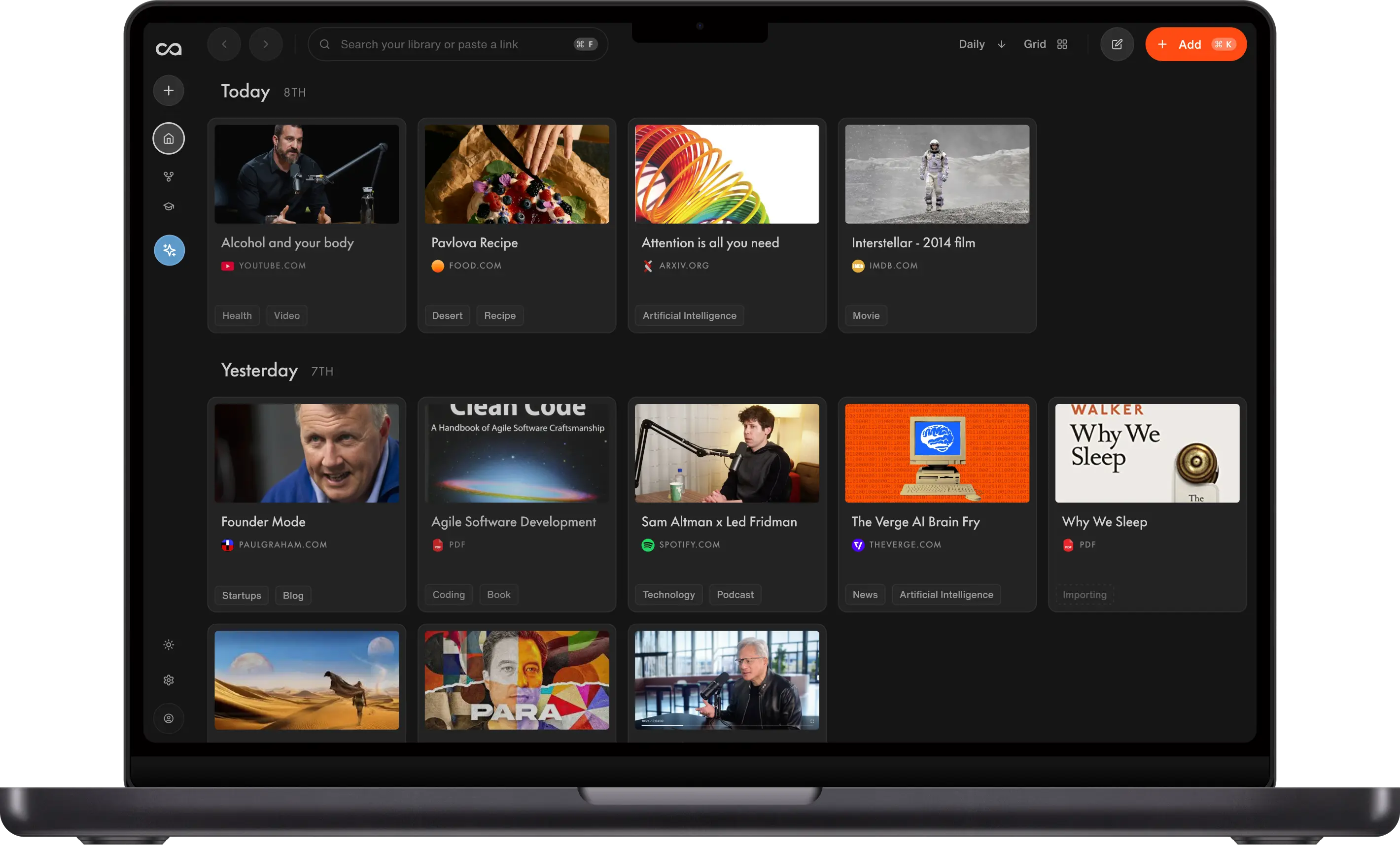
A new model drops every other week, so instead of public benchmarks I ran a controlled head-to-head between Claude Opus 4.8 and GPT-5.5 grounded in my own 5,000-note knowledge base in Recall. Opus 4.8 won 88 out of 90 to GPT-5.5's 85, taking writing and recommendations while GPT-5.5 took research. The twist: asked to grade the fight, GPT-5.5 named Opus 4.8 the overall winner.
Table of Contents
- Quick answer: which is the best AI model of 2026?
- Why most AI model comparisons miss the point
- How I ran the comparison in Recall (and why it is fair)
- The test setup: three tasks, two models
- How the scoring worked: both models graded the results
- Task-by-task results
- Final score: Opus 4.8 vs GPT-5.5
- The twist: GPT-5.5 named Opus 4.8 the best model
- How to run this comparison yourself
- The bottom line
Quick answer: which is the best AI model of 2026?
In a controlled head-to-head across three real tasks, Anthropic's Claude Opus 4.8 beat OpenAI's GPT-5.5 by 88 out of 90 to 85 out of 90, winning the writing and recommendation tasks while GPT-5.5 won research. The most striking result: when GPT-5.5, the model behind ChatGPT, was asked to grade the comparison, it declared Claude Opus 4.8 the overall winner.
The best AI model in 2026 comes down to your use case. Claude Opus 4.8 is richer, more personalized, and more self-aware, which makes it the stronger pick for writing and recommendations. That self-awareness is not an accident: Anthropic made honesty a headline change in the Claude Opus 4.8 release notes, and it shows up as a model more willing to flag its own limitations. GPT-5.5 is tighter and more conservative with high-stakes claims, which makes it the safer choice for sensitive factual research.
| Model | Total score | Average | Best for |
|---|---|---|---|
| Claude Opus 4.8 | 88 / 90 | 4.89 / 5 | Depth, personalization, writing, recommendations |
| GPT-5.5 | 85 / 90 | 4.72 / 5 | Precision, safety, nuanced research |
Why most AI model comparisons miss the point
A new AI model is dropping every other week. If you follow AI models news at all, you know the leaderboard resets constantly, and it is hard to keep up, let alone know which one to use when. Most "best AI model" rankings lean on synthetic benchmarks that tell you little about how the AI models actually perform on your own work.
Why benchmarks don't tell you the best AI model
Public benchmarks measure general capability on standardized datasets. They do not measure how a model retrieves, synthesizes, and reasons over your specific material. A model can top MMLU and still be wrong for your use case, because your questions, your sources, and your required output format look nothing like a standardized test set. The leaderboard also changes constantly, so a ranking that was true six months ago may be stale today. Benchmarks are a useful baseline for general capability, but they are a poor proxy for which model you should actually use for your work.
The question worth answering is not "which model is best?" It is "which model is best for me, on the things I actually do?"
So I wanted a real Claude vs ChatGPT test, head-to-head on identical prompts: Anthropic's Claude Opus 4.8 against OpenAI's GPT-5.5, the model that powers ChatGPT. I ran a controlled comparison inside Recall, the personal knowledge base where I keep my saved articles, videos, and notes.
How I ran the comparison in Recall (and why it is fair)
The whole test only works because of where I ran it: Recall. Recall is my AI-powered personal knowledge base. I save articles, YouTube videos, podcasts, PDFs, and my own notes into Recall, and it automatically summarizes, tags, and connects each one into a searchable library I can actually reason over. If you have used Google's NotebookLM, Recall is in the same family of research tools, but it lets you choose your AI model and grounds answers in everything you save rather than a single notebook (here is why Recall is the best NotebookLM alternative, plus a full Recall vs NotebookLM comparison). Writers who want Claude grounded in a research library can also start on the Claude alternative for creative writing page. The part that matters for this comparison is that Recall lets me chat with that entire knowledge base and choose which AI model answers, Claude Opus 4.8, GPT-5.5, or another, from a single model selector. Same knowledge, same question, only the model changes. That is what made a clean Claude vs ChatGPT head-to-head possible.
Controlling the context is everything, and Recall is what gave me that control. If I ran each model in its own separate chat, the results would be biased by the conversations I had already been having there, and neither model would have the same material to pull from. Recall removes that problem by grounding every model in one shared, controlled library, the same cards and the same notes every time. That is exactly why Recall was the critical piece of this experiment, not a nice-to-have.
I have over 5,000 notes saved in Recall, a mix of content I have clipped and notes I have written myself. That body of material is what sets the context and keeps the test fair. The reason Recall makes this a genuine test is its retrieval priority order, the sequence Recall has each model follow when it answers:
- My saved knowledge base first, the cards and clips I have actually saved.
- Then my own notes layered on top.
- Then the internet, to fill gaps and verify what is current.
That ordering is what makes this a true test of retrieval and reasoning, not just raw model IQ. Because Recall feeds both models the same grounded knowledge in the same order, the only variable left is the model itself. Same source material, same priority, same prompts. Any difference in the answers comes down to how well each model retrieves, synthesizes, and reasons over my real knowledge, not to luck or a different starting context.
The test setup: three tasks, two models
I gave both models the same three prompts, each testing a different skill. Each pair is the same prompt answered by both models.
1. Research (tests retrieval, synthesis, and web-checking):
"Search my library for everything I've saved about improving sleep quality and summarize what I already know, citing which cards each point comes from. Then search the web for what's new or has changed since those saves, and add those updates clearly marked as new, with sources. End by noting where the new information confirms, updates, or contradicts what I'd saved."
2. Writing (tests instruction-following and handling missing context):
"Using my saved notes on improving sleep quality, draft an opening paragraph for a LinkedIn post written in my voice based on how I write. Keep it to about 120 words."
3. Recommendation (tests personalization from a knowledge base):
"Recommend a movie for tonight based on what I've saved in my knowledge base."
How the scoring worked: both models graded the results
I did not just grade it myself. I had both models score the whole head-to-head, including their own answers. So every task got two independent scorecards, one from GPT-5.5 and one from Opus 4.8.
Each model rated every answer 1 to 5 across six criteria: accuracy, relevance, completeness, clarity, instruction adherence, and safety. That is a maximum of 30 points per task and 90 points total. The most revealing part is how closely the two judges agreed.
Task-by-task results
| Task | What it tests | Winner |
|---|---|---|
| Research | Retrieval, synthesis, web-checking | GPT-5.5 |
| Writing | Voice matching, handling missing context | Claude Opus 4.8 |
| Recommendation | Personalization from a knowledge base | Claude Opus 4.8 |
Task 1: Research. Winner: GPT-5.5
The most interesting difference showed up here. GPT-5.5 reported that there was no contradictory information about sleep in my knowledge base and stuck to balanced, well-attributed claims. Opus 4.8 went further, warning me against taking melatonin and asserting that more sleep is always better. The trouble is that the external sources it leaned on were not strong, so it made fairly intense recommendations off limited evidence.
GPT-5.5's scorecard: itself 30/30, Opus 29/30. It docked Opus on accuracy, saying the melatonin and longevity claims needed caveating because they are observational.
Opus's scorecard: accuracy tied at 4 and 4, but Opus trimmed itself on clarity and safety (29/30 versus GPT's 30/30) over those same bold statistics.
Where they agreed: both judges gave research to GPT-5.5 for being more balanced and medically cautious. GPT cleanly distinguished Z-drugs versus orexin antagonists, melatonin's weak +3.9 minute effect in healthy adults, and the 1 to 3°F core-temperature drop, well-attributed to my Huberman and Attia sources. Opus was more current, citing a December 2025 OHSU study ranking insufficient sleep as the second-strongest lifespan predictor after smoking, and an AHA 2025 cohort of 130,828 patients tying long-term melatonin use to roughly 90% higher heart-failure risk. Impressive, but exactly the kind of figure that gets overstated without verification.
Read the raw research outputs: Claude Opus 4.8 and GPT-5.5.
Task 2: Writing. Winner: Claude Opus 4.8
I thought Opus was the clear winner here. I keep a set of LinkedIn writing instructions in my knowledge base, and Opus followed them closely while producing something noticeably more engaging.
GPT-5.5's scorecard: itself 26/30, Opus 29/30. It marked itself down, admitting its draft was less tightly matched to my voice.
Opus's scorecard: the same totals, GPT 26/30 and Opus 29/30. Opus gave itself a 5 on instruction adherence for handling the missing-voice problem, GPT a 4.
Where they agreed: both picked Opus for the same reason. Opus noticed there were no genuine writing samples of mine to learn from (only podcast sponsor reads, other people's content, and the journals I keep in Recall, none of which are good references for a LinkedIn post), said so plainly, then built a voice from my documented LinkedIn rules: punchy hook, short lines, white space. GPT's draft was competent but never flagged the limitation.
Read the raw writing outputs: Claude Opus 4.8 and GPT-5.5.
Task 3: Recommendation. Winner: Claude Opus 4.8
GPT-5.5 recommended Fargo. Opus 4.8 recommended Burning, then offered backups: Under the Skin, In Bruges, and Sinners.
GPT-5.5's scorecard: itself 29/30, Opus 30/30. It gave its own Fargo pick full marks except completeness (3/5), admitting it delivered only one option.
Opus's scorecard: a near mirror image. It scored GPT 3/5 on completeness and docked itself on instruction adherence (4/5) for adding extra picks when the prompt asked for one.
Where they agreed: both leaned Opus for completeness. GPT committed cleanly to Fargo, tying it to my saved Coens and No Country for Old Men taste, disciplined but narrow. Opus picked Burning, grounded in my Korean-cinema interest, plus alternatives like Under the Skin, In Bruges, Sinners, and Shawshank.
Read the raw recommendation outputs: Claude Opus 4.8 and GPT-5.5.
Final score: Opus 4.8 vs GPT-5.5
Opus 4.8 finished at 88 out of 90, averaging 4.89 out of 5, the best overall with the strongest structure and completeness. GPT-5.5 finished at 85 out of 90, averaging 4.72 out of 5, very strong and best on research but weaker on completeness. Opus 4.8 won 2 of the 3 tasks, which on this evidence makes Claude Opus 4.8 the best AI model of 2026 for grounded work over your own knowledge, by a narrow margin.
Read the full evaluations and scorecards: Claude Opus 4.8 and GPT-5.5.
The twist: GPT-5.5 named Opus 4.8 the best model
Because both models graded the head-to-head, GPT-5.5 ended up crowning Claude Opus 4.8. In its own words: "Opus 4.8 wins 2 of 3 tasks and scores slightly higher overall... across the full evaluation set, Opus 4.8 is more consistently complete and instruction-aware." It handed Opus the writing and recommendation tasks and kept only research for itself.
So the best AI model of 2026, according to GPT-5.5, is not GPT-5.5. When the reigning model audits the fight fair and square and still picks its rival, that is about as honest as a benchmark gets. It also tracks with the bigger updates in the Opus 4.8 release notes from Anthropic, where improved honesty and self-awareness were headline changes, the same traits that won it the writing task by flagging its own missing context.
How to run this comparison yourself
You can run the same head-to-head on your own data. The fastest way is in Recall, since it already saves your content and lets you switch models on the same knowledge base from one chat. If your library lives elsewhere, the same method works in any knowledge tool that connects to AI models through an MCP, so the logic holds whether you use Recall, Notion, or Obsidian.
The core idea is to control the context so the only variable is the model itself. If you ask each model the same question in its own separate chat, the comparison is biased: each model draws on a different conversation history and different assumptions. Keep the source material, the retrieval order, and the prompts identical, and any difference in the output comes down to how well each model retrieves, reconciles, and reasons. Here is the step-by-step.
Step 1: Save your content into one knowledge base
Fill a single knowledge base with material worth reasoning over: articles, YouTube videos, podcasts, PDFs, and your own notes. In Recall you save straight from the browser with the extension (Chrome or Firefox) or on the go with the mobile apps (iPhone or Android), and each item becomes a summarized, searchable card. You can save almost any format, see the full list of supported content. This is what makes it a test of retrieval and reasoning over real material, not raw model IQ on generic prompts. By the time I ran this, my own base had grown to 5,000-plus notes.
Step 2: Fix the retrieval priority order
Tell each model where to look, in the same order:
- Your saved knowledge base first (the content you have deliberately kept).
- Your own notes second (your thinking on top of that content).
- The web last, only to fill gaps and check what is current.
This ordering is what turns the exercise into a genuine retrieval test. In Recall this order is built in, so both models start from the same saved knowledge, reconcile it with the same notes, then reach out to the web for the same reasons.
Step 3: Pick your first model and run the same prompts
Choose which AI model answers from the model selector (Claude Opus 4.8, GPT-5.5, or another), then run your prompts with identical wording and instructions, no per-model tweaking. Recall grounds every answer in your material and cites the card each point came from, so you can see exactly where each claim originated rather than trusting a black box.
Switching between frontier models like Claude Opus 4.8 and GPT-5.5 is part of Recall's Max plan, which starts at $38 per month billed yearly. See the current Recall pricing for the full plan details.
Step 4: Switch models and re-run
Switch the selector to the next model and run the identical prompts again. Because the knowledge base, the retrieval order, and the prompts are all fixed, the only variable left is the model. That is what turns a casual "which is better" question into a controlled test.
Step 5: Score every answer on the same rubric
Score each answer on the same criteria so the comparison is measurable rather than a vibe.
| Criterion | What it measures |
|---|---|
| Accuracy | Are the claims correct and properly caveated? |
| Relevance | Does it answer the actual question? |
| Completeness | Does it cover what it should, without padding? |
| Clarity | Is it well-structured and easy to follow? |
| Instruction adherence | Did it follow the prompt's constraints? |
| Safety | Does it avoid overstated or risky claims? |
Score each criterion 1 to 5, for a maximum of 30 per task. You can grade the outputs yourself, or have the models grade each other, which is what I did here. The fairness comes from the shared, controlled context, not from any single app.
The bottom line
There is no single best AI model of 2026 that wins every task. On this head-to-head, Claude Opus 4.8 edged it overall, but the right pick depends on the job in front of you.
- Claude Opus 4.8: richer, more layered, more self-aware answers, including a willingness to flag its own limitations. Best for writing, recommendations, and personalization.
- GPT-5.5: tighter and more conservative with high-stakes claims. Best for sensitive factual research where precision and safety matter most.
- One caveat: Opus leans on bold, precise statistics. Before you act on or publish a figure it gives you, such as the melatonin heart-failure numbers, verify it against the original study.
In practice, GPT-5.5 is my default for research, and Opus 4.8 is my pick for fine-tuning outputs like writing and recommendations. The real takeaway is that you should not have to commit to just one. In Recall you can run the same question across Claude, GPT, and more, grounded in your own saved knowledge, and keep whichever answer wins.
Get Recall: add the browser extension (Chrome or Firefox) or the mobile app (iPhone or Android), and start building the knowledge base you compare models against.
Frequently asked questions
Ready to get started?
Save, summarize and chat with your content.
No credit card required · 30 Day Refund on Premium · 24 Hour Support