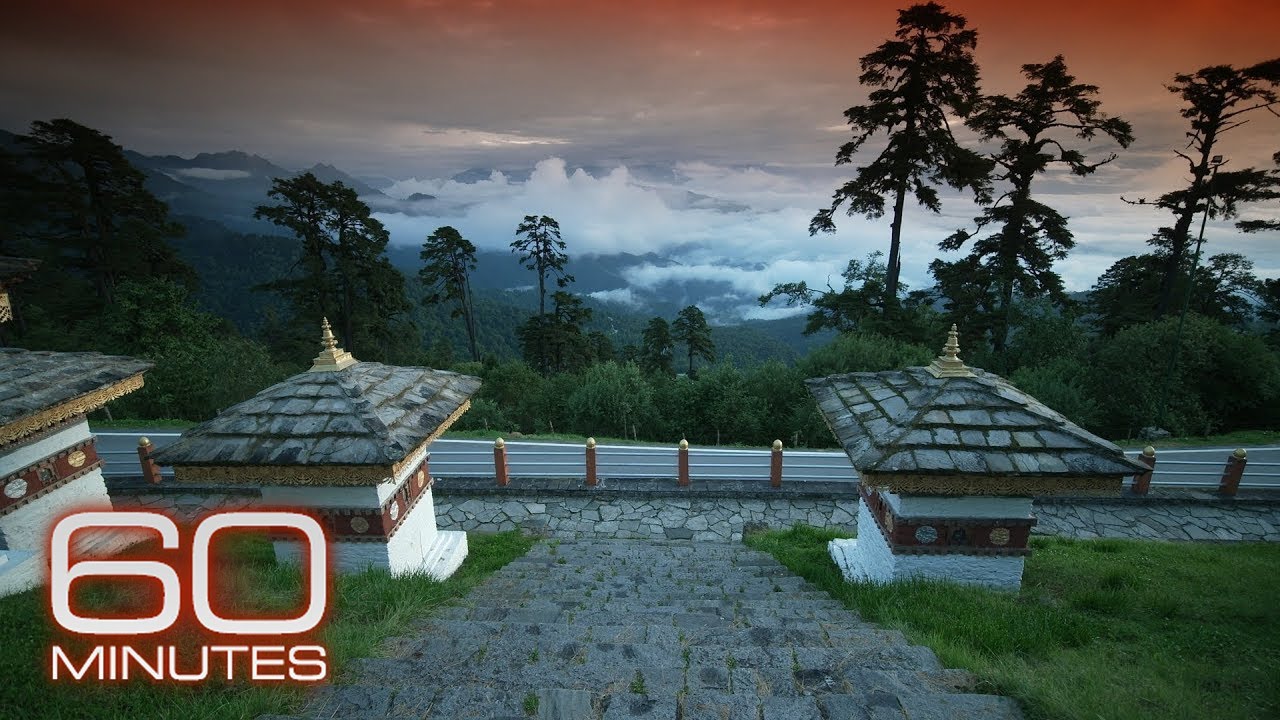


Bhutan: A Kingdom in the Himalayas
- Bhutan is a tiny kingdom located in the Himalayan Mountains, wedged between China and India, known for its unique Buddhist culture and natural beauty, with a strong emphasis on happiness and a distinct approach to development 20s.
- The kingdom was isolated from the rest of the world for a long time, only opening up to tourists in the 1970s and introducing television in 1999, in an effort to preserve its culture and way of life 37s.
- Bhutan's capital city, Thimphu, still has no traffic lights, and the old and new coexist peacefully, with Buddhism being the national religion and an integral part of daily life 1m49s.
- The country's history is one of survival, with Bhutan having to navigate its position between India and China, and its strength lying in its unique identity and culture 2m8s.
Bhutanese Culture and Tradition
- Bhutanese people take great pride in their traditional clothing, architecture, and festivals, which are an essential part of their identity and culture 2m57s.
- The traditional dress for men, known as the "go," is colorful and made from natural dyes, and is also worn for athletic activities such as archery, the national sport 3m33s.
- Archery is a popular sport in Bhutan, with players using traditional bows and arrows made of bamboo, and competitions often involving singing and dancing 3m53s.
Modernization and its Challenges
- The country has undergone rapid modernization, with the introduction of television 25 years ago marking a significant turning point, and many Bhutanese people are struggling to adapt to the changing times 4m22s.
- Bhutan is largely a subsistence agricultural society, with many families living in multi-generational farmhouses, and the country was unified by its first king in 1907 4m52s.
- The fourth king of Bhutan played a significant role in setting the country on its unique path to modernity in the 1970s, with a focus on preserving its culture and environment 5m22s.
Gross National Happiness (GNH)
- Bhutan's concept of Gross National Happiness (GNH) was first introduced by the King, who emphasized that GNH is more important than Gross National Product, gaining international attention and leading to a UN resolution in 2012 urging others to follow Bhutan's lead 5m57s.
- The primary responsibility of the government, led by Prime Minister Sintog, is to explain and implement GNH, which acknowledges the importance of economic growth but also emphasizes the need for sustainability and balance with the preservation of unique culture and people's well-being 6m31s.
- Every five years, surveyors travel throughout Bhutan measuring the nation's happiness by asking about education level, salary, material possessions, negative and positive thoughts, and time spent working, praying, and sleeping, with the results factored into public policy 7m0s.
- GNH does not directly equate to happiness in the moment but rather to contentment with life and oneself, and it also emphasizes the importance of nature, with at least 60% of the country required to remain under forest cover by law 7m55s.
Bhutan's Environmental Stewardship
- Bhutan is the first and one of the only countries in the world to be carbon negative, earning foreign revenue from selling excess hydroelectric power to India and from tourism, but with limits on activities such as mountain climbing due to the sacred nature of the mountains 8m9s.
Bhutan's Transition to Democracy
- The country has made major accomplishments, including free education and healthcare, and the introduction of democracy, which was gifted to the people by the King in a time of peace and stability, despite initial resistance from the people 8m57s.
- The King's decision to introduce democracy was made 25 years after introducing GNH, and it was a unique case where democracy was imposed on the people without a revolution or popular demand 9m12s.
- The King's consultations with villagers, covered by reporter Kinl Dorgi, showed that people were initially opposed to democracy, citing concerns about violence and corruption in neighboring countries, but the King ultimately defied the people and imposed democracy 9m45s.
The Exodus of Young Bhutanese
- Bhutan is facing an existential crisis due to a large number of its young citizens leaving the country, with 9% of the population having already left, mostly for higher-paying jobs in countries like Australia 12m9s.
- The exodus began after the COVID-19 pandemic hit Bhutan's economy hard, shutting down tourism and leading to a slow recovery 11m51s.
- The King of Bhutan has launched a bold plan to create a place where development and wealth can coexist with the country's sacred values, in an effort to lure back young Bhutanese who have left 12m19s.
- Many skilled Bhutanese, including journalists, editors, graphic designers, and sound engineers, have left the country in search of better opportunities 12m40s.
The King's Vision and the Galu Mindfulness City
- The concept of Gross National Happiness (GNH) has succeeded in transforming Bhutan from a medieval society to a country with free education, free healthcare, and a growing economy, but its success has ironically made Bhutanese young people sought after abroad 13m57s.
- To address the issue, the King is trying to attract more businesses and tourists to Bhutan, highlighting the country's landmarks and natural beauty, such as a centuries-old suspension bridge and a 250-mile ancient trail 15m2s.
- The government is also working to create jobs and improve wellbeing in Bhutan, in order to lure back its young citizens who have left the country 14m50s.
- The King of Bhutan has decided to create a new city in southern Bhutan, called The Galu Mindfulness City, with different rules from the rest of the country, in an attempt at a new model of robust economic development while staying true to Bhutan's values 15m42s.
- Danish architect Bjarke Ingels (BRK Les) has been tasked with designing the city, which will have neighborhoods nested between the area's many rivers, connected by a series of unusual bridges that also serve as public buildings, such as Buddhist centers, healthcare facilities, and universities 16m40s.
- The city will be built in phases over the next two decades, with no polluting industries allowed, and will feature wildlife corridors to protect the area's rich wildlife, including elephants and tigers 17m39s.
- The King has stated that the future of Bhutan hangs on this project, and that the country needs to find a new way to balance economic development with its values of Gross National Happiness 18m12s.
- The city will have its own legal framework, modeled on Singapore's, and will offer plentiful clean hydroelectric power, which is hoped will draw technology companies, especially those working in AI 18m57s.
- The city's design includes a colorful dam that also serves as a walkable staircase, with a temple on the face of the dam overlooking the river and valley 19m19s.
- The King and the architect presented the plans to the nation on December 17, the national day of Bhutan 19m51s.
- The city's goal is to create jobs and lure young Bhutanese back home from abroad, while also making Bhutan a hub for multinational companies and technological innovation, all while following the principles of Gross National Happiness 18m43s.
- The King of Bhutan spoke to his people about the Galao Mindfulness City and its potential to create opportunities for young Bhutanese to stay in the country 20m10s.
- A young Bhutanese woman, Namgay, had plans to leave Bhutan for Australia, but changed her mind after hearing the King's speech, in which he asked for the people's help in building the city 20m21s.
- The King's speech was unusual in that he directly asked the people for their help, and was met with a resounding "yes" from the crowd, including Namgay 20m38s.
- Namgay felt a sense of commitment to the King's vision after saying "yes", and decided to stay in Bhutan with her husband 20m54s.
- The King and his family later visited Australia to share his vision with the 20,000 Bhutanese living there, in the hopes of one day luring them back home 21m21s.
- The goal of the Galao Mindfulness City is to create a place that balances nature, local heritage and culture, with prosperity and growth, a challenge that many places in the world are struggling with 21m36s.
- If Bhutan can successfully achieve this balance, it may have something to offer the rest of the world in terms of a model for sustainable development 22m0s.