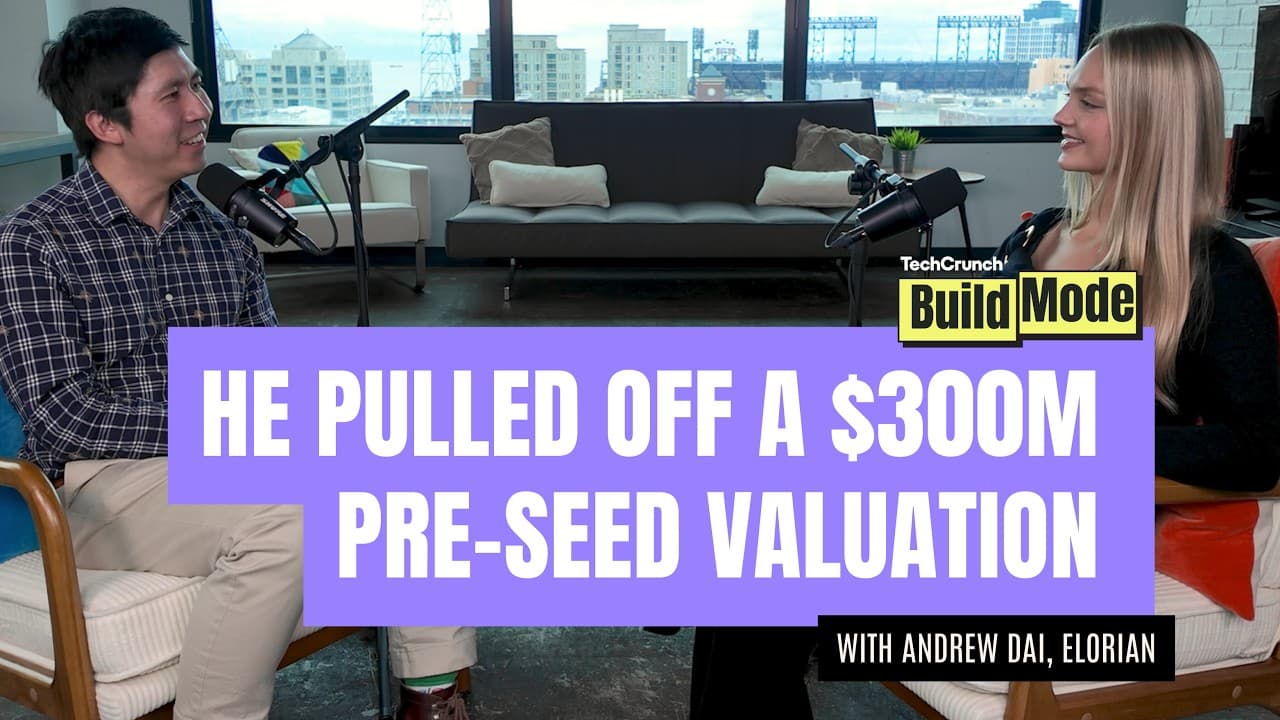

Valuation and Investor Selection
- The company Alorian secured a $300 million pre‑seed valuation, which is far above average for such early‑stage rounds, and the founders emphasized the importance of having the right investors on the cap table who understand the long‑term, potentially revenue‑free nature of an AI venture 0s
- Andrew Dai, co‑founder and CEO of Alorian, previously spent over a decade at Google DeepMind and authored a 2015 paper that OpenAI later cited as the “recipe for ChatGPT” 0s
- Alorian raised $55 million in just a few months, achieving a valuation that even the founders found surprising 0s
- The founders chose to turn down higher valuations in order to work with investors who could support their vision and journey as an AI company 0s
Mission, Vision, and Household Use Cases
- Alorian’s mission is to build models that advance visual artificial general intelligence (AGI), a domain the founder describes as “extremely uneven” compared to progress in areas like math, physics, coding, and games 0s
- Current visual AI systems, such as Google Lens, perform well on simple identification tasks (e.g., recognizing a plant) but struggle with more complex visual reasoning questions that even elementary‑school children can answer, such as counting objects on a table or tracing connections in a wire 0s
- Alorian aims to solve these sophisticated visual reasoning problems, enabling models to understand and reason about visual scenes at a deeper level 0s
- A potential household application highlighted is an internet‑enabled refrigerator that can accurately recognize and count items inside without needing barcode scans, allowing it to alert users when supplies are low or missing 0s
- Another illustrative use case is a smart home cocktail bar that could automatically determine which ingredients are missing and suggest what to restock, demonstrating how visual AGI could enhance everyday appliances 0s
Technical Approach and Fundraising Pitch
- The company aims to build visual‑reasoning AI models, focusing on post‑training techniques that are more capital‑efficient than full‑scale training, allowing development with only a few million dollars 0s
- By targeting the cash needed for post‑training, the team could quickly create a state‑of‑the‑art visual reasoning model, begin engaging customers, and afford competitive researcher salaries 0s
- They raised a $55 million seed round at a $300 million valuation despite having no product or revenue, attracting investors such as Menlo Ventures, Nvidia, and Jeff Dean 0s
- The fundraising process involved extensive pitching and explaining the concept of visual reasoning and its relevance to AGI, which many investors found technically challenging 0s
Benchmarks, Gaps, and Communication Strategy
- Benchmarks like AKG‑I show improvements in multimodal reasoning, but current inputs are limited to very low‑resolution images (32×32 or 64×64 pixels), far from real‑world applicability such as representing fridge contents 0s
- The team emphasized to investors that existing benchmarks miss large capability gaps, and this technical nuance helped secure backing from more technically savvy investors 0s
- Communicating the vision required refining the message repeatedly to bridge the gap between scientific ambition and practical investor understanding 0s
Strategic Investors: Nvidia and Jeff Dean
- Nvidia’s presence on the cap table is strategically important because the company requires massive compute resources for its work on multimodal reasoning, and Nvidia can provide direct engineering support to optimize models for their chips and assist with GPU procurement 0s
- The relationship with Nvidia is still early, having raised only a relatively small amount so far, but there are plans for Nvidia to leverage the startup’s multimodal models to serve its own clients and customers, positioning the startup as a key strategic component 0s
- Jeff Dean, a highly respected AI researcher who previously worked with the founder at Google Brain and DeepMind, is an investor; his hands‑on technical expertise (down to machine‑code level) left a strong impression, and his expectations are modest, focusing mainly on supporting a longtime colleague 0s
Valuation Pressure and Accelerated Fundraising
- The startup secured a $300 million pre‑seed valuation, which is far above average and even more aggressive than historic large rounds such as Thinking Machines, prompting questions about pressure to meet milestones for future funding 0s
- The primary source of pressure on the company comes from the rapidly advancing AI market rather than investors, driving a need to stay at the frontier of research and development 10s
- After leaving his previous role in November, the founder launched the new company in December and pursued an accelerated fundraising process to begin building as quickly as possible 42s
- Fundraising was completed much faster than typical new AI labs, motivated by the desire to move fast rather than specific capital requirements 1m15s
Founder Advice: Timing, Roadmap, and Networking
- The founder notes that fundraising during the holiday season (late November to December) was suboptimal because many investors are on vacation and due‑diligence teams are unavailable; starting in January would be preferable 1m45s
- He suggests that aspiring founders should consider how rapid AI advancements will impact their product roadmap, especially for SaaS, coding, math, and scientific applications, to avoid being outpaced 2m6s
- Networking with other founders—particularly those who have left Google Brain—and consulting angels for feedback on pitches and slide decks is highly valuable for navigating the fundraising process 2m30s
- For AI startups that are not on the cutting edge, founders should be mindful that technology advantages can erode quickly, so continuous innovation and awareness of competitor progress are essential 2m55s
Educating Investors and Framing the Vision
- Educating investors and the broader community about highly technical, sci‑fi‑like technology requires testing the pitch and simplifying explanations, because many investors may not understand terms such as MQA, MHA, or KV caches, and the relevance of these details can change quickly 10s
- It is more effective to frame the discussion around the larger vision—how the company will develop, where its moat will lie (e.g., data, customer acquisition, verticalization)—rather than focusing on specific technical methods that may be less understood 42s
- While some founders develop this big‑picture framing during pitches, it is advisable to consider it beforehand; however, it is acceptable to refine the narrative iteratively as the fundraising process unfolds 1m15s
- Pitches that involve abstract future concepts, such as visualizing the world or advanced multimodal reasoning, are philosophically different and more challenging than more straightforward AI applications like customer‑service bots 1m45s
Team Growth, Public Launch, and Technical Milestones
- The company, Alarian, currently has 13 employees and is experiencing rapid growth, despite having no public revenue yet 2m6s
- A public launch—including a website and launch video—generated 200 applications over a single weekend, creating a high interview volume for the existing team 2m30s
- Hiring is a top priority; the goal is to double or triple headcount within the next six months to secure talent before it moves to other labs 2m55s
- On the technical side, the team aims to achieve state‑of‑the‑art performance on several frontier visual‑reasoning benchmarks later this year and to release a public external API for users to test the model 3m20s
Commercial Interest and Next Steps
- Commercially, the company has received strong interest from both large enterprises and startups, who find the current visual‑reasoning and multimodal models insufficient for use cases such as agentic systems, engineering, and design 3m45s
- The next few months will focus on expanding the team, advancing modeling capabilities, and engaging with early adopters through the upcoming API to refine the product based on real‑world feedback 4m10s
- The founder is a first‑time CEO but previously worked at a startup called Autonomy (later acquired by HP) and spent 12 years at Google, which gave him experience wearing many hats such as handling payroll, vendor orders, and office setup; however, he found the fundraising process surprising because it involves a two‑way “reverse pitch” where investors also need to convince the founders why they should take their money 10s
Hiring Challenges, Compensation, and Funding Stretch
- Hiring for the new venture has proven much harder than at large tech firms like DeepMind, as many candidates are set on staying in big‑tech roles and are difficult to persuade to move to a smaller startup, especially when they have not previously considered such a move 42s
- To attract talent, the company offers competitive compensation packages that are strong relative to other neural‑lab startups but cannot match the top‑tier salaries of firms like Meta; they maintain a high hiring bar and balance compensation against the need to meet target headcount goals for researchers and engineers 2m6s
- The company must stretch the $55 million funding to cover ongoing compute expenses and GPU costs, as they are not yet raising a Series A round 10s
Investor Involvement Preferences
- When evaluating investors, the founders prioritized how closely investors would be involved, preferring high‑touch partners who could become future customers or connect them with valuable contacts 42s
- Access to university recruiting networks was another key factor, since some investors have strong relationships with well‑known colleges that could streamline hiring 42s
- The founders sought concrete, detailed value‑add from investors rather than generic promises, probing exactly how investors could help 1m5s
- They favored a hands‑on approach from investors; with a small team of 13, frequent check‑ins (every two to three days) from investors offering hiring advice and network introductions proved especially valuable 1m30s
Valuation Emergence and Investor Value‑Add Philosophy
- The $300 million pre‑seed valuation was unexpected; the founders’ primary goal was to raise $50 million, the amount calculated to fund compute and data needs for building a world‑class AI model 2m6s
- The high valuation emerged organically as multiple investors competed to support the company, rather than being a target set by the founders 2m6s
- Although higher‑valuation offers with larger capital were presented, the founders declined them to secure investors who understood the unique, revenue‑free early stage of an AI startup and could provide strategic guidance and freedom to procure GPUs and hire appropriately 2m45s
- The founders emphasized that choosing investors for strategic value and guidance, rather than chasing the highest valuation or check size, is a more prudent approach for early‑stage founders 3m20s
Product Differentiation and Rapid Release Strategy
- Alorian differentiates itself by focusing on multimodal understanding, building specialized multimodal models that provide highly accurate answers to visual problems such as counting rooms in a floor plan, calculating square footage, or determining office capacity, where answers are definitively right or wrong 10s
- Unlike broader models like Gemini, ChatGPT, or Claude, Alorian targets users who need precise visual analytics rather than general conversational AI 10s
- The company emphasizes a short‑term, usage‑driven approach, maintaining an aggressive model release schedule with the first model planned for later this year, aiming to outpace other labs 42s
- Rapid development and a fast release cadence are intended to create a moat through early customer acquisition, data collection, and network effects in the accelerated AI market 42s
Acceleration, Founder Experience, and Experimentation Advice
- Acceleration is achieved by working smarter, leveraging AI tools that understand Alorian’s AI‑native codebase, enabling faster coding compared to legacy codebases with massive line counts 1m6s
- Founder’s decade‑long experience on Gemini and front‑line LLM work provides deep knowledge of building models from scratch, further speeding up model development 1m6s
- Advice for aspiring AI founders and researchers: prioritize experimentation—run many trials, modify data, architectures, and algorithms—to discover scalable solutions, noting that successful breakthroughs often emerge from iterative testing rather than a pre‑planned vision 1m45s
- Significant breakthroughs can be achieved without large funding by focusing on hands‑on experimentation and iterative learning 1m45s
Small Funding, Tinkering Mindset, and Gratitude
- Small amounts of funding can enable development using open‑source models that run on a laptop, or training very small models locally, and when results become unexpectedly promising it may be the right moment to approach investors or researchers for larger‑scale scaling. 0s
- Emphasizing a “mess around and find out” mindset encourages hands‑on tinkering rather than spending excessive time on ideation and pitch decks, which is recommended for aspiring builders. 0s
- The guest expressed gratitude for being invited, looked forward to the podcast, and conveyed optimism about future success for themselves and their company Alorian. 0s
Podcast Production Credits
- Built Mode is identified as a TechCrunch podcast, with production and editing by Maggie Nyi, hosting by Isabelle Johannessen, art and design also by Maggie Nyi, and audience development led by Morgan Little, alongside contributions from the Foundry and Cheddar video teams and the broader startup community. 0s