
Apple Lawsuit Against OpenAI
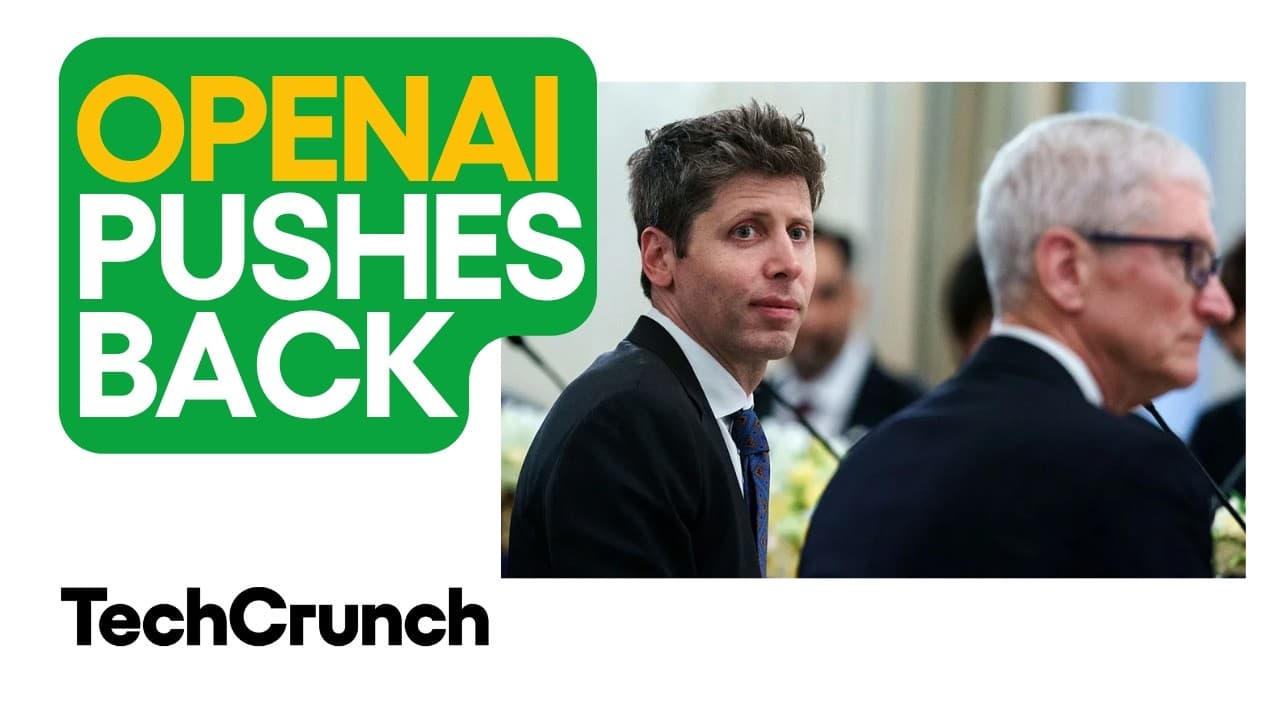
- Apple has initiated a lawsuit against OpenAI, marking a significant legal conflict between two major technology companies 0s.
- OpenAI is reportedly developing a mobile, screenless hardware device intended to function as a next-generation computing tool 2m6s.
- The potential hardware device is speculated to be the first product from OpenAI's hardware division, which involves collaboration with Jony Ive 3m5s.
- OpenAI has maintained a vague stance regarding its hardware ambitions since releasing a video last year that discussed the future of legacy devices like laptops and phones 3m5s.
- Concerns have been raised regarding the privacy implications of such devices, specifically the potential for them to record conversations involving people who have not provided consent 3m45s.
- The development of always-listening hardware may necessitate a renegotiation of social norms if these devices achieve widespread adoption 3m45s.
- The lawsuit filed by Apple against OpenAI is considered a major industry development with significant implications for both companies 4m15s.
Legal Allegations and Trade Secrets
- Apple has filed a trade secret lawsuit against OpenAI, alleging a pattern of misconduct at the highest levels of the organization 0s.
- The complaint specifically names OpenAI's chief hardware officer, Tang Tan, and accuses the company of stealing trade secrets to develop a competing hardware product 0s.
- The allegations remain unproven as the case has not yet proceeded through full discovery 0s.
- The lawsuit poses a potential risk to OpenAI's current projects, as the legal proceedings could cause significant delays regardless of whether the court grants injunctive relief or restraining orders 42s.
- Apple’s decision to initiate legal action is viewed as a calculated move, as the company typically only pursues such litigation when it believes it has a strong case 42s.
Impact of Litigation on OpenAI IPO
- OpenAI has confidentially filed for an initial public offering (IPO), which could potentially occur as early as the end of this year or early next year 42s.
- The lawsuit complicates OpenAI's IPO preparations, particularly if the company intends to pitch investors on a future hardware division, as this could alter the valuation and risk assessment of the business 42s.
Corporate Responses and Legal Strategy
- Apple claims that more than 400 former Apple employees are currently employed at OpenAI, which represents a significant talent drain 2m6s.
- OpenAI has broadly denied the allegations, stating that while they take the claims seriously, they are not aware of any evidence that the complaint has merit 2m6s.
- There is speculation regarding whether the legal process will damage OpenAI's brand and marketing, similar to the "dirty laundry" exposed during a previous trial the company underwent 2m6s.
- It is predicted that OpenAI will continue with its current trajectory despite the lawsuit, as the company has demonstrated a careful approach to its public statements regarding the matter 2m6s.
- OpenAI’s response to allegations regarding trade secrets is characterized as a hedged statement rather than a definitive denial, raising questions about whether the company is conducting an internal investigation or if the language is simply the result of legal caution 0s.
- The level of aggression OpenAI displays in court will likely depend on the findings of its internal review process 25s.
IPO Timing and Legal Precedents
- A lawsuit from a company with a trillion-dollar market cap like Apple could have significant implications for the timing of OpenAI’s potential IPO 35s.
- OpenAI is expected to seek a quick resolution to the legal dispute without admitting wrongdoing to avoid complications during its IPO process 45s.
- The situation may mirror the 2017 Waymo versus Uber trial, which involved allegations against an employee, Anthony Levandowski, and resulted in a settlement after five days 55s.
Public Statements and Relationship Deterioration
- OpenAI updated its public statement from a generic denial of interest in stealing trade secrets to a more specific claim that it is not aware of any evidence supporting Apple’s allegations 1m25s.
- The shift in public statements suggests a change in the company's internal assessment of the situation, despite the two statements appearing similar to the general public 1m45s.
- The relationship between Apple and OpenAI has deteriorated over the last few years, moving from a potential partnership involving ChatGPT and Siri to a state of competition, particularly regarding hardware 2m5s.
- Public perception of OpenAI is often influenced by criticisms regarding the company's communication style and the leadership of its chief executive, who has faced accusations of being not forthcoming 2m30s.
- The legal strategy may involve leaving room for OpenAI to distance itself from certain claims by potentially shifting responsibility onto individual employees named as defendants in the complaint 3m5s.
Platform Fees and Hardware Competition
- The lawsuit against OpenAI is described as heavily detailed, distinguishing it from other trade secret cases, including those involving Apple 0s.
- Software services companies operating in the United States face significant pressure due to their reliance on distribution through Google and Apple 35s.
- Apple’s platform fees can reach up to one-third of the revenue generated from transactions, creating a financial incentive for companies like OpenAI to seek ways around these costs 35s.
- Building a proprietary device and ecosystem is a difficult alternative to paying platform fees, and the current lawsuit may complicate OpenAI's efforts to pursue such a strategy 35s.
Industry Concerns Regarding AI Data Practices
- Microsoft CEO Satya Nadella cautioned that users of AI tools may be paying twice: once for token usage and again by providing their information to AI labs 1m25s.
- The warning from Microsoft regarding the risks of sharing information with AI labs is viewed by some as ironic, given Microsoft's own position in the tech industry 1m55s.
- Similar warnings about AI data practices have been issued by other figures, including Palantir CEO Alex Karp 1m55s.
- The tech industry is experiencing a shift in the relationships between AI labs and big tech companies, moving from an initial phase of rapid, unrestricted partnership to a period of caution 1m55s.
- Companies like Apple and Microsoft are expected to increasingly focus on developing AI capabilities in-house due to concerns over data sharing and reliance on external labs 1m55s.
- It remains unclear whether Satya Nadella’s public comments reflect a deterioration in the partnership between Microsoft and OpenAI, a strategic warning to the market, or a combination of both factors 2m35s.
Data Security and Corporate Responsibility
- The analogy of a "Trojan horse" is being used to describe potential trade secret theft, suggesting that companies may be masking their true intentions through acts of subterfuge 0s.
- There is speculation that the language used in recent legal or public discourse indicates a breakdown in corporate relationships and may be a precursor to stronger actions beyond public statements 0s.
- Satya Nadella has proposed solutions to address data security concerns, including a reciprocity model where customers gain insight into how their data is used to improve AI models, and the creation of private learning environments within cloud infrastructure 0s.
- These proposed solutions are viewed as potentially self-serving for Microsoft, as they encourage the use of Microsoft's own cloud services 0s.
- A notable omission in the current discourse is the suggestion that organizations should simply limit the amount of sensitive information they share with AI companies to mitigate security risks 0s.
- There is a concern that corporations may receive preferential treatment regarding data protection and security compared to individual users, reflecting a long-standing trend in the technology industry 1m15s.
Open-Source AI and Enterprise Adoption
- Open-source AI is identified as a potential solution to the "Trojan horse" problem, driven by both privacy concerns and the desire to avoid vendor lock-in with companies like OpenAI or Anthropic 1m15s.
- Businesses may initially utilize large AI labs but are expected to transition toward open-source approaches over time, primarily due to cost considerations 1m15s.
- Users of AI tools are increasingly adopting a cautious approach, often limiting their usage to publicly available data rather than inputting sensitive source notes or proprietary information. 0s
- Transitioning to open-source models is not viewed as a guaranteed solution for data security, as concerns regarding the exposure of sensitive information remain relevant regardless of the deployment method. 0s
- The concept of "vibe coding" highlights the ongoing tension between the benefits of distributed software and the necessity of maintaining secure environments for enterprise data. 0s
- Enterprise customers are expected to increase their scrutiny regarding data safety, potentially leading to a more measured pace in the adoption of AI technologies. 0s
Forward-Deployed Engineering and Security Risks
- Some companies are choosing to integrate AI labs more deeply into their operations through the use of forward-deployed engineers, a trend highlighted in interviews with leaders at companies like Anthropic. 35s
- The industry is currently split between two distinct strategies: moving toward open-source solutions or deepening collaborative ties with centralized AI labs. 35s
- Forward-deployed engineering involves software engineers working directly on-site with businesses, such as car dealerships, to identify and implement specific AI-driven solutions. 1m5s
- While the hands-on nature of forward-deployed engineering is seen as a positive development, it introduces new security risks by increasing the number of individuals and vectors with access to sensitive enterprise data. 1m5s
- The risks associated with data exposure in enterprise-lab collaborations mirror broader concerns regarding data security in the context of partnerships between major entities like OpenAI and Apple. 1m5s
- There is a growing need for increased awareness and conversation regarding the risks and trade-offs associated with data usage in AI development, similar to the scrutiny applied to token consumption costs 0s.
- Pressure may mount on major AI companies to provide clear guarantees, explanations, and best practices concerning how enterprise data is utilized or excluded from model training to improve user comfort 0s.
Funding and Marketing of IM8 Health Drink
- David Beckham’s health drink startup, IM8, secured $1 billion in funding through the General Catalyst Customer Value Fund 1m15s.
- The investment in IM8 is structured as debt rather than an equity investment, with a significant portion of the funds designated for customer acquisition 1m45s.
- The funding strategy suggests that consumers can expect a substantial increase in online advertising for IM8 in the near future 1m45s.
- IM8 is noted for its resemblance to celebrity-driven, direct-to-consumer companies that were prominent several years ago, with current marketing efforts appearing to target fitness-oriented audiences 2m6s.
- The financing model for IM8 draws comparisons to the "blitz scaling" era of the early 2010s, raising questions about the nature of the collateral used to secure such a large loan 2m35s.
- Danny Young, the co-founder of IM8, has a background in the health industry and previously led a company called Prenetics, which went public in 2022 3m5s.
- The significant investment in IM8 aligns with a broader, current market focus on health and longevity 3m5s.
Challenges in the Beverage Industry
- The health drink market is currently characterized by significant noise, with numerous competing trends, opinions, and data points regarding what constitutes health. 0s
- Consumer drink brands often experience short lifecycles, with many products gaining popularity for only one or two years before fading away. 25s
- Questions have been raised regarding the collateral General Catalyst has secured for a billion-dollar loan provided to a health drink company, given the difficulty of maintaining long-term success in the beverage industry. 25s
- A potential path to longevity for new drink brands involves becoming the "go-to" product within specific communities, such as ultrarunners, through word-of-mouth rather than relying solely on blitz marketing campaigns. 55s
AI Applications in Drug Discovery
- Miles Wang, a former OpenAI researcher, is reportedly raising $200 million for a new drug discovery startup at a valuation of $2 billion, though the deal has not yet been finalized. 1m35s
- Drug discovery and manufacturing are frequently cited as prime examples of the high-level value of artificial intelligence, serving as a counter-argument to claims that AI lacks practical utility beyond enterprise software-as-a-service (SaaS) applications. 1m50s
- The application of Large Language Models (LLMs) in research and drug discovery typically involves focusing on very narrow slices of data rather than broad, generalized research. 2m25s
- The startup Aionics utilizes large language models (LLMs) to conduct narrow research into electrolytes for battery applications. 0s
- There is significant potential for numerous startups to apply LLM technology specifically within the field of drug discovery. 0s
- The recent funding announcement for the discussed company follows a classic startup trajectory, characterized by ambitious goals that remain to be proven. 23s
- Investors are likely making optimistic bets on the company primarily due to the professional backgrounds of its founders. 23s
- Further information is required to fully understand the specific focus and technical developments of the company. 23s