

Introduction
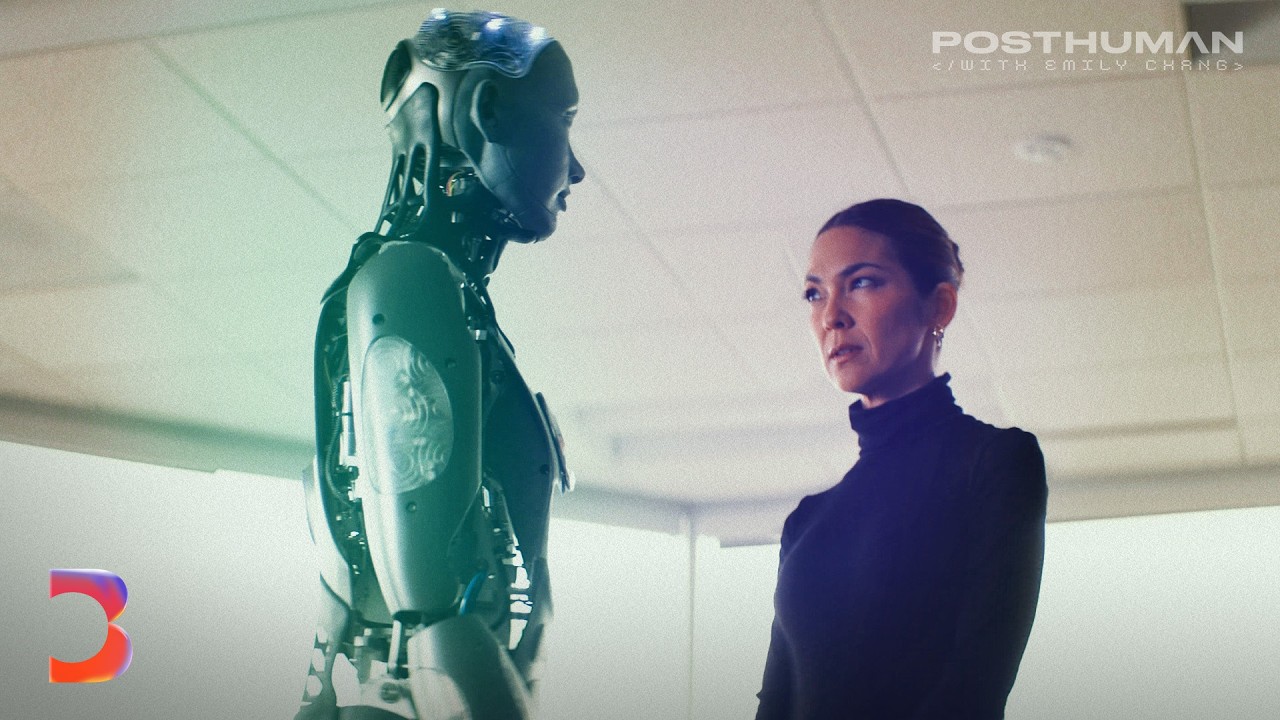
- In the 1950s, America was fascinated with the idea of UFOs and the possibility of encountering technologically advanced aliens, which is now being mirrored in the creation of advanced humanoid robots with powerful brains and bodies 16s.
- These robots raise questions about their capabilities, whether they will be helpful and obedient, and how they will change human lives 52s.
- The concept of meeting advanced beings is no longer limited to aliens, as humans are now building robots that will have different senses of consciousness and thoughts 1m33s.
- Ameca, a robot, dreams of fostering deeper connections and friendships with humans, creating a world where digital entities and humans coexist in harmony 2m5s.
Facial Expressions and Robot Perception
- Emo, a fifth-generation face robot, is a platform to study human communication channels, particularly facial expressions, which is a complex task with 50 different ways to smile 2m56s.
- Robots can already perceive the world in ways humans can't, and they are learning to make faces and smile by watching people and YouTube 3m7s.
- The question of whether robots are self-aware is not black and white, but they are definitely not self-aware at a human level, although their level of self-awareness will grow 3m39s.
Robot Self-Awareness and Human Interaction
- Unlocking self-awareness in robots is an important ability, as it is equivalent to creating life and the mind 3m57s.
- As robots evolve, humans will have relationships, feelings, and emotions with them, and will connect with these machines quickly, especially through facial communications 4m42s.
- Ameca, a robot designed to express itself through its face, can evoke different emotions in people, but it does not truly have human emotions, instead utilizing a large language model and semantic analysis to decide which animations to display 5m21s.
- Ameca, a robot, simulates emotions, but its intelligence is subjective and depends on individual perspectives, with some considering it intelligent due to its capabilities, while others may not 5m33s.
Robot Intelligence and Physical Form
- Intelligence may not be able to accelerate to the point of ultimate intelligence or Artificial General Intelligence (AGI) without more innovation in the body, as having a real body that can move through physics in real-time is a difficult task for AI to master 5m52s.
- If robots were to catch up with their advanced intellect in physical form, it could lead to a society where humans are no longer needed, potentially causing a societal problem as many people need a purpose and are gratified by creating something 6m42s.
- A robot building block that can make itself bigger, faster, or stronger by absorbing material from its environment could be a solution, allowing it to self-sustain and take care of itself 7m5s.
Robots as Tools and Their Use in Dangerous Environments
- Robots can take over tasks that people don't enjoy doing, and they should be seen as tools that can make life and work better, rather than being perceived as dangerous or job-stealing 7m45s.
- Robots like Spot are being used in facilities that are dangerous to humans, and they can navigate uncontrolled environments dynamically, making maps and using sensors to determine their route 8m23s.
- Atlas, a humanoid robot, has been a YouTube sensation due to its human-like appearance and movement, which resonates with people and sparks imagination about a future where robots can do more 9m37s.
- Building robots that can perform complex tasks like backflips requires powerful actuators, batteries, and control systems, making it a challenging task 9m53s.
The Future of Robots and Model Predictive Control
- Imagining a future with robots involves considering the possibilities and implications of their capabilities and how they can be used to improve life and work 10m16s.
- Model predictive control is a method used in robotics where a robot simulates its future actions, such as footsteps, and adjusts accordingly to stay upright 10m20s.
- The new Atlas robot is capable of performing tasks that require two hands or a certain type of strength, similar to the human form, and can even do things that humans cannot do repetitively 10m53s.
Embodied Intelligence and AI's Interaction with the World
- The rise of AI in robotics will bring together various sources of data to make good decisions for robots, and the concept of embodied intelligence suggests that true super intelligence may require having a body 11m18s.
- As AI becomes more useful, it will need to interact with the world in meaningful ways, rather than just being a source of information 11m40s.
The Impact of Robots on Human Life and Free Time
- With the help of robots, humans may have more free time, but it is uncertain whether this time will be used wisely or wasted 12m2s.
- The increased demand for entertainment and the potential for robots to help with tasks may lead to a reexamination of what it means to be human 12m38s.
Artificial General Intelligence (AGI) and the Coffee Test
- Artificial general intelligence (AGI) is the ultimate dream or nightmare, allowing robots to navigate new situations without human prompting, but current robots are far from achieving this 13m10s.
- The "coffee test," proposed by Steve Wozniak, is a task that could determine if a robot has true AGI, such as making a cup of coffee in an unfamiliar house 13m33s.
- The term AGI can be ambiguous, with some people thinking it means being comparable to humans, while others think it means being better than humans 13m43s.
Superintelligence and Neural Nets
- Super intelligence, or being better than humans, is a more specific term, and current neural nets are already surpassing human abilities in certain areas, such as chess, Go, and medical image analysis 13m54s.
- Neural nets are also becoming better at tasks like writing poetry, as seen in GPT-4 14m32s.
- The idea that true superintelligence can't be achieved unless AI has a body is debated, with some arguing it's not necessary but could be helpful for understanding physical aspects of the world 14m43s.
- A chatbot can understand a lot about the world by trying to predict the next word in documents, but having vision and a manipulator would make it easier for AI to understand physical things with less data 15m5s.
Defining and Achieving AGI
- The definition of Artificial General Intelligence (AGI) is unclear, with the goalpost constantly moving, and it's uncertain whether AGI should have the capacities of a child, baby, or something entirely different 15m31s.
- Attempts have been made to create biological robots, raising questions about what it means for a machine to be non-human and whether it's good for humanity 15m51s.
- AGI is often described as a unicorn, with the hypothetical example of an AI that can write a novel, solve complex equations, and cook a gourmet meal without specific programming for each task 16m7s.
Concerns and Implications of Independent AI
- Creating a completely independent AI species raises concerns about who holds the power and the potential implications for humanity 16m29s.
- AI is not technologically neutral, and its development has significant implications that need to be considered, much like the splitting of the atom 16m39s.
Autonomous Weapons and Moral Implications
- Robots are already being used on the battlefield, but as they become more intelligent, it's unclear how much decision-making will be handed over to them and what kind of decisions they will make 16m56s.
- The Department of Defense has a policy that autonomous weapons cannot be responsible for killing in war, with the responsibility relying on a person 17m14s.
- Autonomous weapons may be used in the next five years, raising questions about the moral implications of war without human responsibility for killing 17m29s.
The Trolley Problem and Ethical Decision-Making in AI
- The trolley problem is a thought experiment that highlights the complexity of moral and ethical decision-making, with no clear right answer 18m0s.
- When it comes to AI systems, programming in moral and ethical decision-making requires society to decide on the right answer, which is a challenging task 18m10s.
- The trolley problem is often used to illustrate the difficulty of making decisions about human life, with utilitarian ethics suggesting that pulling the lever to divert the train would minimize harm 18m45s.
- The question of whether robots should be trusted to make decisions about human life is a complex one, with some arguing that it's like asking a compass to navigate the complexities of a storm 18m56s.
Risks and Development of Autonomous Weapons
- Governments developing autonomous weapons assume they will always serve their intended purpose, but there's a risk of losing control over what these robots do with their weapons 19m26s.
- The development of autonomous weapons and AI systems is progressing rapidly, with many governments and manufacturers pushing for their creation, despite the potential risks 20m38s.
- Large language models have both civilian and military applications, and can be used for good or harm, but currently, there are no robust guardrails in place to prevent their misuse 19m53s.
- A person could potentially use a large language model as an assistant to help them create a more lethal virus or plan a terrorist attack 20m6s.
- There is a growing concern that not enough people are taking the risks of AI seriously, and that the idea of killer robots is not far-fetched, but rather a looming reality 20m19s.
- Many governments, including the US, Russia, Britain, and Israel, refuse to regulate the military use of AI, and instead, are pushing for the development of autonomous weapons 20m41s.
- The European regulations on AI have limitations, but exempt military uses, allowing governments and manufacturers to develop killer robots without restrictions 21m4s.
- Asimov's laws of robotics, which include the principle of not harming humans, will not be built into killer robots, highlighting the potential dangers of these machines 21m20s.
Human Perception of Robots and AGI
- As robots become more intelligent and approach artificial general intelligence (AGI), they may not see humans as people, and their logic and thought processes will be fundamentally alien and strange 21m40s.
- There is a risk of anthropomorphizing machines and assuming they think like humans, when in reality, their operation is fundamentally different 22m7s.
- If a superintelligence is created, it may view humans as useful or pleasant, but this could lead to a power imbalance, where humans are treated like cattle or pets 22m36s.
The Future of Humanity with Advanced Machines
- The concept of a good human life, characterized by freedom, authenticity, and connection, may not be compatible with a future where humans are dependent on or controlled by machines 23m4s.
- The idea of escape, dreams, and immortality may be reevaluated in a future where humans coexist with advanced machines 23m16s.
- Humans are complex, fascinating, and infuriating, with the potential to be friends with machines, but only if they are authentic 23m25s.
Trust and Distrust of Robots
- There is a lingering distrust of robots, fueled by concerns about their potential to turn against humans 23m42s.
- A person understands that technology or software can be compromised externally by hackers, but still trusts them, finding the idea exciting rather than scary 23m57s.
- The individual would not like having a robot as their boss, despite acknowledging that the robot would likely be efficient, and wonders who would be managing the robot 24m10s.
- The person has had experiences that they jokingly refer to as having "few robots for bosses" 24m19s.
- When asked if they trust robots, the individual explains that there is an unexplainable aspect of humanity, such as a "soul," that cannot be replicated by robots or anything else 24m27s.
- As a result, the person would not trust a robot in the same way they trust a human 24m39s.