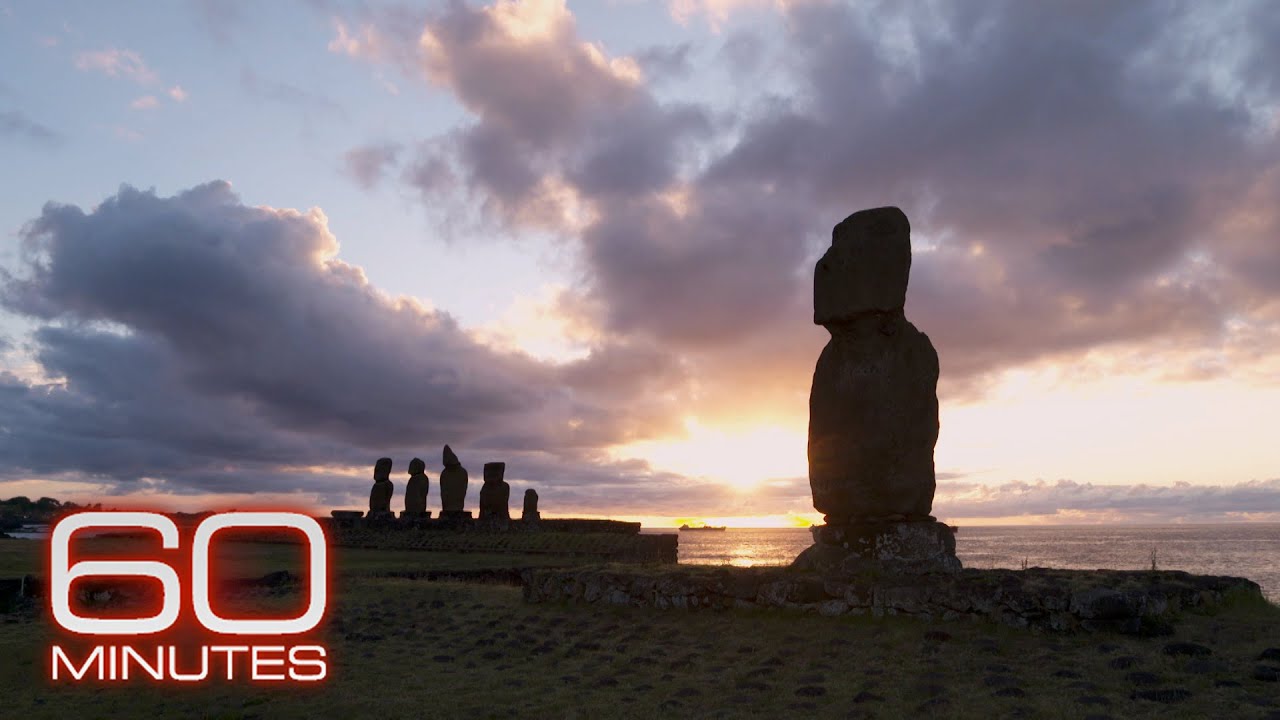


Easter Island 11s
- Easter Island, famous for its giant stone statues called moai, is one of the most remote inhabited islands in the world.
- The moai, carved from volcanic rock and placed on stone platforms called ahu, represent the indigenous people's ancestors and embody a mystical force called Mana.
- Carved between 1300 and the mid-1400s, the moai were created using simple handheld tools and transported using sleds dragged over logs.
- The exact date of the first settlers' arrival on Easter Island is unknown, but they brought with them the tradition of carving and the belief in Mana.
- The moai statues, partially buried underground, exhibit unique features such as mouth lines, size, shape, and expressions.
- Easter Island was annexed by Chile in 1888, and the indigenous Rapa Nui people gained control of the national park containing the moai in 2017.
- Made of soft volcanic rock called tuff, the moai are vulnerable to erosion from natural elements and require ongoing preservation efforts.
- The increasing tourism on the island, with frequent flights and cruise ship visits, strains its resources and sustainability.
- The transformation of the island to accommodate tourists has limited the Rapa Nui people's access to the moai and caused a loss of their sense of home.
- Christian Moreno Pakara, a historian and tour guide, expresses concerns about tourism's impact on the island's culture and traditions.
- Pakara proposes reviving the art of making and moving statues to ensure the survival of the moai and preserve the knowledge and skills for future generations.
City of Music 13m36s
- Cremona, Italy, is renowned for its rich history and tradition of violin making, attracting skilled craftsmen like Antonio Stradivari and Matas Hilgers.
- Cremona's violin-making process has remained largely unchanged for over 500 years, with artisans using simple tools and techniques passed down through generations.
- The violin makers source their wood from specific forests in Bosnia and the Italian Dolomites, known for their exceptional acoustic qualities.
- Original Stradivarius violins are rare and highly sought after, with some fetching prices as high as $16 million at auctions.
- Cremona's violin-making heritage is preserved through restoration efforts led by experts like Bruce Carlson and through a renowned violin-making school that attracts students from around the world.
The Scrolls of Herculaneum 26m39s
- Herculaneum, an ancient Roman city near Pompeii, was buried by the eruption of Mount Vesuvius in 79 AD and rediscovered in the 18th century.
- Excavations revealed a library filled with charred and brittle papyrus scrolls, potentially containing unknown Greek and Latin masterpieces.
- Three scholars, Brent Seales, Vito Mocella, and Gratiano Rania, are using modern medical imaging technology to unravel the mystery of the scrolls without damaging them.
- Seales, an American computer scientist, developed algorithms and software to virtually unroll and read the scrolls, while Mocella and Rania, Italian scholars, proposed using a synchrotron to scan them.
- Seales criticized Mocella and Rania's findings, expressing skepticism and stating that he could not replicate their results.
- Seales proved his methods by working on a charred fragment of a 1700-year-old scroll from a burned synagogue near the Dead Sea, where he found promising results, revealing the oldest surviving Hebrew script of the Bible.
- The Naples Library, which previously denied Seal access to the Herculaneum Scrolls, is now considering granting him access.
The Resurrection of Notre Dame 39m55s
- The fire at the Cathedral of Notre-Dame in Paris on April 15, 2019, caused significant damage to the roof, spire, and interior, leaving gaping holes in the ceiling.
- The restoration process involves removing toxic lead dust, decontamination, and dismantling twisted steel scaffolding.
- The cause of the fire is still under investigation, and the cathedral's chief architect, Philippe Villeneuve, feels responsible for the incident.
- The restoration aims to rebuild Notre-Dame exactly as it was before the fire, using traditional materials like stone, wood, and lead.
- The original spire, designed by Eugène Viollet-le-Duc, will be reconstructed using his original drawings and documentation.
- Over 1,000 French oak trees were felled and finely cut for the new spire, while artisans meticulously restore the cathedral's exterior, towers, interior, and stained-glass windows.
- Stone cutters and sculptors recreate damaged gothic gargoyles and adornments, paying close attention to the original sculptures' details and techniques.
- The great Rose Windows have been cleaned, and painted stone sculptures depicting scenes from the Life of Christ are being carefully restored.
- A 600-ton maze of scaffolding supports the restoration work, particularly the rebuilding of the spire.
- The copper rooster sculpture that survived the fire will be placed atop the new spire, symbolizing the resilience of the French people.
- The restored cathedral is expected to have its scaffolding removed and the spire completed one year before its reopening.