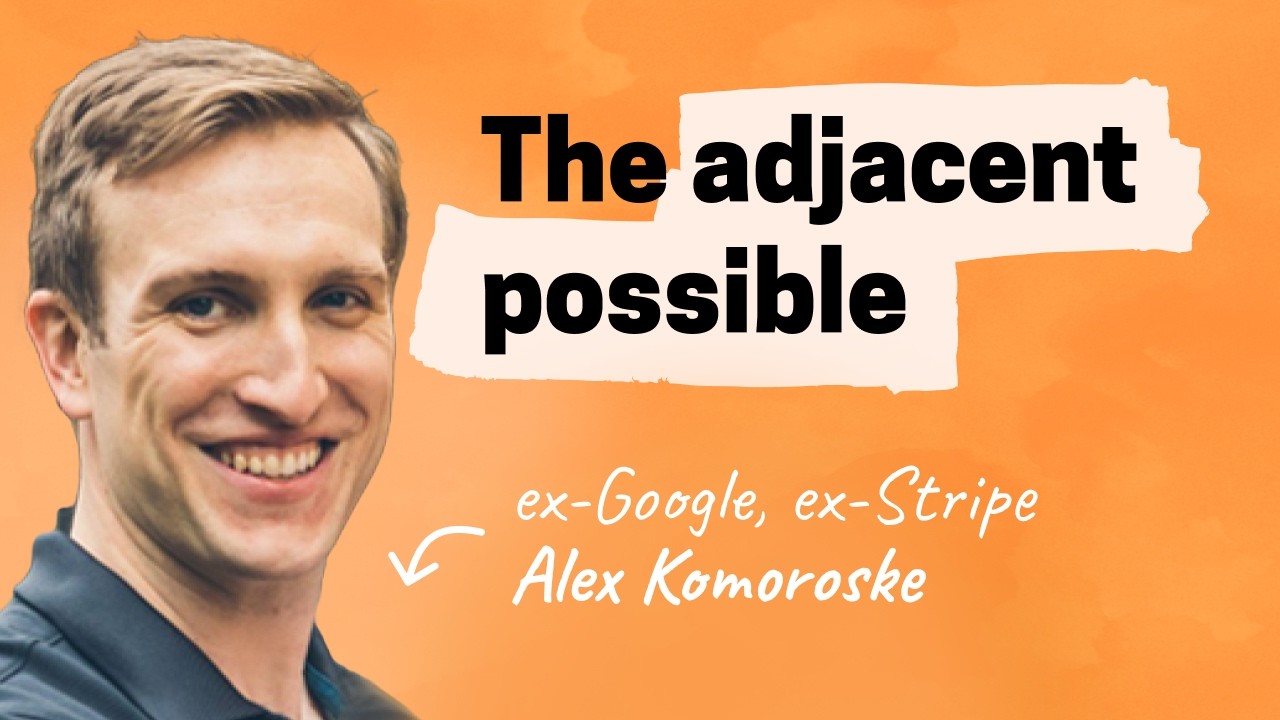


Introduction to Alex 0s
- The traditional "Builder mindset" is a common approach to tackling problems and building products, where one creates a plan and manipulates things to match it, but this approach has limitations and can't create more value than the effort put into it 8s.
- A different mindset is needed, one that involves "gardening" - finding things that can grow on their own and directing or curating them with a little extra energy, which can lead to powerful results 15s.
- This approach is considered unconventional in the product development world, but it can be effective in various contexts 30s.
- Alex Komoroske is a guest who is known for his original and articulate thinking on the future of product and tech 42s.
- Alex has a diverse background, having spent 13 years at Google, working on search, DoubleClick, and leading Chrome's open web platform team, as well as stints at Stripe and his current startup that aims to reimagine the web for the AI era 52s.
- The conversation with Alex covers topics such as the impact of LLMs and Geni on product development, the skills that will matter most as AI becomes more prevalent, and what companies can learn from slime mold and the concept of the "adjacent possible" 1m13s.
- The discussion also touches on the importance of thinking like a gardener rather than a builder, as well as productivity tips, life advice, and more 1m28s.
Alex’s Bits and Bobs document 1m53s
- Alex Komoroske has a document called "Bits and Bobs" that is a collection of his notes and ideas, currently around 600 pages long, which he updates almost daily and reflects on once a week to find patterns and meaning 2m25s.
- The document is a Google Doc that has become so large that it takes a long time to load, and sometimes people accidentally add suggestions or comments while waiting for it to load 2m29s.
- Komoroske takes notes during meetings and writes down ideas that he finds interesting, which he later reflects on to find patterns and meaning 2m42s.
- He started sharing "Bits and Bobs" publicly, but it's primarily for his own self-reflection and not designed to be easily readable or compelling for others 3m33s.
- Komoroske intentionally makes the document a bit illegible and uses terminology that may be unfamiliar to readers, allowing them to work with the content and decide whether it's worth their time 3m43s.
- The document is a collection of unspooled insights, and it's okay if readers don't want to dive into it 4m2s.
- The episode is sponsored by EPO, a next-generation A/B testing and feature management platform, and Vanta, a trust management platform that helps companies automate compliance and security practices .
The Compendium and note-taking process 6m20s
- A personal note-taking system called the Compendium is used to store and organize notes, with 17,248 unpublished working notes currently in the system 6m24s.
- The process involves taking quick notes during meetings, processing and adding context to them every day or two, and using embeddings to find similar ideas from the past 6m43s.
- On Friday afternoons, the notes from the week are reviewed, and the ones that still resonate are exported to a Google Doc for further distillation over the weekend 7m5s.
- The distilled notes are then published on Monday mornings, creating a system that fosters deep thinking and reflection 7m24s.
- The practice of taking time to reflect and write down ideas is crucial for deep thinking, as it allows for the crystallization of thoughts and the identification of interesting insights 7m47s.
- Creating space for reflection is essential, as it enables the exploration of ideas and the discovery of new connections 8m7s.
- The importance of making time for reflection and deep thinking is emphasized, as it can lead to increased productivity and effectiveness 9m51s.
- Working from home on Fridays was a deliberate choice to allow for focused time to read documents, reflect, and think about the week's events 8m21s.
- This dedicated time enables the identification of patterns and the creation of documents that can save time and effort in the future 8m50s.
- The process of reflection and documentation can also lead to the discovery of new ideas and perspectives, such as finding a different approach to a problem 9m25s.
The impact of AI and LLMs on product development 10m10s
- The impact of AI and LLMs on product development is expected to be significant, with LLMs being a disruptive technology that changes many assumptions about software development 10m25s.
- LLMs are considered "magical duct tape" that operates between humans and old computing, allowing for the creation of "good enough" software at a lower cost 11m11s.
- The cost structure of software development is being undermined by LLMs, making it cheaper to write software, but also making some software more expensive to run due to high inference costs 11m18s.
- This shift makes it challenging for consumer startups to rely on advertising as a revenue model, as the cost of inference cannot be cleared by advertising revenue 11m50s.
- The industry's reliance on mature playbooks from the last tech era is no longer effective, and new approaches are needed to adapt to the changes brought by LLMs 11m2s.
- The dynamics of product development are changing, with LLMs allowing for faster prototyping and development, but also introducing new challenges, such as the need to design for "squishy" and not fully accurate systems 12m43s.
- Many people are using LLMs as oracles, expecting them to provide fully-fledged answers, but this approach is not always effective, and a more nuanced understanding of LLMs' capabilities is needed 13m51s.
- Instead of relying on LLMs to solve all problems, product developers should assume that they have access to "magical duct tape" and focus on building new products and experiences that take advantage of this technology 14m8s.
Skills to lean into as a product manager 14m24s
- The current stage of technology is in the "community gardening phase" rather than the "factory farming phase," requiring product builders to have curiosity and playfulness when trying out different things and exploring what is possible 14m50s.
- The ability to think creatively and come up with unique, provocative, and generative ideas will be valuable in finding interesting patterns and solutions 15m23s.
- The existing playbook for product development is no longer applicable, and product builders should be willing to ignore or throw it out and navigate through a new industry 15m36s.
- Vertical SaaS is not the right model for attacking AI-native style problems, and product builders should be adaptable and assume that tactics may not work as expected 16m3s.
- The cost of distribution and production of information has decreased, resulting in a cacophony of information, and product builders should focus on standing out by having good taste and a unique perspective 16m42s.
- Having good taste means having a perspective that is different from the background noise and the average, and product builders should focus on finding and leaning into their own unique taste 16m46s.
- To develop one's taste, product builders should differentiate themselves from what a large language model (LLM) would write, and focus on being distinctive and having something unique to say 17m10s.
- In the new world of product development, product builders should focus on becoming the best version of themselves and leaning into their unique strengths and perspectives 17m28s.
- To differentiate oneself, it's essential to lean into unique perspectives and ideas that resonate with others, as good taste is both individual and compelling to others 17m33s.
- Web Sim is an example of a disruptive and innovative tool that uses AI to generate websites based on a given URL, creating a coherent world that can be steered and explored 17m52s.
- Dylan Field, the founder of Figma, identified Web Sim as the number one thing people will get excited about in the future, showcasing its potential for creativity and innovation 17m58s.
- Web Sim allows users to generate specific content, such as games, by using context from previous pages and can be steered to create unique experiences 18m30s.
- The tool's ability to create a coherent world makes it fascinating to explore, with many users discovering wacky techniques to generate content, such as games for kids 18m37s.
- Disruptive and innovative tools like Web Sim, which may seem alien and weird at first, are worth paying attention to, as they offer new possibilities and opportunities for growth 18m52s.
- Instead of taking an existing playbook and adding AI, it's more valuable to focus on tools that offer new and unique experiences, like Web Sim 18m57s.
How AI makes us better as individuals 19m2s
- Most tools adopted in the workplace are collaborative, helping teams work better together, whereas AI makes individuals better, often in ways they might not want to share with their managers 19m8s.
- AI can be seen as "magical duct tape" that is hard to scale and make repeatable, but it can add significant value when used individually, often below the level of awareness of the organization 19m57s.
- The value created by AI might not be immediately visible, as it often happens in the "long tail of usage," but it can be used heavily in various projects and contexts 20m27s.
- AI tools like Claude can be used to think through problems, generate ideas, and explore different perspectives, making them a valuable asset in day-to-day work 21m1s.
- Using AI tools can be compared to having a conversation with a well-read but slightly naive friend who is willing to engage in any topic without making the user feel dumb 21m39s.
- AI tools can help users explore problem domains and generate ideas, which can then be checked with experts to ensure coherence and validity 22m7s.
- The use of AI tools can be seen as having an "electric bike for idea spaces," allowing users to cover more ground and explore ideas more quickly 22m19s.
- This metaphor builds on Steve Jobs' idea that computers are "bicycles for the mind," highlighting the potential of AI tools to enhance human cognition and creativity 22m28s.
- The role of AI tools is to help users generate and explore ideas, making them a valuable asset for individuals who want to think creatively and come up with innovative solutions 22m53s.
Organizational kayfabe 23m4s
- The concept of organizational kayfabe is discussed, which refers to a situation where everyone in an organization knows something is fake, but they all act like it's real, similar to professional wrestling. 24m30s
- Kayfabe can be optimism and enthusiasm, which is valuable for organizations to believe in their goals and attempt to achieve them, but it can also lead to problems when it's used to hide the truth. 24m50s
- In larger organizations, kayfabe can lead to a situation where employees are reluctant to report the true status of a project, fearing that it will lead to unnecessary reviews and interventions, so they may report a more positive status than the reality. 25m23s
- This behavior is self-defensive and may be beneficial for the organization in the short term, but it can also lead to a lack of transparency and accountability. 25m47s
- The concept of kayfabe is not unique to organizations, but it's a common phenomenon that can be observed in many areas of life, and understanding it can help individuals and organizations make better decisions. 24m35s
- The idea of kayfabe is related to the concept of the "adjacent possible," which refers to the idea that there are many possible solutions to a problem, but only some of them are feasible or desirable. [Not explicitly mentioned in this part of the text, but mentioned in the title]
- The concept of slime mold is also mentioned, which is a type of organism that can solve complex problems through simple interactions, and it's used as a metaphor for how organizations can work together to achieve their goals. 23m58s
- In organizations, a "kayfabe" can form, where everyone pretends to believe something is true, even if it's not, and this can lead to bad decisions being made 26m2s.
- When someone tries to point out the truth, they may be met with resistance, and a senior person may ask them to keep quiet and just help fix the problem, rather than revealing the ground truth 26m34s.
- This can lead to a situation where the organization becomes a "zombie" and continues to lumber on, even though everyone knows it's not working, and this can be a kind of death state for large organizations 27m54s.
- To navigate this, it's essential to acknowledge the kayfabe and find ways to allow disconfirming evidence to show up without killing the organization, and one solution is for leaders to ask their reports to share bad news as soon as possible, so they can address it early on 28m34s.
- This approach can help prevent the buildup of problems that can lead to a critical state that could shatter the organization 28m25s.
- The idea of a kayfabe can be seen in many organizations, and it's essential to recognize it and find ways to address it to make good, grounded things happen 28m5s.
- The pressure to maintain the kayfabe can be intense, and individuals may feel like they have to choose between holding on to the truth and being knocked out of the game, or letting go of the truth and maintaining their position 27m38s.
- In some cases, the easiest way to maintain the kayfabe is to just turn off the part of the brain that knows the truth and earnestly believe the kayfabe, even if it's not true 27m42s.
- When individuals are busy, they often don't take a step back to absorb confirming evidence, which can feel like an existential threat, and this can lead to making bad decisions 28m56s.
- Large companies are radically different from smaller companies due to the dynamic of being surrounded by confirming evidence, which can be created without their knowledge, leading to emergent and dysfunctional behaviors 29m13s.
- In any organization, there is an underlying dynamic where employees can't make their boss look dumb, as this can affect their performance evaluation, leading to systemic compounding and dysfunctional emergent behaviors 29m39s.
- It's essential to acknowledge fundamental and inescapable things, such as entropy, which can cause pain and misery when ignored, and instead, find subsets of ideas that work despite these challenges 30m21s.
- A tactic to overcome these challenges is to plant small, cheap seeds of ideas, which may not have a guaranteed outcome but have a low opportunity cost, and enjoy the process of planting them 31m7s.
- This approach involves not trying to analyze which seed will grow into an oak tree beforehand but instead planting many seeds and watering the ones that start growing 31m24s.
- This method may be perceived as unserious or playful, but it's about admitting that one doesn't know the answer and responding to the ideas that work on a systemic basis 31m39s.
- The viability of working methods does not matter if it is not known ahead of time which ones will be successful 31m45s
Gardening vs. building 31m48s
- The concept of building versus gardening is a core idea that informs the way one thinks, with the builder mindset involving manipulating things to match a plan, whereas the gardener mindset involves directing or curating things to grow on their own 31m53s.
- The builder mindset can create value, but it is limited to the effort put into it, whereas the gardener mindset can lead to more value being created with less effort 32m12s.
- The gardener mindset involves working with what is already present, leaning into things that are going in a valuable direction, and constantly seeking disconfirming evidence 32m35s.
- This approach can lead to "farming for miracles" and increasing the likelihood of finding something that works in a transformative way 32m51s.
- The gardener mindset is not about knowing which specific thing will work, but rather about creating an ecosystem that can grow and accelerate on its own 32m56s.
- This approach is often contrary to the advice given for building products, but it can be a powerful approach that works in many different contexts 33m16s.
- An example of this approach is creating an open-source project that can attract more developers and users, creating a self-accelerating ecosystem 33m43s.
- This approach is often cheap to implement, and it's fine if the project doesn't work out, but if it does, it can be invested in incrementally 33m55s.
- The key is to look for things that have a network effect or a compounding loop, which can lead to growth and acceleration 34m16s.
- Many things have network effects or compounding loops, and it's a matter of finding the dynamics of a thing that can work at an accelerating rate 34m29s.
Emergence-oriented thinking 34m46s
- Thinking in an emergence-oriented way, rather than top-down, can be a powerful approach, as it allows for opportunities to arise from the bottom up, rather than being controlled from the top 34m46s.
- However, this approach can be challenging, as it may make one appear less serious or less in control, and it can be difficult to measure the impact of one's work 35m8s.
- When working on a project, it's common to follow a top-down approach, making a plan and executing it, even if the plan doesn't work out, in order to appear productive and serious 35m19s.
- In contrast, designing for emergence can lead to unexpected and innovative results, but these may be attributed to luck rather than the individual's efforts 35m32s.
- The freedom to work in an emergence-oriented way can be powerful, as it allows for high-impact work without the need for measurable individual effort 35m49s.
- To balance this approach with the needs of an organization, it's recommended to allocate 70% of effort to tasks that are widely acknowledged as important and useful, and 30% to more experimental and innovative projects 36m12s.
- This approach allows for minimizing the risk of being seen as unnecessary, while also allowing for the possibility of high-impact innovation 36m25s.
- By giving team members the freedom to work on their own ideas, even if they seem silly or unconventional, they can exercise their agency, learn, and grow, with the potential for unexpected successes 36m50s.
- This approach also allows for the opportunity to plant "seeds" of innovation, which can be nurtured and developed over time 36m52s.
- To help teams grow, it's essential to create a supportive environment where they can thrive without being forced or stopped, similar to how a gardener nurtures plants, allowing them to grow and develop naturally 37m34s.
- A leader's role is to provide "cover fire" for their team, protecting them from external pressures and allowing them to focus on their work, while also building a foundation for future success 37m45s.
- One of the most challenging aspects of growth is protecting the team from external threats, such as criticism or skepticism, and giving them the space and time they need to develop 38m0s.
- To achieve great work, a team needs an extremely high trust environment where individuals can lean into their strengths and work together to create something greater than the sum of its parts 38m30s.
- New ideas are often initially met with resistance, as they may seem unpolished or unrefined, but it's essential to recognize the potential for greatness in every idea and nurture it 38m47s.
- When working with individuals, it's crucial to identify and acknowledge their unique strengths and superpowers, and provide guidance and support to help them develop and grow 39m18s.
- By treating people with respect and assuming they have seeds of greatness within them, leaders can create a positive and supportive environment that fosters growth and development 39m55s.
- Adopting a mindset that treats everyone with respect and dignity, similar to how one would treat the Buddha, can help leaders find and nurture the seeds of greatness in others 40m14s.
- Being compassionate and creating value is a win-win-win situation, where it is the right thing to do as a person and a member of society, and also creates business value and real value in the world 40m30s.
- Koda is an app used for coordinating workflows, such as podcasting and newsletter management, and combines the best of documents, spreadsheets, and apps to help users get more done 40m48s.
- Koda can help teams stay aligned and ship faster by managing the planning cycle in one location, setting and measuring OKRs with full visibility, mapping dependencies, creating progress visualizations, and identifying risk areas 41m10s.
- Koda offers hundreds of pre-built templates for various tasks, including roadmap strategy and decision-making frameworks 41m25s.
- Companies like DoorDash, Figma, and Qualtrics use Koda, and startups can take advantage of a limited-time offer to get six free months of the team plan by signing up at coda.io/Lenny 41m30s.
Slime molds and organizational structure 41m55s
- Slime molds are used as a metaphor to describe the organizational structure of companies, highlighting the challenges of coordination and decision-making as the organization grows in size 41m55s.
- The core dynamic that makes organizations hard to navigate is the emergent force of coordination, which involves finding a subset of projects that everyone agrees on and commits to, and this coordination cost grows with the square of the number of people involved 42m34s.
- Companies typically try to fight or ignore this coordination cost, but as the organization grows, it becomes more difficult to navigate, much like trying to drive a big rig like a sports car 43m7s.
- To address this challenge, companies can either invest more in program management, processes, and planning, or split into smaller, autonomous teams that can move quickly and make decisions independently 43m40s.
- The downside of the latter approach is that it may appear disorganized to external observers, but it can also lead to greater autonomy and strength at the bottom-up level 44m13s.
- Companies like Apple have chosen to prioritize coherence and unity, while companies like AWS have chosen to prioritize autonomy and diversity, with multiple teams working independently 44m30s.
- Slime molds can be seen as a model for organizations that prioritize autonomy and agency, and embracing this approach can lead to finding creative solutions to problems 44m52s.
- By acknowledging and embracing the slime mold-like nature of their organizations, companies can avoid fighting against their natural tendencies and instead leverage their strengths 45m2s.
Identifying resonant ideas 45m15s
- The process of identifying resonant ideas involves talking to people from diverse backgrounds and skill sets to discover what resonates with them, with the goal of finding ideas that will be interesting to a wide audience 45m15s.
- The test for a resonant idea is when multiple people from different backgrounds respond positively to it, such as a person in sales and a person in engineering both finding the same idea interesting 45m52s.
- The diversity of people who resonate with an idea is an important factor, as it implies a larger potential audience, and finding ideas that resonate with people from different subgraphs in a social network can indicate a much larger maximum audience 46m24s.
- Once a resonant idea is identified, it's essential to invest more time in it, think about how to frame it, and refine it through conversations with others 46m35s.
- Writing down key formulations and metaphors as they emerge in conversations can help to tighten and refine ideas over time 46m44s.
- The use of metaphors can facilitate connections between different ideas and concepts, and having a large collection of examples and metaphors can be beneficial for this type of thinking 46m57s.
The power of metaphors 47m5s
- Leaving one connection open in an argument allows the listener to engage and connect the dots themselves, making the message more relatable and less likely to be met with resistance, as it appears to be their own discovery 47m6s.
- Connecting all the dots in an argument can be seen as more confrontational and may be met with resistance, especially if it goes against the official strategy 47m17s.
- Leaving one dot unconnected allows people to make the connection themselves and come to a realization, making the message more impactful and memorable 47m23s.
- To make a metaphor more effective when leaving one dot unconnected, it's essential to make it evocative and interesting, capturing the listener's attention and imagination 47m35s.
- The use of unexpected or unconventional metaphors, such as comparing something positive to something typically seen as negative, like slime, can be particularly effective in grabbing attention and making a lasting impression 47m37s.
- The use of visuals, such as emojis, can also make a message more engaging and memorable, especially when used in a non-traditional way, such as in a presentation deck 47m55s.
Strategy salons and nerd clubs 48m2s
- Strategy salons, also referred to as "nerd clubs," are a secret group created to facilitate collaborative debate and idea generation, with the goal of strengthening techniques used in open source community organizing 48m24s.
- The concept of strategy salons was discovered many years ago and was initially used to address a complex problem domain at Google, where 12 different groups were working on various aspects of the same problem, but their efforts were undermining each other 48m49s.
- To set up a strategy salon, a secret group is created with explicit norms, including a collaborative debate environment where only positive energy is allowed, and participants are encouraged to engage in a "yes and" approach, where they build upon each other's ideas 49m37s.
- In a strategy salon, participants are free to not engage with ideas they disagree with, and if they choose to engage, they are encouraged to do so in a productive way by saying "I wonder" to make the conversation about themselves, not the other person 49m58s.
- The "yes and" approach may seem non-rigorous, but it allows participants to choose which ideas to build upon, and if multiple people are building on the same idea, it's a sign that there's something interesting and potentially valuable 50m20s.
- New perspectives are introduced gradually, one to three per week, to minimize the chance of disrupting the group's norms and to allow participants to absorb and build upon the new ideas 50m35s.
- To minimize the chance of a single person disrupting a group and to maximize the benefits of diverse perspectives, it's essential to have people with different viewpoints added to the group, a concept that can be referred to as novelty search, as coined by Ken Stanley 51m1s.
- When novelty search is done properly, it can lead to the creation of a group that people find intrinsically valuable and enjoyable to participate in, and can also lead to game-changing insights for the surrounding context 51m10s.
- This type of group can be thought of as an "idea lab," a term used by Tim, where ideas are shared and built upon in a low-stakes environment, leading to amazingly interesting insights 51m30s.
- The key to creating such a group is to allow it to be bottom-up and emergent, rather than trying to steer it towards a specific outcome, as this can stifle the creative process 51m38s.
- By creating these types of groups, individuals can experiment with different ideas, build on them, and be inspired by others, which can lead to the creation of valuable environments 51m55s.
- This approach is an example of emergent properties, where things are allowed to emerge naturally, rather than being dictated by a top-down approach 52m20s.
- The creation of such groups can lead to the development of novel and innovative ideas, and can be a valuable strategy for individuals and organizations 52m23s.
Building and sustaining communities 52m30s
- Building and sustaining communities is all about momentum, and to achieve this, it's essential to start with a small, engaged group of people who share similar interests and topics of discussion 52m35s.
- This initial group should be the smallest seed of people who are actively engaged, and then incrementally add others who are likely to fit in and contribute to the community 52m58s.
- To keep the community alive, it's crucial to feed it with interesting conversations and ensure that there's always someone facilitating and participating in discussions 53m6s.
- A community with only one person talking is considered dead, and it's essential to maximize the chance of having interesting conversations even when the facilitator is not present 53m12s.
- Active policing is necessary to maintain a healthy community, similar to a gardener tending to a garden, and this involves pruning back and providing feedback to members 53m23s.
- When people reach out with ideas, it's essential to encourage them to share their thoughts in the group and engage with their contributions to create a self-sustaining norm 53m41s.
- To maintain momentum, it's necessary to propose new ideas and activities, such as live conversations, and ensure that they have a quorum to avoid the appearance of a dead community 54m27s.
- After events, it's essential to send follow-up messages, such as notes or thank-you messages, to create a sense of FOMO (fear of missing out) and encourage others to participate in future events 54m42s.
- Starting a community requires someone with a lot of energy to seed the group and provide the foundation for growth, and it's essential to look for people who already want to be part of the community rather than trying to convince those who don't 55m4s.
- The key to building a successful community is to create a space where people feel comfortable sharing their ideas and taking risks, and this can be achieved by setting the right tone and norms from the beginning 54m3s.
Productivity hacks and self-control 55m59s
- Productivity can be improved by understanding how you work and what gives you energy, and structuring your day accordingly to maximize energy and motivation 56m14s.
- Activation energy is required to start a task, especially those that are not enjoyable, but completing tasks can provide a burst of energy to help with subsequent tasks 56m26s.
- Breaking tasks into smaller, manageable chunks with limited time allocations can make them easier to complete and help build momentum 56m46s.
- Using "always rules" instead of "sometimes rules" can be an effective way to maintain self-control and stick to goals, such as dieting or exercise routines 57m8s.
- Having clear, black-and-white rules can make it easier to maintain streaks and avoid exceptions that can lead to breaking a streak 57m31s.
- Creating a daily habit, such as a Peloton workout, can help build a streak and make it easier to maintain over time 57m49s.
- Keeping track of progress, such as the number of days in a row a task has been completed, can be a helpful tactic for maintaining motivation and productivity 58m42s.
- Tactics like these can be effective for getting things done and achieving goals, but may not always be given enough credit 58m46s.
- There are various social tricks that can help increase productivity, such as acknowledging when a particular approach is not working and being open to change, which can lead to significant improvements in productivity 58m49s.
- A community with zero people speaking is considered dead, and a community with one person speaking may not realize it's dead, highlighting the importance of engagement and participation 59m16s.
- The ability to type quickly and capture ideas efficiently is a valuable skill, developed through practice and experience, such as writing a thesis and transcribing 150 hours of interviews 59m27s.
- Constantly capturing ideas and writing notes can help to refine and develop them into more stable and coherent concepts 59m55s.
- The ability to work efficiently and be in a state of flow is crucial for productivity, and it's essential to identify and avoid situations that can grind progress to a halt 1h0m35s.
- When working on a project with potential for significant impact, it's possible to become fully engaged and motivated, leading to a state of unstoppable productivity 1h0m47s.
- Allowing oneself to lean into exciting ideas and pursue them, even outside of regular working hours, can be beneficial for creativity and progress 1h1m0s.
Life philosophy and personal insights 1h1m4s
- When an idea strikes, it's essential to capture it immediately, as delaying can lead to forgetting the details, and it's easier to clean up a rough draft later rather than trying to recall the idea from memory 1h1m4s.
- The concept of "do things that give you energy that you are proud of" is a guiding philosophy, as it combines doing something you believe in, which gives you energy, making you 10 times more productive, and the effort becomes its own reward 1h1m46s.
- Finding activities that align with this philosophy can provide infinite energy, as they energize you more than the opportunity cost of time spent on other things 1h2m8s.
- It's crucial to distinguish between things that give you energy in the short term, such as addictive video games or substances, and things that you'll look back on and be proud of 1h2m24s.
- Taking a 10-year perspective on decisions and imagining how you'll feel about them in the future can help you make choices that align with your values and goals 1h2m40s.
- Considering how you'll feel about your decisions in front of people whose opinion you care about can help you take a broader perspective and make choices that you'll be proud of 1h2m47s.
- Focusing on activities that give you energy and make you proud can help you avoid taking shortcuts and losing sight of who you want to be 1h3m27s.
- The quote "the secrets to life are things you've heard a million times already, you just weren't ready to hear them" highlights the importance of being open to insights and perspectives that may have seemed insignificant in the past 1h3m45s.
- The "Hallmark card fallacy" refers to the tendency to share deep insights that resonate with us, but may not be new or original, and to recognize that true insights often come from being ready to hear and understand them 1h3m52s.
- The phrase "the point of life is the friends we made along the way" is often shared because it holds meaning, and people tend to appreciate it more when they're ready to understand its significance 1h4m7s.
- Having epiphanies and experiencing vertical development can lead to a desire to share newfound knowledge with others, but it can be challenging to get them to understand and appreciate it 1h4m33s.
- Sharing ideas can be likened to planting seeds in someone's brain, even if the soil isn't ready, as it can create a crack for the idea to grow into in the future 1h4m54s.
- Mentoring and sharing ideas can have a lasting impact on people, and it's fulfilling to hear from those who have been influenced by one's words years later 1h5m14s.
- It's essential to recognize that people can't be forced to understand certain topics before they're ready, and it's crucial to be patient and allow them to come to their own realizations 1h5m40s.
- Clichés can become profound and meaningful when experienced personally, as seen in the example of having a psychedelic trip and deeply feeling the phrase "Love is All You Need" 1h6m0s.
- The Transcendent mindset involves feeling part of something larger than oneself and losing one's ego, which can be achieved through various means such as hiking, concerts, or psychedelics 1h6m26s.
- Being in awe, wonder, or curiosity is essential for being open to disconfirming evidence and seeing beyond current limits, and it should not be treated as a childlike or unserious thing 1h6m51s.
- Constructing the world around oneself to avoid disconfirming evidence can make systems and individuals stronger through confirming evidence that supports their views 1h7m15s.
- To receive and process disconfirming information, one must come to terms with the possibility of being perceived in a certain way, such as being seen as "kooky" 1h7m30s.
- Embracing and being at peace with such perceptions can help individuals focus on the impact of their work, even if others do not fully understand the methods or approaches used 1h7m40s.
The adjacent possible 1h7m52s
- The concept of the "adjacent possible" is a powerful idea that suggests focusing on small, achievable actions that are within one's reach, rather than jumping to big, bold ideas 1h7m58s.
- This concept argues that people often default to assuming that the adjacent possible is a big leap, when in reality it is a small set of actions that can be taken with certainty 1h8m36s.
- Recognizing the adjacent possible as small allows for full agency to pick from a subset of actions that are within reach, and each action matters because it reconfigures the world and leads to new possibilities 1h8m55s.
- By slicing decisions into smaller and smaller actions, it's possible to arc to wildly different outcomes while minimizing risk 1h9m12s.
- The general advice is to not be scared to take incremental steps, but also to have a coherent worldview and a principled approach to guide decision-making 1h10m5s.
- It's necessary to have both incremental and bold thinking, as only doing incremental will lead to following the steepest gradient in front of you, while having a North Star in three to five years can provide coherence and direction 1h10m12s.
- A North Star should be a low-resolution description of a plausible future that everyone agrees is possible, and it should be used to guide decision-making and provide direction 1h10m27s.
- A Northstar is a guiding vision that should be far off in the distance and will update over time, but it won't drastically change direction, instead, it will arc slightly differently 1h11m5s.
- To achieve the Northstar, one should look at the adjacent possible, which is the next step that has the steepest gradient pulling towards the Northstar, and choose the option that users want and also aligns with the desired direction 1h11m18s.
- Having both a Northstar and an understanding of the adjacent possible is crucial, as only focusing on incremental steps can lead to random walking into a corner, and only focusing on the long-term can lead to designing impossible castles in the sky 1h11m32s.
- A metaphor for achieving success while not clinging to a specific outcome is to point your cart in a specific direction and start walking, without figuring out the exact path, and being open to adjusting the path as needed 1h12m3s.
- It's essential to navigate unknowns and accept uncertainty, rather than trying to achieve false precision through analysis, which can be a comfort blanket that ignores the uncertainty that is present everywhere 1h13m16s.
- Overemphasizing efficiency and trying to avoid wasting effort can lead to doing nothing or doing things that don't work, and it's better to have a slightly inefficient path that is adaptable to unknowns 1h12m27s.
- In strategy, it's not necessary to know exact numbers or details, and trying to achieve precision can be a waste of time and resources, especially when dealing with unknowns that can't be predicted 1h12m49s.
- Ideas with strong potential can have a compounding return, and it's often not about achieving a specific outcome, but rather about making progress and having a better alternative, which can be a freeing mindset 1h13m28s.
- Happiness can be defined as reality minus expectations, a concept coined by Tim Urban, which suggests that setting high expectations can lead to disappointment even if reality is good, but not perfect 1h13m58s.
- It's often easier to change one's expectations rather than reality, so it's essential to hold expectations lightly and not set them too high, especially in situations that are hard to control 1h14m25s.
- Having a flexible mindset and being open to change can help in achieving something great and authentic, rather than being stuck on a specific outcome 1h15m45s.
- It's possible to find humor in difficult situations, even in the moment, by trying to feel the emotion that the story will evoke in the future, such as looking back on a challenging experience and finding it funny 1h14m55s.
- Having a long-term perspective can help in dealing with difficult situations, such as a friend's experience with their newborn's frequent and projectile pooping, and finding the humor in it even in the moment 1h15m4s.
- Holding expectations lightly and being open to change is not about settling for mediocrity, but rather about being willing to adapt and seek something great and authentic 1h15m40s.
Lightning round 1h15m56s
- The conversation has covered a lot of topics and could have gone on for hours, but it's time to wrap up and move on to the lightning round 1h15m56s.
- The book "Origin of Wealth" by Eric Beinhocker is recommended as it provides a complexity of economics and an evolutionary lens on business plans and company execution, serving as an introduction to systems thinking 1h16m31s.
- Another recommended book is "Thinking in Systems" by Donella Meadows, which is short, easy to read, and approachable, offering a unique perspective on systems thinking 1h16m51s.
- The concept of "dancing with systems" is mentioned, which involves letting go and adapting to the system, a phrase coined by Donella Meadows 1h17m14s.
- The movie "The Green Knight" is recommended as a thought-provoking and impactful film that encourages engagement and reflection 1h17m25s.
- The use of parables is discussed as a way to encourage listeners to engage with ideas and think critically 1h17m40s.
- Web Sim is mentioned as a favorite product, a tool that generates fake data and can be used for various purposes, such as creating email templates or generating data for arbitrary schemas 1h18m9s.
- An example use case of Web Sim is generating email templates for famous people, which can be a fun and creative way to use the tool 1h18m32s.
- The tool Clad is also mentioned as something that is used 20 times a day, although the speaker is now considering using Strawberry as an alternative 1h18m16s.
- Elms are considered as little holograms of humanity, packed with information, and can be seen as a mirror reflecting different aspects of human knowledge, which is amazing and sometimes shocking 1h19m6s.
- A favorite life motto is to do things that give you energy and make you proud, and happiness is reality minus expectations, which are simple yet clarifying words 1h19m46s.
- Non-aggregator ecosystems are preferred as they allow participants to contribute without fearing the empowerment of an overlord, and aggregators can curtail exploration in the early stages of an era 1h20m20s.
- The current technical paradigm is considered to be in its late stage, and many things feel figured out, but this outcome is not ideal, and there is a desire for a different approach 1h20m52s.
- The idea of software as alchemy, extending human agency beyond ourselves, and creating something that can combine with others' creations in unexpected ways, is preferred over the current monolithic app-based approach 1h21m25s.
- The potential of human agency should not be limited to a dozen little boxes on a phone, and the assumption that everyone will be locked inside a box with a super good AI is not desirable 1h21m41s.
- The concept of "arrogators" in software and humans using it allows for agency and creativity in a safe environment, but it cannot be fully open-ended as it needs to maintain the ecosystem's boundaries 1h22m7s.
- Large language models (LMs) can be a disruptive technology, enabling people to break free from monolithic organizations and exercise their agency in a pro-social way, leading to increased creativity and collaboration 1h22m21s.
- Alex can be found online at ky.com, where links to their posts, Google group, and Medium articles can be accessed, and people can subscribe to updates 1h22m56s.
- Listeners can be useful to Alex by joining their office hours, which are open to anyone, and sharing ideas, experiences, and backgrounds that can lead to new connections and insights 1h23m17s.
- Alex values talking to people with different life experiences and backgrounds, as seen in an example where a magician shared a parallel between one of Alex's tactics and cold reading used by psychics 1h23m41s.
- The conversation with Alex was valuable, and listeners can subscribe to the show on Apple Podcast, Spotify, or their favorite podcast app, and consider giving a rating or leaving a review to help other listeners find the podcast 1h24m16s.


