

Alisa’s background 0s
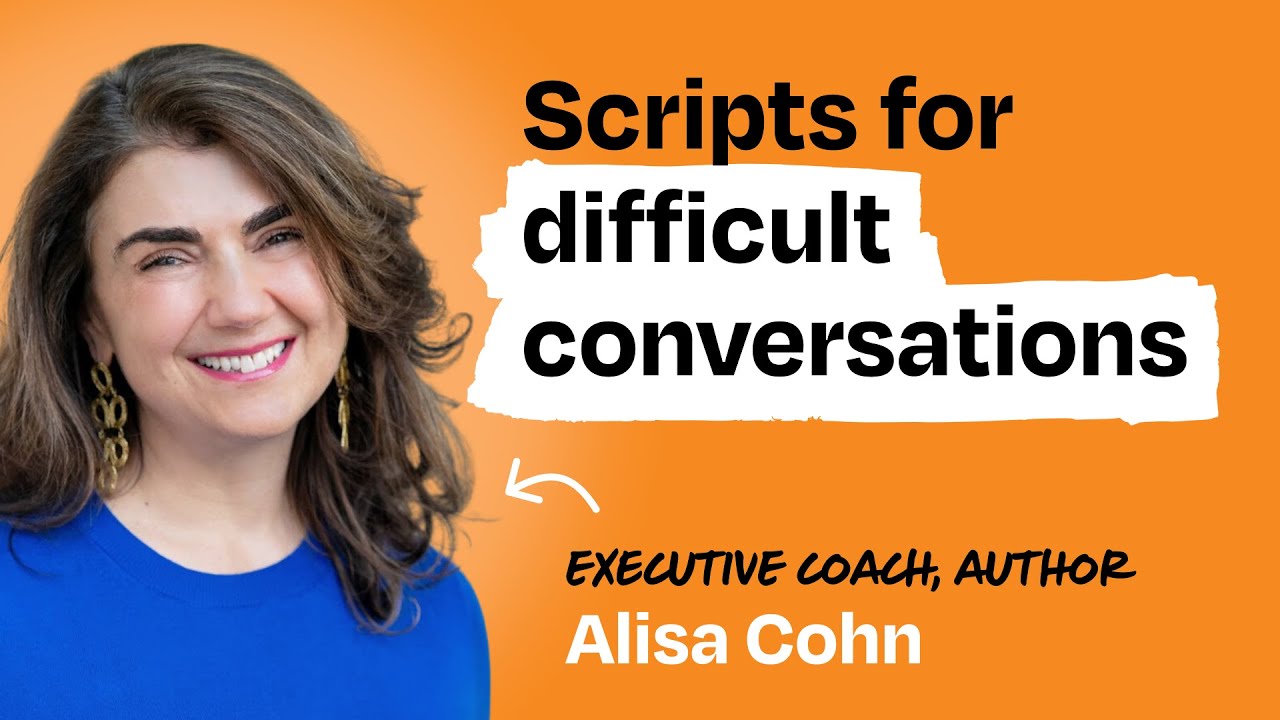
- Alisa Cohn is an executive coach who has worked with executives at startups like Etsy, Wirecutter, Venmo, and DraftKings, as well as Fortune 500 companies like Microsoft, Google, Pfizer, and The New York Times 1m0s.
- She was named one of the top 50 coaches in the world by Thinkers 50 and the number one startup coach for the past four years by Global Gurus 1m14s.
- Alisa provides specific and actionable advice to her clients, including language and phrases to use in difficult conversations with reports to make them smoother and less difficult 1m23s.
- She emphasizes that a leader's job is not to make employees happy, but rather to drive towards results, and shares advice on how to have effective meetings and conversations 26s.
- Alisa also discusses the importance of having tough conversations, such as telling an employee they won't be getting a promotion, and shares strategies for making these conversations more effective 10s.
- Additionally, she shares three questions to ask at the end of every meeting to make progress and a set of questions called the "Founder Prenup" to discuss with potential founders 1m37s.
- Alisa's advice is particularly relevant for leaders who dread having hard conversations and want to improve their communication skills 2m5s.
Having difficult conversations 4m48s
- Difficult conversations are challenging for many people, and it's common to feel like they never go as planned, with individuals often saying the wrong thing and feeling unprepared. 5m4s
- Executive coach Alisa Cohn has developed scripts to help make these conversations less difficult, which can be applied in various situations. 5m23s
- When picturing a difficult conversation, it's helpful to clarify what makes it challenging, as this can help individuals prepare and approach the conversation more effectively. 5m42s
- A common concern in difficult conversations is the fear of making someone sad or upset and dealing with their reaction, which can be overwhelming and create additional work. 5m58s
- However, not having the conversation can mean missing the opportunity to help the person improve, resolve the issue, or improve the relationship, which can lead to new possibilities and positive outcomes. 7m34s
- It's essential to consider what is being put on top of the conversation, as this can help motivate individuals to have the conversation and make it go more smoothly. 7m7s
- Understanding the underlying concerns and motivations can help individuals approach the conversation with more confidence and clarity. 7m16s
- Difficult conversations can be a catalyst for growth, improvement, and positive change, and it's essential to focus on the potential benefits rather than just the uncomfortable aspects. 8m2s
- Difficult conversations can be challenging, but it's essential to approach them with an open mind and consider multiple possibilities of what the other person might mean, rather than just hearing and saying the words 8m18s.
- Examples of common difficult conversations include telling someone they're not getting a promotion, letting someone go, and providing difficult performance feedback or constructive criticism, which is often only focused on areas for improvement 8m42s.
- There are two types of constructive performance feedback: one that addresses mistakes or poor performance and another that focuses on development and growth, suggesting changes or additions to improve 9m3s.
- A common fear in difficult conversations is the other person disagreeing, which can lead to self-doubt and feeling like one might be wrong 9m13s.
- To navigate difficult conversations, it's crucial to tap into what's uncomfortable about the conversation and get one's mindset right, ensuring that the goal is to help the person improve, not to hurt their feelings 9m36s.
- Identifying the reason behind giving feedback is essential, and it's often helpful to express oneself and vent, but it's crucial to transform this reasoning into a constructive purpose 10m2s.
- As a manager, the primary goal of giving constructive feedback is to help the person improve and change their behavior, which is essential for their growth and success 10m15s.
- A story by Kim Scott illustrates the importance of timely and honest feedback, where an employee was unaware of their poor performance and wished someone had told them earlier so they could have changed 10m37s.
- Providing feedback is not meant to hurt the person but to help them, and it's essential to approach these conversations with empathy and a growth mindset 11m0s.
- A client example demonstrates the importance of addressing performance issues, even if it's uncomfortable, as avoiding the conversation can hinder the person's growth and success 11m4s.
- A manager had a difficult conversation with an underperforming employee, which led to the employee crying and going home early, but the next day, the employee thanked the manager for the conversation, expressing that it was something they wished they had been told 15 years ago, which could have changed the course of their career 11m37s.
- This experience highlights the importance of leaders having tough conversations with their team members to help them grow and become the best version of themselves, even if it makes the leader uncomfortable 12m0s.
- Having tough conversations is crucial for an employee's career growth, and leaders should lean into these conversations rather than avoiding them 12m13s.
- Scripts can be helpful in navigating difficult conversations, providing a simple approach to laying out the conversation in various contexts, which can be especially useful when faced with an impending meeting or conversation 12m40s.
- Using scripts can help leaders prepare for and have effective difficult conversations, making it easier to address challenging topics and provide feedback to employees 12m47s.
Scripts for performance feedback 12m48s
- A script for navigating a difficult conversation about performance feedback can start with a phrase like "Matilda, I want to chat with you about the way you're interacting with your peers" to initiate the conversation in a non-confrontational manner 13m11s.
- The script should focus on what others are saying, rather than making a personal attack, by using phrases like "what I'm hearing from them is that" to convey the message 13m14s.
- It's essential to acknowledge the importance of teamwork and collaboration, stating that the goal is to work together consistently and reliably, and that the conversation is aimed at finding a solution 13m32s.
- The conversation should end with a clear call to action, such as "we need to leave this discussion knowing how you're going to make sure that you're keeping your peers in the loop" to ensure a positive outcome 13m49s.
- The tone of the conversation should be even-keel and matter-of-fact, avoiding blame or aggression, to help the other person receive the feedback more constructively 14m53s.
- Building a relationship with the person beforehand is crucial, so they can receive feedback as helpful advice rather than criticism 15m9s.
- Starting the conversation can be challenging, but using a simple phrase like "I wanted to have a conversation with you about some things I've been hearing from your peers" can help initiate the discussion 15m26s.
- It's helpful to have previously acknowledged the person's strengths and accomplishments, such as saying "great job on the way that project landed," to create a positive context for the conversation 15m54s.
- Giving positive feedback is essential in building relationships and trust, and it's crucial to point out what's working to create a foundation for constructive conversations when issues arise 16m3s.
- Using a "mad libs" approach to scripts for difficult conversations can be helpful, but it's essential to make the script one's own to ensure authenticity and avoid sounding unnatural 16m33s.
- When addressing an underperforming employee, it's essential to focus on specific behaviors or actions rather than general perceptions, and to provide concrete examples and suggestions for improvement 17m23s.
- When addressing an issue that may be based on personal perception rather than objective feedback, it's essential to rephrase the conversation to focus on specific behaviors or actions, such as "I've observed that your writing can often be unstructured" rather than "I've heard that your writing needs improvement" 17m39s.
- A helpful approach to addressing performance issues is to start with a positive statement, followed by a specific observation, and then provide concrete suggestions for improvement, such as "I appreciate that you do your documents on time, but I've observed that they can often be unstructured and lack a conclusion" 17m48s.
- Focusing on what one has observed or heard, rather than making assumptions or judgments, is essential in difficult conversations, and is in line with the principles of non-violent communication 18m41s.
- Using phrases such as "what I've observed" or "what I've seen" can help to focus the conversation on specific behaviors or actions, rather than making general statements or attacks 18m33s.
- When providing feedback, it's essential to focus on observable facts rather than making judgments, which helps to keep the conversation neutral and based on expectations 19m8s.
- The goal is to maintain a certain standard of interaction with peers, as it's crucial for effective teamwork and execution 19m35s.
- Staying in sync with peers is vital, and if someone doesn't feel fully in sync, it's essential to address the issue through feedback 19m46s.
- Giving feedback based on feelings can be challenging, but using observable data and evidence makes the conversation easier to have and to receive 19m57s.
- To provide effective feedback, it's necessary to spend time thinking about the specific reasons for the issue and gathering evidence to support the claim 20m4s.
- Asking oneself "what's my evidence that this is happening?" can help in preparing for the conversation and making the feedback more constructive 20m10s.
- Focusing on observable facts and evidence makes the feedback easier to give and receive, ultimately leading to a more productive conversation 20m16s.
How to respond when someone is defensive or upset 20m20s
- When giving feedback, it's essential to be prepared for the recipient to become defensive or emotional, and having a script can help navigate this situation 20m39s.
- A possible script to use when someone gets defensive is to acknowledge their emotions, reiterate the importance of the feedback, and offer a pause in the conversation if needed 20m47s.
- This script involves expressing that the feedback is given to help the person improve, acknowledging their emotional state, and asking if they're ready to continue the conversation 20m51s.
- The goal of this script is not to react to the person's defensiveness but to provide a tool to manage the situation and create space for a more productive conversation 21m29s.
- It's also important to know the person receiving the feedback and tailor the approach to their needs, using delicate language if necessary 22m51s.
- Using this script can help the person giving feedback stay strong in their convictions and avoid backing down unnecessarily 23m17s.
- The script serves as a reminder that the feedback is important and that the person giving it has put thought and effort into it, making it unlikely that they're entirely wrong 23m25s.
- A conversation can be an opportunity to build a relationship and trust by recreating a set of expectations between individuals, and it's essential to lean into having these conversations despite the discomfort 23m34s.
- To start a conversation when someone is feeling defensive, it's crucial to pause and acknowledge the change in energy, expressing no intention of upsetting the other person and highlighting the benefits of the conversation 24m14s.
- When pausing the conversation, it's essential to acknowledge the other person's feelings, express no intention of upsetting them, and highlight the benefits of the conversation, such as helping their career 24m26s.
- The pause can also involve suggesting to come back to the conversation at a later time if the other person is not ready to discuss the topic 24m54s.
- Recreating a set of expectations between individuals can ultimately lead to a stronger connection and a better relationship 23m52s.
- It's essential to encourage individuals to get over their discomfort and have these conversations, as they have the potential to build trust and strengthen relationships 23m58s.
Scripts for handling promotion disappointments 25m7s
- When discussing a difficult conversation, such as telling someone they won't get a promotion, it's essential to have the right mindset, recognizing the person's disappointment and coming from a place of compassion, while also being clear about the reasoning behind the decision 25m24s.
- The conversation should start by acknowledging the person's hopes and expectations, followed by a clear explanation of the decision, using phrases like "I know this is going to be challenging for you to hear" and "I want to let you know that we are going to actually be looking for an external candidate" 25m57s.
- It's crucial to provide specific reasons for the decision, such as the need for someone with more experience in the role or a specific area of expertise, to help the person understand the reasoning behind the decision 26m8s.
- Offering hope for the future is vital, by expressing a commitment to helping the person build their skills and advance in their career, and by finding someone who can help them develop as a professional 26m37s.
- Being upfront and direct is essential, as it allows the person to process the information and move forward, and it's also important to acknowledge the person's feelings and show empathy 26m55s.
- Providing a clear explanation of the decision and the reasons behind it helps the person feel like they understand the thought process, and it's also essential to paint a picture of how they can get to their desired outcome in the future 27m10s.
- Sometimes, it's helpful to offer a follow-up conversation to discuss the person's thoughts and feelings after they've had time to process the information 27m55s.
- Sending the "I care about you" message is crucial in the workplace, as it helps people stay resilient in the face of setbacks and feel that they have an ally in their leader, even when things are not going their way 28m6s.
- When an employee disagrees with a decision, such as not getting a promotion, and claims they have the necessary skills, it's essential to have done homework to identify that they actually don't have those skills 29m7s.
- If an employee responds with defensiveness or explains things that are not part of the decision-making process, it's helpful to acknowledge their perspective and provide context for the decision 29m35s.
- A possible response to an employee's defensiveness is to say something like, "I understand that you were thinking that after a year you'd get promoted, but our company's needs have changed as we scale" 29m37s.
- If an employee claims to have the necessary skills, it's a good idea to ask them to explain what they see as those skills, which can lead to a productive conversation 30m6s.
- If the conversation becomes unproductive, with a back-and-forth of "yes, I do" and "no, you don't," it's best to take a pause and suggest discussing the issue again at a later time 30m24s.
- Mirroring back an employee's concerns, such as "I hear what you believe" or "I understand you've been here for a year," can be a powerful tool in making them feel heard 30m47s.
Scripts for handling terminations 31m0s
- When firing someone, the goal is that it's not a surprise to them, having had multiple conversations about not meeting expectations, which is essential for creating a culture where people are not surprised by being fired 31m5s.
- Before firing someone, it's helpful to have a conversation beforehand to ensure clarity on expectations and to address any potential issues, as being unclear can lead to problems 31m44s.
- To ensure clarity, it's essential to be crystal clear about what is needed from the person and what the consequences will be if those needs are not met 32m6s.
- A script for having this conversation can start with being upfront about the difficulty of the conversation, then observing the specific issues that have been happening multiple times, and clearly stating what will happen if the issues don't change 33m25s.
- It's also important to acknowledge the person's strengths and talents while communicating the critical nature of the issues and that they are a deal-breaker 33m55s.
- The conversation should be clear and direct, with a specific timeline for improvement, such as 30 days, and a clear understanding of the consequences if improvement doesn't happen 32m57s.
- The goal of this conversation is to be clear and direct while still showing appreciation for the person's skills and talents, and to give them a chance to change and improve 33m10s.
- The conversation should also be clear about what will happen if the person doesn't meet the expectations, such as finding a way to part ways 33m0s.
- It's essential to be clear and direct while still being empathetic and understanding, and to give the person a chance to change and improve 33m16s.
- Addressing performance issues before they lead to termination is crucial, as it can potentially resolve the problem and make the termination process easier if it eventually becomes necessary 34m22s.
- A script for addressing performance issues can be used to have a difficult conversation with an underperforming employee, which involves stating that the conversation will be challenging, mentioning the specific issues that have been discussed multiple times, and clearly outlining the expected changes 34m47s.
- It is essential to have a clear and direct conversation with the employee, ensuring that they understand the issues and the necessary changes, and to involve HR professionals and lawyers to ensure that the process is handled correctly 35m4s.
- When terminating an employee, the conversation should be simple and straightforward, stating that the expected changes were not made, and that the decision to terminate has been made, with HR representatives present to discuss logistics 35m19s.
- The termination conversation should be handled in a reasonable and professional manner, with the option for a longer conversation if the employee desires, and should clearly communicate the decision to terminate 35m37s.
The importance of positive feedback 35m44s
- Delicate conversations in the workplace are not just limited to difficult conversations, but also include simple praise and specific feedback, which are often overlooked by leaders and managers 35m44s.
- Leaders should get in the habit of pointing out what their team members are doing well, just as they prepare for pointing out areas that need improvement 36m2s.
- Positive feedback should have the same standard as negative feedback, providing specific examples and benefits, such as "I saw the way you ran that launch, it was fantastic, all these different benefits came from it" 36m40s.
- Giving positive feedback regularly helps leaders become better at it, which is extremely motivating to team members and helps them see their progress 37m7s.
- Positive feedback is morale-boosting and helps team members know where they stand, making it easier to have difficult conversations later on 37m25s.
- Giving positive feedback well requires thought and effort, and leaders should have scripts for how to do it effectively 37m47s.
- There is often less demand for learning how to have great conversations or give compliments, but it is an important skill for leaders to develop 37m53s.
Understanding your job as a leader 38m49s
- Leaders often mistakenly believe their primary job is to make employees happy, which can lead to subpar performance and ultimately harm the company, 38m56s.
- This misconception may stem from Founders, who often have limited experience as leaders or managers, trying to create a happy and engaged workforce based on advice from others, including HR leaders, 39m7s.
- However, the primary focus of a leader should be driving towards results, rather than solely focusing on employee happiness, 39m59s.
- To achieve success, leaders should create a winning culture, which involves setting up the structure and culture for success, ensuring everyone understands their role and its impact, and celebrating wins, 40m56s.
- This approach may require having hard conversations and pushing employees, but ultimately leads to a more dynamic workforce and attracts the right people who want to win and achieve results, 41m25s.
- An example of a Founder who shifted their approach from focusing on employee happiness to driving results is a leader who initially focused on providing perks like avocado toast, but eventually realized the importance of creating a winning culture, 41m54s.
- A company had a culture where employees would socialize and hang out together, but they were unclear about their work expectations and results, leading to a gossipy culture and lack of focus on results 42m18s.
- The company started a culture committee to improve employee happiness, but the leader had not set clear expectations or codified the company culture, leading to a misguided focus on engagement and employee experience 43m5s.
- The leader, who was sincere about creating a great workplace, had to confront their own discomfort with addressing the issues and setting clear expectations, and ultimately had to part ways with toxic employees who were creating a negative culture 43m20s.
- The company's culture was not just about socializing and having fun, but about the way work was done, such as going the extra mile, measuring twice and cutting once, and focusing on results 43m35s.
- The leader had to make courageous changes to the way they operated and get everyone on the same page to gain traction and improve results 44m37s.
- Coaching and working with people involves understanding their underlying assumptions and beliefs, and helping them to make changes to achieve their goals 44m24s.
- The company was able to gain more traction and improve results once they had a clear and focused culture, and had addressed the issues that were holding them back 44m51s.
Recognizing your own blind spots 44m55s
- Many leaders and founders want to create a great culture and maintain a friendly atmosphere, but often things don't work out, and there's a shift towards making a business that works, which can be a sign of hypergrowth and success 44m55s.
- Founders and leaders have to come to terms with the difference between what they thought leadership was going to be and what it really is, and realize their own blind spots 45m43s.
- A common blind spot for leaders is not realizing that what their company needs is structure and accountability, and that it's their job to make that happen 46m11s.
- Some leaders may need to adjust their style and consider having a partner, such as a COO, to manage the internal aspects of the business while they focus on being more visionary and inspirational 46m50s.
- Failing to adjust one's style and not seeing the situation for what it is can lead to wheel spinning and inefficiencies, even for well-intentioned leaders 47m9s.
- The phrase "what you resist persists" suggests that resisting confrontation or structure can lead to more of it, and that embracing these aspects can be necessary for success 47m32s.
- Some leaders may initially resist structure and process, but eventually realize that it's necessary for growth and success, as seen in the example of Joe Gebbia at Airbnb 47m45s.
- Many founders are Mavericks who want to do things their own way, which is a fantastic trait that drives them to start companies, but they often need to reinvent leadership and eventually understand the importance of process, hierarchy, roles, and responsibilities. 48m11s
- Founders may initially want to avoid traditional structures such as process, hierarchy, and roles, but ultimately, they often find that these elements are necessary for success and that there are well-established ways to organize a group of people to achieve their goals. 48m26s
- It's helpful for founders to go through the process of trying new approaches and learning from their experiences, but it's also important to avoid constantly reinventing the wheel and to establish a solid foundation for leadership as quickly as possible. 48m55s
- Successful founders often use first principles thinking to develop innovative approaches, but they also need to balance experimentation with the need to establish effective structures and processes to achieve their goals. 49m20s
- Founders should be willing to try new things, but they should also be prepared to learn from their failures and to adapt their approaches as needed to find what works best for their company. 49m31s
Three vital questions to ask in every meeting 49m38s
- Meetings can be ineffective due to lack of continuity from one meeting to the next, resulting in re-discussion and re-decision of the same topics 49m38s.
- To improve meeting effectiveness, three questions should be asked at the end of each meeting: what did we decide here, who needs to do what by when, and who else needs to know 50m31s.
- These questions help capture decisions, action items with dates, and ensure that relevant parties are informed, leading to better meetings 50m47s.
- Executive teams often forget to share important information with others, highlighting the importance of cascading information down and making it part of the company's protocol and process 51m21s.
- Asking each meeting participant to write down what they think was decided can reveal differing opinions, even among people in the same meeting, and help clarify decisions 51m40s.
- The advice is not a template, but rather a ritual to be incorporated into meetings, with someone assigned to ensure these three questions are addressed, typically someone who enjoys follow-up and organization 52m18s.
- This person, often the meeting leader, is responsible for capturing decisions, action items, and communication needs, making the meeting more effective and productive 52m31s.
- Baking these questions into the meeting ritual can help ensure that meetings are more effective, even when time is limited 52m41s.
- To ensure a clear understanding of meeting outcomes, it's recommended to leave 5-10 minutes at the end of the meeting to ask three key questions and confirm the follow-through actions 52m49s.
- Asking the question "what did we decide here?" can help crystallize the discussion and raise any differences in understanding, allowing for a more comprehensive agreement 53m15s.
- To encourage participation, it's suggested to ask the question to the entire room, rather than just the most senior person, and have each person share their understanding of the decision 54m10s.
- In a small meeting, it's possible to go around the room and have each person share their understanding, while in a larger meeting, it's recommended to ask 2-3 people to share their thoughts 54m38s.
- The goal is to get a common understanding of the decision and the actions that need to be taken, and to identify who needs to do what by when 54m46s.
- Anyone can take the initiative to ask these questions and start this process, regardless of their role in the meeting, and it can become a ritual that improves the effectiveness of meetings 55m27s.
- By taking the initiative to ask these questions and ensure a clear understanding of the meeting outcomes, individuals can demonstrate leadership and contribute to more productive meetings 55m40s.
- The video likely discusses strategies and techniques for navigating difficult conversations in a professional or personal setting 0s.
- Alisa Cohn, an executive coach, may provide guidance on how to approach challenging conversations with confidence and effectiveness 0s.
- The video might cover topics such as preparing for difficult conversations, active listening, and using specific scripts or phrases to navigate tough discussions 0s.
- Viewers may learn how to manage their emotions and respond to difficult questions or situations in a calm and professional manner 0s.
- The video could also provide tips on how to follow up after a difficult conversation and maintain relationships 0s.
The founder prenup 55m57s
- Founding a company can be compared to a marriage in a business context, where founders are stuck with each other for a long time, and it's essential to be aligned before starting the company 56m0s.
- According to Noam Wasserman, 65% of startups fail due to conflict with founders or the founding team, highlighting the importance of getting this right 56m46s.
- It's crucial for founders to do their due diligence and get to know each other before deciding to co-found, as quick decisions can lead to problems down the line 57m11s.
- One essential topic for founders to discuss is their values, and doing a values clarification exercise can help identify core values and potential areas of misalignment 57m40s.
- When founders have aligned or adjacent values, it can be beneficial, but when values conflict, such as excellence and work-life balance, it's essential to discuss and understand each other's perspectives 58m10s.
- Regularly updating and discussing core values can help prevent problems and ensure founders understand each other's motivations and actions 58m34s.
- Signs of misaligned values can manifest as conflicting priorities, and addressing these issues upfront can prevent problems from arising 59m6s.
- Difficult conversations are necessary and worth having, especially when it comes to values and expectations that may be at odds or aligned, in order to come to a mutual understanding and avoid conflicts 59m23s.
- A lack of communication can lead to assumptions and conflicts, as seen in the example of a founder who would text or slack their co-founder on weekends, but the co-founder wouldn't respond, causing frustration and conflict that could have been avoided with a conversation 59m51s.
- Having these conversations is not only necessary but also helps the other person, as it can prevent small issues from becoming huge problems over time 1h0m23s.
- There are various values frameworks available, but a simple approach is to Google "list of values," circle the ones that are most meaningful, and narrow them down to 3-5 core values that are important to you 1h1m4s.
- It's helpful to review and update your values regularly, as they can change over time, and this exercise can help you make difficult decisions and operate with more clarity 1h1m39s.
- Another important conversation to have is about the vision of the company, including what success looks like and what trade-offs need to be made to achieve it, in order to avoid differences in expectations and assumptions 1h1m59s.
- Differences in vision can come to a head when it's too late, so it's essential to have explicit conversations about the company's vision and goals 1h2m31s.
- An example of this is two co-founders who had different visions for their company, one wanting independence and freedom, and the other wanting a big venture outcome, highlighting the importance of discussing and aligning on the company's vision 1h2m40s.
- A company's growth can lead to challenges and growing pains, and it's essential for co-founders to be on the same page regarding their goals and vision for the company, as differences in goals can lead to painful reckonings 1h2m45s.
- It's crucial to have conversations about what success looks like for the company and what winning means to each co-founder, as goals and visions can change over time 1h3m48s.
- Understanding how each co-founder handles conflict is vital, and it's helpful to ask someone close to you how you handle conflict to gain more self-awareness 1h4m3s.
- People handle conflict differently, and some may want to discuss it immediately, while others may want to let it settle first and go through their thinking process 1h4m44s.
- Having open conversations about conflict resolution can help prevent unnecessary conflicts and dynamics 1h5m14s.
- It's surprising that many people don't have these conversations when finding a co-founder, which can explain why many founder relationships don't work out 1h5m25s.
- Deciding how to make decisions when co-founders disagree is essential, and there are different ways to approach this, which should be discussed upfront 1h6m0s.
- When navigating difficult conversations, it's essential to discuss how to handle disagreements upfront, as it's inevitable that disagreements will arise, and having a practice and process in place can help make the conversation more productive 1h6m17s.
- Disagreements can be handled in various ways, such as letting the person with the best perspective and expertise win the argument, or going back and forth until a resolution is reached 1h6m21s.
- Having a process in place can help prevent difficult conversations from becoming unproductive and sulky 1h6m48s.
- Dynamic tension in a relationship, where individuals bring different perspectives and ideas to the table, is normal and can be beneficial 1h6m54s.
- Discussing company culture is crucial, as co-founders often assume they're on the same page without explicitly talking about it, which can lead to conflicting visions and a lack of coherence 1h7m22s.
- Different company cultures, such as a family-like culture or a results-focused culture, can exist together, but if co-founders are pushing in different directions, it can feel like two separate companies 1h7m43s.
- A lack of coherent company culture can lead to different standards and expectations, causing difficulties in working together 1h8m18s.
Failure corner 1h8m24s
- The concept of "Failure Corner" is introduced as a recurring segment to share stories of failure and what can be learned from those experiences, to help listeners understand that everyone faces setbacks and that it's possible to grow from them 1h8m25s.
- A personal story is shared about the early days of a coaching practice, where a conversation didn't go well, leading to feelings of fear and uncertainty about the future, but ultimately resulted in learning to pick oneself up and keep taking action 1h9m4s.
- The story highlights a "rock bottom moment" where the person was crying on the floor for an hour, but eventually got back up and continued working, and eventually found success 1h9m41s.
- Another story is shared about a failed offsite coaching event, where the client suggested ending the event early due to its poor progress, leading to feelings of humiliation and failure 1h10m54s.
- However, this experience was used as an opportunity to improve skills, take training, and work with a mentor, ultimately leading to becoming great at running offsites 1h11m31s.
- The key takeaway from both stories is that even in the lowest moments, it's possible to learn and grow, and turn failures into fuel to build skills and become great at something 1h12m19s.
- The stories also address the concept of imposter syndrome, where the fear of doing something wrong and being judged can be overwhelming, but ultimately, it's possible to move on from failures and use them as opportunities for growth 1h12m32s.
Final thoughts and lightning round 1h13m0s
- A leader needs to have the wisdom to know when to have patience and when to look at the process to address issues, and also have their finger on the pulse to recognize whether it's an issue with patience or process 1h13m1s.
- Signs that a problem might be related to process rather than patience include not knowing how something will come together, having no plan in mind, not having touched base with people, and hearing uncomfortable silence about the issue 1h14m28s.
- To address process problems, leaders should dive deeper, talk to people, look at data, and figure out a way to make the issue unstuck, whether it's a massive problem or just one little thing that needs to be resolved 1h14m46s.
- Leaders should not just hope that a problem will work out, but rather see a path to it working out, and if not, it's probably a problem 1h15m10s.
- The concept of a "co-founders prenup" can be applied to any team by creating a personal operating manual that helps team members discuss their working styles and preferences 1h15m20s.
- A personal operating manual can prompt discussions about communication style, work preferences, pet peeves, and delegation style to help team members work more effectively together 1h15m30s.
- Questions to consider in a personal operating manual include what communication style is preferred, how to work best, how to handle meetings and interruptions, and what are the best ways to communicate and delegate tasks 1h15m41s.
- Conversations about working styles can be beneficial for teamwork and collaboration, as people often assume others work in the same way they do, but in reality, everyone has their unique style 1h16m12s.
- A "read me" document can be helpful in outlining how to work with someone, including their preferences and pet peeves, to avoid misunderstandings and promote a harmonious work environment 1h16m32s.
- The "gold star concept" is a useful visual tool to help people understand how to be successful in their work and what is expected of them 1h16m36s.
- Being clear about one's operating style and expectations can help prevent conflicts and promote better workplace harmony 1h16m57s.
- Recommended books include "Radical Candor" by Kim Scott, "Working Backwards" by Colin Bryar and Bill Carr, and "Walt Disney" by Neil Gabler 1h17m28s.
- The book "Radical Candor" is a frequent recommendation, and the podcast has featured Kim Scott and Bill Carr as guests 1h18m24s.
- A favorite recent movie is "Inside Out," which explores the complexity of human emotions and is relatable to coaches 1h18m42s.
- A favorite product is the Ninja Creami, a device that can turn any liquid into ice cream in 10 minutes with minimal prep and effort 1h19m2s.
- A favorite life motto is "if you can see your path all the way through to the end, you are following someone else's path," which emphasizes that one's path becomes clear moment by moment as each step is taken 1h19m32s.
- This motto is empowering as it helps people realize that not knowing where they're going is normal and good 1h20m0s.
- For those considering becoming a coach, a key piece of advice is to listen to people more deeply and ask deeper questions to understand their thoughts and feelings 1h20m40s.
- This involves not just responding to what they say, but also asking why they think that way or where their thoughts are coming from 1h20m51s.
- To become a coach, it's essential to be able to get behind the surface and understand people on a deeper level 1h21m8s.
- Alisa Cohn works with executives at startups and large public companies, and people can reach out to her at alisacohn.com or alisacohn.com/lenny for resources 1h21m45s.
- She offers resources such as a co-founder prenup, a personal operating manual, and invites people to join her newsletter 1h22m0s.
- To be useful to Alisa Cohn, people can try something that makes them uncomfortable and share their experience with her, or listen to her podcast "From Startup to Grownup" and give it a rating and review 1h22m21s.
- The podcast is titled "From Startup to Grown Up" and features an interview with Alisa Cohn. 1h23m7s
- Alisa Cohn expresses gratitude for being a guest on the podcast. 1h23m14s
- The host, Lenny, thanks Alisa Cohn for her participation and bids farewell to the listeners. 1h23m16s
- Listeners are encouraged to subscribe to the show on various platforms, including Apple Podcasts, Spotify, or their favorite podcast app. 1h23m21s
- Viewers are also asked to consider giving the podcast a rating or leaving a review to help other listeners discover the show. 1h23m27s
- Additional information about the podcast, including past episodes, can be found at Lenny podcast.com. 1h23m31s