

Eilon’s background 0s
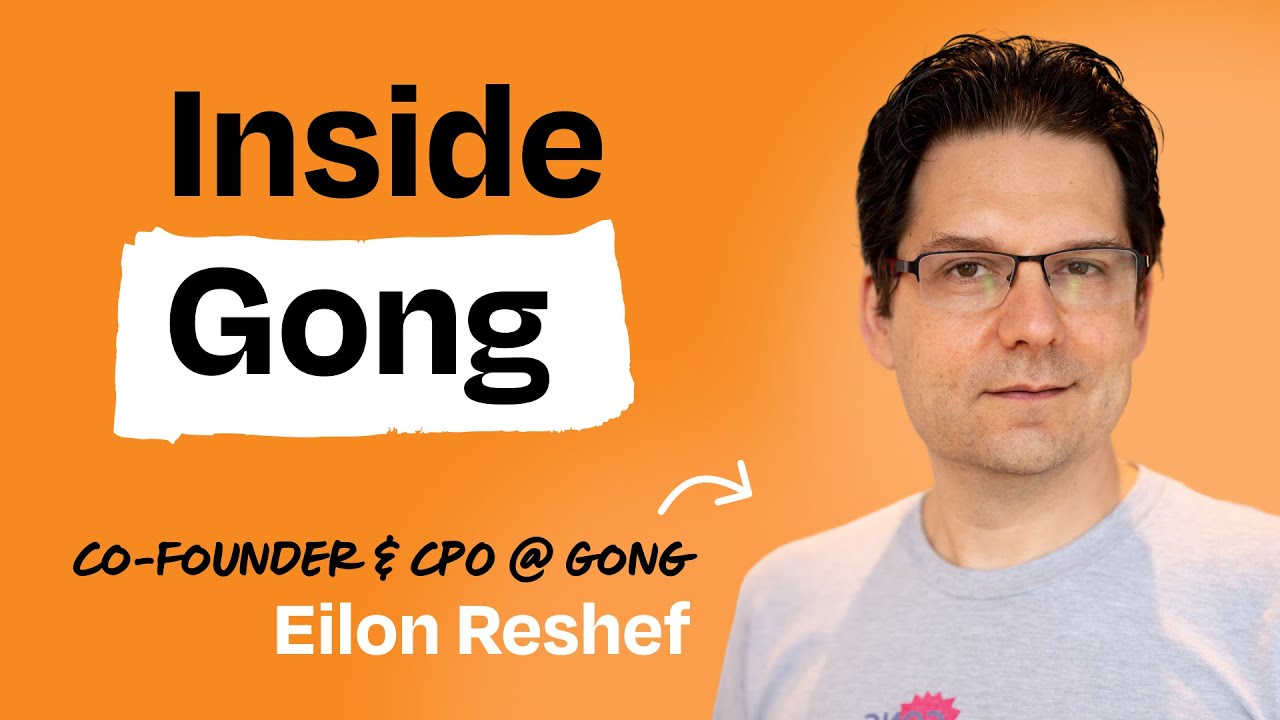
- Eilon Reshef is the co-founder and Chief Product Officer at Gong, and he was also the longtime Chief Technology Officer. 1m15s
- Gong's product teams work with 6 to 12 design partners on every new product and feature they invest in. 1m44s
- Gong's pod model is a unique way of building and organizing product teams, which was first implemented in 2016. 5s
- The pod model consists of a product manager, a user experience designer, backend engineers, and a couple of frontend engineers. 14s
- Gong's success rate with new product features is very close to 100%, with most features being used by a significant number of people. 49s
- The company's approach to product development is focused on autonomy and trust, which allows for quick decision-making and minimizes the risk of building something that may not be used. 1m7s
- Eilon believes that autonomy and trust are essential for a company's success and that they are personal and selfish aspects of his approach to product development. 1m9s
- Gong's product teams work with design partners to build new product lines, which feels like a "cheat code" for building successful products. 41s
The pod model 4m20s
- The pod model at Gong is a unique way of building and organizing product teams, which was started around 2016, before it became popular, and possibly before Marty Kagan's set of books 5m14s.
- When Gong started scaling from around 50 to 60 people, they tried to figure out the operating model for product and engineering, and they decided to replicate the initial team structure, which consisted of a product manager, a user experience designer, backend engineers, and frontend engineers 5m36s.
- The current pod structure consists of a product manager, a UX designer, a fractional writer, a fractional analyst, and a team leader from an engineering standpoint, along with five to seven engineers 6m2s.
- Each pod is given an agenda, such as launching a forecast product, and they have autonomy in identifying how to solve problems and working with customers 6m11s.
- The pods work independently, and the team leaders ensure that they are not "hallucinating" or going in an unreasonable direction, allowing the company to trust their decisions 6m29s.
- The pod model allows for a high degree of autonomy, trust, and independence, enabling teams to work effectively and efficiently 6m31s.
Working with design partners 6m33s
- The company's pods work with design partners in a unique way, with each pod sometimes working with one, two, or even five design partners, depending on the capability, and they work hand-in-hand with these partners 6m48s.
- The pods are cross-functional product teams that are organized around an outcome, with each pod responsible for a specific job to be done, such as sales engagement or conversation intelligence 7m54s.
- The pods have autonomy to work with design partners to design new products, with the design partners guiding them, and the goal is to achieve a specific outcome 8m37s.
- The company's approach is less metric-driven than other companies, and instead focuses on achieving a specific job or outcome 8m3s.
- The pods are responsible for designing and building products that make progress according to customer feedback, and customers appreciate the company's approach to working hand-in-hand with them 7m34s.
- The company's forecasting tool is a product that helps organizations forecast their sales performance, using AI to predict the right numbers and analytics to assess performance at scale 8m49s.
- The product manager and design partner work together to build the product, with the product manager providing feedback and guidance, and the design partner building the product 7m13s.
- The company's approach to working with design partners is extreme in terms of collaboration, with design partners working closely with product managers to build products that meet customer needs 7m0s.
- The pods have a high degree of autonomy to work with design partners and design new products, with the goal of achieving a specific outcome 8m26s.
- The company's approach is focused on achieving a specific job or outcome, rather than just building a product or moving a metric 8m7s.
Finding and coordinating design partners 9m13s
- Design partners are usually existing customers who have expressed interest in a specific capability, and can be found by searching through conversation databases to identify customers who have expressed a need for a particular feature or product 9m22s.
- The company uses a research coordinator to reach out to potential design partners, who sets up meetings between the product manager and the design partner, using a micro CRM to manage the process 10m19s.
- The research coordinator works with the product manager to identify the target market and ideal customer profile, and then reaches out to potential design partners to set up meetings 10m22s.
- The company has a unique approach to working with design partners, where each pod works directly with a dozen customers to build a new product, and the product team is responsible for coordinating with customer success to ensure that the design partner process does not interfere with other customer relationships 11m22s.
- The design partner process can be structured or unstructured, depending on the context, with some projects having a more linear path and regular meetings, while others may be more free-form and have less frequent meetings 12m9s.
- The company uses weekly or bi-weekly meetings to show progress and get feedback from design partners, and may also use less structured approaches, such as a series of meetings with each design partner, to build a product or feature 12m20s.
- The design partner process is flexible and can be adapted to different projects and timelines, with the goal of getting enough feedback and input from design partners to build a high-quality product or feature 12m55s.
Balancing customer feedback and vision 13m12s
- Balancing customer feedback and vision is a core skill expected of Product Managers (PMs), who must figure out what customer requests are "must-haves" versus "not must-haves" 13m33s.
- To determine the priority of customer requests, PMs typically ask customers about their current situation and how happy they are with it, on a scale of zero to 10, with the goal of improving their satisfaction to an eight or nine 13m48s.
- While PMs may proactively reach out to more customers to validate unique requests, the company still accommodates one-off requests from high-value customers, such as those with seven or eight-figure deals 14m8s.
- In contrast, design partners focus on building solutions that work across the customer base, rather than for specific customers, which is why a dozen or more design partners are often more valuable than just one or two 14m25s.
- As the number of customer requests increases, they tend to converge, with most customers asking for the same things, and only occasional outliers 14m35s.
- Gong's approach to balancing customer feedback and vision is rooted in its early days, when the company worked with 12 design partners to develop its product and then successfully converted 11 of them into paying customers 14m47s.
Gong's 95% feature adoption 15m10s
- The approach to building products with a design partner significantly increases the utility of the products, with nearly 100% of the features built ending up being used by a significant number of people 15m33s.
- Although most features are used, not all of them are charged for, and some may not provide huge value or be applicable to a larger segment of the customer base 15m39s.
- The design partner program focuses on providing value and being understandable, rather than solving for quality or bug issues 16m3s.
- Generally, more than 95% of the capabilities built are used in a significant way, which is likely higher than most companies 16m22s.
- This approach feels like a "cheat code" for building new product lines, expanding product expansion, and adding new ways to charge existing customers 16m32s.
- The key to this approach is working closely with customers to understand their needs and building products that meet those needs, with the understanding that customers know better than anyone what they need 16m51s.
- While customers may not know how to build a solution or implement it, they can describe the pain points they are experiencing, which is a crucial part of the product development process 17m0s.
The importance of autonomy and trust 17m5s
- Autonomy and trust are key aspects of a successful team, allowing members to work independently and make decisions, which leads to better results and increased motivation 17m6s.
- Giving teams autonomy allows them to be themselves and work in the way they believe is best, resulting in more productivity and job satisfaction 17m34s.
- A personal anecdote about a school picnic illustrates the benefits of autonomy, where instead of assigning specific tasks, people were allowed to bring their own dishes, resulting in a diverse and enjoyable experience 17m49s.
- This approach was successful because people were able to bring their unique personalities and preferences to the table, making the event more enjoyable and satisfying 19m19s.
- Applying this concept to software development, teams should be guided towards working autonomously, allowing them to bring their individual strengths and ideas to the project 19m35s.
- Autonomy and trust are essential for long-term success, as they keep people motivated, thinking, and contributing in meaningful ways 19m49s.
- A personal example of searching for daycare for a 17-month-old son highlights the importance of autonomy and individuality in different approaches and philosophies 19m59s.
- The approach to autonomy is similar to teaching kids, where they are given the freedom to choose what they want to work on and are not interrupted, allowing them to take responsibility for their actions 20m6s.
- This approach is also applied to personal life, where kids are not restricted by software or protection, and are instead taught to take responsibility for their own protection and limits 20m31s.
- At Gong, autonomy means that team members are responsible for deciding whether to implement an idea from a customer, and are not punished for making decisions without consulting a manager 21m27s.
- The culture at Gong is to give feedback and advice, but ultimately allow teams to operate the way they want, build the features they think are important, and work with design partners they think are important 22m7s.
- Team members are expected to solicit feedback, but are not forced to do so, and are responsible for driving the review process 22m25s.
- Gong has a weekly session where team members can bring up reviews, but it is up to them to initiate the review and drive the process 22m27s.
How to implement this unique way of working 23m30s
- Implementing a unique way of working that gives teams more freedom and trust requires leaders to let go of control, be willing to make mistakes, and have fundamental trust within the team and with colleagues 24m22s.
- Leaders must also get their peers on the same page, as they will have less visibility into what's happening, and be prepared to give up some visibility in exchange for higher velocity and morale 25m18s.
- To make this work, leaders need to sign up to a mindset shift, be willing to experiment, and acknowledge that giving people more control means having less visibility into what they're doing 24m31s.
- Sales teams can be part of the virtual pod and are encouraged to talk directly to the pod to ask about features and products, but this is not always possible due to their busy schedules 25m41s.
- The design partner way of working is essential for building successful products, and not operating this way can feel like leaving too much to luck, as it's crucial to know if a product will be used before launching it 26m28s.
- This approach can be seen as a "cheat code" that many companies can learn from, as it allows for higher velocity, morale, and better products 27m11s.
- Leaders should be prepared to answer questions from peers, such as the head of sales, about what's happening and how to justify decisions, and be transparent about the trade-offs of giving teams more autonomy 24m50s.
- The benefits of this approach include higher velocity, morale, and engagement from people, which can lead to better products, but it requires a mindset shift and a willingness to experiment 25m27s.
Speed and decision-making 27m15s
- The approach to decision-making involves making quick decisions, even if all the information is not available, and is inspired by a short story by Isaac Asimov called "The Machine That Won the War", which highlights the tendency to trust machines or complex systems even when they may not be providing accurate information 27m39s.
- This approach is based on the idea that many decisions are not clear-cut and can be made with a 51-49 split, and that trying to bring in more data or people may not necessarily lead to a better decision 28m45s.
- The company's co-founders, including Amit Bendov, the CEO, have discussed the importance of making quick decisions, even in the face of uncertainty, and have found that it can be a freeing way of thinking about decision-making 29m0s.
- The idea is to avoid getting bogged down in analysis paralysis and to just make a decision, even if it's not perfect, as it can be adjusted later if necessary 29m56s.
- This approach is in contrast to the "talk is cheap" value at Spotify, which emphasizes the importance of discussing and debating decisions before making them, but this approach is specific to Spotify's regulatory challenges and may not be applicable to all companies 30m6s.
- There are different ways of operating, such as spending months discussing and making a decision versus making a decision quickly and adjusting as needed 30m23s.
- Overthinking decisions can be a common issue, and the quality of decisions may not necessarily improve with more time spent thinking about them 30m38s.
- Having deep experience in a particular space is necessary for trusting one's gut and instinct when making decisions, as instincts are often trained based on past experiences in the market and with customers 31m9s.
- It's essential to have a good understanding of what you're doing before making decisions, especially when entering a new space or trying something new 31m25s.
- Most day-to-day decisions are made within one's domain of expertise, but when faced with completely new things, it's necessary to take the time to learn and understand the subject matter before making a decision 31m41s.
Early AI adoption and lessons learned 31m47s
- Gong was an early adopter of AI, with its product built on machine learning, and has since learned valuable lessons about working with AI that can help others avoid potential pain points 31m49s.
- Initially, the term "AI" was not used due to its negative connotations, but the company understood its potential and has since utilized various AI technologies, including LLMs (Large Language Models) 32m26s.
- A key lesson learned is to avoid extremes, such as relying solely on data scientists for small projects or assuming LLMs can solve everything, as they have huge utility but also limitations 32m58s.
- It is essential to have expertise in AI and machine learning to guide LLMs and make informed decisions, as LLMs cannot solve everything and may not be suitable for specialized tasks 33m25s.
- Measurements and metrics are crucial for advancing AI models, and having experts who specialize in measuring AI systems can help make progress 34m19s.
- Companies should not assume they can outsource all their AI magic to foundational model companies and need to have their own AI expertise to understand what is doable and what is not 34m45s.
- Even if outsourcing core work, having expertise to understand what is doable and what is not, and how to approach AI projects, is essential for success 34m55s.
- Product management aspects, such as understanding the quality of LLM output and how to conceptualize and build workflows around it, require an expertise layer that comes on top of LLMs 35m22s.
- Companies need to have a clear understanding of what LLMs can and cannot do, and how to train users to assume certain capabilities, to effectively utilize AI in their products 35m40s.
Building effective AI teams 35m50s
- Key functions that help build effective AI teams include having a data scientist role, which can be a full-time position or an advisor, to guide the company and help with tasks such as building prediction models and measuring their effectiveness 35m54s.
- Data scientists are also responsible for determining whether a model is better than another and making judgments on prompts and models 36m30s.
- Another important role is the prompt engineer, who works with large language models (LLMs) and guides them, requiring technical skills that don't necessarily need to be full-time 36m57s.
- Having expertise in optimizing LLMs and prompts is crucial, and companies need to invest in this area to achieve good AI results 37m10s.
- The pod model, which gives teams autonomy, is well-suited for the rapidly changing world of AI, allowing teams to iterate quickly on using LLMs or other models 37m40s.
- Embedded AI specialist teams or pods can iterate quickly on using LLMs or other models, such as small language models (SLMs), and make rapid changes as needed 37m55s.
The spiral method for learning 38m16s
- The spiral method is a learning approach that involves gathering information from multiple sources to gain a deeper understanding of a complex topic, with the goal of eventually feeling like you're hearing the same information repeatedly and reaching a point where you're not learning anything new 38m37s.
- The method is inspired by the concept of analing, where a material becomes crystallized as its temperature decreases, and is applied to learning by gradually building knowledge through conversations with different people 38m57s.
- To use the spiral method, start by asking someone about the topic, then ask them who else you should talk to, and continue this process until you start hearing the same information repeatedly 39m14s.
- The spiral method is not just about speed, but also about knowing that you've actually learned something, and it's a way to verify that you've reached a certain level of understanding 38m46s.
- The method can be applied to various topics, including technical fields like deep learning, and can be used to gain a deeper understanding of a subject without becoming an expert 40m5s.
- The spiral method can also be used to learn about specific use cases or personas, such as understanding the needs of account managers in sales, by talking to multiple people and gathering information until you start hearing the same things 40m47s.
- The method is simple and involves just starting conversations with people, asking who else you should talk to, and continuing to spiral deeper into knowledge and wisdom 41m25s.
Narrowing down the initial customer profile 41m36s
- When starting Gong, the initial customer profile was narrowed down to a very specific group of companies, with constraints including selling their product in the US in English over video conference, using WebEx, and selling software worth $1,000 to $100,000, resulting in a target market of only 5,000 companies 41m58s.
- This narrow focus was important because it allowed for the creation of a "small pond" where people could talk about each other and create a viral effect, which is not common in B2B but can be achieved through focused conversations 42m46s.
- The traditional approach to marketing, often referred to as the "Crossing the Chasm" methodology, emphasizes starting narrow and then expanding, which was a key factor in Gong's success 42m44s.
- Having a smaller set of customers with a clear definition allows for the development of more focused solutions and makes it easier to create a viral effect, as people are more likely to talk about and recommend a product to others in their industry 43m17s.
- Gong's narrow focus led to a situation where a company became a customer after interviewing a salesperson who only wanted to work for companies that used Gong, demonstrating the power of a small pond with like-minded companies 43m30s.
- Starting with a narrow focus and then expanding is a key strategy for success, as it allows for the creation of a viral effect and makes it easier to scale the business 44m19s.
Failure corner 44m24s
- The "Fail Corner" segment is a part of the podcast where guests share stories of failures and lessons learned from their careers or journeys, as successes are often highlighted but failures are a reality that can happen to anyone 44m27s.
- The guest shares a story from their previous company, where they made many mistakes, including trying to go horizontal with their technology instead of specializing in a certain market, which was not a smart decision 45m12s.
- The company was started in 2000, during the bubble, and they managed to get three customers in different segments, but instead of focusing on finding product-market fit, they hired 20 salespeople, which led to failure due to the lack of a true product-market fit and a focused ICP (Ideal Customer Profile) 46m4s.
- The guest learned from this experience and is determined not to make the same mistake again, but acknowledges that they might make new and different mistakes in the future 46m31s.
- The guest mentions that Amit, the CEO of Gong, drove the business strategy, and they, as a co-pilot, are bringing the lessons learned from their previous experience to avoid making the same mistakes again 46m28s.
Lightning round 46m35s
- The Ideal Executive is a recommended management book that helps define people by four characteristics: administrator, producer, integrator, and change agent, which can be useful in creating high-velocity discussions with others 46m52s.
- The book's original version was called "Mismanagement," but the title was changed to "The Ideal Executive" as it is more appealing to readers 47m3s.
- The book's framework can help leaders and managers understand people in their organization, including themselves, through key characteristics, which can be useful in creating high-velocity discussions 48m17s.
- Another recommended book is "Crucial Conversations," which provides guidance on how to conduct conversations with people in an organization, and is useful for re-immersing oneself in how to speak properly with others 49m5s.
- The speaker recently enjoyed the British TV series "Slow Horses" starring Gary Oldman, which they found to be a fun, funny, and intelligent spy series 49m48s.
- The individual recently enjoyed watching the comedy series "Slow Horses" on Apple, despite the third season not being their favorite, and recommends the first two seasons as really good and fun 50m1s.
- They also mentioned that it took them three tries to get into the show initially, but eventually found it enjoyable after continuing to watch 50m30s.
- A favorite product recently discovered is a silverware caddy for the dishwasher, which they found useful for organizing cutlery and silverware 50m45s.
- After losing the original caddy, they purchased a new one, only to find the original later, and now use both caddies to continuously load cutlery while the dishwasher is working 51m15s.
- This setup has changed how they organize their kitchen, and they recommend others to consider using two caddies, despite it being an unintentional use of the product 51m34s.
- A previous guest, Rory Southernland, suggested an idea of having two dishwashers, one for clean dishes and one for dirty dishes, to simplify the process of washing and putting away dishes 52m2s.
- The individual's favorite life motto is "Hanlon's Razor," which states "never attribute to malice that which is adequately explained by stupidity," and finds it helpful in understanding people's behavior 52m48s.
- A mindset of assuming good intent or "stupidity" can be helpful in day-to-day life, as it allows individuals to approach problems with a more positive and solution-focused attitude, rather than assuming malice or bad intent 53m35s.
- Israeli food has become more popular in recent years, but there are still many lesser-known dishes that are worth trying, such as "sa" - a type of pita bread filled with humus, eggplant, eggs, and tahini 55m0s.
- Alon, the guest, is available to connect with on LinkedIn, where he tends to read and respond to messages 55m44s.
- Gong is hiring for various roles, including product team positions based in Tel Aviv and Dublin, Ireland, as well as remote positions in the US 55m52s.
- Listeners can be useful to Alon by considering a career at Gong or reaching out to him on LinkedIn with questions or follow-up discussions 55m41s.
- The podcast is available on Apple Podcasts, Spotify, and other popular podcast apps, and listeners are encouraged to subscribe, rate, and review the show to help others discover it 56m20s.