

Early Childhood and School Admission
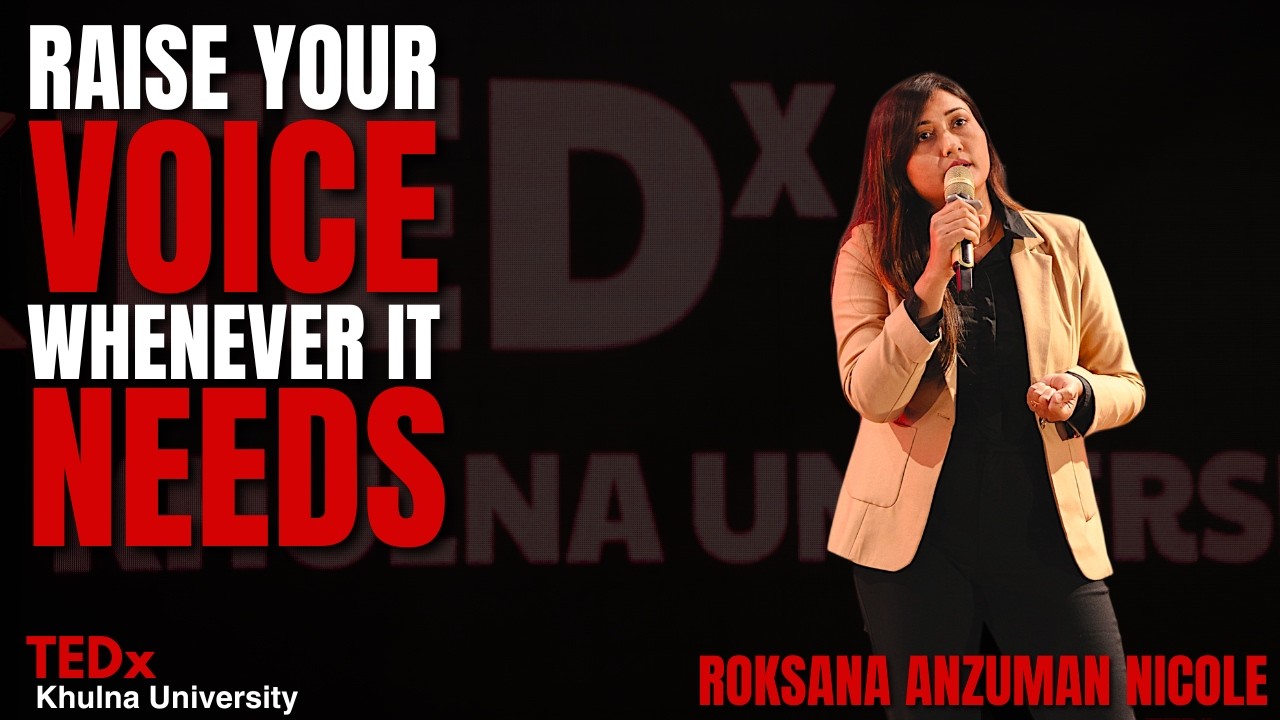
- Roksana Anzuman Nicole has been advocating for the importance of raising one's voice for over 40 years 0s.
- At the age of three or four, Nicole expressed a desire to study with a private tutor who was teaching two older girls living nearby 25s.
- Despite Nicole not yet being enrolled in school, her parents agreed to let her join the tutoring sessions 45s.
- By the age of four and a half, Nicole had acquired the ability to read and write in Bengali 1m5s.
- When Nicole’s mother attempted to enroll her in school at that age, the school refused admission due to her young age, which caused Nicole to cry because she wanted to attend 1m15s.
- At the age of five and a half, Nicole was invited to take an admission test for school 1m30s.
- During the admission test, Nicole demonstrated advanced skills by writing her name, her father's name, and her address, while other children her age were still learning basic letters like "ka" or "A, B, C" 1m35s.
- As a result of her performance, Nicole was admitted directly into the first grade, making her significantly younger than her classmates 1m55s.
Academic Challenges and Family Expectations
- Due to starting school at a young age, the narrator was consistently the youngest student in their class, which created difficulties in understanding conversations among older classmates 0s.
- The narrator remained the youngest student in their school until completing the eighth grade 22s.
- After changing schools, the narrator enrolled in a Cantonment Board school, an autonomous institution managed by the military that admitted a limited number of students from the general public 28s.
- The narrator’s parents generally prioritized their child's health, nutrition, and play over academic pressure or high achievement 42s.
- The narrator’s father once expressed that because the new school was prestigious and attended by the children of military officers, the narrator needed to maintain the family's reputation 55s.
- This comment from the father caused the narrator significant stress, marking what they considered the biggest challenge of their young life 1m8s.
- Prior to this experience, the narrator had never been concerned with academic rankings, typically holding a class rank around 13th, 19th, or 20th 1m15s.
- Feeling a sudden sense of responsibility, the narrator began studying intensely, despite previously struggling with basic arithmetic without a calculator 1m25s.
- To prepare for academic improvement, the narrator collected old textbooks and notebooks from relatives and neighbors to relearn foundational subjects, including the alphabet, and to improve their poor handwriting 1m35s.
Academic Improvement and Transition to Dhaka
- Early academic struggles included difficulty with handwriting and reading, which stemmed from being placed in the first grade at an age when one would typically be in nursery or playgroup 0s.
- A period of intense effort and starting studies from the beginning led to gradual academic improvement, moving from passing grades to better results in subsequent examinations 25s.
- By the time of the test examinations, the student achieved the second-highest rank among female students, which was considered a satisfactory accomplishment 42s.
- The results of the Secondary School Certificate (SSC) examination were considered good relative to personal ability, though they did not reach the level of achieving a top board ranking 55s.
- Despite the availability of reputable colleges in Gazipur, the decision was made to move to Dhaka for further education, consistent with a history of making independent life choices 1m12s.
- Due to the parents' limited financial capacity to afford private institutions, the decision was made to enroll in a government institution, specifically Begum Badrunnesa Government College, where tuition costs were minimal 1m35s.
- The move to Dhaka marked the beginning of living away from home, which involved residing in a private hostel 1m55s.
Living Independently and Academic Setbacks
- The transition to living away from home marked a significant life change, as the individual had previously never traveled even two kilometers to a local market alone while living in Gazipur 0s.
- After being dropped off at a hostel by a father, the individual began a long period of living independently, which eventually spanned 28 years away from the family home 15s.
- The struggle of living in Dhaka and navigating the environment there negatively impacted academic performance during the Higher Secondary Certificate (HSC) examinations 35s.
- The academic results were poor, barely reaching a first-class grade, and nearly falling into the second-class category 45s.
- While traveling on a bus with a father to discuss the poor results, the individual asked to buy peanuts, seemingly unaware of the gravity of the situation or the potential emotional impact on parents 55s.
- Although the father purchased the peanuts, he remained silent for the duration of the bus ride and subsequently did not speak to the individual for three months 1m10s.
- The father’s silence stemmed from the frustration of supporting the individual’s education in Dhaka despite financial hardships, especially after the individual insisted on staying in the city while other friends returned to Gazipur 1m20s.
- The three-month period of silence served as a significant turning point that influenced the individual's perspective and resolve to continue the journey in Dhaka 1m40s.
University Studies and Photography Pursuits
- The narrator decided to remain in Dhaka for higher education, specifically aiming to attend the best university in the city. 0s
- Although the narrator attended Dhaka University and studied physics, their personal preference was to study literature, a path that was not pursued due to parental expectations. 5s
- Despite being a physics student, the narrator remained involved in poetry organizations and photography throughout their academic career. 15s
- The narrator earned money as a student by taking photographs of women, which were subsequently used by those women to present themselves to potential suitors for marriage. 22s
- The narrator received significant media coverage in newspapers around 2000 and 2001 for their photography work, which was considered a major achievement at the time. 35s
- The narrator noted that physics students typically had little time for extracurricular activities due to the heavy demands of laboratory work and classes. 48s
- The narrator experienced fluctuations in their academic performance, often balancing studies with their photography pursuits. 55s
- Upon the announcement of a nationwide photography competition featuring prominent photographers, the narrator decided to participate. 1m2s
- To prepare for the competition, the narrator spent extensive time with visually impaired fellow students at their university hall, observing their daily lives, struggles, and study methods. 1m12s
- The narrator documented the lives of these visually impaired students to create a story for the photography competition. 1m25s
Career Shift to Journalism and Early Rejections
- Despite never achieving the top rank in school or other activities, the narrator eventually achieved the first position in a national-level competition in Bangladesh. 0s
- After this success, the narrator concluded that physics and science were not suitable career paths, despite previous efforts to succeed in those fields to satisfy parents. 7s
- The narrator eventually gravitated toward journalism after seeing a circular for new talent at various universities. 22s
- Before joining CSB News, the narrator participated in multiple interviews at various television channels and faced several rejections. 32s
- During an audition at Channel i, the narrator felt intimidated by the presence of interviewers like Shykh Seraj and Faridur Reza Sagar. 45s
- The narrator struggled with pronunciation errors during the Channel i interview, despite having better speaking skills at the time than they do currently. 52s
- Shykh Seraj told the narrator that while they might find success elsewhere, they would likely never work at an institution like Channel i and should pursue opportunities elsewhere. 1m2s
- The narrator experienced significant emotional distress following the feedback from Shykh Seraj, even though the comments may not have been intended to be hurtful. 1m12s
- In a turn of events described as a form of life's irony, Channel i was the very first television station to interview the narrator for a professional role. 1m22s
Professional Development in Television Media
- Channel i was the first television station to conduct an interview with the individual, which led to the start of their professional career. 0s
- Journalism was perceived as a highly challenging field, particularly because the individual lacked a formal academic background in the subject. 5s
- To compensate for a lack of formal training, the individual began studying journalism from the basics, treating the profession as a learning opportunity. 15s
- Although hired as a trainee reporter, the individual proactively sought to learn additional skills, including camera operation, video editing, and scriptwriting. 25s
- After completing an eight-hour shift, the individual would spend extra time in the international desk department, requesting opportunities to produce stories to gain more experience. 35s
- The individual intentionally worked across various wings of the media industry to acquire a comprehensive understanding of how different departments functioned. 45s
- Despite warnings from seniors that frequently changing jobs would hinder professional stability and learning, the individual continued to switch channels specifically to gain new knowledge. 55s
- The individual left ATN Bangla, which was the top-rated television channel in Bangladesh at the time, despite its high advertising revenue of 70,000 taka per minute. 1m5s
- The decision to leave ATN Bangla was driven by the realization that there was no further opportunity for professional growth or learning within that specific organization. 1m20s
- The individual continued to transition between various television channels in Bangladesh to pursue further learning and development. 1m30s
Career Reflection and Advocacy
- Professional experience includes various roles, both part-time and full-time, culminating in an 11-year tenure at Jamuna Television 0s.
- The decision to join television was driven by a desire to reach a position where the ability to make decisions is possible 12s.
- Career progression has been marked by both public praise, such as for emotional segments regarding Mugdho, and significant criticism, such as for comments regarding "Lungi Dance" 20s.
- Personal agency has been a consistent theme, as the individual has made deliberate decisions about their life path since early childhood, including the selection of teachers 35s.
- Parental wishes were respected, leading to the pursuit of a science education, but the individual eventually chose their own path upon realizing that the science track was not sustainable for them 45s.
- Raising one's voice is defined as the act of speaking out to label actions as either correct or incorrect, as silence prevents necessary societal change 1m5s.
- For the past nine years, the individual has driven their own vehicle in Dhaka and frequently intervenes when bus drivers obstruct traffic, directly confronting them to explain how their actions negatively impact others 1m20s.
- Although confronting traffic violators consumes significant time and energy, these actions are taken because addressing issues directly is essential for the country's progress 1m35s.
- The commitment to speaking out remains firm, regardless of whether the public responds with praise or criticism, because contributing to the advancement of Bangladesh and its people is a priority 1m50s.