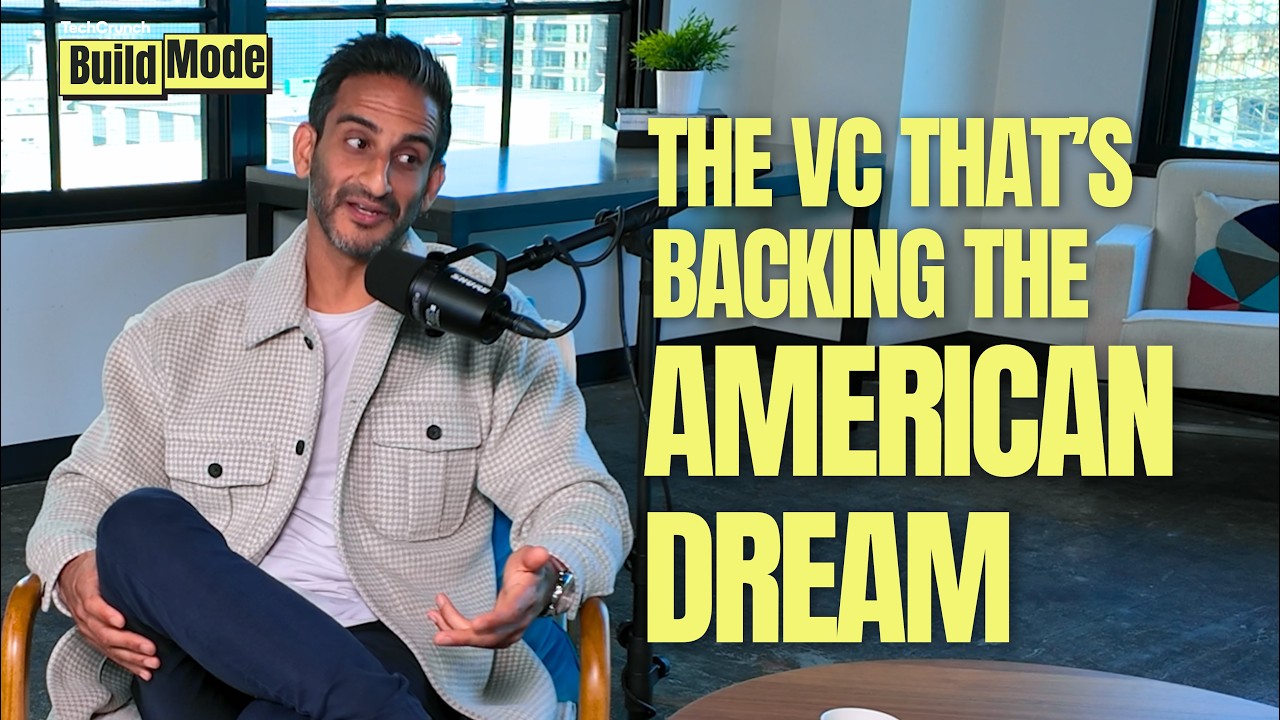


Founding Principles of Unshackled Ventures
- Wealth creation is often found by identifying and solving structural gaps, which provides an instructional advantage 0s.
- Entrepreneurs should be provided with capital that accelerates their growth rather than concessionary funding, as investors tend to be more engaged when their own money is at risk 0s.
- Manan Mehta, co-founder and managing partner of Unshackled Ventures, established his firm over a decade ago to address the systemic barriers faced by immigrant founders, such as visa restrictions, limited professional networks, and restricted access to early-stage capital 15s.
- Unshackled Ventures utilizes a unique investment model that supports immigrant entrepreneurs by backing them earlier than most traditional investors 15s.
Critique of Venture Capital Pattern Matching
- A core critique of the venture capital industry is that an over-reliance on pattern matching causes investors to overlook high-potential founders 15s.
- When evaluating founders before a product is built, resilience, purpose, and lived experience are prioritized over the quality of a pitch 15s.
Personal Background and Motivation of Manan Mehta
- Manan Mehta’s perspective on adversity was shaped by his upbringing in Silicon Valley during the 1980s and 1990s, where he frequently felt like an outsider due to his background 1m5s.
- Experiences such as facing racial stereotypes while playing baseball in high school and college contributed to the development of his personal resilience and competitive nature 1m5s.
- After working in investment banking and marketing, Manan Mehta attempted to launch a company with an immigrant co-founder who was on an H-1B visa 2m6s.
- During the fundraising process for that venture, potential investors expressed skepticism about the co-founder's visa status, often suggesting that the "best" immigrants would find a way to succeed regardless of structural obstacles 2m6s.
- This experience highlighted a pattern of bias among investors that prioritized judgment over curiosity, mirroring the exclusionary attitudes Manan Mehta encountered earlier in his life 2m6s.
Systemic Challenges in the Venture Capital Ecosystem
- Unshackled was established 11 years ago with the objective of identifying and backing eligible immigrant founders before other investors, acting as a signal for others to follow 0s.
- Many venture capitalists rely on pattern matching, which involves backing founders who resemble previous successful investments 25s.
- Relying on familiarity and past patterns in Silicon Valley acts as a "tax" that leads to higher entry points and valuations for startups 55s.
- Higher valuations require larger investments to maintain ownership, which consumes a greater percentage of a venture fund and increases investor fear of being wrong 1m5s.
- The consequence of prioritizing familiarity is a venture system that becomes overly safe, makes fewer bets, discovers less talent, and struggles to generate returns 1m20s.
- The current venture capital ecosystem is described as feeling broken and highly concentrated, making it difficult for new talent to break in 1m45s.
Barriers Faced by Immigrant Founders
- A significant challenge for immigrant founders in Silicon Valley is the lack of a "friends and family" round, as many local founders can typically raise $50,000 to $100,000 from their personal networks to start a company 2m5s.
- There are four primary challenges for immigrant founders attempting to enter Silicon Valley: the need for legal work authorization, the lack of friends and family capital, shallow professional networks, and an industry bias toward pattern recognition 2m30s.
- Immigrant founders face "unnatural challenges" compared to those born and raised in the United States, often forcing them to achieve more with fewer resources 3m0s.
- While the industry often celebrates the stories of immigrant founders who overcome these obstacles, the reality is that venture capitalists are ultimately paying a premium for their success 3m15s.
- Immigrant founders often lack access to friends and family funding, despite representing 15.4% of the population and demonstrating high productivity 0s.
Operational Infrastructure for Visa Sponsorship
- Unshackled Ventures aims to unlock talent by addressing four first-principle problems, allowing the firm to access and identify potential before others 23s.
- Many venture capitalists view visa status as a liability, whereas Unshackled Ventures treats it as a solvable infrastructure challenge 42s.
- The firm was established 11 years ago with the primary goal of unlocking talent, using venture capital as the business model to achieve that objective 1m15s.
- Alongside the venture fund, the firm created an R&D technology lab that serves as a legal structure to invest in projects and act as an employer 1m33s.
- If an entrepreneur requires visa sponsorship, the firm can deploy capital through the R&D lab's payroll to sponsor the visa 1m52s.
- Investments are structured using a standard YC post-money SAFE, and all intellectual property created by the entrepreneur is pre-assigned to their Delaware C-corp to avoid taxable events or liabilities 2m6s.
- The firm spent approximately 300 hours with attorneys to navigate the complexities of immigration, labor, securities, tax, and employment laws 2m28s.
- The specific infrastructure developed by Unshackled Ventures is unique to the United States, as the firm focuses on helping individuals who are already legally present in the country to remain and build 2m53s.
Navigating Immigration Policy and Success Stories
- While immigration policy uncertainty and visa backlogs exist, there remains a significant population of individuals who have passed through the U.S. education system and wish to stay 3m25s.
- The firm advocated for H-1B visa reform nine years ago, and recent changes under the current administration now allow H-1B visa holders to pursue entrepreneurship 3m52s.
- Maintaining a glass-half-full perspective and curiosity allows for the discovery of solutions to complex immigration challenges, rather than assuming current political climates or obstacles are insurmountable 0s.
- Unshackled has successfully completed 300 immigration filings across 13 different visa types with a 100% success rate spanning four different White House administrations 1m5s.
- The organization successfully secured an O-1 visa for a founder with DACA status after a four-month process, despite widespread skepticism from others who claimed it was impossible 1m20s.
- The success of the DACA case demonstrated that the U.S. government is willing to grant visas if a compelling case is made, provided that the process is not treated as a "factory mill" for petitions 1m55s.
Economic Impact and Talent Discovery
- While founders with a strong vision will pursue their goals elsewhere if they cannot build in the United States, the U.S. remains a uniquely powerful environment due to its talent density, customer market, and risk tolerance 2m25s.
- The primary mission of Unshackled is to ensure that immigration hurdles do not prevent founders from choosing the United States as the starting point for their companies 3m5s.
- Many major companies, including Google, Yahoo, eBay, Stripe, Tesla, and Nvidia, were co-founded by immigrants, highlighting the significant economic impact of immigrant-led ventures 3m25s.
- A lack of widespread support for immigrant founders in the venture capital industry is attributed to a perceived laziness among investors, as discovering new talent requires significant effort and expense 3m45s.
- Effective talent discovery requires active engagement within communities, such as visiting college campuses to provide personal guidance on starting companies while on a visa, which creates a level of trust that automated tools cannot replicate 4m5s.
Evolution and Validation of the Investment Model
- Venture capital funds should focus on maximizing the value of taking risks rather than attempting to minimize risk. 0s
- The venture capital industry has become increasingly concentrated, with general partners often backing individuals within their own social circles, which creates a barrier for entrepreneurs who do not fit established patterns. 25s
- Pattern recognition in venture capital has failed to produce exceptional results, as many of the most successful founders, such as Jensen Huang, the Collison brothers, and Elon Musk, did not fit existing patterns before they started their companies. 55s
- Unshackled Ventures was founded in 2015 with a debut fund of $4.5 million, exceeding its $3.5 million target, though only $2 million of that capital was ultimately invested. 1m45s
- The firm established an R&D technology lab structure to provide visa sponsorship, aiming to prove that individuals could successfully start companies while on a visa. 1m55s
- Building the necessary hybrid structure for the firm required two funds: the initial $4.5 million fund and a subsequent $20 million fund. 2m10s
- The first fund required 79 limited partners (LPs), and the second fund required 99 LPs, necessitating a significant number of conversations to secure backing. 2m20s
- Between 2015 and 2017, there was less societal and industry clarity regarding the economic potential of legal immigrants compared to the present day. 2m35s
- While many venture capital firms claim to support immigrant founders by pointing to companies like Google and Stripe, Unshackled Ventures argues that the industry is not yet fully maximizing the economic potential of legal immigrants. 2m50s
- Unshackled Ventures operates by widening the surface area for sourcing talent, effectively acting as a lead generation firm that sources and prices talent for other venture capital firms. 3m10s
- The firm faced initial skepticism from investors who feared that founders needing Unshackled's specific support might represent adverse selection. 3m30s
- The firm successfully validated its model by backing companies that have since received investment from firms like Blackstone and Fortress, with some companies going public. 3m45s
Practical Advice for Immigrant Entrepreneurs
- It is possible for individuals on an H-1B visa to start a company in the United States, though the process involves specific conditions and challenges 25s.
- Recent administrative changes allow H-1B visa holders to self-petition and act as their own employer, provided they can secure necessary capital 42s.
- A significant barrier for immigrant founders is the lack of access to "friends and family" funding, which creates a "chicken and the egg" problem when attempting to leave traditional employment 55s.
- Potential pathways for immigrant founders include obtaining an O-1 visa, seeking funding from firms like Unshackled, applying to Y Combinator, utilizing cap-exempt H-1B positions at universities, leveraging remaining STEM OPT, or temporarily moving abroad 1m5s.
- Immigrant founders are advised to focus on building their network, product, and company while managing their personal runway, despite the risk that current employers could terminate their employment if they discover the founder is working on outside projects 1m20s.
- Because funding is not guaranteed and immigration status is a significant factor, founders must approach their situation on a case-by-case basis 2m15s.
The Quotients Framework for Founder Evaluation
- When evaluating founders at "day zero"—often before a product or traction exists—investors look for a deep, personal relationship between the founder and the problem they are solving 2m45s.
- The evaluation process for early-stage founders involves assessing the founder's genuine conviction and truth regarding the problem, rather than relying solely on subjective feelings 3m15s.
- Declaring an investment decision unilaterally can stifle conversation and curiosity, leading to the development of a structured evaluation framework known as the quotients framework 0s.
- The quotients framework evaluates founders based on four specific metrics: IQ (intelligence and first-principles thinking), AQ (adversity quotient, representing resilience and tolerance), EQ (emotional quotient, covering self-awareness and growth mindset), and SQ (social quotient, measuring the ability and desire to navigate social environments) 15s.
- At Unshackled, team members score founders after a pitch based on their personal experience of the interaction rather than as a formal judgment of the founder 42s.
- The scoring process involves team members comparing their individual ratings and discussing the reasons behind them, which helps identify personal biases and facilitates a deeper understanding of the founder 55s.
- The primary goal of the post-pitch discussion is to determine if the team wants to learn more about the founder, utilizing a specific bank of questions related to the quotients 1m20s.
Analyzing Founder History and Potential
- Many founders struggle to explain their personal belief in themselves during pitches because they are overly focused on standard venture capital advice regarding the problem, solution, and team 1m30s.
- The quotient framework is used to remain present during the pitch, while archetypes are used to predict the future and the quotients are used to examine the founder's past 1m45s.
- By piecing together a founder's past, present, and future, investors can identify potential in individuals, such as young students, who might otherwise not share their personal history 1m55s.
- Asking specific questions about a founder's upbringing, such as their experiences leaving their hometown or early achievements, reveals how their life story informs their current behavior 2m10s.
- An investment is viewed as a representation of a life lived, and the firm prices in risks associated with the lack of business incorporation, product development, or customers 2m30s.
- A discovery engine requires the ability to learn unique information that only the founder possesses 2m45s.
- Investment decisions at the pre-seed, day-zero stage are based on the founder's truth rather than market size, as the latter is difficult to determine at that early phase 2m55s.
Refining Intuition and Investment Archetypes
- Investing in founders involves co-signing a future that is likely different from the one the founder currently envisions, with the investment decision based on the founder's grit and tolerance for adversity 0s.
- Intuition in investing is defined as the alignment of heart, mind, and gut, which can be refined through a thoughtful and discerning process rather than quick decision-making 35s.
- Utilizing Daniel Kahneman’s framework of system one and system two thinking allows for the combination of rapid pattern recognition with the deliberate, activated learning required for thorough investment analysis 42s.
- Communicating one's intuition to others is a necessary step to identify blind spots and refine the investment perspective 1m5s.
- A lack of social adeptness or emotional expression in technical founders does not negatively impact their standing in the investment ranking system 1m20s.
- Investment rankings are subjective, representing a specific experience of a founder at a particular moment in time rather than a standardized metric across companies 1m32s.
- Two primary archetypes for investment are technical visionaries, who often possess high IQ and AQ and have backgrounds in rigorous academic research, and systems disruptors, who excel in complex, regulated environments and often score higher on EQ and SQ 1m45s.
- Founders who receive investment are provided with feedback on how they were scored, which serves as a baseline for evaluating their growth during subsequent fundraising rounds 2m15s.
- It is not necessary for every founder to be proficient in all areas; instead, founders can hire personnel, such as a COO or chief of staff, to augment their existing skill sets 2m30s.
- The investment process avoids rigid playbooks, focusing instead on an authentic match between the investor and the founder 2m45s.
- Using a sounding board of other people to discuss individual experiences of a founder helps convert subjective intuition into a more data-driven evaluation 3m0s.
- There is a concern that the term "intuition" is sometimes used by venture capitalists to mask biases against immigrant founders 3m15s.
Managing Fear and Decision-Making in Investing
- Fear is a natural human experience that exists on a spectrum, ranging from existential threats to the lower-intensity fear of being wrong 0s.
- Fear serves as a boundary that helps individuals transition from their comfort zone into a learning zone while avoiding the danger zone 0s.
- Developing self-awareness regarding the subtle, low-level triggers of fear is considered a valuable skill 0s.
- Investors who are not afraid to ask difficult questions, such as those with backgrounds in journalism, have historically demonstrated strong track records 0s.
- When investors become overly attached to a specific conviction, they may stop asking critical questions, which can lead to poor decision-making 0s.
- Allowing the fear of negative feedback from Limited Partners (LPs) to influence investment decisions can lead investors toward familiar, low-risk "party round" investments that ultimately fail to generate returns 0s.
- While many investors claim to "bet on people," they often fail to understand the specific conditions required for those individuals to succeed or their own role within the broader ecosystem 0s.
Addressing Structural Gaps for Diverse Founders
- Structural gaps in the market affect various groups, including immigrant founders, Black founders from Atlanta, first-generation college graduates from rural areas, and women without traditional tech pedigrees 1m5s.
- The venture capital industry claims to value outliers, and structural gaps are often where these outliers operate and where significant wealth is created 1m5s.
- Identifying and solving for structural gaps provides a distinct structural advantage for investors 1m5s.
- Many successful companies are built by teams that combine the perspectives of immigrant founders with local partners who possess deep knowledge of specific markets like energy storage or logistics 1m5s.
- Addressing these market gaps requires a capitalistic mindset rather than a focus on handouts, as entrepreneurs are primarily motivated by the desire to change their personal circumstances and the world around them 1m5s.
- Previous diversity, equity, and inclusion strategies have sometimes lost sight of the fundamental entrepreneurial nature of these populations 1m5s.
Alternative Funding and Future Societal Shifts
- Founders should seek capital that provides meaningful acceleration rather than concessionary funding, as financial stakes increase the level of commitment and care from all parties involved. 0s
- Underrepresented founders who find the traditional venture capital ecosystem inaccessible should explore alternative funding sources, including community development financial institutions (CDFIs), philanthropic organizations, and grant programs. 15s
- Local municipalities and universities frequently host entrepreneurship competitions that serve as viable resources for getting new business ideas off the ground. 42s
- The rise of artificial intelligence is expected to shift societal focus back toward fundamental human creativity, encouraging individuals to identify and leverage their unique skills. 1m2s
- A cultural shift toward building, manufacturing, and scaling is anticipated over the next five to seven years, which will likely benefit society as a whole. 1m35s
- Entrepreneurship does not necessarily require building a billion-dollar company; creating positive impact within a local community is a significant and valid achievement. 1m48s
- Drawing from Eric Ries’s book "Uncorruptible," the concept of a for-profit entity can be redefined as the maximization of human flourishing, a model exemplified by successful organizations like Costco and Novo Nordisk. 2m3s
- Entrepreneurs who focus on maximizing human flourishing within their local communities are likely to gain recognition for their efforts. 2m25s
Finding Purpose and Authenticity in Entrepreneurship
- Founders often experience a sense of isolation when starting a company, regardless of their background or location. 2m55s
- Even individuals raised in successful immigrant communities in Silicon Valley may face challenges in securing backing, as demonstrated by the experience of starting Unshackled. 3m5s
- A critical factor for success is identifying one's personal "what," which involves finding a clear through line that transforms daily tasks into meaningful, purposeful work. 3m25s
- Entrepreneurial success is driven less by administrative tasks like email follow-ups and more by the ability to inspire others to join a mission, regardless of whether they ultimately participate 0s.
- Individuals who experienced challenging childhoods often reach a state of clarity faster because they are accustomed to relying on themselves and managing the consequences of their actions 0s.
- Life experiences from challenging backgrounds serve as a "superpower" for finding purpose, and founders should lean into these stories rather than framing them as requests for pity 0s.
- Sharing a personal story of purpose helps identify investors who are genuinely aligned with a founder's mission, which is more valuable than securing larger investments from misaligned sources 0s.
- Investors who are misaligned with a founder's vision can be detrimental, as they are likely to abandon the project when difficulties arise, creating unnecessary distractions 0s.
- Identifying a personal "why" early on increases the likelihood of attracting the right partners and supporters 0s.
- Founders should avoid trying to fit into a traditional venture capital mold and instead focus on creating their own path, category, and environment 30s.
- Because every individual is unique, founders should embrace their status as an "N of 1" rather than attempting to emulate others 30s.