
Introduction to Ants and Their Significance
- Ants are often viewed as pests, but they are actually the world's premier engineers and innovators of agriculture and warfare, with almost 20 quadrillion ants on earth, which is approximately 2.5 million ants for every person 10s.
- Ants first evolved from wasps during the Cretaceous period, around 141 million years ago, but it wasn't until the end of this period that they started to diversify and evolve rapidly, largely due to the emergence of flowers 2m6s.
- The evolution of flowers, which are part of the family angioperms, allowed ants to survive in new habitats and create mutualistic relationships with plants, such as through extrafloral nectaries, which attract ants with sugary secretions, and seed dispersal 2m6s.
- Leaf cutter ants are an example of the evolutionary marvels of ants, as they eat fungus, not leaves, and have developed a system of agriculture, with massive fungus gardens in their nests, which is a unique and complex relationship 4m30s.
The Life Cycle and Reproduction of Ants
- An ant colony functions around a queen, which is the center of everything, and starts with a fertilized egg that hatches into a larvae, is fed by workers, and eventually grows into a pupa, emerging as an adult ant, which can be a worker, queen, or male ant 6m10s.
- The queen ant is fed by workers to prepare her to start a new colony, and when conditions are right, she and male ants will fly in swarms, mate, and then the queens will start new colonies on their own, while the males die 8m20s.
Ecological Role and Impact of Ants
- Ants play a vital role in the environment, providing ecosystem services like soil aeration, competing with worms for the top spot, cycling nutrients, and playing a crucial role in food webs 10m30s.
- Ants are incredible carnivores that hunt small mammals and amphibians, and they are also prey items for thousands of species that are specialized in eating them 10s.
Evolution and Spread of Super Colonies
- The creation of super colonies, which are formed out of invasive species, has been significantly affected by human interference, and these super colonies are collections of nests that work together, sharing resources and queens 2m6s.
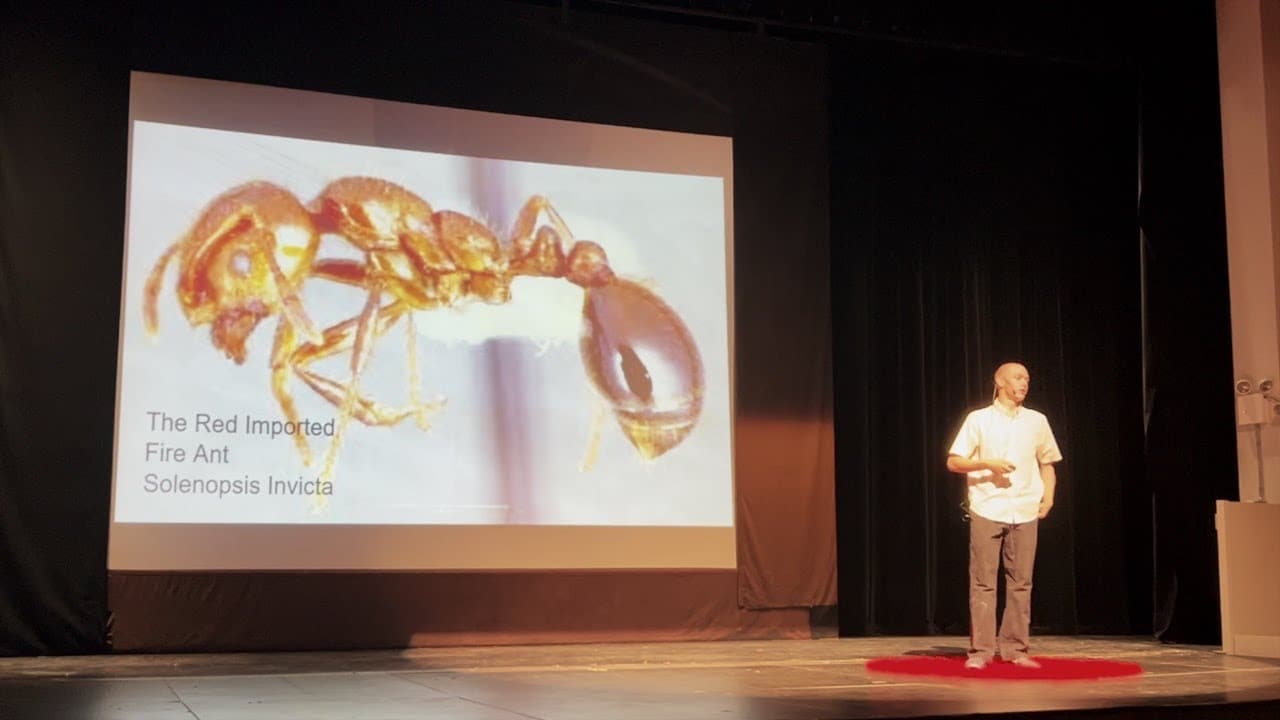
- Super colonies are formed when lone queens hitch a ride on boats and arrive in new locations with limited genetic diversity, causing them to cooperate with each other instead of fighting, as seen in the example of the red imported fire ant (Solenopsis invicta) 2m6s.
Case Study: The Red Imported Fire Ant
- The red imported fire ant is a nuisance that causes over $8 billion in damages annually in the United States, according to the United States Department of Agriculture, and has also impacted other areas such as electrical equipment and agriculture 4m42s.
Case Study: The Argentine Ant and Global Super Colonies
- Another example of a super colony is the Argentine ant (Iridomyrmex purpureus), which was first identified in 1913 and has since been found to form hundreds of super colonies across the world, including one in California that spans 600 miles and one in Europe that spans over 3,700 miles 5m15s.
Environmental Impact and Human Responsibility
- These super colonies have an incredible impact on the environment, as they can outcompete native species and have few natural predators, making them difficult to eradicate, as seen in the example of the solenopsis invicta, which originated in South America and has spread to the United States and Southeast Asia 6m30s.
- The impact of these invasive species on the environment is significant, and humans stand to learn from the cooperation of ants in super colonies, which can be an unstoppable force when they work together, and recognizing the role of humans in the expansion of these species is crucial to mitigating the loss of biodiversity 8m40s.