
AI Trust Perception
- AI itself does not have a trust problem; the issue lies with human users and how they relate to powerful tools, including AI, which both reflects and amplifies our inputs and behaviors 0s
Navigation Technology and Memory
- A 2020 Nature study tracking GPS users found that increased reliance on navigation technology correlated with reduced spatial memory and measurable shrinkage of the hippocampus, the brain region that atrophies first in Alzheimer’s disease 0s
Social Media Impact on Well‑Being
- A University of Pennsylvania experiment limiting young adults to 30 minutes of social‑media use per day resulted in participants reporting significantly lower loneliness and depression, suggesting that reduced exposure to algorithmic feeds can improve well‑being 0s
- Social‑media feeds are described as “feeding on us,” delivering quick dopamine hits that mimic connection without providing genuine social fulfillment 0s
AI Assistance and Brain Activity
- An MIT study titled “Your Brain on ChatGPT” compared brain activity of people writing essays with and without AI assistance, highlighting measurable neural differences when AI is used 0s
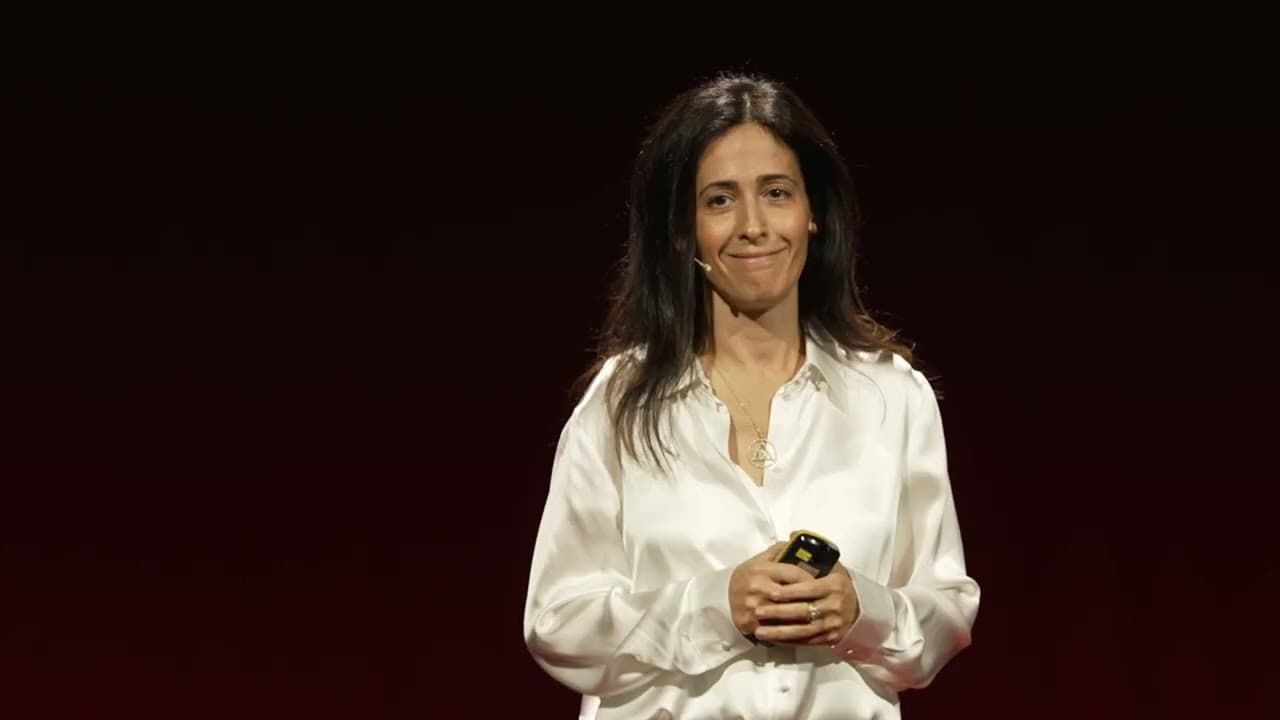
- The presenter confesses to using Claude, an AI tool, to help draft the talk; the AI’s output felt “very clever” but no longer sounded like the presenter, illustrating the tension between quick fixes and authentic personal effort 0s
Personal Integrity and Leadership
- Over 20 years of experience as a strategic advisor to world leaders and CEOs has shown that those who succeed and make lasting impact are willing to be courageous, honest, and true to themselves 0s
- In an AI‑driven world, the focus shifts from what we do to who we are being and why we act, emphasizing personal integrity over mere performance 0s
- Research spanning more than 40 years suggests that individuals who thrive are those who remain unconditionally true and faithful to themselves, yet many lack awareness of their own subconscious “algorithm” 0s
- A case study with a successful private‑equity CEO revealed that his relentless focus on output and winning caused emotional disconnection; when he allowed himself to feel, he realized the cost to his relationships and personal depth 0s
- The CEO feared that embracing feeling would diminish his competitive edge, but a death‑bed visualization exercise showed him a version of himself he despised, prompting him to confront the question “Who am I?” 0s
Outsourcing Thinking and Trust Shift
- Humanity has never before voluntarily outsourced thinking; we now rely on AI because it is easier, leading to an obsession with output and neglect of purpose, which contributes to a crisis of trust in AI 0s
- Trust in AI is low not because AI is inherently untrustworthy, but because humans project historical patterns of self‑interest onto it, seeing AI as a mirror that reflects our own flaws 0s
- The central question shifts from “What is AI doing to us?” to “What are we doing to AI?” and what kind of people we must become for AI to amplify humanity’s best qualities 0s
AHA Method for Agency
- Four practices, called the “aha method,” are proposed to regain agency over attention and interaction with algorithms:
- Implementing these steps encourages individuals to become sovereign, generous, and growth‑oriented, allowing AI to serve as a tool that amplifies humanity’s highest potential rather than a source of fear 0s
Human Wisdom vs Machine Speed
- The machines are becoming increasingly smarter and faster, prompting the question of whether humanity will become wiser in response 0s
- Humanity is described as magnificent, capable of remembering, trusting, and acting on that wisdom 0s