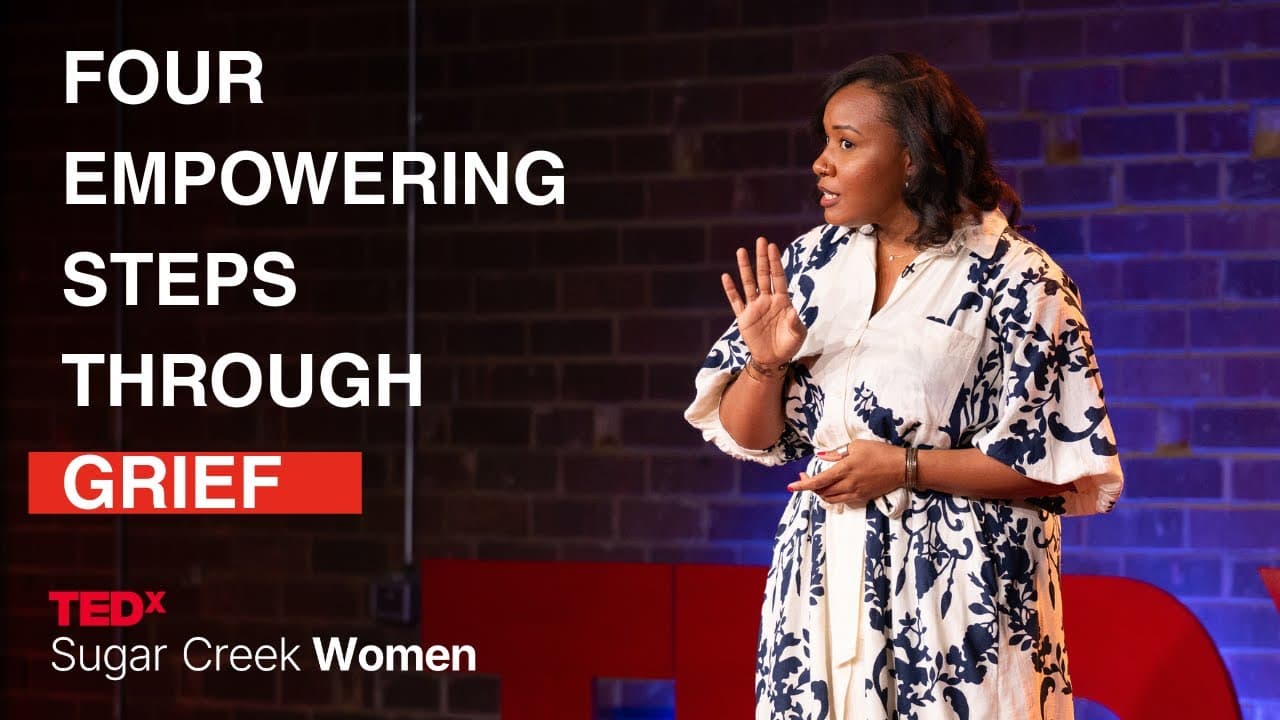

Understanding Death and Grief as Life Transitions
- The two biggest fears people have are public speaking and death, and having had near-death experiences has taught that dying is not just a physical event, but also a frequent and repetitive action that occurs with major life shifts, such as changes in careers, sense of self, beliefs, or relationships 10s.
- Dying has also taught that grief is involuntary and inextricably linked to it, and that unprocessed grief can have a significant impact on every experience and relationship, making it an essential part of one's story 2m6s.
- Grief stories are not just about the individual, but also about the people around them, and the problem is not the grief or dying itself, but rather the lack of tools, community support, and holistic methods to navigate it 4m42s.
- To reclaim these tools, it is necessary to reframe the way death and grief are viewed, stopping to see death as fixed and grief as performative, and instead honoring life transitions and grief stories as temporary, critical, powerful, and beautiful chapters in one's story 6m15s.
The Impact of Grief on Health and Healing
- Integration of experiences, rather than separation, is the key to healing, and this requires finding ease in daily life, which is a concept that modern science is starting to acknowledge through concepts like cortisol levels, nervous system regulation, and mental health 8m30s.
- The concept of time healing wounds is not accurate, and instead, more holistic approaches are needed to address grief and stress, which can have a profound impact on physiological health, as seen in the case of the speaker's mother who died of a broken heart 10m45s.
- The speaker's personal experience with accumulative grief, having lost their mother and faced numerous other challenges, has taught them the importance of integrating grief and finding ways to process and heal, rather than resorting to stoicism, busy work, denial, or doom scrolling 12m50s.
Reframing Grief as a Process, Not a Fixed State
- The speaker has found that writing and using their "pen" has been a helpful tool in processing grief, but also acknowledges the need for better language and concepts to describe death and grief, recognizing that death is a verb with beginnings and endings, rather than a fixed state 15m30s.
- Death can be viewed as a verb, representing the end of one phase of life and the beginning of another, such as the death of the maiden as she becomes a mother, or the death of one future for another when experiencing a significant life change 10s.
Creative Storytelling and Narrative Healing
- The concept of reverse engineering, often used in writing fiction, can be applied to grief, where one starts at the end of a story and works their way back to the beginning, crafting a meaningful and loving ending to the chapter of their story 2m6s.
- Crafting a magical and loving ending to a difficult chapter can serve as a guiding light through the maze of grief, providing courage and direction when navigating challenging emotions and situations 2m6s.
- Writing and rewriting one's story, including the editing process, is essential for healing and growth, allowing individuals to process their emotions and create a new narrative for their life 2m6s.
Personal Experiences with Grief and Storytelling
- A personal experience of receiving news of a cousin's passing and the subsequent struggle to cope with grief, including a moment of clarity when a child's concerns were acknowledged and addressed, highlighting the importance of facing and editing one's own story 4m30s.
- The realization that unaddressed grief and unedited stories can be passed down to future generations, and the importance of taking responsibility for one's own story and emotions to break this cycle 6m40s.
- The process of healing and editing one's story is not a solo endeavor, but can involve others, such as family members, and can lead to a new sense of purpose and direction, as exemplified by the launch of Rose and Honey, an herb shop 10m20s.
Publishing and Sharing the Grief Story
- The act of "hitting publish" on one's grief story, or sharing it with the world, can bring a new wave of grief, but also marks a significant step towards healing and living a new reality 12m30s.
- The experience of achieving success, such as having a name on a building for a written poem, can bring a sense of relief rather than happiness, and it's okay to feel that way because the more one publishes, the better they get, and the more they integrate their story, the stronger they become 10s.
Integration, Purpose, and the Collective Story
- Integrating one's story can bring peace, and it's essential to handle the pain within before being able to handle the pain outside, and everyone has a role to play in the collective story 42s.
- It's crucial to remember how far love has brought an individual and how far it's still guiding them to go, and they are needed to fulfill their purpose, so they should go live, find better words, craft magic, make edits, and publish their work, even if it's not perfect 2m6s.