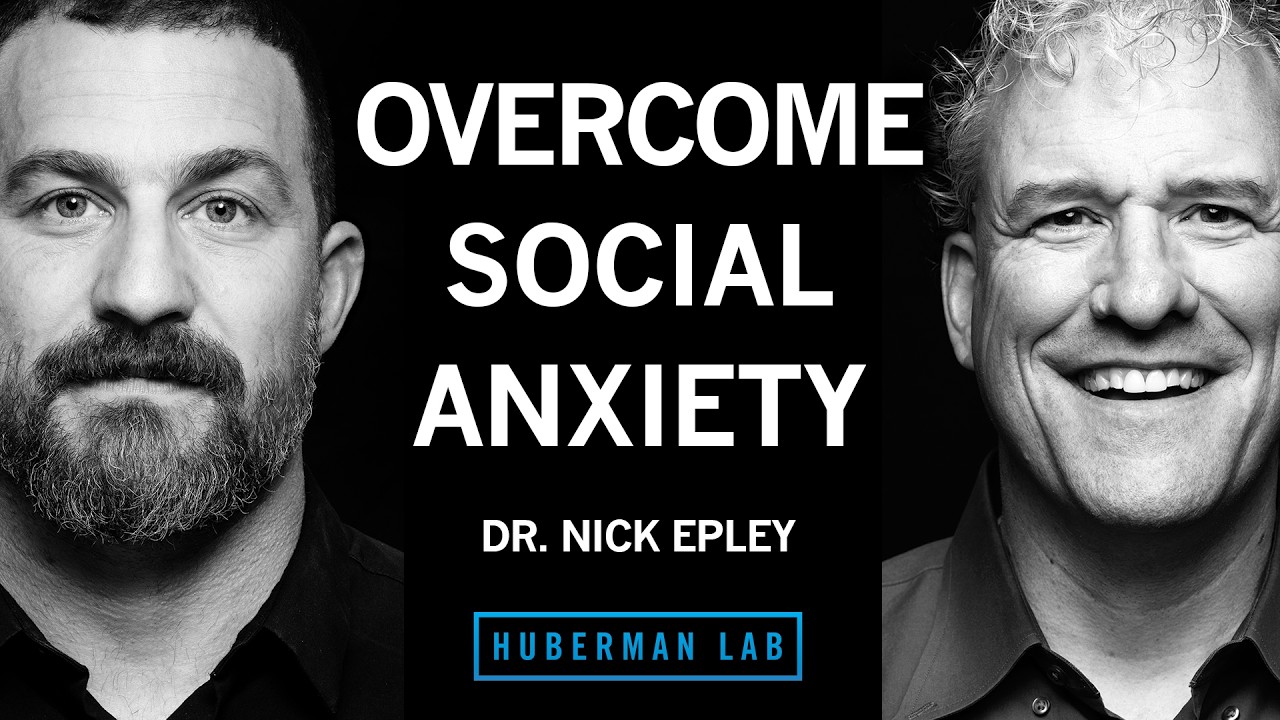


Strategies for Overcoming Social Anxiety
- Social anxiety can be helped by exposing people to the thing they are anxious about, and this exposure should be real, not simulated, as simulating it does not work because it is still pretending 10s.
- The strategy to overcome social anxiety involves sending people out into the world to do the thing they are afraid of, such as talking to strangers or asking for help, and this helps to change their beliefs about what other people are like 42s.
- Exposing people to their fears helps them learn that their fear is misplaced, and they get accepted more often than they might guess, which eases social anxiety and gets rid of it by changing their beliefs, not by dulling their anxiety 1m6s.
The Role of Social Interaction in Health and Well-being
- The conversation also touches on the importance of everyday conversations with people we don't know well and the positive impact it can have on mental and physical health, including taking opportunities to connect with people once or several times per day 2m6s.
- The discussion also explores the assumptions we make about other people, both in real life and online, and how those assumptions match up with reality, as well as the concept of anthropomorphism and how it applies to understanding other people 4m6s.
- Anthropomorphism is the process of trying to understand what's going on within another person, and it can both hurt and help us, as it is a way of attempting to understand other agents, but can also lead to misconceptions 6m6s.
- The importance of social connections is also highlighted, including the benefits of connecting with people in everyday life, and how this can have a positive impact on mental and physical health, as well as the role of social connections in informing research and personal growth 8m6s.
Anthropomorphism and Understanding Others
- Humans tend to attribute independent actions to the presence of a mind, thoughts, or beliefs, and this interpretation is used to understand the behavior of other people, animals, and even non-human entities, by inferring their thoughts or intentions 10s.
- This kind of anthropomorphism, or mind reading, is helpful in understanding why someone is doing something and in predicting their future actions, allowing people to navigate social situations more effectively 42s.
- When making assumptions about others, people consider their intentions, past choices, and behavior, and they use their own minds as a guide when thinking about strangers or people they don't know well 2m6s.
- As people learn more about someone, they can use that information, including stereotypes, to make inferences about the person's thoughts or beliefs, and once they can observe the person's behavior, that behavior becomes the dominant factor in understanding their intentions 2m6s.
- However, behavior can be tricky to interpret, as people may not always be aware of the intentions behind someone's actions, and different observations can lead to different inferences, such as watching two people kissing and making assumptions about their relationship 4m6s.
Cognitive Biases in Social Perception
- The use of stereotypes can be somewhat accurate, but not perfect, and people can make reasonable inferences about someone's thoughts or beliefs based on their group membership, such as their political affiliation or profession 3m6s.
- When observing human behavior, people tend to make inferences about what's going on behind the behavior, and this can be done through mechanisms such as egoentrism, stereotyping, and behaviorism, which provide some accuracy but also create errors 10s.
- Egoentrism creates egocentric biases, where individuals assume others think more like they do than they actually do, while stereotyping tends to exaggerate the differences between groups, and behaviorism leads to the correspondence bias, where people infer intentions or attitudes that correspond with the behavior they see 42s.
- The correspondence bias can sometimes get people into trouble when the relationship between intentions or thoughts and behavior is complicated, and it's often seen in situations where people leap to conclusions about someone's character based on a single action 2m6s.
The Significance of Nonverbal Cues in Social Understanding
- The visual system, particularly the eyes, provides a significant amount of information about a person's intentions and goals, and people tend to make assumptions about others' thoughts and behavior based on their gaze and eye movements 4m30s.
- The eyes are considered a window into the brain, and they can provide clues about what motivates a person's decisions, and this is also seen in non-human primates, where the visual system plays a crucial role in social interactions 6m10s.
- In addition to the eyes, the voice also contains a lot of valid information about a person's thoughts and intentions, and studying these cues can help improve judgments about other people's behavior 8m40s.
- Humans are considered the most socially sophisticated primate species, with a brain uniquely equipped for connecting with the minds of others, and this is reflected in their hypersensitivity to certain social cues, such as the eyes and voice 10m20s.
Human Social Intelligence and Comparative Cognition
- Research, such as the cultural intelligence hypothesis, has shown that humans have a unique ability to understand and interpret social cues, and this is evident even in young children, such as two-year-old toddlers, who are able to pick up on subtle social signals 12m30s.
- Researchers at the Max Blank Institute in Germany conducted a study involving over 100 chimpanzees and 36 orangutans, where the animals were given two types of IQ tests, one involving physical objects and the other involving social problems, to determine what makes humans unique 10s.
- The physical IQ test problems involved tasks such as tracking rewards under a shell game or using tools to solve problems, and the results showed that human toddlers, adult chimps, and orangutans performed equally well, indicating that reasoning about physical things in space is not what makes humans unique 1m42s.
- The social IQ tests, on the other hand, required reasoning about the mind of another person, involving tasks such as tracking eye movements to monitor what someone is thinking, and understanding somebody's intentions from their actions, and the results showed that 2-year-old toddlers outperformed the chimps and orangutans in these tests 2m6s.
- Humans are extremely sensitive to social cues, such as eye movements, which allows them to anticipate what another person is doing before they do it, and this ability is unique to humans, as demonstrated by the fact that humans can easily infer someone's thoughts and intentions, but chimps and orangutans cannot 3m10s.
- The study's findings highlight the importance of social intelligence in humans, and how it enables them to navigate complex social situations and understand other people's minds, which is a key aspect of human cognition and behavior 4m20s.
The Role of Voice in Social Communication
- The discussion also mentions Jane Goodall's observation of chimpanzees using twigs to get termites out of a termite mound, which challenged the idea that tool use was unique to humans, but the study's results suggest that social intelligence is a more distinctive feature of human cognition 1m15s.
- Wealthfront is a financial service that offers a 4.05% variable APY, and users can sign up at wealthfront.com/huberman to receive the boost offer and start earning today 10s.
- Eightle is a company that makes smart mattress covers with cooling, heating, and sleep tracking capacity, and the latest model, the Pod 5, has features such as autopilot, which is an AI engine that learns sleep patterns and adjusts the temperature of the sleeping environment 1m30s.
- The temperature of the sleeping environment is important for getting a great night's sleep, as the body temperature needs to drop by about 1 to 3° to fall asleep and increase by about 1 to 3° to wake up feeling refreshed and energized 1m45s.
- The voice contains a lot of information about a person's autonomic tone, stress levels, and relaxation, and it is closely connected to the mind, reflecting thoughts and emotions 5m20s.
- The voice conveys information such as intentionality, enthusiasm, and sadness, and it allows people to understand each other better, especially when compared to typing, as tone and sarcasm can be clearer when speaking 6m40s.
- Research has shown that people tend to be less sensitive to how their own communication is interpreted by others, partly due to ego centrism, and that the method of communication, whether typing or talking, can affect how well the message is understood 8m30s.
- The voice contains a lot of information that allows us to understand what somebody is saying better and conveys the presence of mind, including cues to thinking and emotion, which can be observed through the variability in the pace of the voice 10s.
- Research conducted with Juliana Schroeder on the eve of the 2016 election found that when people could hear a verbal pitch from someone voting for a different candidate, they rated the person as more thoughtful, intelligent, and rational, reducing the tendency to dehumanize the other side 2m6s.
- The voice, along with eye gaze, provides a lot of information about what's on somebody's mind and allows us to understand that the person has a mind, which is an important aspect of human interaction 10s.
- The content of people's words is informative, but the tone of their voice can also convey additional information, although it is not true that 80% of communication is through paralanguage, as some pop psychology claims 4m38s.
- Experiments have shown that people are not as sensitive to certain aspects of a person's voice, such as the pace and tone, which can provide cues to the presence of mind and thinking, and that the words themselves are also important in communication 6m14s.
- Research has also involved asking MBA students to give an elevator pitch for their desired job, which can be done with their voice, and analyzing the audio and visual cues to understand how people perceive the speaker's mind and capabilities 8m30s.
- Research has shown that people who hear a pitch are more likely to perceive the person as intelligent, rational, and hirable compared to those who only read the pitch, and this phenomenon has been observed in both MBA students and Fortune 500 recruiters 10s.
The Impact of Communication Medium on Perception
- When given the option to communicate in a way that makes them seem most intelligent, most people prefer to write, thinking that they can edit and refine their thoughts, but this approach misses the importance of paralinguistic cues and features conveyed through the sound of one's voice 42s.
- The sound of a person's voice can convey a lot of information, including the fact that they have a mind, and talented writers can sometimes replicate this effect in their writing, but most text lacks intonation, pitch, and other features that make human communication more engaging and believable 1m6s.
- The increasing use of AI and text-based communication may lead to a lack of understanding of the importance of voice and paralinguistic cues in human communication, but advancements in AI, such as video and audio capabilities, may help to address this issue 2m6s.
- Researchers, including Liz Dunn, a psychologist at the University of British Columbia, are exploring the potential of AI to help people practice conversations and connect with others, which could be particularly helpful for those who feel lonely or disconnected 3m30s.
The Influence of Voice and Paralinguistic Cues in Social Perception
- The use of AI to mimic human voice and conversation may increase trust and anthropomorphism, as people are more likely to trust and relate to a voice that sounds like a human, and this could have significant implications for social interactions and communication 4m40s.
- The importance of voice and style of speech in forming impressions of others has been observed in various contexts, including politics, where a person's ability to connect with others through their voice and language can be a significant factor in their popularity and perceived likability 6m10s.
- The amount of information available about public figures has increased significantly, allowing for more exposure to their voices, behaviors, and decision-making processes, but it is unclear whether this has improved or worsened the assessment of these individuals 10s.
Challenges in Evaluating Others and Social Perception
- Evaluating other people can be challenging due to their ambiguous nature, as the same statement or action can be perceived differently by various individuals, and this ambiguity is a key aspect of research in social psychology 2m6s.
- The field of social psychology originated in the early 1900s, emerging from biology, vision sciences, and basic sensory perception, but it has become apparent that human thinking and judgment are more complex and cannot be measured in the same way as physical sensations 2m6s.
- The concept of "my side bias" refers to the tendency for individuals with different beliefs, attitudes, or perspectives to interpret the same stimulus in vastly different ways, highlighting the subjective nature of perception and judgment 2m6s.
- Research has focused on the negative effects of undersocialization, but it is also important to explore the benefits of socialization, as actions to increase social interaction can be highly beneficial 2m6s.
The Benefits of Social Interaction and Socialization
- Various forms of social interaction, including texting, phone calls, and video chats, can be beneficial for individuals, and while in-person interaction is often considered the most effective, other forms of socialization can still have positive effects 2m6s.
- Studies have shown that even limited social interaction, such as texting with a friend, can be healthier than spending time alone, and that the biggest improvement in well-being comes from transitioning from no social contact to some form of social interaction 2m6s.
- Research by Danny Kahneman and Angus Deaton, Nobel Prize winners in economics, analyzed the Gallup daily well-being poll, which asks people about their feelings and experiences, including social interactions, and found that spending time alone versus with others has a significant impact on well-being, with social interactions having a positive effect 10s.
- The difference in well-being between spending time alone and with others is about seven times bigger than the difference between being relatively high or low on the income measure, which is approximately a $60,000 difference, indicating that social connections have a profound impact on well-being 2m6s.
The Evolutionary and Biological Basis of Human Sociality
- Different forms of media, such as texting, can be useful for maintaining existing relationships, but may not be effective for building new relationships, and it is essential to use these media in ways that complement in-person interactions 4m30s is not present in the text, so the most relevant timestamp is 10s.
- Humans are highly social creatures, and the ability to think about the minds of others is a sophisticated skill that reflects the importance of sociality, with the brain's structure, particularly the neocortex, being adapted for social interactions and theory of mind use 10s.
- The size of the neocortex relative to the rest of the brain is correlated with the social complexity of the group in primate species, and humans' large brain size reflects the complexity of living in large social groups, indicating that humans are built to be social 10s.
- Throughout most of human history, being alone and isolated has been a significant threat to survival, highlighting the essential role of social connections in human life 10s.
- Humans have a neural architecture that is designed to keep them connected with other people, and when they spend time alone, their brain screams at them to reach out and connect with others, which is why loneliness feels bad and the opposite of loneliness feels good 10s.
The Consequences of Social Isolation and Loneliness
- When people are lonely, they experience spikes in cortisol in their bloodstream, which can compromise their cardiovascular functioning and immune system, making them sick and shortening their life, whereas connecting with others feels good and is beneficial for their health 10s.
- Having conversations with strangers, even if they are brief, can create a strong bond and feel meaningful, as it is a natural human behavior to connect with others, and this is evident in the fact that living alone for most of human history was a bad thing 10s.
- Some people may enjoy spending time alone, but even they may experience negative effects of social isolation, such as distorted thoughts and a disconnection from reality, which can lead to questions about their own existence 2m6s.
- The idea that humans like to create action at a distance, such as controlling a remote control car, may be related to the need for social connection and the desire to have an impact on the world, and this need may be compromised when people spend too much time alone 2m6s.
- Social isolation can affect people's perception of themselves and their place in the world, leading to philosophical questions about their existence, and this can be mitigated by connecting with others and engaging in activities that create a sense of purpose and meaning 2m6s.
- Researchers like John Cacioppo, who was an expert on loneliness, have studied the effects of social isolation on human behavior and physiology, and their findings suggest that connecting with others is essential for human well-being 10s.
The Psychological and Philosophical Implications of Isolation
- The concept of isolation and being alone for extended periods of time can raise questions about one's existence and sense of self, with examples including Ted Kazinski and the movie "Into the Wild" 10s.
- The idea of being alone and having no one to reflect thoughts and emotions can lead to a loss of sense of self, similar to the concept of "if a tree falls in the woods and no one is there, did it make a sound" 2m6s.
- Research on prisoners in solitary confinement shows that isolation can have negative effects on mental health and sense of self, as people tend to lose their sense of identity when they are alone for long periods of time 4m30s.
- The "looking glass self" theory from sociologists in the early 1900s suggests that people understand themselves through interactions with others, and that sense of self-esteem is highly tied to how well one gets along with other people 6m20s.
- The sense of self-worth is believed to be a monitor for how well one is getting along with others, and when there is no one to interact with, people can lose their sense of who they are, as seen in cases of people who go into isolation in the woods 8m40s.
- Personal experiences, such as the story of a person who romanticized being a mountain man as a child, can illustrate the appeal of isolation, but also the potential negative consequences of actually living in isolation 10m50s.
The Role of Supplements in Health and Well-being
- A daily supplement called AG1 combines vitamins, minerals, prebiotics, probiotics, and adaptogens to support gut health, immune health, and overall energy by filling gaps in daily nutrition 10s.
- The supplement AG1 is recommended as it has been critical for supporting physical health, mental health, and performance by covering foundational nutritional bases, and people who take it regularly often report feeling better in various ways 42s.
- A special offer is available for AG1, including a week's supply of the sleep supplement AGZ and a free bottle of vitamin D3 K2 with subscription, which can be accessed at drinkagg.com/huberman 2m6s.
The Dual Nature of Social Media and Human Connection
- Social media has both healthy and unhealthy aspects, and it offers people an opportunity to connect with others and escape loneliness, with the potential for visible impact on others' thoughts and words providing a form of confirmation 4m6s.
- The desire for interaction and to have one's thoughts and feelings acknowledged is a fundamental human need, and creating incentives for positive interactions on social media platforms could help fulfill this need 6m9s.
- Conversations are often pleasant due to the back-and-forth responsiveness, which allows individuals to detect that the other person is paying attention and recognize that their thoughts are having a positive effect on the other person 8m10s.
- Psychologists consider responsiveness or being in synchrony with another person to be a key component of what makes conversation feel good, and this is evident in the way recording artists thrive on the energy of their audience, often touring despite the hassle and security issues, because they get to experience the apex of collective human action 10s.
The Evolutionary and Social Foundations of Human Cooperation
- Recording artists like Eddie Vedder love to perform live because they feed off the response of the people they sing to, and the audience attends concerts because they understand the reciprocity of the experience, feeling like they have an impact on what's happening on stage 1m42s.
- As humans, social connection is driven by a core wiring to cooperate and coordinate with others, particularly non-kin, which allows groups to outperform those that don't cooperate, and this is evident in the success of corporations that function effectively as a single unit 4m6s.
- Socialization in human primates is built on core components such as dialogue, vision, and sharing, but people don't receive much training in these skills, instead learning through experience and imitation, and this socialization is crucial for functioning well socially 5m30s.
- The ability to coordinate with others is essential for survival, existence, and passing along genes, and groups that can cooperate with each other are more likely to outperform those that can't, which is why social connection matters so much 7m10s.
- The evolution of social connection is driven by the need to cooperate and care for non-kin, which is what makes humans truly social, and this is evident in the success of corporations and other collective endeavors throughout history 9m30s.
The Nature of Human Bonds Beyond Kinship
- Social connection is believed to serve a coordination function, enabling people to work together and cooperate with one another, even if they are not genetically related, which is evident in everyday activities such as driving on the right side of the road and befriending people who are not relatives 10s.
- The concept of family is not limited to genetic offspring, as people can form strong bonds with adopted children, close friends, and community members, and this is exemplified by the experience of having adopted kids who become an integral part of the family 1m42s.
- The role that people play in their relationships is a crucial factor in driving behavior, and this is particularly significant in the context of adoption, where the decision to adopt can lead to a profound shift in perspective and emotions, as seen in the story of adopting children from Ethiopia 4m6s.
- The power of context and roles can lead to a deep sense of love and connection, even in the absence of a genetic link, and this is a unique aspect of human nature that sets people apart from other species, as they are capable of loving and caring for others beyond their kin 6m30s.
- The ability of humans to form strong bonds with others, regardless of genetic relationships, has significant implications for fields such as economics, where it challenges the traditional assumption that people are primarily self-interested, and instead suggests that people are often motivated by a desire to help and care for others, as evidenced by charitable giving 9m30s.
The Altruistic Nature of Humans and Its Implications
- Humans have a natural inclination to care for others, as evidenced by experiments where people are willing to give away money to strangers, with the standard prediction from economic theory being that people will act purely out of self-interest, but in reality, people often give away 30% to 50% of the money, depending on the context 10s.
- The moment a decision is made to adopt a child, the visual perception of that child changes, and it is as if two circuits in the brain merge, creating an instant and permanent connection, with no reconsideration or going back 2m6s.
- Humans have an underappreciated aspect of sociality, where they are capable of loving and caring for each other beyond what would be expected based on kinship relationships and biological offspring, due to their highly social nature and the need to cooperate with each other to succeed in life 2m6s.
Cultural Differences in Social Behavior and Interaction
- In some cultures, such as in South America, people tend to socialize with those they already know, and there is no expectation of meeting new people or exchanging numbers when going out to a club or bar, with friendships often being lifelong and not driven by a desire to meet strangers 4m42s.
- This cultural phenomenon may be related to how humans evolved in small villages of around 100 people, where everyone knew each other, and the concept of strangers was not as prevalent, with Bob Sapolski discussing this topic and the idea that humans have always had some level of anxiety about connecting with strangers 6m10s.
- Social anxiety can vary depending on the location and the level of sociability, but there is always some anxiety about the unknown or uncertainty, which can lead to a reluctance to connect with strangers 10s.
- This anxiety can be attributed to evolutionary heritage or unfamiliarity with new things, and people tend to prefer what is familiar because it is known and trusted, making everything else seem riskier by comparison 42s.
The Role of Manners and Etiquette in Social Interaction
- Manners, such as asking how someone's day is going or holding the door for people, are often seen as superficial, but they can be a way to establish a connection with others and can lead to deeper conversations 2m6s.
- The erosion of standard etiquette and manners in modern society has led to a decrease in opportunities for casual, low-level exchanges, making it more difficult for people to engage with each other and form deeper connections 4m30s.
- People's reluctance to engage with others in public spaces can be due to a desire not to interrupt or be impolite, which is related to manners, and technology can sometimes give signals that someone does not want to be bothered 6m20s.
- Cultural norms, such as the norm of politeness in the UK and Japan, can also influence people's behavior and make them less likely to initiate conversations with strangers 8m10s.
- The habit of saying hello or greeting people has diminished in part due to people being constantly connected to their phones, but it is still important to make an effort to engage with others and establish connections 10m0s.
Misconceptions About Social Interest and Fear of Rejection
- People may underestimate how interested others are in engaging with them, and this misconception can lead to missed opportunities for social connection, as individuals may assume that others do not want to talk to them, even when they actually do 10s.
- The fear of being seen as creepy or being rejected can prevent people from reaching out to others, and this fear is likely present on both sides, making it difficult for individuals to initiate conversations or ask someone out 42s.
- Research has shown that people are often overly pessimistic about how others will respond to them when they reach out in a positive way, and this pessimism can hold them back from forming connections with others 2m6s.
- Adopting a different way of thinking about social connection, such as viewing it as an opportunity or invitation to connect with someone, can help individuals overcome their fears and engage with others in a more meaningful way 2m6s.
The Value of Small Social Interactions in Well-being
- Even brief, fleeting connections with others can have a positive impact on well-being, and it's not necessary to create a lasting relationship in order to experience the benefits of social connection 10m0s.
- Well-being and happiness can be thought of as being similar to a leaky tire, where small, frequent connections and positive interactions can help to maintain and improve overall well-being, rather than just relying on intense, impactful moments 14m30s.
- Creating good moments and paying attention to them is crucial for well-being, as nothing lasts forever and moments come and go, allowing individuals to lift themselves and those around them up 10s.
- Focusing on happiness and connection in terms of moments rather than long-term impact helps individuals see opportunities to connect with others everywhere, such as on plane flights or in grocery stores 42s.
- Taking an interest in other people, noticing things that might have gone unnoticed before, and sharing kind thoughts can help create brighter moments and reduce anxiety 2m6s.
- Stringing together good moments can lead to good days, weeks, months, and ultimately, a good life, by using the skill of connecting with others instead of being held back by fear 2m6s.
The Role of Health Monitoring and Lab Testing
- Function, a sponsor, provides advanced lab tests and analyzes results to give individuals a clear snapshot of their bodily health, including heart health, hormone health, and nutrient levels, and offers recommendations for improvement from top doctors 6m28s.
- Comprehensive lab testing, like that offered by Function, is important for health and can help individuals identify and address potential issues, such as blood lipid levels, and make informed decisions about their health 6m28s.
- A Function membership is affordable, costing only $1 a day or $365 a year, and can provide significant value by helping individuals avoid health challenges and enhance their overall well-being 10m5s.
The Power of Brief Interactions in Human Connection
- The importance of small, fleeting interactions with strangers, such as a fist bump or a compliment, can have a significant impact on one's sense of connection to others and overall feeling of kinship, as exemplified by the experience of wearing a Minor Threat shirt and receiving a shoutout from a stranger 42s.
- These brief interactions can provide a sense of nourishment and connection to others, even if they are not deeply meaningful or substantial, and can be just as valuable as more significant interactions, as illustrated by the comparison of small talk to a cracker versus a more substantial meal 2m6s.
- The hypothesis that interacting with a stranger can change one's sense of connection to the entire group or humanity is discussed, and examples are given, such as delivering a compliment to someone and receiving a positive response, which can make one feel more connected to others and have a more favorable view of human nature 4m6s.
- The experience of sitting next to a young man on the train and striking up a conversation, despite initial impressions of him being disconnected, highlights the potential for meaningful connections with strangers and the importance of taking the initiative to interact with others 6m6s.
- The idea that these small interactions can have a profound impact on one's perception of humanity and sense of connection to others is emphasized, and the example of the woman with the red glasses who received a compliment and felt uplifted is given as a testament to the power of these interactions 5m6s.
- The discussion also touches on the idea that these interactions can be a source of comfort and reassurance, as exemplified by the experience of receiving a fist bump from someone and feeling a sense of kinship, and the importance of recognizing and appreciating these small moments of connection in daily life 1m6s.
The Impact of Public Interactions on Personal Perception
- A conversation with a young man named Gustavo, who was entering a trade program to become a chef, left a positive impression and felt uplifting, not just about Gustavo, but about the entire category of young people trying to make a better life for themselves 10s.
- The conversation highlighted the importance of manners and kindness in social interactions, and how these traits are often misunderstood as being fake, when in reality, they are a genuine part of the social fabric 2m6s.
- Being a public-facing person can lead to a loss of anonymity and genuine social interactions, which can be compensated for by other benefits, but can also lead to nostalgia for simpler, more authentic interactions 4m42s.
The Psychological Effects of Public Engagement and Social Exposure
- Engaging in brief, anonymous exchanges with others can reinforce a sense of shared humanity and affiliation, which can be a powerful and reinforcing experience, especially for people who are naturally affiliative 6m15s.
- However, not everyone is affiliative, and some people may not have an interest in interacting with others beyond their family or close social circle, and may not be unhappy or unfulfilled as a result 8m30s.
- Observations of people in public places, such as on a train, can sometimes suggest that nobody is interested in talking to each other, but this may not always be the case, and individuals may have different preferences and comfort levels when it comes to social interaction 10m50s.
The Correlation Between Extroversion and Well-being
- Research has shown that when people are asked to connect with others, it can have a positive effect on their well-being, regardless of their introversion or extroversion, and this is evident in studies that date back to 1980 10s.
- A common hypothesis is that extroverts get their energy and enjoyment from connecting with others, while introverts get their energy and enjoyment from keeping to themselves, but the data does not support this, and instead, extraversion is correlated with well-being and happiness, with a correlation of .5 between happiness and extraversion 42s.
- This correlation is significant and has been consistently found in studies around the world, with Ed Deer stating in 1996 that the foundational result in personality science is that extroversion is correlated with well-being or happiness 2m6s.
- Studies have also shown that when people are asked to act more extroverted, they report feeling more positive, and when they are asked to act more introverted, they feel less positive, regardless of their personality type, as found in a study by Will Fleeon 2m6s.
- Additionally, research by Sonia Luberki has found that when people connect with others over the course of a day, a week, or more, it can shift their positive affect meter up, and this is comparable to the benefits of exercise, which can improve well-being regardless of a person's habits or preferences 4m0s.
- The idea is that connecting with others can be thought of as a habit, similar to exercise, and that people can choose to develop this habit to improve their well-being, and this is supported by the fact that people who are more extroverted tend to be happier and have higher well-being 6m0s.
- Overall, the data suggests that people can benefit from opening themselves up to others and trying to connect in positive ways, regardless of their personality type or habits, and this can be a useful intervention for improving well-being 8m0s.
Strategies for Managing Social Anxiety and Building Confidence
- People who keep to themselves, like porcupines, are not necessarily living a happier life, and reaching out to engage with others can help improve their life, regardless of where they are on the social spectrum 10s.
- For individuals with social anxiety, having a dog can be a helpful way to meet new people, as it provides an excuse to start conversations, similar to how people used to ask for cigarettes in the past 2m6s.
- Tokens like dogs or cigarettes can help people work around their anxiety about connecting with others, but they are not necessary, and it's possible to overcome social anxiety without them 2m6s.
- Social anxiety is a common and painful experience that everyone faces to some extent, and it can be addressed with the help of psychologist clinicians, who can provide effective treatments like exposure therapy 4m6s.
- Exposure therapy, developed by Stefon Hoffman, involves sending people out into the world to confront their fears in real-life situations, rather than just simulating or imagining them, which has been shown to be an effective way to overcome social anxiety 6m6s.
- The strategy of exposure therapy is simple: if someone is afraid of talking to strangers, they should go out and start conversations, and if they're worried about getting rejected, they should ask people for help, which can help them learn that their fear is often misplaced 8m6s.
- Exposure therapy is an effective way to overcome social anxiety by changing one's beliefs about what other people are like, rather than simply reducing anxiety, as it allows individuals to learn that others are often nicer and more responsive than they expect 10s.
- This type of therapy works by repeatedly exposing individuals to social situations that they fear, which can help them realize that their fears are misplaced and that others are more likely to respond positively than they anticipate 42s.
- The story of Gia Giang, an aspiring entrepreneur who subjected himself to 100 days of exposure therapy by making outlandish requests to strangers, illustrates the effectiveness of this approach in changing one's beliefs and reducing fear of rejection 2m6s.
- Gia Giang's experience, which can be found on his website rejectiontherapy.com, shows that even when people are rejected, the rejection is often not as harsh as they expect, and that others may even go out of their way to help or accommodate them, as in the case of Jackie Braun at a Crispy Cream Doughnut store 4m6s.
- Over the course of his 100 days, Gia Giang made 106 requests and found that his anxiety and fear of rejection decreased as he learned to expect more positive responses from others, demonstrating the potential of exposure therapy to help individuals overcome social anxiety and develop more positive relationships with others 6m6s.
The Effectiveness of Exposure Therapy in Social Anxiety Treatment
- We Don Lions, a lab manager, conducted an experiment where he made unusual requests to people, such as asking to play soccer in someone's backyard or to give a security briefing on a plane, and found that he was accepted more often than rejected, with only about seven out of 100 requests receiving a negative response 10s.
- The experiment showed that people are more willing to agree to requests than expected, and that they often feel better when they agree to help someone, as helping others can make them happier, with research by Frank Flynn and Vanessa Bohns supporting this phenomenon, known as the underestimation of compliance effect 2m6s.
- We Don Lions' experience changed his perception of other people, making him realize that they are kinder than he expected, and that asking for help can be a powerful tool, as people are more interested in helping than one might imagine, with Lions considering this belief to be a kind of superpower 42s.
- The research literature, including studies by Frank Flynn at Stanford and Vanessa Bohns at Cornell, supports the idea that people tend to overestimate how many requests they need to make in order to get someone to agree to something, and that they underestimate how willing others are to comply with their requests 2m6s.
- We Don Lions was not very persistent in his requests, but would often accept alternative offers, such as when a manager at Costco offered to buy him lunch instead of letting him make an announcement over the intercom, showing that people are often willing to help in some way, even if they cannot fulfill the original request 10s.
- Social anxiety can be overcome by understanding that not everyone will reject or accept social interactions, and it's essential to respect people's boundaries, as seen in the example of a person who was able to address an entire plane flight after being unable to do the security briefing 10s.
The Importance of Social Skills and Boundary Awareness
- A neurologist named Ben Baris was an extremely friendly person who would often interact with people on campus, including janitors and administrators, and he believed in being kind and outgoing, which is an important aspect of overcoming social anxiety 2m6s.
- Some people may not know where the line is between a normal, healthy, casual social exchange and being too "sticky," which can lead to social anxiety, and this can be observed in people who take casual exchanges and make assumptions about being closer than they actually are 4m30s.
- The concept of being "sticky" refers to people who take casual social exchanges and make assumptions about being closer than they actually are, which can be uncomfortable for others and lead to social anxiety 5m20s.
- Understanding social cues, such as eye contact, is also important in overcoming social anxiety, as seen in the example of a roommate who would stare at people, making them uncomfortable, and highlighting the importance of respecting people's personal space 7m10s.
- Social anxiety can cause people to be concerned about being perceived as creepy or sticky, and this fear can prevent them from developing social skills, such as understanding when to stop staring at someone or how to initiate conversations without being overly aggressive 10s.
- Developing social skills is an art that requires practice and learning to understand boundaries, such as knowing when to keep a conversation going and when to stop, and being sensitive to other people's responses, like not texting someone a third time if they haven't responded 2m6s.
- It's essential to recognize that both men and women can be "sticky" in social situations, and it's not just a gender-specific issue, but rather a matter of being respectful of other people's boundaries and personal space 4m30s.
- Women, in particular, may be more nervous about men misinterpreting their actions or words, due to concerns about physical danger, and it's crucial to be sensitive to these concerns while also encouraging people to test their beliefs and not let fear hold them back from social interactions 6m40s.
Practical Steps for Developing Social Confidence
- Practicing social skills, such as conversation and public speaking, can help people become more confident and better at interacting with others, and it's essential to focus on taking an interest in other people rather than trying to make oneself feel good 8m50s.
- Learning to be sensitive to other people's responses and boundaries is a skill that can be developed over time with practice, and it's essential to recognize that not everyone will be a great conversational partner, but that's okay, and it's possible to move on from those interactions 10m50s.
- To overcome social anxiety, it is suggested to start small by picking easy and safe interactions, such as saying hello to someone in the office who is familiar but not well-known, and then gradually building up to more challenging interactions 10s.
- Developing social skills, including ending conversations with someone who is too talkative or knowing how to approach a group of people, can be achieved by practicing and taking small steps, rather than avoiding social interactions altogether 42s.
The Consequences of Avoiding Social Interaction
- Avoiding social interactions can lead to missing out on opportunities to meet new and wonderful people, such as Gustavo, the Uber driver, or Brian, a person met on a flight, and can also prevent others from feeling good about helping someone in need 2m6s.
The Role of Hydration and Electrolytes in Physical Performance
- Proper hydration and electrolyte balance are crucial for brain and body function, and drinking a product like Element can help ensure adequate hydration and electrolyte intake, especially during physical exercise or in hot weather 4m30s.
- Many people are often engaged with their phones, texting with people they already know, and this can create a barrier to breaking into conversations or interacting with new people, as it can be perceived as impolite to interrupt someone who is texting or on a call 6m40s.
- Breaking into a conversation can be challenging, especially when people are engaged with their phones, but it can be done by giving people an invitation to interact, such as saying hello or asking if you're interrupting something important 8m10s.
The Power of Initiating Social Interactions
- A person had an encounter with a man, Tibo, who looked like an Orthodox monk, on a train, and despite initial impressions that Tibo did not want to talk, saying "Hi, I'm Nick" led to a friendly conversation and a long-term friendship 10s.
- The encounter highlights that social cues can be ambiguous, and the only way to know what they mean is to test them, which can lead to new connections and friendships 42s.
- Reaching out to connect with others can be thought of as an invitation, rather than a demand, and it's possible to make mistakes, but it's also possible to discover new relationships and experiences 2m6s.
- People often infer that others do not want to talk to them, but this can be a mistaken assumption, and testing these beliefs can lead to new opportunities for connection and social interaction 4m6s.
The Social Benefits of Community and Shared Activities
- Many people are attending social gatherings, such as church or festivals, where they can meet others with similar values and interests, and these events often have a friendly and inviting atmosphere 6m30s.
- It's possible to meet new people and make connections in various settings, such as festivals, conferences, or other social events, and being open to these opportunities can enrich one's life 8m10s.
- People crave interactions with strangers, which can be seen in common gatherings such as churches, sauna gatherings, and other venues where individuals come together for their own reasons but also to interact with others, including strangers 10s.
The Impact of the Pandemic on Social Behavior
- The pandemic has led to people spending more time indoors and on their devices, resulting in a greater desire for human interaction, with many seeking out opportunities to connect with others in person 1m42s.
The Positive Influence of Children with Down Syndrome on Social Dynamics
- The importance of human connection is highlighted by the example of individuals with Down syndrome, who often have less social anxiety and are more outgoing, allowing them to form meaningful relationships and bring joy to those around them 4m6s.
- The story of Lindsay, a child with Down syndrome who was adopted from China, illustrates the value of being open to new experiences and connections, and how this can lead to a more positive and fulfilling life 6m6s.
- Research has shown that people tend to be overly pessimistic about how others will respond to them when they reach out to connect, but by being more open and willing to take risks, individuals can form meaningful relationships and have a more positive experience of life 8m6s.
- The experience of expecting a child with Down syndrome and then losing that child, Sophie, led to a greater appreciation for the value of human connection and the importance of being open to new experiences and relationships 10m6s.
- The experience of losing a child, specifically a stillbirth on July 11th, 2016, was extremely difficult and led to a period of mourning that lasted about a year 10s.
- After this loss, the consideration of adopting another child arose, and the wife suggested adopting a child with Down syndrome, which had not been previously considered 2m6s.
- The decision to adopt a child with Down syndrome was influenced by data from research on people reaching out to others and the positive responses they received, giving courage to make this choice 2m6s.
- The family, with resources and a strong marriage, felt they could handle the challenges of raising a child with an intellectual disability, and the data suggested it would be a surprisingly good experience 4m30s.
- A year after the decision, the family adopted a two-year-old girl named Lindsay from China, who had been abandoned and had a difficult start in life, but brought immense joy and positivity to their lives 6m30s.
- Raising Lindsay, who has an intellectual disability, has been challenging, but she has also been a blessing, living without social anxiety and spreading joy to those around her with her open and friendly nature 8m40s.
- The experience of adopting and raising Lindsay has shown that reaching out to love and bring someone into their lives has been incredibly rewarding, and it is a choice that they are grateful to have made 10m50s.
The Challenges and Rewards of Raising a Child with Down Syndrome
- The youngest daughter, Lindsay, has a special role in the family as the "magnet" that everyone is drawn to, and she has a strong connection with her siblings, who all love her and receive a warm welcome from her when they come home 10s.
- Children with Down syndrome can be adopted, and in the United States, there is often a waiting list for these children, indicating that many families are willing to provide a loving home for them 2m6s.
- Genetic testing can identify genetic differences, including Down syndrome, and some families may choose to end a pregnancy due to concerns about their ability to handle the challenges, but many families find that having a child with Down syndrome is a blessing 2m6s.
- Despite the challenges, children with Down syndrome can be amazing, and their intellectual disability can become a background aspect of their personality, allowing their individuality and strengths to shine through 2m6s.
- Lindsay, for example, has a huge personality, loves playing with dolls and Disney characters, listening to stories, reading books, and playing with her friends, and it is her personality that defines her, not her diagnosis 2m6s.
- The lack of shame and openness about Lindsay's Down syndrome is a positive force in her life, and it is likely that this attitude has a significant impact on her well-being and happiness 4m30s.
- A famous neuroscientist had a son with epileptic seizures, but the neuroscientist was ashamed of his son and wouldn't bring him to events, which is an example of how shame can impact the way a child is treated and perceived by others 10s.
- In contrast, Lindsay's parents do not exhibit any shame about her condition, and instead, they show pride and acceptance, which is a testament to their character and what is possible when people focus on their relationships rather than what others think 2m6s.
- The importance of accepting and loving children for who they are, without trying to change them or force them into certain paths, is highlighted by the story of another son who was struggling in college but found happiness in a trade school, and this acceptance requires practice, careful thought, and attention 42s.
- Every parent struggles with loving their kids for who they are, and it takes deliberate effort and challenge to oneself to do so, but it makes a significant difference for the children, as seen in the example of Lindsay, who is described as a "ray of sunshine" and a "unicorn" 2m6s.
The Importance of Acceptance and Support in Raising Children
- The story of the son who switched to a trade school and found happiness illustrates the importance of letting go of expectations and allowing children to follow their own paths, and this can lead to increased pride and joy for both the parents and the child 42s.
- The concept of a blessing is discussed, and it is mentioned that a person can be a blessing to others, bringing lessons and things to think about in terms of relationships and personal growth 10s.
- The topic of relationships with people who are not typical of the average population is explored, using the example of children with intellectual or atypical behavior, and how their behavior can sometimes be disruptive and cause feelings of shame for their parents 42s.
- The challenge of knowing how to react to people with atypical behavior is discussed, and it is suggested that patience is a good approach, similar to how one would interact with someone who has a stutter, by waiting patiently and not calling attention to their behavior 2m6s.
- The importance of not isolating people with atypical behavior is emphasized, and it is noted that asking directly how to help or respond can be a good way to show support and understanding 2m6s.
- The idea that fulfillment can come from various paths in life is discussed, and the example of a son who is happy working in trades is mentioned, highlighting that happiness and fulfillment can be found in many different careers and activities 4m30s.
The Value of Diverse Career Paths and Personal Fulfillment
- The value of serving others and finding happiness in non-traditional careers is also discussed, with the example of considering a career in the fire service being mentioned as a potentially fulfilling path 6m10s.
- Fulfillment can be found in various ways, and it is about engagement, as seen in professions like firefighters or police officers, where people can find purpose and meaning in their work 10s.
- Parents can play a significant role in helping their children find their path and feel good about it, by loving them for who they are and encouraging them to pursue their passions, whether it's being a carpenter or getting a PhD 2m6s.
- Spending time outdoors can be a great way to connect with nature and with people, as it often involves social interactions, such as hunting or fishing with others, and can provide a sense of community and fulfillment 4m37s.
The Social and Emotional Benefits of Outdoor Activities
- Engaging in outdoor activities, such as conservation work, can also be a way to care for the environment and connect with others who share similar interests, as exemplified by the person's experience of removing invasive species and planting trees on their 40-acre property 6m42s.
- The importance of social connections and community is highlighted through the person's childhood experiences of hunting and fishing with their dad and friends, which created lasting memories and a strong appreciation for the outdoors 5m15s.
- It's essential to recognize that any path in life is okay, and parents should encourage their children to explore their interests and find what makes them happy, rather than pushing them to follow a specific expectation or traditional path 3m21s.
- The importance of social elements is highlighted through personal experiences, such as fishing and hunting with family and friends, which demonstrates that social interactions are a crucial aspect of these activities 10s.
The Role of Hunting in Social and Environmental Connection
- A personal story is shared about an elk hunting trip with Ben, the oldest son, in Oregon, where they spent a week together in the remote wilderness, showcasing the value of spending quality time with loved ones 42s.
- During the elk hunting trip, Ben and his father encountered a group of hunters, led by Dennis, who had been hunting in the area for decades, and initially, Ben felt anxious about interacting with them, but his father encouraged him to stay and talk 2m6s.
- The group of hunters, which included Corey and Eric, turned out to be friendly and helpful, sharing their knowledge and experience with Ben and his father, and even inviting them to their tent for dinner, where they were treated to a warm and welcoming atmosphere 2m6s.
- The encounter with the group of hunters transformed the trip into a more enjoyable and memorable experience, demonstrating the benefits of reaching out and connecting with others, and even led to a lasting connection, as evidenced by Corey's recent text message about applying for elk tags 2m6s.
- A hunting experience is described where the individuals involved showed courage and connected with each other, leading to a positive social interaction and a lasting connection, which is an example of how easy it is to underestimate how positively other people respond when you reach out to them 10s.
- The description of hunters in this experience challenges the common stereotype of hunters, as they are shown to be caring and respectful of the outdoors, with a focus on preserving wildlands and protecting the environment, such as harvesting deer to prevent ecological damage 2m6s.
- The importance of responsible and respectful hunting is emphasized, with the use of a crossbow as an example of a humane and accurate way to hunt, and the idea that getting an animal is not the main goal, but rather a part of the overall experience of being outdoors and connecting with nature 4m30s.
- The experience of hunting is also described as a way to teach valuable lessons, such as the importance of caring for the outdoors and being respectful of the environment, and the value of spending time with others and forming connections 6m20s.
The Importance of Modeling Positive Social Behavior
- A personal anecdote is shared about a childhood experience of visiting a lab with a parent, where the parent realized that showing equations on a whiteboard would not be engaging, and instead found a more interactive and fun way to spend time together, such as dipping bananas into liquid nitrogen 10m30s.
- The conversation touches on the idea that people often have misconceptions about hunters and the hunting community, and that there are many examples of hunters who are passionate about preserving the environment and protecting wildlands, such as Cam Haynes, who is a serious bow hunter and advocate for preserving wildlands 8m0s.
- Social dynamics and learning occur in species through interactions between older and younger generations, where the older members teach the younger ones how to socialize, as observed in humans, chimps, and other animals 10s.
- The process of socialization is intense and can involve ostracization, but it also has its beauty, and understanding this can help individuals raise their children and interact with others more effectively 2m6s.
- Training animals, such as dogs, also relies on socialization, where older dogs can teach younger ones how to behave, and this principle applies to humans as well, where older generations can model good social interactions for younger ones 4m30s.
- Modeling good social interactions is critical, especially for parents, siblings, and older individuals, as it helps younger people learn how to navigate social situations and overcome anxiety 6m40s.
- To model good social interactions, individuals should pay attention to their habits, recognize their flaws, and actively work to create positive habits, such as taking a step back when feeling frustrated, rather than reacting impulsively 10m30s.
- Creating good socialization habits is essential, especially for those who may not have positive role models in their lives, such as children of single parents or those who have experienced negative interactions with their parents 12m10s.
- By being mindful of their actions and habits, individuals can help model positive social interactions and contribute to a more supportive and understanding environment for everyone 14m20s.
The Influence of Daily Habits on Social Interaction
- People tend to notice small details about others, and developing habits to behave differently in these moments can make a significant impact on how others perceive them 10s.
- Creating a routine habit, such as greeting people with a smile and a hello, can help to brighten one's mood and create a positive atmosphere, as seen in the example of making a "happiness walk" from the office door to the office 42s.
- Cultivating habits to do small things routinely, such as greeting colleagues like Nigel, Keith, Mario, Zia, Eric, Virginia, Jane, Emma, and Joe, can become a part of who you are and influence how others see you 2m6s.
- As a parent, it is essential to think about how to cultivate habits to do positive things routinely, as children are always watching and learning from their parents' behavior 2m6s.
- Developing habits to avoid negative behavior, such as swearing, can help to create a positive image and set a good example for others, as seen in the example of a colleague who made a habit of never swearing in class or anywhere else 4m10s.
- Applying the concept of "classroom rules" to social media interactions can help to maintain a tone of education and respect, by avoiding exchanges that would not be allowed in a classroom and blocking comments that attack others 6m20s.
- The key to creating positive habits is to focus on small things that can be done routinely and over again, rather than trying to make significant changes all at once 8m30s.
The Role of Small Social Choices in Happiness and Health
- The importance of small habits and creating a safe environment for people to interact is emphasized, allowing individuals to feel comfortable and express themselves without fear of negativity, which is a key aspect of overcoming social anxiety 10s.
- Dr. Nick Epley's work focuses on the idea that there is goodness and untapped beauty to be found in spaces that people may not typically engage with, and he applies this concept to his own life, making him a shining example of his research 42s.
- Dr. Nick Epley has written a book titled "A Little More Social: How Small Choices Create Unexpected Happiness, Health, and Connection", which explores the benefits of making small social choices and is set to be released soon 2m6s.
- The discussion highlights the value of Dr. Nick Epley's work and how it has informed his life, making him an extreme example of someone whose research has had a significant impact on his personal experiences and choices 2m6s.
Promotion of the Host's Book and Podcast
- The conversation also mentions the host's upcoming book, "Protocols: An Operating Manual for the Human Body", which covers protocols for various aspects of human health and wellness, including sleep, exercise, and stress control, and is available for pre-sale at protocolsbook.com 4m30s.
- The host encourages listeners to subscribe to the YouTube channel, follow the podcast on Spotify and Apple, and leave comments or reviews to support the show, and also invites them to follow him on social media platforms where he discusses science and related topics 6m0s.
- The Neural Network newsletter is a zero-cost monthly newsletter that includes podcast summaries and protocols in the form of one to three-page PDFs, covering various topics such as optimizing sleep and dopamine, deliberate cold exposure, and fitness training 0s.
- The newsletter provides access to a range of protocols, including a foundational fitness protocol that covers cardiovascular training and resistance training, all of which are available at no cost 10s.
- To subscribe to the Neural Network newsletter, individuals can visit hubermanlab.com, navigate to the menu tab in the top right corner, scroll down to the newsletter option, and enter their email address, with the assurance that their email will not be shared with anyone 42s.
- The discussion with Dr. Nick Epley has come to a close, and appreciation is expressed for the interest in science and for joining the conversation 2m6s.