

Changes in Tennis Gameplay and Equipment
- The game of tennis has undergone significant changes over the last 10 to 15 years, particularly in terms of serving, with players now mixing up their second serves substantially more than they used to, likely due to the type of balls used, which bounce lower and are more pressurized 10s.
- The use of newer, softer balls has made the game slower, as they do not bounce as high as older balls, making it easier for players to control but also resulting in slower gameplay, despite court speeds remaining unchanged 10s.
Physical and Psychological Aspects of Tennis
- Grunting while playing tennis may not directly improve a player's hitting, but it can help them get into a rhythm and exhale, which can be beneficial for some players 42s.
- To improve serving, it is essential to have good balance, keep weight back, and move slowly until the moment of hitting, similar to an archer pulling a bow back, and then releasing quickly 2m6s.
Rivalries and Momentum in Tennis Matches
- The most competitive rivalry in tennis history is debated, with some arguing it is between Nadal and Djokovic, while others believe it is between Nadal and Federer, with momentum shifts in matches often being influenced by confidence and players' ability to adapt 2m6s.
- Momentum shifts in tennis matches can be attributed to confidence, with players who are feeling confident often playing more aggressively and taking risks, while those who are struggling may hold back and become less aggressive 2m6s.
Left-Handed Advantage and Tactical Challenges
- Left-handed players may have an advantage in tennis due to the fact that most players are right-handed, resulting in lefties being less practiced against, and therefore having an edge in terms of rhythm and feel 2m6s.
- When facing an opponent who constantly lobs, it can be annoying and challenging, but a strategy to counter this is not specified in the discussion 2m6s.
Strategies for Countering Lobs and Improving Forehands
- When dealing with an opponent's lob, it is essential to develop a high flat forehand and take the ball on the rise to prevent them from continuing to lob, and this can be achieved by stepping up and hitting the ball as it's coming up 10s.
Injuries and Physical Conditions in Tennis
- Tennis elbow is not exclusively caused by playing tennis, and people can get it from other activities like golfing, and it is crucial to understand the difference between tennis elbow and other similar conditions like fiddler's elbow 2m6s.
Shot Technique and Tactical Decision-Making
- Having more spin on a tennis shot is not always better, as it depends on the situation and the type of ball being used, and players need to know when to lift and spin the ball and when to drive it flat and through the court 2m6s.
Behavior and Etiquette in Tennis
- Arguing with an umpire over a decision is unlikely to yield positive results, but it can help players release their anger and frustration, although it may look stupid if the player is completely wrong 4m0s.
Reading Opponents and Match Strategy
- To read an opponent's serve and receive it effectively, pattern recognition is key, as players tend to favor certain serve spots and returners can make an educated guess by analyzing these patterns 5m0s.
- When down 0-3 or 0-4 in a set, the strategy differs, and being down 0-4 is a more significant deficit, and in such cases, it might be better to focus on winning some games and trying to lose the set 6-0, as this can mentally affect the opponent 6m0s.
Improving Technique and Regaining Rhythm
- To improve a forehand shot, it is essential to avoid tinkering with it too much, as this can lead to losing the feel of what made it effective in the first place, and instead, players should focus on making their unique shot style work for them 8m0s.
- To regain a lost rhythm in tennis, it is helpful to watch old videos, break down techniques, and practice repetition, as the smallest details can make a significant difference in performance 10s.
Equipment Choices and Performance
- Tennis players choose the tennis balls they will serve with based on the amount of wear, opting for the newest ball with the least use, as newer balls move faster through the air and off the bounce 2m6s.
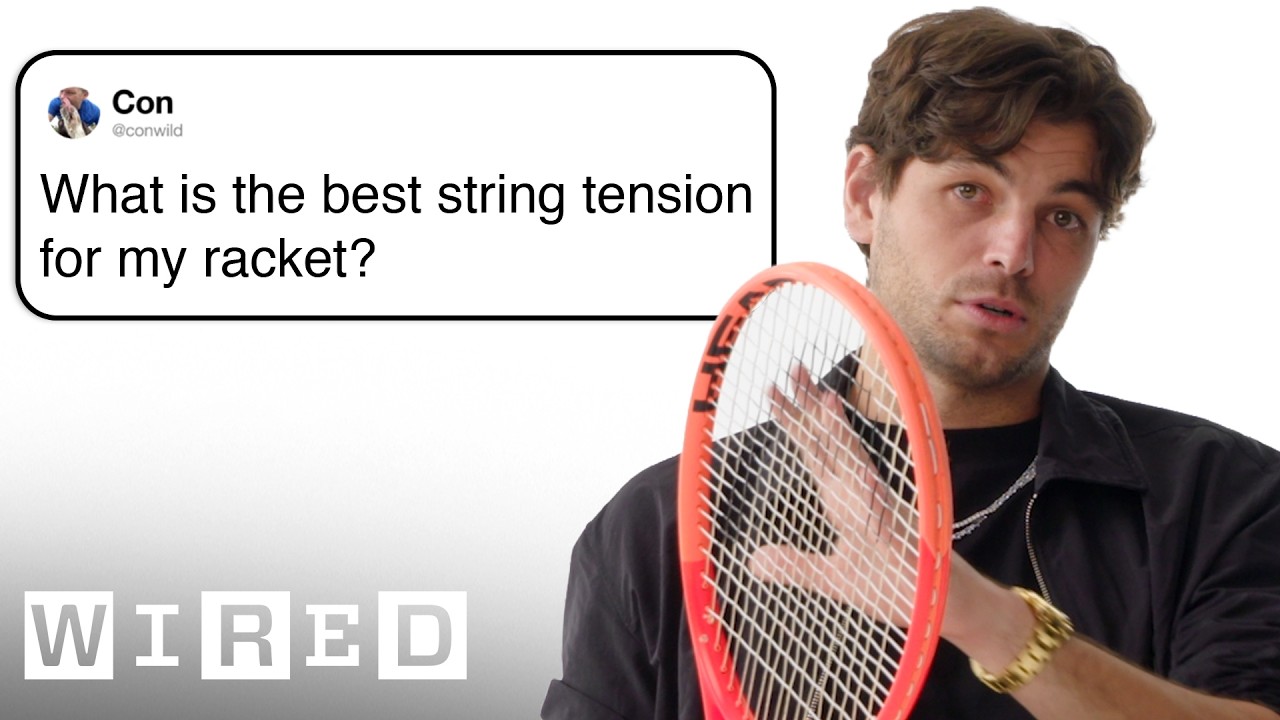
- The best string tension for a tennis racket depends on various factors, including the string pattern, with more open patterns providing more pop and spin, and more closed patterns offering easier control, and the ideal tension can vary depending on conditions, with a typical range of around 53 lbs on the main strings 4m23s.
- The choice of string pattern, such as 18 by 20 or 16 by 19, can affect the play, with more open patterns requiring slightly tighter tension for control, and more closed patterns allowing for slightly looser tension 5m15s.
- Switching rackets can be challenging, but it is possible to adapt quickly, as evidenced by an experience where a player used a completely different racket with a different string pattern, grip size, and brand, and still managed to win a set without losing a point 8m30s.
Adapting to Pressure and Fear
- When playing with an unfamiliar racket in a tight situation, issues may arise, but overall, it is possible to perform at a close to same level with any racket 0s.
Serving Strategy and Performance Metrics
- To deal with pressure and fear during a tennis match, it is essential not to be scared to lose, as this is when the fear and pressure really set in, and sometimes these feelings are more pronounced than others 10s.
Coaching and Rules in Tennis
- The serving strategy involves going for the lines, aiming for aces, and maintaining a high percentage of successful serves, with a target of serving above 65% being a great day 42s.
- The rule of no coaching during matches is a topic of discussion, with some advocating for its return, as it makes tennis special as an individual sport that requires mental battles and figuring things out on the court independently 1m30s.
- Coaching is now allowed in tennis, which is disliked by some, and it is noted that coaching is common in team sports, but tennis is unique due to its individual nature 1m50s.
Court Surfaces and Their Impact on Play
- The terms "slow" or "fast" courts refer to the surface of the court, with slow courts having more sand and a rougher texture, causing the ball to stick and slow down, while fast courts have worn-down sand, allowing the ball to shoot through quickly 2m50s.