
Establishment and Infrastructure of xAI Data Centers
- South Memphis resident Loretta Thornton reports that the presence of xAI’s data centers has resulted in constant noise and fumes, negatively impacting her quality of life and the resale value of her property 0s.
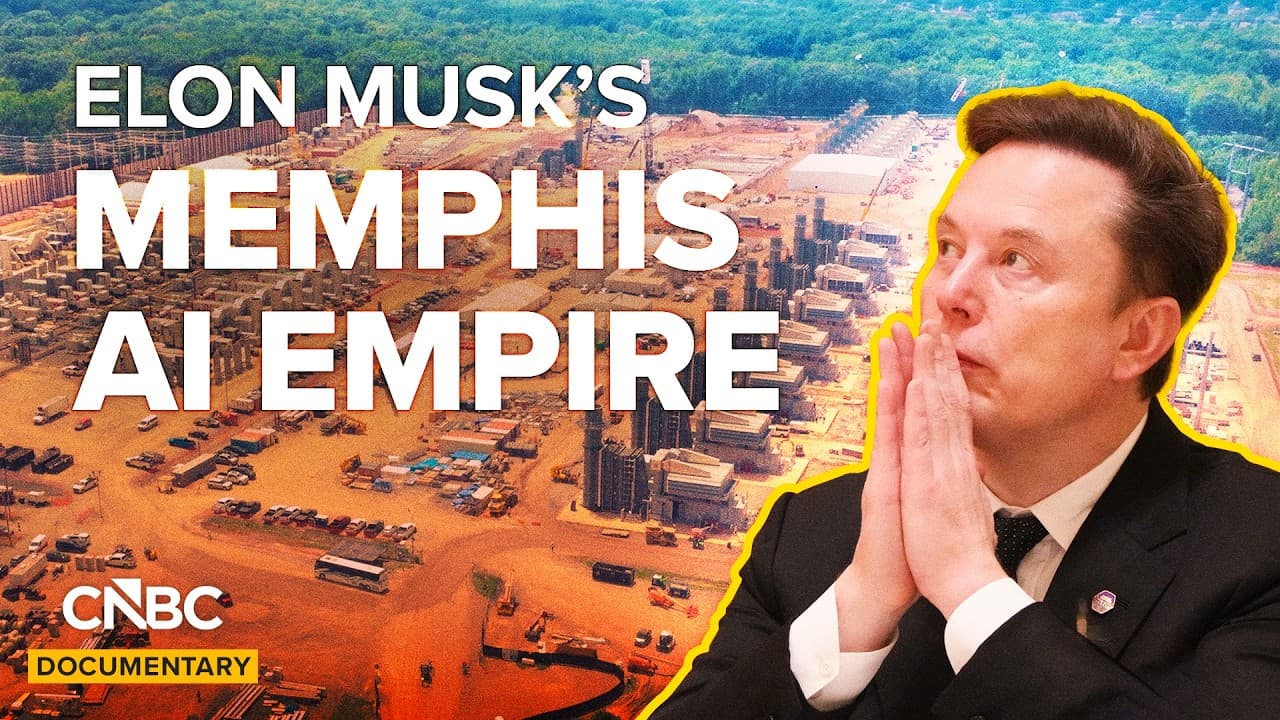
- Elon Musk’s xAI, now referred to as SpaceXAI following a merger with SpaceX, has established the Memphis area as a primary hub for its artificial intelligence operations 35s.
- The company completed the Colossus 1 data center south of Memphis, which began training AI just 123 days after construction began 45s.
- Construction is currently underway on two additional data centers in South Memphis, originally titled Macrohard and Macroharder, and now known as Colossus 2 54s.
- To provide power for its supercomputers, xAI purchased a decommissioned power plant in Southaven, Mississippi, where it operates dozens of methane gas-burning turbines 1m3s.
Environmental and Noise Concerns in Southaven
- Observers at the Southaven power plant site describe the facility as extremely loud, comparing the noise levels to those found at an airport 1m15s.
- xAI is facing multiple lawsuits alleging that the company is operating loud, pollution-emitting turbines, some of which reportedly lack the necessary air permits 1m26s.
- Critics argue that the power plant built for Colossus 2 is unprecedented and lacks the air pollution control technology typically required for such facilities 1m38s.
Revenue Generation and Corporate Partnerships
- Despite local opposition, SpaceX generates significant revenue from its AI infrastructure, with Anthropic renting compute capacity for up to $1.25 billion per month and Google renting capacity for up to $920 million per month 2m6s.
- Reflection AI has also secured a deal for compute capacity at Colossus 2 for up to $150 million per month 2m18s.
Community Impact and Local Resistance
- The development in Memphis is being viewed as a cautionary tale regarding AI safety, pollution, and the management of electricity and water resources 2m35s.
- Residents in Memphis have engaged in organizing and protesting, creating a model of resistance that is being observed by communities across the United States 2m48s.
Project Expansion and Land Acquisition
- The Colossus infrastructure includes cooling systems, gas power generation, solar farms, and Tesla Megapacks, housing hundreds of thousands of Nvidia GPUs 3m15s.
- The initial focus of the project was the former Electrolux facility in Boxtown, but operations have since expanded to include the sites in Southaven, Mississippi 3m30s.
- Since the project's announcement in June 2024, xAI and its affiliates have acquired over 1,100 acres of land in the Memphis and Southaven areas, an amount equivalent to approximately 35% of downtown Memphis 3m55s.
Lack of Transparency and Community Opposition
- xAI began construction on the Colossus 1 data center before the Memphis Chamber of Commerce publicly announced the project, leaving the local community without prior information or notice 0s.
- KeShaun Pearson, director of Memphis Community Against Pollution, characterizes the expansion of xAI as a "virus" that targets majority-Black and low-wealth neighborhoods 25s.
- Local residents express concerns regarding the lack of community input, the potential for increased pollution, declining air quality, and the loss of the area's previous quiet environment 45s.
- Energy entrepreneur Jigar Shah notes that while data centers can be designed to lower electricity rates for the public—citing examples in Minnesota that saved $1.7 billion—they are often placed in communities without proper hearings or communication 1m25s.
- A recent health department hearing regarding the project resulted in a confrontation, during which an xAI executive exited through a side door 1m55s.
Governance, Taxation, and Community Benefits
- Although initial deals for xAI were conducted under subsidiary names behind closed doors, Memphis Mayor Paul Young states that he was involved in discussions from the beginning to mitigate negative impacts and amplify benefits 2m5s.
- The xAI project contributed $25 million in taxes during its first year of operation, becoming the second-largest tax-paying property in Shelby County after FedEx 2m20s.
- The city implemented a community benefit ordinance that allocates 25% of tax revenue from the facilities to communities within a five-mile radius 2m30s.
- Requests for comment from the Memphis Chamber of Commerce, the Memphis City Council, and Southaven Mayor Darren Musselwhite went unanswered 2m40s.
Operational Controversies and Legal Challenges
- Colossus 1 was initially used to train Grok models, which support xAI’s chatbots and image-generating tools; the company is currently facing lawsuits and investigations regarding the use of Grok to create non-consensual deepfake content and hate speech 2m50s.
- While xAI updates its technology, its data centers generate billions in revenue for SpaceX by leasing compute capacity 3m10s.
- The process of integrating data centers correctly takes time, but the current situation sends mixed signals because companies that bypass established rules may still be rewarded with large contracts at the expense of local residents 3m20s.
Military Contracts and Power Grid Integration
- In July 2025, the U.S. Department of Defense awarded xAI a $200 million contract to develop agentic AI workflows across various mission areas 0s.
- Upon establishing its data center in Memphis, xAI discovered that the Tennessee Valley Authority (TVA) lacked the available power to support the facility 15s.
- To address the power deficit, xAI initially deployed natural gas turbines on skids, but these units frequently failed due to the high operational demands of the data center 25s.
- Although the Colossus data center is now connected to the TVA grid, it maintains natural gas units and batteries on-site to provide power when TVA requires the facility to reduce its grid consumption 45s.
Permitting and Turbine Installation Issues
- xAI leased natural gas turbines from Solaris Energy Infrastructure in Houston to expedite the construction and operational launch of its facilities 1m5s.
- The build-out of the Colossus 1 site has been characterized by allegations of chaotic development, specifically regarding the installation of gas-burning turbines without required permits 1m15s.
- While xAI initially claimed that the turbines at Colossus 1 were temporary and did not require permits, it later obtained permits for 15 turbines despite continuing to operate a larger number 1m25s.
- Environmental advocacy groups discovered 35 turbines at the Colossus 1 site by the summer of 2025, with thermal imaging suggesting that 33 of them were operational 1m40s.
- Senior attorney Patrick Anderson of the Southern Environmental Law Center noted that the scale of the xAI operation is unusual, as a typical power plant might only utilize six such turbines 1m55s.
Pollution Controls and Legal Disputes
- Colossus 1 currently utilizes a combination of solar power, grid electricity, and turbines equipped with pollution controls designed to reduce harmful emissions by up to 90% 2m25s.
- xAI is applying a similar development strategy at the Colossus 2 site in Southaven, where 59 turbines have been installed despite only having a permit for a smaller number 2m40s.
- In April 2026, the NAACP, Earthjustice, and the Southern Environmental Law Center filed a lawsuit against xAI, alleging that the company is operating gas turbines in violation of the Clean Air Act 3m5s.
- Legal representatives for the NAACP argue that the turbines used by xAI are of a scale typically found at power plants, yet the vast majority lack the pollution control technology necessary to significantly reduce emissions 3m25s.
- Concerns have been raised regarding the emission of fine particulate matter from these turbines, which can enter the bloodstream and contribute to heart disease and heart attacks 3m45s.
- In its defense against the NAACP lawsuit, xAI maintains that the turbines currently on-site are temporary and that the company has established plans to install permitted turbines equipped with pollution controls 4m0s.
National Security and Industrial Impacts
- The greater Memphis area already experiences significant concentrated pollution, and the addition of over 50 gas turbines is expected to have a major impact on the local community 0s.
- The U.S. Department of Justice has filed a motion to intervene in a lawsuit regarding the xAI data centers, urging the court to dismiss the case 15s.
- The Department of Defense stated that the xAI data centers in the region are critical to national security and military operations in Iran 22s.
- Local advocates express frustration regarding the speed of the xAI project and the government's assistance, emphasizing the need to prioritize human health and clean air 32s.
- Air quality studies indicate that downtown air quality is comparable to that of the community near the facility, with local concerns primarily driven by transportation 55s.
Industry Trends and Environmental Consequences
- While natural gas turbines are used across the United States, critics argue they should be placed away from residential areas to mitigate pollution 1m20s.
- Concerns have been raised that the "move fast and break things" approach of Silicon Valley is negatively impacting human health and community trust 1m35s.
- Some data centers are facing scrutiny due to their associations with companies like Anthropic and Google, though Anthropic reports it is having active conversations with the mayor and the community 1m50s.
- The gas turbine industry is experiencing a boom, with prices increasing by 300% over the last two years, driven by manufacturers such as GE Vernova, Caterpillar, Siemens, and Mitsubishi Power 2m10s.
- The energy demands of hyperscalers are contributing to a fossil fuel infrastructure expansion that has not been seen in decades 2m25s.
- Critics argue that the current energy usage model results in job losses and places the burden of energy and water costs on local families 2m35s.
- xAI and SpaceX executives did not respond to multiple requests for comment regarding these issues 2m45s.
Noise Pollution and Public Nuisance
- A professional noise assessment in Southaven compared the sound of the turbines to jet planes, noting continuous levels of 70dB that can cause hearing damage over time 2m55s.
- The noise report concluded that the sound levels near the Colossus 2 facility could cause stress, hypertension, anxiety, sleep disruption, and disorientation 3m10s.
- Local resident Jason Haley reported that the noise, which initially sounded like a leaf blower, has persisted 24/7 and increased in volume since August 3m20s.
- A class action lawsuit has been filed against SpaceX, alleging that the company's operations created a public nuisance through excessive and offensive noise 0s.
- Residents living near the Colossus 2 facility report constant noise disturbances that disrupt daily life and sleep, with some describing the situation as a form of torture that negatively impacts property value 15s.
Resource Management and Water Usage
- Elon Musk has noted the difficulty of securing power for data centers on the ground, suggesting that orbital data centers could eventually bypass the limitations of Earth-based electricity generation 1m5s.
- South Memphis and Boxtown have faced long-standing issues with legacy air pollution, and there are ongoing concerns regarding the strain that new industrial projects, particularly hyperscale data centers, place on the Memphis aquifer 1m35s.
- The xAI Colossus 1 facility consumes approximately 1.28 million gallons of water daily and does not currently utilize a water recycling system 2m0s.
- Although xAI broke ground on a wastewater recycling plant in October 2025, construction was paused in April 2026 as the company shifted focus toward completing the Colossus 2 facility 2m15s.
- Following a period of inactivity at the recycling plant site, Memphis Mayor Young announced that xAI agreed to resume construction no later than the first quarter of 2027 2m45s.
- There is skepticism regarding the project's timeline due to concerns that a formal, binding contractual agreement may not be in place to guarantee the timely completion of the wastewater facility 3m5s.
Public Sentiment and Community Health Risks
- A Gallup survey indicates that 70% of Americans oppose the construction of AI data centers in their local areas, with 48% expressing strong opposition and only 7% in strong favor 3m35s.
- Some local residents express concerns that the presence of these facilities near schools and neighborhoods poses risks to the health of community members and their families 4m5s.
- While one local resident expressed interest in selling property to xAI and reported no issues with noise, most community members interviewed expressed frustration and feelings of disrespect regarding the rollout of the xAI data center in Memphis. 0s
National Opposition and Economic Burdens
- Data centers are increasingly facing opposition nationwide due to concerns regarding pollution, as well as rising electricity and water costs. 23s
- The transition to "hyperscale" data centers has resulted in massive electricity loads being added to grids overnight, leading to significant price spikes. 35s
- Electricity prices in Virginia have risen by 200% over the last two years, and residents in Pennsylvania have paid $492 million in grid upgrades to support data centers. 52s
Legislative Responses and Policy Changes
- Testimonies from Memphis have influenced national policy, including Senator Edward Markey’s AI accountability agenda. 1m15s
- New York has implemented the first state-level data center moratorium, New Jersey has passed legislation requiring large data centers to pay for their electricity usage, and communities near Memphis are updating zoning regulations. 1m23s
- The planning commission in Olive Branch, Mississippi, is proactively updating zoning laws after observing that existing codes in Memphis and Southaven allowed hyperscale data centers to be classified as simple storage warehouses. 1m36s
- Jackson, Mississippi, has implemented new parameters for data centers based on the events in Memphis. 1m58s
- The Illinois legislature is considering the "Power Act," supported by Governor Pritzker, which aims to reduce both costs and pollution associated with data centers. 2m4s
- Ohio has ended tax breaks for data centers after the incentives negatively impacted the state budget. 2m17s
Best Practices and Advocacy Frameworks
- Recommended best practices for officials include requiring data centers to participate in demand response programs to curtail usage during peak hours and mandating the use of closed-loop water systems to prevent the depletion of local wells. 2m24s
- Advocates suggest that data centers should not receive tax breaks, as they have the financial capacity to fund their own projects, and that facilities should be located away from residential areas. 2m45s
- Placing data centers in existing industrial areas may deepen the burden on "sacrifice zones" that communities have long fought to improve. 3m2s
- In January, the NAACP released a guide and a set of national principles to help communities protect themselves from "dirty data" and to provide a framework for tech companies to avoid the conflicts experienced in Memphis. 3m15s
- Organizing, protesting, and public advocacy by Memphis residents have served as a model for communities across the country. 3m38s
Collective Action and Future Implications
- Proactive community action and holding elected officials accountable are identified as effective strategies for achieving legislative wins 0s.
- Successful advocacy efforts in Arizona, South Carolina, and Georgia are attributed to the precedent set by events in Memphis 7s.
- There is an ongoing effort to ensure that the situation in Memphis serves as a positive example of community influence rather than a cautionary tale 13s.
- The Memphis experience demonstrates how collective public power can be utilized to enact legislation that provides protection for citizens 17s.
- The placement of industrial or large-scale projects in the middle of residential neighborhoods is characterized as a sign of disrespect toward the community 23s.