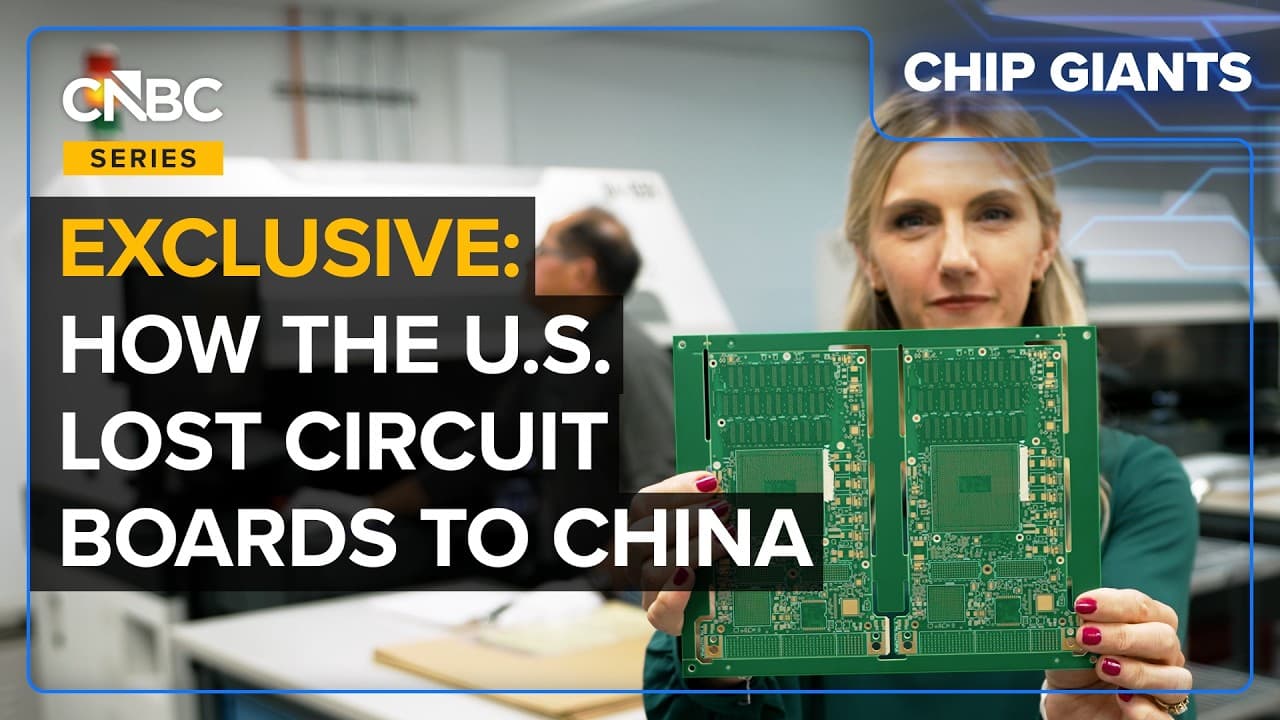

Introduction to Printed Circuit Boards (PCBs)
- The base of every electronic device, including iPhones and AI servers, is a printed circuit board, with the vast majority of these boards currently being made in China, but the US also manufactures them, and the goal is to ensure that US manufacturers can meet some of the demand as the AI industry grows 10s.
- The manufacturing process of circuit boards involves up to a thousand different steps, starting with a thin layer of copper, and can result in boards with up to 140 layers, costing from single digits to $100,000, with the complexity of chips increasing to the point where combining them is necessary 2m6s.
- The demand for circuit boards has skyrocketed in recent years, primarily due to the demand for AI chips and the wars in Iran and Ukraine, with the US Department of Defense requiring circuit boards to be made in the US to prevent malicious components from being introduced 4m30s.
- The US share of the global circuit board market has decreased significantly, from 30% in 2000 to 4% today, with China's share soaring over the past three decades, and some advanced AI chips, such as those from Nvidia, using Chinese printed circuit boards, which poses a vulnerability 6m20s.
Supply Chain and Geopolitical Impacts on PCBs
- The war in Iran has also affected the supply chain, with certain raw materials like resin being scarce, and circuit board prices have been increasing, with two large demand signals, AI and defense, putting pressure on the supply chain 8m10s.
- TTM, one of the two public US-based PCB makers, has seen significant stock gains over the past year, and the company is expanding its domestic footprint, with a new factory starting production in Syracuse, New York, and an even bigger plant opening in Wisconsin 10m30s.
- The PCB industry is projected to grow 12.5% this year, reaching nearly $96 billion, and growing to $123 billion by the end of the decade, with the cost of PCBs reportedly rising by up to 40% from March to April, and TTM raising its prices by 5% to 25% 12m40s.
Overview of PCB Manufacturing and Complexity
- Modern electronic devices, from small items like AirPods to large server racks, rely on printed circuit boards (PCBs) to connect and operate chips, with a single board potentially containing 50 or 60 chips and capacitors, and the complexity of the board determining its price, which can range from $5 to $100,000 10s.
- The manufacturing process of PCBs involves creating a copper core with resin epoxy and copper foil, which can have up to 140 layers, and applying heat and pressure to bond the materials together, resulting in a highly technical and complex piece of infrastructure 42s.
- The design of PCBs is created using lithography, and interconnect pathways are made by drilling precise holes, allowing for the creation of denser pathways for electrical signals to travel through, enabling multiple chips to communicate with each other 2m6s.
Environmental and Resource Demands of PCB Production
- The production of PCBs requires significant amounts of power and water, with a single company, TTM, using as much power as 70,000 homes and 2.1 billion gallons of water in 2024, and aiming to increase its use of renewable energy and water recycling 2m6s.
- The cost of raw materials for PCBs, such as copper and resin, is increasing due to factors like the Middle East conflict, and the use of precious metals like gold and palladium adds to the expense, with the bill of materials determining the final cost of the board 2m6s.
Demand Drivers and Industry Applications
- The demand for PCBs is driven by various industries, including aerospace and defense, with 71% of PCBs produced at TTM's California plant being used in these sectors, and the company's China plant having a different distribution, with U.S. defense circuit boards being prohibited from being sourced in China 2m6s.
- The use of PCBs in defense products raises concerns about potential security risks, as some adversaries have sophisticated methods of attacking chips and substrates, and a compromised PCB could have severe consequences, such as disrupting the guidance of a missile or drone, highlighting the need for trusted sources of supply 2m6s.
Security Risks and National Security Concerns
- The use of Chinese-made circuit boards in weapons systems and AI chips poses a significant national security risk, as a potential adversary could install a switch to route data back to China or a kill switch to turn off weapons at a time and place of their choosing 10s.
- The global supply of printed circuit boards (PCBs) is heavily dependent on China, with almost 89% of the global supply and six out of ten PCBs being made in mainland China, which is considered a risky dependency 1m42s.
- The vast majority of circuit boards used by the world's AI leaders are still sourced in Asia, driven by cost and capacity, which raises concerns about the trustworthiness of these components 2m6s.
Mitigating Risks in PCB Supply Chains
- Companies like Nvidia mitigate risk by physically inspecting all PCBs using X-rays and AI-enabled image detection tools to look for anomalies that any country, including China, could have introduced 3m10s.
- The scale of PCB manufacturing in China is significantly larger than in the US, with some factories having 100 or 200 PCB assembly lines, compared to nothing of that scale in the US 4m20s.
Cost and Manufacturing Challenges in the US
- The cost of manufacturing PCBs in China is lower due to subsidies, cheaper labor, and easier access to raw materials, making it challenging for US manufacturers to compete 5m30s.
- To bring PCB manufacturing back to the US, significant investment is needed, and the US government has started to address this issue with the Chips Act and proposed legislation like the Protecting Circuit Boards and Substrates Act 8m40s.
Government Incentives and Legislative Efforts
- To bring PCB manufacturing back to the US, significant investment is needed, and the US government has started to address this issue with the Chips Act and proposed legislation like the Protecting Circuit Boards and Substrates Act 8m40s.
- The proposed legislation offers a 25% tax credit to companies that choose American-made circuit boards and $3 billion in grants for US manufacturers, which is considered a step in the right direction but still falls short of the investment needed 10m10s.
Economic and Strategic Considerations for US PCB Production
- Supply chain executives typically want to de-risk and diversify, but the numbers need to add up, and moving PCB sourcing from China to the US would require more spending by tech companies to prove AI profitability to Wall Street 10s.
- Many companies prioritize profit margins over national interests, but executives consider risk as part of their cost analysis, and scaling up commercial capacity in the US with government incentives could make American-made circuit boards competitive 42s.
Investments and Expansion in US PCB Manufacturing
- Companies like TTM are making significant investments in US-based PCB production, including a 750,000ft² facility in Wisconsin and a new 200,000 square foot PCB factory in Syracuse, New York, entirely devoted to defense 2m6s.
- The goal is to increase production in the US and reduce reliance on Asia over the next 5-15 years, with AI being a key area of focus, and companies like Sanmina are also expanding their manufacturing sites in California, China, and Singapore 2m6s.
Innovation and Future Directions in PCB Technology
- Startups like Itera and Quilter are innovating in the PCB space, with Itera developing fluid circuit boards that can be rapidly rewired and Quilter using AI to design complex circuit boards faster than humans 2m6s.
- The development of a robust domestic PCB industry that can compete with subsidized pricing from other countries and provide options for companies to buy domestically from trusted partners is considered crucial 2m6s.