

Intro 0s
- There are two strategies to build on AI: assuming the model won't improve or assuming OpenAI's trajectory continues.
- Most startups are built on the former strategy, while Sam Altman believes 95% of the world should bet on the latter.
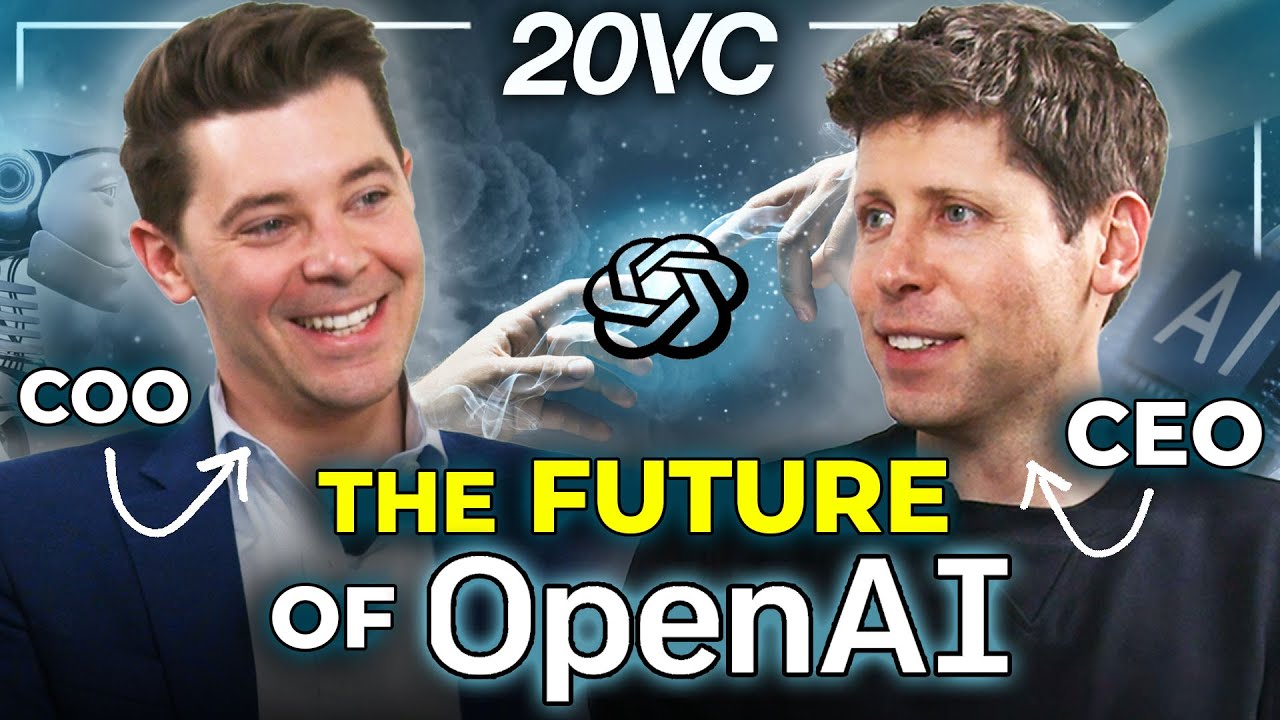
- Sam and Brad Lightcap are doing their first interview together.
Building OpenAI 7 Years Ago 55s
- Sam Altman was interested in AI since childhood and studied it in college.
- In 2015, two things convinced him to start OpenAI: deep learning seemed to be working, and it improved with scale.
- Despite doubts from others, Altman and his team persisted because they believed in their approach and saw progress.
- They had a fundamental conviction that AI would be a big deal if they could achieve it.
Origins of the Unique Partnership 3m15s
- Brad Lightcap joined OpenAI as CFO after Sam Altman faced difficulties in recruiting for the non-profit organization.
- Lightcap's adaptability and willingness to take on new challenges, transitioning from finance to business operations, have been crucial to OpenAI's growth.
- The complementary skill sets and effective communication between Sam Altman and Brad Lightcap have contributed to their successful partnership.
- Brad Lightcap highlights Sam Altman's ability to identify and focus on the one to three most important things for the company at any given time, maintaining velocity at scale.
- Altman's long-term future orientation and unwavering focus on the future world guide the company's decision-making and innovation.
- Lightcap emphasizes the significance of repeated innovation, not only in technology but also in business models, to ensure OpenAI's continued success.
Challenges Slowing OpenAI's Innovation 11m34s
- OpenAI's innovation could be slowed down by:
- Losing their best researchers or research culture.
- Not having enough compute resources to meet the demand for their models.
Collaborative Decision-Making Process 12m45s
- Sam and Brad make decisions based on what is most important.
- They spend a lot of time on decisions that are specific or tangential to the most important things.
- They agree that there are only a handful of strategic decisions, but there are a lot of "how" decisions.
- Sam believes that he is not a natural operator, but he is happy to do it because he loves OpenAI and believes AI will be the most important thing he ever touches.
- Brad agrees that Sam is not a natural operator, but he is doing a great job.
Balancing Marginal Revenue & Cost in LLM Products 15m49s
- The price of compute will continue to fall.
- The value of AI will go up as models improve.
- The cost of high-quality intelligence will approach zero.
- Open-source models will have a place in the world, but managed services will also be important.
- The bigger picture is that we are in the midst of a technological revolution where intelligence is becoming abundant and inexpensive.
- There will be a place for open-source models in the world.
- Some people will want managed services, while others will use both.
- The bigger picture is that we are in the midst of a technological revolution where intelligence is becoming abundant and inexpensive.
- We probably overestimate adoption in a year and underestimate it in 10.
- Societal inertia is a big deal, and it takes time for new technologies to be widely adopted.
- Expectations for AI are currently extremely high, but reality is still pretty bad.
- Expectations will start to come down as people come into contact with today's models.
- Models will quickly improve, leading to an inversion of expectations where reality exceeds expectations.
Navigating Model Commoditization in AI 18m52s
- The AI industry is experiencing rapid commoditization, with new models emerging and gaining popularity quickly, similar to the early days of the automobile industry.
- Eventually, the AI industry will consolidate, with a small number of large providers dominating the market.
- The long-term differentiation in AI will not be the base model itself, but rather the models that are most personalized and integrated into users' lives.
- For now, the focus should be on improving the base models.
AI Startup Strategies for Model Progress 20m48s
- OpenAI's rapid progress in AI development poses a significant threat to AI companies that build applications on top of existing models without anticipating further improvements.
- Startups should assume that OpenAI's models will continue to improve rapidly and build their products accordingly to avoid becoming obsolete.
- Companies in sectors that benefit from significant improvements in AI models, such as healthcare, are more likely to succeed in the long term.
- OpenAI's iterative deployment approach allows for societal engagement and feedback, shaping the responsible development and use of AI.
- OpenAI's deployment of advanced AI has drawn global attention to the field.
Challenges of Iterative Deployment as OpenAI Scales 26m3s
- OpenAI's iterative deployment strategy may face challenges as the company grows larger.
- Releasing imperfect products can have significant consequences, such as the backlash faced by Flan and Bard.
- Expectation setting is crucial for successful iterative deployment.
- OpenAI incorporates feedback from the creative community and industry into its research roadmap.
- The company aims to release products that feel useful and familiar to users.
- Sam Altman expresses his passion for using AI to solve complex problems, particularly in the field of cancer research.
- He believes that scientific progress is the highest order bit of progress for society.
- Altman sees AI as a tool that can significantly increase the rate of scientific progress.
- The biggest barrier to AI progress is that models are not smart enough.
- Altman emphasizes the fundamental importance of model intelligence.
- With smarter models, various challenges, such as integrating AI tools into workflows and ensuring model adaptability, can be overcome.
- As models become more intelligent, their capabilities and applications will expand.
Secrets to OpenAI's Efficient Scaling 29m9s
- OpenAI's rapid growth and efficient scaling are unprecedented.
- The diverse applications of ChatGPT, from research to parenting, contribute to its widespread adoption.
- The company's focus remains on pushing the boundaries of AI development, with a specific emphasis on the developer platform.
- OpenAI's expansion into the enterprise sector will involve a more gradual adoption cycle.
Talent Attraction 31m21s
- OpenAI's popularity as a workplace destination can make talent filtering challenging.
- The company emphasizes the importance of mission-driven employees and cautions against becoming a mere resume booster.
- OpenAI recognizes the potential risks associated with losing mission orientation and becoming dominated by mercenaries.
Learning from Exceptional Founders 32m18s
- Chesky has been incredibly hands-on and helpful, especially in areas where Altman lacks expertise, such as product development and communication.
- The Cison brothers consistently provide deep and unique insights that Altman would not have thought of on his own.
- Altman has learned from many exceptional founders and investors, and he believes that learning a little bit from each of them has been a great strategy.
AI Go-to-Market Strategies for Enterprise Adoption 33m46s
- Enterprises often focus on quantifiable ROI when adopting AI, but overlook the value of giving employees access to the technology and the time-saving benefits it can provide.
- The return on investment from AI adoption may not be immediately apparent in traditional budget lines, but becomes significant when considering the cumulative effect of time saved across the workforce.
- Enterprises need to adjust their expectations regarding the static nature of AI technology and consider the rapid rate of change and future advancements.
- Large corporations, especially in Europe, may find it challenging to adapt to the fast pace of AI development due to their established workflows and processes.
Challenges in Blending Product & Sales Cultures 37m47s
- Sam Altman and Brad Lightcap discuss the challenges of blending product and sales cultures.
- They believe that research should drive product development and product should drive sales.
- They agree that the best way to sell more products is to make the product better.
- They also agree that the best way to make the product better is to have better research.
Evolution of Growth Mindset Post-OpenAI 39m15s
- Sam Altman discusses the challenges of learning from extreme success, such as the case of ChatGPT, and suggests seeking advice from experts like Alex Schultz for insights on growth.
- Altman believes that learning from failures is limited, as they only provide information on what to exclude, while successes offer more valuable lessons.
- Altman emphasizes the importance of promoting from within and carefully considering factors when hiring or promoting individuals, such as their ability to generate new ideas, iterate quickly, and communicate effectively.
- He highlights the significance of strong communication skills in leadership roles, as it enables effective explanation of goals, hiring, selling to customers, and engaging wider audiences.
Strategies for Hiring: Experience vs. Hunger 43m19s
- Sam Altman believes in a flat organizational structure where great ideas are elevated regardless of experience.
- He finds that truly groundbreaking ideas often come from unexpected places within the team, not necessarily from the most experienced individuals.
- Altman emphasizes the importance of creating an environment where everyone's perspectives are valued and considered.
- While experienced hires bring valuable insights, Altman believes that company-changing ideas often come from those with less experience.
- OpenAI's leadership team skews older (30s-40s) compared to other startups, while the technical team averages in the early 30s.
- Altman acknowledges the value of both experienced and inexperienced hires, but ultimately focuses on finding the right person for the job.
- In new industries like AI, the lack of established playbooks levels the playing field, making age less of a factor in success.
Quick-Fire Round 46m59s
- Sam Altman and Brad Lightcap discussed the challenges and opportunities for OpenAI in the coming years, including research, productization, supply chain, and computing power.
- Lightcap revised his expectations for enterprise adoption, predicting a faster rate with dedicated budgets for experimentation.
- Altman expressed concerns about global macro instability and geopolitical issues.
- Both Altman and Lightcap were surprised by the consistent scaling and improved performance of larger models.
- Altman reflected on the unexpected impact of technology on creative industries and wished he had better anticipated its significance.
- Despite a busy schedule, Altman finds fulfillment in his work and considers it a worthwhile trade-off for personal activities.
- Both Altman and Lightcap emphasized the importance of communication, empathy, and support in their successful marriages, given the demands of their work.
- They discussed the potential impact of OpenAI on various companies but acknowledged the difficulty of making long-term predictions.
- Altman expressed optimism about the future, envisioning significant advancements and improvements, and addressing societal issues such as premature deaths and unequal access to education.
- The conversation concluded with gratitude for the opportunity to have an in-person discussion.